Does an EV Charger Need Surge Protection?
No charging standard requires it, no manufacturer we track publishes a surge rating, and nobody will sell you an EV-specific surge device worth having. What exists instead is a whole-home requirement at your service panel, which the code has mandated on new and replaced services since the 2020 edition - and which protects the charger as a side effect.
How this is funded: we earn a commission if you buy through our links, at no extra cost to you. It never changes which product we recommend, and we’ll tell you when we’d skip one. Full disclosure.
The honest answer has two halves. The charger itself does not need a surge device, because no standard requires one and no manufacturer publishes a rating to match one to. Your house probably does need one at the service panel, and on a new or replaced service the code has required it since the 2020 edition. Which means the right question is not “should I protect my charger?” but “does my panel already have the device the code asks for?” — and if you are about to have an electrician out for a charger install anyway, that is a five-minute conversation rather than a project.
We are going to be unusually explicit about sourcing on this page, because surge protection is a topic where confident numbers get repeated without provenance. NFPA’s own article pages render their code text in JavaScript and return nothing readable to a plain fetch, so the code language below is cited to a surge-protection manufacturer’s reproduction of it, named as such in our sources rather than passed off as the authority. Adopted editions vary by jurisdiction, and your local inspector is the authority on which one applies to your house.
What the manufacturers publish: nothing
We maintain a registry of twenty home chargers, and every spec figure in it was read off the maker’s own sheet or store listing on a dated visit. Here is the finding: not one manufacturer publishes a surge rating, a transient withstand voltage, a joule rating or a clamping specification for any of them. Not ChargePoint, not Autel, not Emporia, not Grizzl-E, not Wallbox, not EVIQO, not Lectron, not ELEGRP, not Ampure.
| Charger | Surge / transient rating | Warranty | Enclosure | Listings | Install |
|---|---|---|---|---|---|
| Autel MaxiCharger 80A | No surge rating published | 5 years | NEMA 3S (IK10) | UL 2594, UL 2231-1/2, UL 1998, CSA C22.2 No. 280, ENERGY STAR | Hardwired |
| ChargePoint Home Flex | No surge rating published | 3 years | NEMA 3R | UL/cUL listed, ENERGY STAR | Hardwired, NEMA 6-50 or NEMA 14-50 |
| EVIQO 48A Level 2 Charger | No surge rating published | 3 years | IP66 / NEMA 4 | UL, ETL, FCC, ENERGY STAR | Hardwired |
| Grizzl-E Ultimate 48A | No surge rating published | 3 years | NEMA 4 (IP67) | UL tested and certified | Hardwired |
That absence is informative rather than frustrating. It tells you there is no spec to shop against. If a charger published “withstands 6 kV transients” you could compare units on it and choose accordingly; because none does, any page ranking chargers by surge resilience is making it up. The closest thing to a durability commitment any of these brands offers is a warranty term, and across the registry that is three years with very few exceptions.
Worth noting what the safety listings do and do not cover, since people reasonably assume a UL mark handles this. UL 2594 is the standard for the equipment itself and UL 2231covers personnel protection systems — the ground-fault detection inside every listed charger. Neither is a surge standard. Our certifications guide sets out what each label tests, and surge immunity is not on the list.
What the code requires, and where
The requirement that exists is not about EV chargers at all. According to the manufacturer reproduction of NEC 230.67 we cite, surge protection for dwellings arrived in the 2020 NEC and the 2023 edition extended it to dormitory units, hotel and motel guest rooms, and patient sleeping rooms in nursing and limited-care facilities. The reprinted requirements are specific:
- Type.“The SPD shall be a Type 1 or Type 2 SPD.”
- Location.“The SPD shall be an integral part of the service equipment or shall be located immediately adjacent thereto”, with an exception permitting it at downstream distribution equipment instead.
- Rating. The 2023 text adds a nominal discharge current rating of not less than 10 kA.
- Replacement.“Where service equipment is replaced, all of the requirements of this section shall apply.”
Three consequences follow for an EV charger buyer. First, the device belongs at the service, not next to the charger — which is both the code position and the better engineering, since a transient arriving on the service conductors is clamped before it reaches any branch circuit, the charger’s included. Second, this is a requirement about dwellings, so if your service equipment is newer than your jurisdiction’s adoption of the 2020 NEC, you may already have it. Third, and this is the one that catches people: if your charger install involves replacing the service equipment— a new panel, a new meter base — the requirement applies to that work. It stops being optional and becomes a line on the quote.
None of the sections that source covers — 230.67, 409.70, 551.72(E), 620.51(E), 645.18, 694.7(D), 695.15, 700.8, 708.20(D), 760.33 or Article 242 — is about EV charging equipment. There is no EV-specific surge rule to find. Article 625, the one that governs your charger’s circuit, is about the circuit, the conductors and the continuous-load sizing that gives us the 80% rule.
Surge protection is not ground-fault protection
This confusion is worth a section of its own, because the two get used interchangeably and they solve unrelated problems.
Ground-fault protectionwatches for current leaving the intended circuit — through a person, through water, through damaged insulation — and opens the circuit in milliseconds. It protects people. Every listed Level 2 charger has it built in, which is exactly why the GFCI breaker question is more subtle than it looks, and why a nuisance-tripping breaker is usually a case of two protective devices arguing rather than a fault.
Surge protectionclamps a brief overvoltage — a lightning strike on the distribution network, a utility switching event, a large motor elsewhere in the house — so the energy goes to ground instead of through your electronics. It protects equipment. A charger with impeccable ground-fault protection has precisely zero surge protection unless someone installed some.
The practical upshot: nothing on a charger’s spec sheet, no enclosure rating, and no safety listing tells you anything about its surge behavior. A NEMA 4X or IP67 rating is about water, dust and corrosion. Those are the hazards our outdoor roundup ranks on, and they are not this one.
So should you spend the money?
Here is how we would decide, and none of it requires a number we cannot source.
Yes, if your service equipment is being replaced.Not a judgment call — per the code text above the requirement comes with the work. Have it quoted as part of the job.
Yes, if you are in a high-lightning region or on a rural overhead service. A whole-home device protects the charger, the heat pump, the oven, the networking gear and everything else on an expensive list. The charger is not the reason to buy one; it is a beneficiary. Judged against the whole house, this is inexpensive protection.
Probably, if the charger is a significant purchase and the panel has nothing. You are already paying for an electrician’s visit. Adding a panel-mounted device to that visit is far cheaper than a separate call-out later, and it is the right time to ask whether the existing panel has one at all.
No to anything marketed as an EV-charger surge protector that sits between the outlet and a plug-in charger. A Level 2 charger draws 24 to 40 amps continuously for hours. Consumer surge strips are not built for that duty, and every extra connection in a high-current continuous path is a junction that can heat. It is the same reasoning that makes extension cords a bad idea for charging, and it applies with more force here because the device is designed to fail safe by sacrificing itself.
The hardware that gives you the most to work with
Since no charger publishes a surge spec, there is no “most surge-resistant charger” to recommend and we are not going to invent one. What we cando is point at the units whose makers publish the most about durability generally — the longest warranty terms, the widest temperature envelopes, the real safety listings — because a manufacturer willing to print numbers is easier to hold to them.
Quick picks
Ranked on published specs, charging speed, electrical fit and value. Select a row to jump to the full write-up. We have not bench-tested these chargers — here is exactly what we do instead.
| # | Product | Best for | Price |
|---|---|---|---|
| 1 | 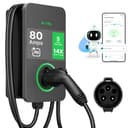 Autel MaxiCharger 80A The ceiling of home AC charging: 19.2 kW on a 100-amp circuit, which is roughly double what a 48-amp charger does. Almost no car can actually take it — most cap their onboard charger somewhere between 7.7 and 11.5 kW — so buy this for a specific vehicle that accepts 80 amps, or for a future-proofed circuit you already have. Otherwise it is a very good, very expensive 48-amp charger. | Longest published warranty | |
| 2 | 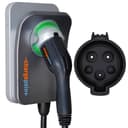 ChargePoint Home Flex The safest default for most homes: you set the amperage in the app to 16, 24, 32, 40, 48 or 50A, so one charger fits whatever circuit your panel can spare today and scales up if you upgrade later. The app is the most mature here, firmware arrives over the air, and the warranty is long. | UL/cUL plus 90 days local session storage | $516.71 · View on Amazon Price as of October 18, 2026. #ad How we’re funded |
| 3 | 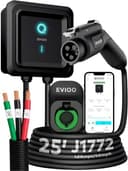 EVIQO 48A Level 2 Charger A lot of charger for the money: a full 48 amps, WiFi with scheduling, ENERGY STAR, and the longest usable reach in this group thanks to a 25 ft cable plus a 40-inch input lead. A strong value alternative to Emporia if you want maximum reach. | UL, ETL, FCC and ENERGY STAR | |
| 4 | 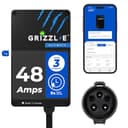 Grizzl-E Ultimate 48A The tank of the 48-amp class: cast-aluminum body, IP67 sealing, a full 11.5 kW, a 25 ft cable built to stay flexible in the cold and a DIP switch instead of a setup wizard. We recorded it as discontinued in August 2026 after its Amazon listing went dark; Grizzl-E sells it and Amazon lists it again as of our 2026-09-28 check, so that record is corrected here. | Cast aluminum, IP67, nothing to brick | $479.99 · View on Amazon Price as of October 18, 2026. #ad How we’re funded |
One last point about connected chargers specifically, because it is adjacent and it is real. A surge is a hardware risk; a dead cloud serviceis a software risk, and no brand in our registry publishes a support commitment for its app. The chargers that cannot be orphaned are the ones with nothing to log into — which is the argument our no-app roundup is built on, and worth weighing against what the app actually buys you. The Grizzl-E Ultimate above is on this list partly for that reason: a DIP switch does not need a server.
Whatever you decide, decide it with your electrician on the install visit rather than afterwards. Our guide to hiring the electrician has the questions worth asking, and permits and inspection covers who has the final word on which code edition applies to your house.
Frequently asked questions
Does an EV charger need a surge protector?
No EV charging standard requires one, and not one of the twenty chargers in our registry publishes a surge, transient or joule rating - so there is no manufacturer figure to match a protector to. What the National Electrical Code does require, per the industry reproduction of 230.67 we cite, is a Type 1 or Type 2 surge protective device at the service equipment of a dwelling unit, introduced in the 2020 edition and applying again whenever service equipment is replaced. That device sits at your panel and protects everything downstream, including the charger. Whether your jurisdiction has adopted that edition is a question for your inspector.
Where does the surge protector go - at the charger or the panel?
At the panel. The code language reproduced by the manufacturer we cite says the device shall be an integral part of the service equipment or located immediately adjacent to it, with an exception permitting placement at downstream distribution equipment instead. That is the opposite of how people imagine it, which is a strip or a module next to the charger. A whole-home device at the service is both what the code addresses and the better engineering, because a surge arriving on the service conductors is clamped before it reaches any branch circuit.
Will a surge destroy an EV charger?
It can damage any mains-connected electronics, and a charger is mains-connected electronics on an outdoor wall. But we are not going to quote you a failure rate, because no manufacturer publishes one and we have not tested anything. What we can tell you is what the makers are willing to stand behind: three years is the standard warranty term across the registry, and no brand publishes an exclusion or an inclusion for surge damage in the specifications we can read. Read your own warranty document before assuming a lightning event is covered.
Does a charger's own ground-fault protection help with surges?
No, and conflating the two is the most common mistake here. Every listed Level 2 charger contains ground-fault protection - that is part of what UL 2231 certification is about - and its job is to protect a person from a fault current to ground. A surge protective device clamps a transient overvoltage to protect equipment. Different hazard, different physics, different device. A charger with excellent GFCI protection has no surge protection whatsoever unless someone installed some.
Is a plug-in surge strip an option for a plug-in charger?
Treat it as not an option. A Level 2 charger pulls 24 to 40 amps continuously for hours, which is nothing like the duty a consumer surge strip is designed for, and inserting any additional connection into a high-current continuous-load path adds a heat-generating junction where you least want one. The same reasoning is why we tell people not to run a charger through an extension cord. If you want protection on a plug-in charger, put it at the panel.
Does a surge device need replacing after it works?
The components in a surge protective device degrade as they absorb energy, which is why the better ones have a status indicator, and why the code text reproduced in our source specifies a minimum nominal discharge current rating in the 2023 edition. Treat it as a consumable with a service life rather than a permanent fixture, and ask your electrician how yours reports its own health. We are not going to put a replacement interval on it; that is a question for the device's own documentation.
Sources
- Leviton - NEC Code Requirements for Surge Protection (industry reproduction of NEC 230.67) — A surge-protection manufacturer's reproduction of the NEC's surge-protective-device sections, cited here as the reprinting party and not as the issuing authority: NFPA's own article pages render their code text in JavaScript and return no readable text to a plain fetch. Per this page, surge protection for dwellings arrived in the 2020 NEC ('The 2020 NEC featured a new article related to surge protection'), covering dwelling units; the 2023 edition extended it to 'Dormitory units', 'Guest rooms and guest suites of hotels and motels' and 'Areas of nursing homes and limited-care facilities used exclusively as patient sleeping rooms'. It reprints the requirement as 'The SPD shall be a Type 1 or Type 2 SPD' and 'The SPD shall be an integral part of the service equipment or shall be located immediately adjacent thereto', with an exception permitting the SPD at each downstream distribution equipment level instead; the 2023 text adds a 'nominal discharge current rating (ln) of not less than 10kA'; and 'Where service equipment is replaced, all of the requirements of this section shall apply.' The sections it covers are 230.67, 409.70, 551.72(E), 620.51(E), 645.18, 694.7(D), 695.15, 700.8, 708.20(D), 760.33 and Article 242 - NONE of which is about EV charging equipment. The page does not discuss EV chargers at all. Adopted editions vary by jurisdiction; the local inspector is the authority on which one applies (accessed October 11, 2026)
- NFPA — Using the Latest NEC for EV Charger Installations — NFPA on NEC (NFPA 70) Article 625: EV charging is a continuous load, so circuits are sized to 125% of load (the 80% rule) (accessed July 19, 2026)
- UL Solutions — EV Charging Infrastructure Services — UL on EVSE safety certification: ANSI/UL 2594 is the Standard for Electric Vehicle Supply Equipment (accessed July 19, 2026)
- Autel Energy — MaxiCharger 80A 19.2kW Residential EV Charger (US store listing) — Autel's own US listing: 19.2 kW (240V AC 80A), 208/240V AC 50/60 Hz, SAE J1772, hardwired, 25 ft (7.5 m) cable, output adjustable from 6A to 80A in the app and 16/24/32/40/48/50/64/72/80 A by DIP switch, UL 2594, UL 2231-1, UL 2231-2, UL 1998, CSA C22.2 No. 280, FCC Part 15 Class B, ENERGY STAR, OpenADR 2.0b, NEC Article 625, Wi-Fi / Ethernet / RS485 with the Autel Charge app and cloud, and a warranty of 5 years on the charger body, backplate and internal components with 1 year on the display screen, charging cable and connector (accessed August 12, 2026)
- Autel Energy — MaxiCharger AC 80A product page — Autel's own product page for the MaxiCharger AC 80A: NEMA 3S / IK10 enclosure, operating temperature -40F to 131F (-40C to +55C) with derating above 113F, 19 ft or 25 ft cable options, SAE J1772 or NACS connector, hardwired with wall or pedestal mounting, output adjustable 6A to 80A via the mobile app, and a stated warranty of 3 years extendable up to 5 — a figure that differs from the 5-year term on Autel's own US store listing for the same unit (accessed August 12, 2026)
- ChargePoint — Home Flex home charger product page — ChargePoint's own current product page for the Home Flex, read for the 2026-09-03 review refresh: three install configurations are offered — hardwired, NEMA 6-50 plug and NEMA 14-50 plug — with 'up to 50 amps of power delivered to your EV' on the hardwired model and 'up to 40A of power' on the plug-in models. ChargePoint's own range claim is 'up to 37 miles of range per hour' hardwired and '30 miles of range per hour' plug-in. J1772 and NACS connectors are offered across all configurations, and ChargePoint states the unit is 'UL Listed for safety', 'ENERGY STAR certified for efficiency' and carries a '3-year warranty' (accessed September 3, 2026)
- EVIQO — Level 2 EV Charger, 40A (9.6 kW), NEMA 14-50 plug-in (Gen 2) — EVIQO's own product page: 40A / 9.6 kW on a NEMA 14-50 plug, SAE J1772, 25 ft charging cable plus a 40 in input cable, IP66 / NEMA 4 enclosure, UL / ETL / FCC / ENERGY STAR listings, 3-year standard warranty, app-adjustable 6-40A output, and a note that it needs an EV-grade 4-prong 14-50 receptacle rather than a dryer outlet. RE-READ September 15, 2026 for the garage roundup: the page additionally states an operating temperature range of -22F to 122F, that the app needs a 2.4 GHz WiFi connection, that the standard 3-year warranty is extendable to 4, and that the unit ships in 1-2 business days (accessed September 15, 2026)
- United Chargers — Grizzl-E Ultimate 48A specifications — Grizzl-E's own spec page for the Ultimate 48A: 11.5 kW max output on J1772 or NACS, aluminum enclosure, 25 ft output cable, 208-240 VAC, selectable 48/40/32/24/16 A input current, operating temperature -30C to +50C (-22F to 122F), IP67 protection, LED indicator, DIP-switch power selector, hardwire-only install. RE-CHECKED September 28, 2026: every spec above is unchanged, and the page sells the Ultimate 48A at $383.99 with a J1772 or a NACS connector, listed alongside the 80A / 19.2 kW unit rather than replaced by it. This corrects our August 20, 2026 note, which recorded the 48A as no longer sold on the strength of a dead Amazon listing. RE-READ October 17, 2026 for the EVIQO head-to-head, and the page HAS CHANGED in two ways worth recording. (1) Connectivity is now published: the smart-function row reads 'Wi-Fi (2.4 GHz); Mobile Application' and the communication-protocol row reads 'OCPP', where our September reading of this same page published no app support for the unit. (2) The enclosure row now reads 'UL Type 4 Indoor/Outdoor Rating' with no IP figure alongside it, where the September reading carried IP67. Also published on this visit: an adjustable-current list of '40A, 32A, 24A, 16A' (the 48 A headline is not repeated in that list), 'Hardwire Only', a 25 ft output cable, -30C to +50C (-22F to 122F), 'UL E510712', enclosure dimensions of 10.25 x 6.25 x 3.75 in, a unit weight of 11.00 kg / 24.25 lbs, country of origin Canada, a price of $479.99, SKU GRS-HW-25NACS48-B, and a warranty selector offering '3 Year' or '5 Year' without stating what either covers. No ETL and no ENERGY STAR certification is published, and no Alexa, Google Home, HomeKit, Matter or Home Assistant integration is published (accessed October 17, 2026)
- United Chargers — Grizzl-E Classic user manual (PDF) — Grizzl-E's own manual: NEMA 4 indoor/outdoor installation rating, operating temperature -22F to 122F, a caution that the enclosure's water rating cannot be guaranteed if the unit is mounted upside down, and a note to use a 20mA GFCI breaker where one is required because a 5mA breaker may cause disruptions (accessed July 20, 2026)
- U.S. DOE Alternative Fuels Data Center — Charging Electric Vehicles at Home — US DOE on home EV charging: most owners charge overnight on Level 1 or Level 2, installs follow NEC Article 625, with example home-charging costs (accessed July 19, 2026)
Keep reading
When the GFCI breaker trips
The protection a charger does have, and the single most common way an install makes a working charger misbehave.
Read the guideHow long does a charger last?
Nobody publishes a service life, so the warranty is the only durability figure - and one brand tells you which part it expects to fail.
Read the guideUpgrading the service
The one job where a surge device stops being optional, because replacing service equipment brings the requirement with it.
Read the guideUL, ETL and ENERGY STAR
What each listing actually tests for - and why none of them is a surge rating.
Read the guide