The five picks, on plug and circuit
For most cars the first question is how many amps. For a Rivian the first question is which plug, because the answer depends on the model year and Rivian supplies an adapter that changes it.
The five picks on the two questions a Rivian actually raises: which plug, and which circuit. Rivian publishes no onboard-charger kilowatt figure for the R1, so the speed column here is the charger’s rated output rather than a vehicle claim — see the arithmetic note below.| Charger | Plug for a Rivian | Rated output | Circuit needed | Cable | Enclosure |
|---|
| Emporia Level 2 EV Charger | J1772 - uses the adapter Rivian includes | 48 A / 11.5 kW | 60 A hardwired, or 50 A on a NEMA 14-50 | 25 ft | NEMA 4 |
|---|
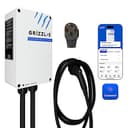
| Grizzl-E Ultimate 48A NACS | NACS - plugs straight into a MY2026 R1 | 48 A / 11.5 kW | 60 A hardwired | 25 ft | UL Type 4 (indoor/outdoor) |
|---|
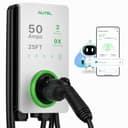
| Autel MaxiCharger Home | J1772 - uses the adapter Rivian includes | 50 A / 12 kW | 70 A for the full 50 A, per Autel | 25 ft | IP65 / NEMA 4X |
|---|
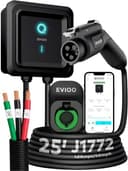
| EVIQO 48A Level 2 Charger | J1772 - uses the adapter Rivian includes | 48 A / 11.5 kW | 60 A hardwired | 25 ft | IP66 / NEMA 4 |
|---|
| Grizzl-E Classic Connect 40A | J1772 - uses the adapter Rivian includes | 40 A / 9.6 kW | 50 A (NEMA 14-50) | 25 ft | NEMA 4 (IP67) |
|---|
Read the plug column first. Four of the five picks are J1772, which is the connector Rivian’s own included adapter is for — and which also fits a pre-2026 R1 natively. One is a native NACS unit, which plugs straight into a model-year 2026 R1 with nothing in between. Then read the circuit column, because it is the constraint that will actually decide which of these you can have.
Why we will not do our usual arithmetic on this car
This site normally converts a charger’s output into miles of range per hour using a stated reference of about 3.5 miles per kWh, and prints the assumption so a reader can re-run it. For an R1 that reference would be misleading, and it is worth showing why rather than quietly dropping it.
At 48 amps a charger delivers 11.5 kW. Our usual reference would turn that into roughly 40 miles of range per hour. Rivian’s own published band for Level 2 charging is 16 to 25 miles of range per hour— so the top of Rivian’s range is well below the figure our general-purpose assumption produces. The explanation is not a contradiction: an R1T is a full-size electric pickup and an R1S a large SUV, and a heavy vehicle travels fewer miles per kilowatt-hour than the mid-size reference car behind a 3.5 mi/kWh figure. Rivian’s 25 miles per hour at 11.5 kW implies something closer to 2.2 miles per kWh, which is a believable number for a vehicle of that mass.
The practical consequence is simple and worth internalising: plan around Rivian’s band, not around a charger’s kilowatts. Sixteen to 25 miles per hour over a ten-hour overnight charge is 160 to 250 miles, which covers almost any day’s driving — and the difference between the bottom and the top of that band is, in Rivian’s own words, “the electrical current available”, which is to say your circuit. Cost by battery size is the page that does the same arithmetic for your electricity rate, and how long charging takes is the general version.
What we ranked on
One: the plug, and whether an adapter is in the chain.Rivian puts a J1772 AC adapter in the box with every 2026-and-later vehicle, which makes a J1772 wall charger the no-extra-cost default and opens up the widest and cheapest field in the category. A native NACS charger removes the adapter from a nightly ritual, and on recent price checks the cheapest hardwired 48-amp NACS unit we track sits in the same band as mid-range J1772 ones — so this is a preference rather than a premium. The two connectors explained and the NACS-under-$500 page are the two pages for that side of the decision.
Two: 48 amps, because the pack is large.The argument for the top rung is not that the charging feels faster — it is that a big battery takes a long time to refill, so the difference between the bottom and the top of Rivian’s own band compounds over a full charge. Three picks here reach 48 amps or more; two cap at 40 because they plug in. Reaching 48 means hardwiring onto a 60-amp circuit, since the NEC’s continuous-load rule gives 48 × 1.25 = 60. Sizing the circuit has the conductor that number implies.
Three: cable length, which an R1T punishes.A full-size pickup is long, and the charge port is at the front left. A charger mounted for a hatchback’s convenience will not reach it from the far side of a pad. Every pick here ships a 25-foot cable; nothing shorter made the list, which is a deliberate filter rather than a coincidence. The long-cable roundup sorts the registry on it.
Four: does the purchase foreclose anything?The Emporia leads partly for this. Emporia sells the same unit for a 48-amp hardwired install or a 40-amp NEMA 14-50 one, so an owner with an existing receptacle can start cheap and wire it in later without buying a second charger. Three of the five picks are also adjustable — Autel publishes 16 to 50 A in the app, EVIQO a DIP list plus a 6-to-48-amp slider in 1-amp steps, Grizzl-E a DIP switch at 16/24/32/40 A — which decouples the charger from the panel you have today. Every published setting in one table is the reference page.
Which one, for which R1
If the R1 is your only EV and you have, or can have, a 60-amp circuit, buy the Emporia Level 2 and hardwire it. Forty-eight amps, a 25-foot cable, a NEMA 4 body for an exterior wall, UL listing and ENERGY STAR for the rebate form, and genuine energy tracking rather than on/off.
If it is a model-year 2026 NACS car and the adapter annoys you, buy the Grizzl-E Ultimate 48A NACS. Same 48 amps, a 25-foot cable, a Made-in-Canada cast-aluminum UL Type 4 body with a published −22°F to 122°F range, Wi-Fi and OCPP. The caveats are on the record: Grizzl-E publishes no ENERGY STAR certification for it and offers its warranty as a “3 Year” / “5 Year” selector without publishing terms for either.
If the charger will live outdoors in a hard climate, buy the Autel MaxiCharger Home. The −40°F to 131°F published range is the widest we track and the IP65 / NEMA 4X body is built for it. Note that Autel specifies a 70-amp circuit for the full 50 amps, so unless your panel is generous you will be running it at 48 or 40 — which is fine, and which the app will do.
If the panel is the problem, buy the EVIQO 48A for its amperage control — a DIP switch for the ceiling and an app slider published as 6–48 A in 1-amp steps, the finest control of any unit we track — or read the small-panel roundup for the units that manage load rather than just limit it.
If a NEMA 14-50 already exists where you park, buy the Grizzl-E Classic Connect 40A, plug it in, and spend nothing on an electrician. Forty amps is 9.6 kW, comfortably inside Rivian’s own band, in a cast-aluminum IP67 box with Wi-Fi, a 25-foot cold-flexible cable and nothing that needs to work for the charging to work. Check the receptacle is genuinely EV-grade and on a dedicated 50-amp circuit first — an old dryer outlet is not the same thing.
What Rivian does not publish, and what we are not claiming
For the record, because this page is deliberately narrower than most per-vehicle roundups. Rivian publishes no onboard-charger kilowatt figure, no maximum AC amperage, and no kW rating for its own Wall Charger on any page we could reach — its support articles cover purchasing, Wi-Fi setup and warranty rather than specifications. So this page states no AC maximum for the R1, compares no charger against a Rivian kW ceiling, and quotes Rivian’s miles-per-hour band as the only vehicle-side figure it has.
What that means in practice is reassuring rather than limiting: at 48 amps you are at or beyond the top of Rivian’s published Level 2 band, so there is no scenario in which a 48-amp charger is the thing holding an R1 back. Paying for more than 48 amps — and 80-amp chargers exist— would be buying headroom against a number Rivian has not published, which is not a purchase we would recommend on this evidence. Here is what we do instead of testing, and onboard chargers explained is the page on why the car, not the wall box, usually sets the ceiling.