Level Two Club

Best EV Chargers for a 30-Amp Circuit

Our pick is the Grizzl-E Ultimate 48A, set to 24 amps on its DIP switch. That sounds backwards until you know the thing nobody selling chargers tells you: no manufacturer builds a native 30-amp home charger, so every honest answer to this question is a larger charger dialed down.

By Stephen V.Last updated How we pick

Our pick for a 30-amp circuit is the Grizzl-E Ultimate 48A, set to 24 amps. Here is the fact that makes that answer less strange than it sounds: nobody makes a native 30-amp home charger. Search our registry of twenty Level 2 chargers and the ratings run 32, 40, 48, 50 and 80 amps. There is no 30. So the real question is not which 30-amp charger to buy — it is which larger charger publishes a verifiable 24-amp setting, because 24 amps is the most a 30-amp circuit may carry continuously.

That 24 comes from the code, not from us. EV charging is a continuous load, so the National Electrical Code sizes the branch circuit to 125% of the charger’s draw— the “80% rule”. Run it backwards: 80% of 30 amps is 24 amps, which at 240 volts is 5.76 kW, or roughly 20 miles of range per hour on a reference 3.5 miles per kWh EV. For an average American driving day that is a comfortable overnight charge with hours to spare.

There is a second constraint most pages miss, and it eliminates most of the market. A plug-in charger is off the table on a 30-amp circuit.Every plug-in unit we track ends in a NEMA 14-50 plug, a 50-amp receptacle you cannot legally fit to a 30-amp circuit — a receptacle on an individual branch circuit has to be rated for that circuit. So this page is a hardwired page, and the four picks below are the only chargers in our registry that are both hardwireable and publish a 24-amp step. Any unit whose adjustable range its maker does not publish is excluded rather than credited with a setting we cannot verify.

How this is funded: we earn a commission if you buy through our links, at no extra cost to you. It never changes which product we recommend, and we’ll tell you when we’d skip one. Full disclosure.

Quick picks

Ranked on published specs, charging speed, electrical fit and value. Select a row to jump to the full write-up. We have not bench-tested these chargers — here is exactly what we do instead.

#ProductBest forPrice
1
Grizzl-E Ultimate 48A

Grizzl-E Ultimate 48A

The tank of the 48-amp class: cast-aluminum body, IP67 sealing, a full 11.5 kW, a 25 ft cable built to stay flexible in the cold and a DIP switch instead of a setup wizard. We recorded it as discontinued in August 2026 after its Amazon listing went dark; Grizzl-E sells it and Amazon lists it again as of our 2026-09-28 check, so that record is corrected here.

Best overall
$479.99 · View on Amazon

Price as of October 18, 2026. #ad How we’re funded

2
ChargePoint Home Flex

ChargePoint Home Flex

The safest default for most homes: you set the amperage in the app to 16, 24, 32, 40, 48 or 50A, so one charger fits whatever circuit your panel can spare today and scales up if you upgrade later. The app is the most mature here, firmware arrives over the air, and the warranty is long.

Best app control
$516.71 · View on Amazon

Price as of October 18, 2026. #ad How we’re funded

3
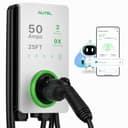
Autel MaxiCharger Home

Autel MaxiCharger Home

Built for the harshest driveway. The NEMA 4X enclosure is rated to keep charging in extreme cold and heat, it pushes a full 50 amps, and the app is capable. If your charger lives fully exposed to the weather, this is the one.

Best for outdoors
$499.00 · View on Amazon

$568.0012% off

Price as of October 18, 2026. #ad How we’re funded

4
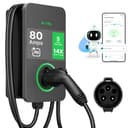
Autel MaxiCharger 80A

Autel MaxiCharger 80A

The ceiling of home AC charging: 19.2 kW on a 100-amp circuit, which is roughly double what a 48-amp charger does. Almost no car can actually take it — most cap their onboard charger somewhere between 7.7 and 11.5 kW — so buy this for a specific vehicle that accepts 80 amps, or for a future-proofed circuit you already have. Otherwise it is a very good, very expensive 48-amp charger.

Best if the circuit will grow
$908.65 · View on Amazon

$1,299.0030% off

Price as of October 18, 2026. #ad How we’re funded

The picks in full

#1Best overall

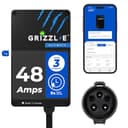
Grizzl-E Ultimate 48A

The tank of the 48-amp class: cast-aluminum body, IP67 sealing, a full 11.5 kW, a 25 ft cable built to stay flexible in the cold and a DIP switch instead of a setup wizard. We recorded it as discontinued in August 2026 after its Amazon listing went dark; Grizzl-E sells it and Amazon lists it again as of our 2026-09-28 check, so that record is corrected here.

Strengths

  • Full 48A / 11.5 kW in Grizzl-E's cast-aluminum, IP67-sealed body
  • Rated to -22F, with a 25 ft cable built to stay flexible in cold weather
  • Amperage set by DIP switch (16/24/32/40/48A) — no account or setup wizard

Trade-offs

  • Its Amazon listing went dark for five weeks in 2026 — stock can be patchy
  • Hardwired only — no plug-in option, and 48A needs a 60-amp circuit
  • Grizzl-E does not publish WiFi/app support for this SKU, so no scheduling or energy data
Max output
48 A
Power
11.5 kW
Connector
J1772
Install
Hardwired
Cable length
25 ft
Warranty
3 years
WiFi + app
Not published
Certifications
UL tested and certified

Our charging-speed math. At 48A (11.5 kW) and ~3.5 miles per kWh, about 40 miles of range per hour. The DIP switch drops it to 40A (about 34 mi/hr) for a 50-amp circuit.

Build note. Cast-aluminum enclosure with IP67 sealing, rated -22F to 122F; amperage is set by a DIP switch (16/24/32/40/48A) and status shown on an LED.

Specs read from the manufacturer spec sheet, on September 28, 2026. “Not published” means the brand does not state that figure.

#2Best app control

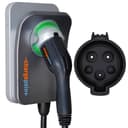
ChargePoint Home Flex

The safest default for most homes: you set the amperage in the app to 16, 24, 32, 40, 48 or 50A, so one charger fits whatever circuit your panel can spare today and scales up if you upgrade later. The app is the most mature here, firmware arrives over the air, and the warranty is long.

Strengths

  • Adjustable 16-50A means it fits a small panel now and a bigger circuit later
  • The most mature app of the group — scheduling, reminders, usage history, over-the-air firmware
  • 3-year warranty and a long 23 ft cable
  • Sold hardwired or on a NEMA 6-50 or NEMA 14-50 plug, in J1772 or NACS

Trade-offs

  • You pay a premium over value 48A chargers for the app and brand
  • Full 50A output needs a 60A circuit most older panels don't have to spare
  • The plug-in SKUs cap at 40A, so the top speed is a hardwired-only feature
Max output
50 A
Power
12 kW
Connector
J1772
Install
Hardwired, NEMA 6-50 or NEMA 14-50
Cable length
23 ft
Warranty
3 years
WiFi + app
Yes
Certifications
UL/cUL listed, ENERGY STAR

Our charging-speed math. At its 50A max (12 kW) and a typical 3.5 miles per kWh, the Home Flex adds roughly 42 miles of range per hour. Dial it down to 40A to fit a 50A circuit and you get about 34. ChargePoint's own, more conservative claim is up to 37 miles per hour hardwired and 30 on the plug-in SKUs.

Build note. Amperage is set in the app to 16, 24, 32, 40, 48 or 50A. The plug-in SKUs are capped at 40A, so the full 50A is a hardwired-only figure. UL and cUL listed per UL 2594 and UL 2231; firmware updates over the air, and the station stores up to 90 days of session data locally if the network drops.

Specs read from the manufacturer spec sheet, on September 3, 2026. “Not published” means the brand does not state that figure.

#3Best for outdoors

Autel MaxiCharger Home

Built for the harshest driveway. The NEMA 4X enclosure is rated to keep charging in extreme cold and heat, it pushes a full 50 amps, and the app is capable. If your charger lives fully exposed to the weather, this is the one.

Strengths

  • NEMA 4X enclosure rated for very cold and hot conditions
  • Full 50A output with a 25 ft cable
  • WiFi, Bluetooth and a capable app

Trade-offs

  • Autel's own page specifies a 70A circuit for full output, and the unit is hardwired only
  • App and ecosystem are newer than ChargePoint's
  • Autel publishes CSA and ENERGY STAR for this unit, not a UL listing
Max output
50 A
Power
12 kW
Connector
J1772
Install
Hardwired
Cable length
25 ft
Warranty
3 years
WiFi + app
Yes
Certifications
CSA certified, ENERGY STAR

Our charging-speed math. At its 50A max (12 kW) and ~3.5 miles per kWh it adds roughly 42 miles of range per hour.

Build note. IP65 / NEMA 4X enclosure with a published operating range of -40F to 131F (-40C to 55C), output adjustable from 16 to 50 A, a 25 ft cable, Bluetooth / WiFi / Ethernet / CAN / RS485 connectivity, and a 13.2 x 7.4 x 3.8 in body weighing 15.4 lb. Autel states a 70 A circuit is required for full output, and that its Adaptive Load Management 'requires compatible additional hardware' while charger-to-charger Dynamic Load Balancing does not.

Specs read from the manufacturer spec sheet, on October 10, 2026. “Not published” means the brand does not state that figure.

#4Best if the circuit will grow

Autel MaxiCharger 80A

The ceiling of home AC charging: 19.2 kW on a 100-amp circuit, which is roughly double what a 48-amp charger does. Almost no car can actually take it — most cap their onboard charger somewhere between 7.7 and 11.5 kW — so buy this for a specific vehicle that accepts 80 amps, or for a future-proofed circuit you already have. Otherwise it is a very good, very expensive 48-amp charger.

Strengths

  • 80 A / 19.2 kW — the fastest AC charging you can install at a house
  • Output adjustable from 6 A to 80 A in the app, so it can be dialed to any circuit
  • NEMA 3S / IK10 enclosure rated -40F to 131F, with UL and CSA listings and ENERGY STAR

Trade-offs

  • Needs a 100-amp circuit for full output — a service upgrade for most homes
  • Very few EVs accept more than 11.5 kW on AC, so the extra amps often go unused
  • Autel's own pages disagree on the warranty term (5 years on the body vs 3 extendable to 5)
Max output
80 A
Power
19.2 kW
Connector
J1772
Install
Hardwired
Cable length
25 ft
Warranty
5 years
WiFi + app
Yes
Certifications
UL 2594, UL 2231-1/2, UL 1998, CSA C22.2 No. 280, ENERGY STAR

Our charging-speed math. At its full 80A (19.2 kW) and ~3.5 miles per kWh it would add roughly 67 miles of range per hour — but only into a car that accepts 19.2 kW on AC. Dialed to 48A (11.5 kW) it is about 40 miles per hour, the same as any other 48-amp charger.

Build note. Hardwired 19.2 kW unit with a 25 ft cable; output is adjustable 6-80 A in the Autel Charge app and by DIP switch (16/24/32/40/48/50/64/72/80 A), in a NEMA 3S / IK10 enclosure rated -40F to 131F, with WiFi, Ethernet and RS485.

Specs read from the manufacturer spec sheet, on August 12, 2026. “Not published” means the brand does not state that figure.

Why there is no such thing as a 30-amp charger

Thirty amps is a circuit size. It is what the wire and the breaker are rated for. Charger makers build to the amperage the charger will actually deliver, and because of the 80% rule those two numbers are never the same. A 40-amp charger wants a 50-amp circuit; a 48-amp charger wants a 60. Run it the other way and a 30-amp circuit supports a 24-amp charger — and 24 is not a rating anyone sells either, because nobody would buy a box labeled “24 amps” when the same box can be labeled 40 and configured down.

So the market solves this with configuration rather than product. The good manufacturers publish a list of amperage steps their unit can be set to, and 24 is almost always on it. The step is set either in software, or with a physical DIP switch inside the enclosure. The whole job of this page is to record who publishes that step, and to exclude everyone who does not.

The four chargers in our registry whose makers publish a 24-amp setting — the most a 30-amp circuit may carry continuously. Every one of them can also be hardwired, which matters here: you cannot legally fit a 50-amp receptacle to a 30-amp circuit, so the plug-in route is closed.
ChargerPublished amp settingsRated maxInstallCableEnclosure
Grizzl-E Ultimate 48ADIP switch: 16 / 24 / 32 / 40 / 48 A48 AHardwired25 ftNEMA 4 (IP67)
ChargePoint Home FlexIn the app: 16 / 24 / 32 / 40 / 48 / 50 A50 AHardwired, NEMA 6-50 or NEMA 14-5023 ftNEMA 3R
Autel MaxiCharger HomeIn the app: adjustable 16-50 A50 AHardwired25 ftIP65 / NEMA 4X
Autel MaxiCharger 80AApp 6-80 A; DIP 16 / 24 / 32 / 40 / 48 / 50 / 64 / 72 / 80 A80 AHardwired25 ftNEMA 3S (IK10)

Three registry units that look like candidates are deliberately absent. The EVIQO 48A, the Lectron Nexus 48A and the Emporia Pro are all hardwired units we rate highly elsewhere, but none of their makers publishes an adjustable amperage range. They may well support a 24-amp configuration; we are not going to put them on a page about a specific setting on the assumption that they do. If you are drawn to one of them, ask the seller to confirm the setting in writing before the electrician arrives.

The constraint that closes the plug-in route

This is the part that surprises people, and it is worth being precise about because it eliminates about half of our registry. Every plug-in charger we track terminates in a NEMA 14-50plug. That is a 50-amp device, and it belongs on a 50-amp circuit — a receptacle serving a single outlet on an individual branch circuit has to be rated for the circuit it is on. You cannot fit a 14-50 receptacle to a 30-amp circuit and call it done, and you should be wary of anyone who offers to.

That leaves two legitimate paths on a 30-amp circuit: hardwire a dial-down-capable charger, which is what the four picks above are for, or fit a NEMA 14-30 receptacleand find a charger that plugs into it — and here is the honest finding: no charger in our registry publishes a NEMA 14-30 plug option. Not one. The adapter market fills that gap, and our dryer-outlet page deals with it at length rather than in a footnote, because the answer there has more caveats than a roundup can carry.

The practical consequence is that a 30-amp install is an electrician job either way. If you were hoping to avoid one, price a 50-amp circuit at the same time: the incremental cost of heavier wire on a short run is often small, and it buys you the plug-in route, a charger you can take with you, and 40 amps instead of 24. Our installation cost breakdown has the line items, and wire size and breaker covers what changes between the two.

What 24 amps actually gets you

Numbers first, with our assumption printed. At 24 amps and 240 volts a charger delivers 5.76 kW. On a reference EV doing 3.5 miles per kWh that is about 20 miles of range per hour, or roughly 160 miles over an eight-hour night. Those are our figures from the voltage and current, not a manufacturer claim, and real-world efficiency moves them either way — a heavy truck in winter does considerably worse, a small sedan in mild weather better.

Set that against how people actually drive. The average US driver covers well under 40 miles a day, which a 30-amp circuit replaces in about two hours. For the overwhelming majority of households, 24 amps is not a compromise at all — the car is parked for ten hours and needs three of them. Our charger-sizing guide works this from first principles, and is a Level 2 charger worth it is the page to read if you are wondering whether to spend anything at all.

Where 24 amps genuinely pinches is a large battery from near-empty. An 84 kWh pack takes around 13 hours at 5.76 kW against about 7 on a 48-amp charger. If you regularly arrive home nearly flat with a big battery and leave early, that gap is real and a bigger circuit is worth the money. If you top up 30 or 40 miles a night like most owners, you will never notice it. The other case to think about is two EVs: 24 amps split between two cars is slow enough to matter, and our two-car roundup covers the alternatives.

The picks, in plain terms

The Grizzl-E Ultimate 48A is our pick because its amperage control is the most honest form of it: a DIP switch with a printed 24-amp position, no account, no app, no firmware that can forget the setting. It is a cast-aluminum, IP67-sealed body rated to -22°F with a 25-foot cable built to stay flexible in the cold, and it is hardwired, which is what a 30-amp circuit needs anyway. Two honest notes: Grizzl-E publishes no WiFi or app for this SKU, so you schedule in the car, and its Amazon listing went dark for five weeks in 2026, so stock can be patchy. See the Ultimate review.

The ChargePoint Home Flex is the pick if you would rather set the amperage in software. Its published steps are 16, 24, 32, 40, 48 and 50 amps, and because it can be hardwired orplugged in, it is the one unit here that moves with you if you later upgrade to a 50-amp circuit — you change the setting in the app rather than the hardware on the wall. It is premium money for that flexibility, plus the most mature app in the category and a UL/cUL listing with ENERGY STAR. The Home Flex review has the detail.

The Autel MaxiCharger Homeis the pick when the charger has to live outside. Adjustable 16 to 50 amps in the app, in an IP65 / NEMA 4X enclosure — 4X is the rating that adds corrosion resistance — with a published operating range of -40°F to 131°F, the widest we track, and WiFi, Bluetooth and Ethernet on board. One figure to read carefully: Autel states a 70-amp circuit is required for its full output. On a 30-amp circuit set to 24 amps that is irrelevant, but it tells you this unit’s headline number is a much bigger electrical job than the box implies. The MaxiCharger review covers it.

The Autel MaxiCharger 80Ais on this page for exactly one buyer: someone on 30 amps today who knows a service upgrade is coming. Its range is the widest published of anything we track — 6 to 80 amps in the app, with a DIP switch carrying 24 amps among its positions — and it is the only charger that spans a 30-amp circuit and a 100-amp one. It also publishes the longest warranty we have found, five years on the body and backplate with one year on the cable and connector on Autel’s own US store listing. For anyone not planning that upgrade it is a great deal of money for 24 amps, and we would buy the Grizzl-E instead. The 80A review and our fastest-chargers roundup are where it properly belongs.

Before you buy: three things to confirm

One: confirm the circuit is actually 30 amps and actually spare.A 30-amp double-pole breaker in the panel is not the same as a 30-amp circuit run to where the car parks, and an existing dryer or welder circuit is not spare — EV charging equipment needs its own. Our dedicated-circuit page explains why the clever workarounds do not survive contact with the code, and panel capacity shows how to check what you have.

Two: get the 24-amp setting in writing.On the DIP-switch units the setting is physically inside a sealed enclosure, and once the cover is on you will not see it again. Ask the electrician to note the configured amperage on the invoice. It is the single most useful line on that piece of paper if the charger ever misbehaves — and a wrong setting is a common cause.

Three: price the 50-amp alternative at the same time.You are paying for a trip, a permit and labor either way, and the wire is often the smallest line on the quote. If upgrading the circuit is within a few hundred dollars, it buys 40 amps, the plug-in route and a far wider choice of charger — including everything on our 40-amp roundup and our plug-in roundup. If it is not, dial a good charger down to 24 and sleep soundly; the car will be full in the morning either way.
Frequently asked questions

Can you run an EV charger on a 30-amp circuit?

Yes, at 24 amps. EV charging is a continuous load, so the NEC sizes the circuit to 125% of the charger's draw — the 80% rule — which caps a 30-amp circuit at 24 amps continuous. That is 5.76 kW at 240 volts by our arithmetic, or roughly 20 miles of range per hour on a reference 3.5 mi/kWh EV. What you cannot do is put a 40-amp or 48-amp charger on that circuit at its rated setting; the charger has to be configured down to 24 amps, which is why only units publishing a 24-amp step belong on this page.

Is there a 30-amp EV charger?

Not in our registry, and we have not found one worth tracking. Home Level 2 chargers are built at 32, 40, 48, 50 and 80 amps; 30 is not a rating manufacturers use, because 30 amps is a circuit size rather than a charger size and a 30-amp circuit can only carry 24 amps continuously anyway. If a listing advertises a "30 amp EV charger", read the spec sheet carefully — it is usually a 32-amp unit, a unit that draws 24 amps on a 30-amp circuit, or a Level 1 cord with a 240-volt plug on it.

Can I plug a charger into a 30-amp dryer outlet?

Not without solving three separate problems: the plug does not match, the code requires EV charging equipment to be on a dedicated circuit, and the receptacle is not an EV-grade part. Every plug-in charger we track ends in a NEMA 14-50 plug, not the NEMA 14-30 a dryer uses. Our dryer-outlet page works through the whole question honestly, including where the adapter route genuinely does and does not hold up.

How fast does 24 amps charge an EV?

By our arithmetic, 5.76 kW at 240 volts, which on a reference 3.5 miles per kWh EV adds roughly 20 miles of range per hour — call it 160 miles over an eight-hour night. The average US driver covers well under 40 miles a day, so a 30-amp circuit replaces a normal day's driving in about two hours. Where it starts to pinch is a large battery charged from near-empty: an 84 kWh pack would take around 13 hours at this rate rather than the 7 a 48-amp charger manages.

Should I upgrade to a 50-amp circuit instead?

If the panel has the room and the run is short, often yes — it is the one upgrade that buys you a plug-in install, which means no electrician the next time you change chargers and a unit you can take with you when you move. If the panel is full, though, a 30-amp circuit set to 24 amps is a genuinely good outcome rather than a consolation prize, and it is far cheaper than a service upgrade. Price both before deciding; our panel-capacity and install-cost pages are the way to scope it.

Does a 24-amp setting need a smaller breaker?

The breaker matches the circuit, and the charger setting has to match the breaker — the two are not independent. On a 30-amp circuit you have a 30-amp breaker and a charger set to 24 amps; setting the charger to 32 or 40 on the same breaker is how you get nuisance trips at best. Your electrician sets the charger's configuration as part of the install and should confirm it in writing, because on the DIP-switch units it is physically inside the charger and you will not see it again.

Sources

  • NFPA — Using the Latest NEC for EV Charger Installations — NFPA on NEC (NFPA 70) Article 625: EV charging is a continuous load, so circuits are sized to 125% of load (the 80% rule) (accessed July 19, 2026)
  • U.S. DOE Alternative Fuels Data Center — Electric Vehicle Charging Stations — US DOE on charging levels: Level 1 (~1.9 kW, ~5 mi/hr), Level 2 (2.9-19.2 kW, ~7.2 kW typical residential, ~25 mi/hr), and DC fast charging (accessed July 19, 2026)
  • U.S. DOE Alternative Fuels Data Center — Charging Electric Vehicles at Home — US DOE on home EV charging: most owners charge overnight on Level 1 or Level 2, installs follow NEC Article 625, with example home-charging costs (accessed July 19, 2026)
  • United Chargers — Grizzl-E Ultimate 48A specifications — Grizzl-E's own spec page for the Ultimate 48A: 11.5 kW max output on J1772 or NACS, aluminum enclosure, 25 ft output cable, 208-240 VAC, selectable 48/40/32/24/16 A input current, operating temperature -30C to +50C (-22F to 122F), IP67 protection, LED indicator, DIP-switch power selector, hardwire-only install. RE-CHECKED September 28, 2026: every spec above is unchanged, and the page sells the Ultimate 48A at $383.99 with a J1772 or a NACS connector, listed alongside the 80A / 19.2 kW unit rather than replaced by it. This corrects our August 20, 2026 note, which recorded the 48A as no longer sold on the strength of a dead Amazon listing. RE-READ October 17, 2026 for the EVIQO head-to-head, and the page HAS CHANGED in two ways worth recording. (1) Connectivity is now published: the smart-function row reads 'Wi-Fi (2.4 GHz); Mobile Application' and the communication-protocol row reads 'OCPP', where our September reading of this same page published no app support for the unit. (2) The enclosure row now reads 'UL Type 4 Indoor/Outdoor Rating' with no IP figure alongside it, where the September reading carried IP67. Also published on this visit: an adjustable-current list of '40A, 32A, 24A, 16A' (the 48 A headline is not repeated in that list), 'Hardwire Only', a 25 ft output cable, -30C to +50C (-22F to 122F), 'UL E510712', enclosure dimensions of 10.25 x 6.25 x 3.75 in, a unit weight of 11.00 kg / 24.25 lbs, country of origin Canada, a price of $479.99, SKU GRS-HW-25NACS48-B, and a warranty selector offering '3 Year' or '5 Year' without stating what either covers. No ETL and no ENERGY STAR certification is published, and no Alexa, Google Home, HomeKit, Matter or Home Assistant integration is published (accessed October 17, 2026)
  • ChargePoint — Home Flex datasheet (PDF) — ChargePoint's own datasheet: enclosure rating Type 3R per UL 50E, operating temperature -22F to 122F, 23 ft cable, plus installer notes that an outdoor plug-in install requires an outdoor-rated GFCI breaker upstream while an external GFCI may conflict with the charger's internal ground-fault protection on a hardwired install. RE-READ September 3, 2026 for the review refresh: the same datasheet also publishes maximum 12 kW (240V AC x 50A) with output amperage adjustable via the mobile app to 16A, 24A, 32A, 40A, 48A or 50A; a required dedicated dual-pole breaker rated for 125% of maximum load; 'Software Updates: Firmware updated over-the-air (OTA)'; 2.4/5 GHz Wi-Fi (802.11 a/b/g/n); local storage of up to 90 days of charging session data (100 sessions) if the network drops; power measurement accuracy +/- 2.0%; ground-fault detection by 20 mA CCID with auto retry; and UL and cUL listing per UL 2594, UL 2231-1 and UL 2231-2, NEC Article 625 compliant. Ordering information lists the plug-in station models CPH50-NEMA6-50-L23 and CPH50-NEMA14-50-L23 (accessed September 3, 2026)
  • ChargePoint — Home Flex home charger product page — ChargePoint's own current product page for the Home Flex, read for the 2026-09-03 review refresh: three install configurations are offered — hardwired, NEMA 6-50 plug and NEMA 14-50 plug — with 'up to 50 amps of power delivered to your EV' on the hardwired model and 'up to 40A of power' on the plug-in models. ChargePoint's own range claim is 'up to 37 miles of range per hour' hardwired and '30 miles of range per hour' plug-in. J1772 and NACS connectors are offered across all configurations, and ChargePoint states the unit is 'UL Listed for safety', 'ENERGY STAR certified for efficiency' and carries a '3-year warranty' (accessed September 3, 2026)
  • Autel Energy — MaxiCharger AC Elite Home 50A product page — Autel's own listing: compliant with NEMA 4X standards, operating temperature -40F to 131F, 25 ft cable, 3-year warranty. RE-READ October 10, 2026 for the Emporia head-to-head, and the page now publishes materially more: 'Maximum Output | 12 kW / 50 A' with output 'Adjustable 16-50 A'; installation given as 'Hardwired - 70 A Circuit for Full Output'; an 'SAE J1772' connector; an enclosure rating of 'IP65 / NEMA 4X'; an operating range of '-40 to 131 F (-40 to 55 C)'; a '3 Years' warranty quoted as a single term with no component split; 'CSA and ENERGY STAR compliance' (no UL listing is claimed on this page); connectivity listed as 'Bluetooth, Wi-Fi, Ethernet, CAN, RS485'; app control to start, stop and schedule charging, monitor activity and adjust current; dimensions of 13.2 x 7.4 x 3.8 in (336 x 187 x 97 mm) and a weight of 15.4 lbs (7 kg); and the load-management sentence this comparison turns on - 'Supports both Adaptive Load Management (ALM) and charger-to-charger Dynamic Load Balancing (DLB). ALM requires compatible additional hardware, while DLB works between chargers without additional hardware.' The page publishes no solar-specific feature (accessed October 10, 2026)
  • Autel Energy — MaxiCharger 80A 19.2kW Residential EV Charger (US store listing) — Autel's own US listing: 19.2 kW (240V AC 80A), 208/240V AC 50/60 Hz, SAE J1772, hardwired, 25 ft (7.5 m) cable, output adjustable from 6A to 80A in the app and 16/24/32/40/48/50/64/72/80 A by DIP switch, UL 2594, UL 2231-1, UL 2231-2, UL 1998, CSA C22.2 No. 280, FCC Part 15 Class B, ENERGY STAR, OpenADR 2.0b, NEC Article 625, Wi-Fi / Ethernet / RS485 with the Autel Charge app and cloud, and a warranty of 5 years on the charger body, backplate and internal components with 1 year on the display screen, charging cable and connector (accessed August 12, 2026)
  • FuelEconomy.gov — Electric Vehicles: Learn More About the Label — DOE/EPA on EV efficiency: kWh per 100 miles and MPGe, accounting for AC charging losses (accessed July 19, 2026)
  • UL Solutions — EV Charging Infrastructure Services — UL on EVSE safety certification: ANSI/UL 2594 is the Standard for Electric Vehicle Supply Equipment (accessed July 19, 2026)

Keep reading