What the extra money actually buys
Four capabilities live above the mid band and nowhere below it. Each one answers a specific question about a specific house, and if none of the questions is yours, the premium tier has nothing to sell you.
One: a panel that cannot spare the circuit.This is the strongest argument in the tier and the reason the Emporia Pro leads. A load calculation either has room for a 60-amp circuit or it does not, and when it does not, the usual answers are a service upgrade or a smaller charger. Whole-home load management is the third answer: the charger reads the service and gets out of the way when the range and the dryer are both on. Emporia bundles the Vue 3 monitor that makes it work — which is also the catch, because the monitor has to be installed in your panel too, so this is not a charger-only feature. How to read your own panel capacity tells you whether this paragraph is about you.
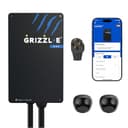
Two: two cars and one circuit.The Grizzl-E Duo Connect puts two 25-foot cables on one cast-aluminum IP67 body rated −30°C to +50°C and splits one 40-amp supply between them, with a DIP-switch selector (16/24/32/40 A) and per-connector limits in the app. It costs roughly what two single chargers cost, so the saving is in the wiring rather than the box — which is exactly the point when the wiring is the part your house cannot have. What a second circuit really involves is the comparison to price it against.
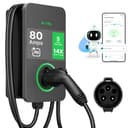
Three: an enclosure and a term for somewhere unkind.The Autel 80A publishes a NEMA 3S / IK10 enclosure — IK10 is an impact rating, not a weather one — an operating range of −40°F to 131°F, four named safety standards, and a five-year warranty on the body. For a charger on a post in a driveway, or anywhere a car door or a snow shovel can reach it, that is a different class of hardware. Our pedestal page ranks on exactly this, and the ratings guide explains why IK and IP are not the same promise.
Four: software you will actually use.ChargePoint publishes the deepest documented feature set of the brands we track, Wallbox publishes OCPP 1.6j alongside Bluetooth and Wi-Fi, and Emporia publishes the energy data its monitor collects. This is the softest of the four arguments, because an app is worth paying for only if somebody opens it — and the most common honest answer in this category is that nobody does after the first two weeks. The smart-home roundupstarts from the finding that not one charger we track publishes Matter, Apple Home or Home Assistant support, which is a useful corrective before paying for “smart”.
Where the money buys nothing
Three places, stated as plainly as we can manage on a page whose whole subject is expensive chargers.
Speed.Five of the six picks here are 48 or 50 amps. So are the chargers on our under-$500 page. Into the same car they deliver the same rate, because the car’s onboard charger is the constraint. Forty-eight amps against eighty is the comparison that makes this concrete: even doubling the charger does nothing if the car caps at 11.5 kW.
Safety. A UL or ETL listing to UL 2594 and UL 2231 is a pass/fail attestation, not a scale. The $210 ELEGRP portable carries an ETL listing and the $900 Autel carries four named standards; both are listed. Paying more does not buy a safer charger, it buys more documentation of the same floor. What the listings certify is the page that settles it.
Cable length.Twenty-five feet is the normal figure across this market at every price. The ChargePoint publishes 23 feet — shorter than several chargers costing a third as much. If reach is your problem, buy on reach, not on tier: the long-cable roundup sorts the field on the one spec that cannot be fixed later.
How we ordered these six
The ranking is by how specific and how unavailable-elsewherethe capability is, not by price. The Emporia Pro is first because whole-home load management in the box is the one thing on this page you genuinely cannot buy cheaper. The Autel 80A is second because the impact-rated enclosure, the five-year term and the 6-to-80-amp adjustment range are all real and all absent from the mid band — even though the 80 amps themselves will go unused in most houses.
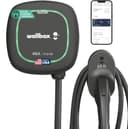
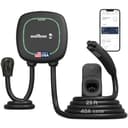
The Grizzl-E Duo Connect is third because its argument is narrow but complete: two cars, one circuit, no panel work. The two Wallbox entries follow because compactness and load management are real and well documented, but both are also available in cheaper forms elsewhere in the registry — and note that the NACS Wallbox we track is the 40-amp plug-in SKU, which is a different install from the 48-amp hardwired J1772 version rather than the same unit with another plug.
The ChargePoint Home Flex is last, and it is the one we would actually recommend most often to someone who simply wants to shop at this end of the market. It is the cheapest way in, the most adjustable charger on the site (16 to 50 amps in the app, which means it fits a small panel now and a bigger circuit later), and it is sold hardwired or on a NEMA 6-50 or NEMA 14-50 plug, in J1772 or NACS. The caveats are on the record too: the full 50 amps needs a 70-amp circuit by ChargePoint’s own 125% breaker rule, the plug-in SKUs cap at 40 amps, and the 23-foot cable is short for the price. The full review has all of it.
One final piece of arithmetic worth doing before you spend at this level. The install is usually the larger number — conduit, a 60-amp double-pole breaker, 6 AWG copper, a permit, an inspection, and labor that scales with distance from the panel. A $200 difference between chargers is small against that, and a $200 upgrade to the circuit is money spent on the part of the project that lasts longest. The install-cost breakdown is the page for that decision, and whether a Level 2 charger pays for itself is the one for the bigger question behind it.