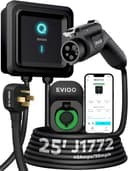
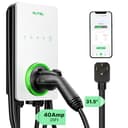
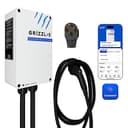
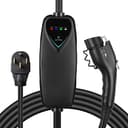
Every unit here terminates in a NEMA 14-50 plug and is capped at 40 amps — the plug-in ceiling, set by the NEC’s continuous-load rule on a 50-amp receptacle, not by any of these manufacturers. Specs as published by each brand.| Charger | Max amps | Cable | Enclosure | App |
|---|
| EVIQO 40A NEMA 14-50 Charger | 40 A | 25 ft | IP66 / NEMA 4 | Yes |
|---|
| Autel MaxiCharger AC Elite Home 40A | 40 A | 25 ft | NEMA 4 | Yes |
|---|
| Grizzl-E Classic Connect 40A | 40 A | 25 ft | NEMA 4 (IP67) | Yes |
|---|
| Lectron 40A Portable Level 2 Charger | 40 A | 16 ft | Not published | No |
|---|
Why 40 amps is the ceiling
This is not a manufacturer choice, and it is worth understanding before you go looking for a 48-amp plug-in charger that does not exist. Under the NEC, EV charging is a continuous load, so a circuit is sized at 125% of the charger’s current — which read backwards means a receptacle supports 80% of its rating. A NEMA 14-50 is a 50-amp receptacle, so 40 amps is the limit.
There is no common household receptacle rated for a 48-amp continuous load, which is why every 48-amp charger on the market is hardwired. If you need 48, you are choosing hardwired by definition — the reasoning is in hardwired vs plug-in, and the segment is our 48-amp roundup.
Get the receptacle right, or none of this works
The single most consequential detail in a plug-in install is not the charger. It is the outlet behind it.
It must be an EV-grade receptacle. A charging session is hours of near-maximum continuous draw, which is duty that budget receptacles are documented to fail under. This is the one place not to save twenty dollars, and it is worth naming specifically when you brief an electrician.
An old dryer outlet is not a NEMA 14-50. A NEMA 14-30 is a 30-amp receptacle supporting 24 amps of charging — still genuine Level 2 — and an older NEMA 10-30 has no separate ground at all. Neither is something to adapt casually. Our plug and outlet reference lays out every type, and the 14-50 install guide covers what to ask for.
GFCI protection is usually required for a receptacle-fed charger, and it is the most common source of nuisance tripping in plug-in installs. If that is already happening to you, our GFCI guide works through the causes in order.
How we separated them
EVIQO 40A takes the top spot because it gives up the least. It has the full 25-foot cable plus a 40-inch input lead — the best total reach here by a clear margin, and reach matters more than people expect on a plug-in install where the outlet position is fixed. It keeps a real app with 6-to-40-amp adjustment, scheduling and energy tracking, in an IP66 / NEMA 4 body, with UL, ETL, FCC and ENERGY STAR listings. That ENERGY STAR certification is also the most common eligibility filter in utility rebate programs.
Autel MaxiCharger AC Elite Home 40A is the one to buy if the charger lives outside. It is the 50-amp MaxiCharger’s plug-in sibling: same 25-foot cable, same NEMA 4 enclosure, same Autel Charge app, plus an in-body holster that stops the connector living on the floor. Two honest caveats — Autel’s page for this SKU does not publish a UL or ENERGY STAR listing or a temperature range, unlike its 50A and 80A pages, so we record both as not published rather than assuming they carry over. If a rebate depends on ENERGY STAR, that matters.
Grizzl-E Classic Connect 40A is the best-built box here. Cast aluminum, NEMA 4 / IP67, rated -22°F to 122°F, with a 25-foot cable engineered to stay flexible in the cold — which is the specification northern owners actually feel every winter morning. It adds WiFi, the Grizzl-E Connect app and utility demand-response enrollment. The quirk: the amperage is set by a physical DIP switch, not in the app. This is the model Grizzl-E introduced when it discontinued the Grizzl-E Smart, and we compare it directly with its cheaper sibling in Classic vs Classic Connect.
One honest omission. The Grizzl-E Classic — the same cast-aluminum box with the radio removed, and the cheaper way in — is not on this list, and the reason has changed twice. It used to be that the only Classic listed was the NEMA 6-50 variant, which does not belong on a 14-50 page. Then our 3 September 2026 check found every variant unlisted on Amazon. As of 28 September 2026 all three are listed again, NEMA 14-50 included, and its review carries a buy link once more. We have left the list as it stands rather than re-rank on a listing that has already gone dark once, but it is a real plug-in option again if you want that build with no app — our no-app roundup covers the alternatives.
Lectron 40A is the cheapest honest route to real Level 2 charging and the most genuinely portable unit here — a 16-foot cable and no pretense of being a permanent fixture. It is ETL listed to UL 2594 / UL 2231, and Lectron does not publish an outdoor or IP rating for it, which is a finding rather than a gap in our research: treat it as an indoor unit unless you hear otherwise from the brand. If the charger will genuinely travel rather than just come off the wall once, the units designed for that — sealed bodies, a second cord for a 120V socket — are in our portable charger roundup.
Can you install a plug-in charger yourself?
If a suitable, correctly protected NEMA 14-50 already exists and you are mounting the charger on the wall beside it, that is genuinely a homeowner job — you are hanging a bracket and plugging something in.
If the outlet does not exist, the outlet is the electrical work, and it needs an electrician and a permit exactly as a hardwired circuit would. The plug-in advantage is real but it is a one-time advantage: it does not apply to the first install unless the circuit is already there. Our honest take on where the line falls is in can I install a Level 2 charger myself, and the whole sequence is in the install, start to finish.
Who should not buy plug-in
Three cases. If your car accepts more than 40 amps and you genuinely need the speed, hardwired is the only route to 48 — check the car’s rating first using the charger is inside your car. If your panel is tight enough that load management is the difference between installing anything and not, the load-managing units are hardwired — see chargers for small panels. And if the charger will live somewhere fully exposed on a post, a hardwired install avoids having a plug and receptacle sitting outdoors at all — see mounting with no wall.