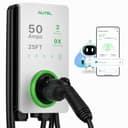
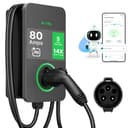
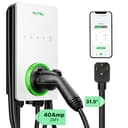
The three Autel chargers, side by side
Autel’s naming is better than most — the amperage is in the product name — but the figure that actually constrains you is not. Here is the ladder with the circuit requirement put back in.
Autel’s three home chargers side by side, on figures Autel publishes on its own store and product pages. The circuit column is the one that decides this purchase, and it is the column Autel’s marketing is quietest about.| Charger | Rated output | Circuit for full output | Install | Enclosure | Warranty |
|---|
| Autel MaxiCharger AC Elite Home 40A | 40 A / 9.6 kW | 50 A (via the receptacle) | NEMA 14-50 plug | NEMA 4 | 3 years |
|---|
| Autel MaxiCharger Home | 50 A / 12 kW | 70 A, per Autel | Hardwired | IP65 / NEMA 4X | 3 years |
|---|
| Autel MaxiCharger 80A | 80 A / 19.2 kW | 100 A | Hardwired | NEMA 3S (IK10) | 5 years |
|---|
Read down the circuit column and the ladder reorganises itself. The 40A is the only one of the three that can be installed without an electrician, because it plugs into a receptacle; if that receptacle already exists, your install cost is zero. The 50A needs a 70-amp circuit for its full output, which is a bigger ask than the 60-amp circuit a 48-amp charger wants. And the 80A needs a 100-amp dedicated circuit, which in most houses means upgrading the service before you can even start.
What we ranked on
With one brand and three products, the usual cross-brand tie-breakers fall away. Four things did the work instead.
One: what does the enclosure publish, and is there a temperature range with it?This is Autel’s strongest suit and the reason the 50A wins. Autel publishes IP65 / NEMA 4X with an operating range of −40°F to 131°F for the MaxiCharger Home, which is the widest published range of any charger in our registry — wider than the Grizzl-E’s −22°F to 122°F and wider than anything EVIQO publishes as a range at all. The 80A publishes the same temperature range in a NEMA 3S / IK10 body, where IK10 is an impact rating rather than a weather one. The 40A publishes NEMA 4 and, on its own SKU page, no temperature range, which is why it is the budget pick and not the cold-weather pick. What those ratings actually mean is worth five minutes before you compare them.
Two: how far down can it be dialed?All three are adjustable, and the ranges differ in a way that matters for a tight panel. The 50A publishes 16 to 50 A. The 80A publishes 6 to 80 A in the app and a DIP-switch list of 16/24/32/40/48/50/64/72/80 A — the broadest adjustment range we have found anywhere. The 40A publishes adjustment up to 40 A in the app. Adjustability is the feature that lets a charger be bought once and matched to the circuit you can actually have, which is why we keep a table of every published list.
Three: which load-management problem does it solve? Autel publishes two modes under names that are easy to confuse, and the distinction decides whether you need to buy anything else. Charger-to-charger Dynamic Load Balancing divides one circuit between two MaxiChargers and, Autel states, needs no additional hardware — which makes the brand genuinely good for a two-EV household on one circuit. Whole-home Adaptive Load Management, the mode that throttles the charger against the rest of the house, “requires compatible additional hardware” in Autel’s own words. If your constraint is a small panel rather than a second car, read that sentence twice before budgeting.
Four: what is published about safety listings, and what is not.The 80A names UL 2594, UL 2231-1/2, UL 1998 and CSA C22.2 No. 280 plus ENERGY STAR. The 50A names CSA certification and ENERGY STAR, with no UL listing published anywhere. The 40A SKU’s own page names neither a safety listing nor ENERGY STAR, which is the single biggest gap in Autel’s documentation and the reason that unit is ranked third rather than second here on anything but price. Our registry records what a manufacturer publishes and prints “Not published” where it does not, so the spec table on each review page shows exactly where the silence is.
Where Autel is the wrong answer
Three cases, stated plainly, because a brand page that recommends the brand in every situation is an advertisement.
If nobody in the house will open an app. All three Autel units are connected products whose amperage adjustment lives in software. There is a whole class of charger built to be installed and then ignored, with a DIP switch and no account, and our no-app roundup argues that case properly.
If your car has a NACS port.Autel’s units in our registry are all J1772. A Tesla can use them through the adapter that came with the car, and a model-year 2026 Rivian can too, but a native NACS cable is tidier and no longer costs a premium — the NACS roundup has the field, and the under-$500 cut has the cheap half of it.
If you might move. Two of the three are hardwired, and a hardwired charger conventionally stays with the house. The 40A is the hedge within the brand; outside it, the chargers sold for either route are the real answer, and the hardwired-versus-plug-in comparison lays out what each decision costs.
What the money buys as you go up the ladder
It is worth being precise about this, because the obvious assumption — that the expensive Autel charges faster — is true only on paper.
From the 40A to the 50A you buy ten amps, a published temperature range, and the hardwired install that unlocks them. That is a real upgrade, and it is mostly an upgrade in durability and fit rather than speed: 40 A is 9.6 kW and about 34 miles of range per hour on our arithmetic, 50 A is 12 kW and about 42.
From the 50A to the 80A you buy thirty more amps that your car probably cannot use, an impact-rated enclosure, a five-year warranty term on the body, and the widest adjustment range in the category. The honest framing is that the 80A is a very good 48-amp charger with a future in it, and that is a legitimate thing to buy — just not a faster one for most cars. Our 48-versus-80 comparison is the proof by counter-example, and what size charger you actually need is the page to read before spending the difference.
One last note on the warranty, because Autel’s own pages disagree with each other on it: the 80A is presented as a five-year term in one place and as three years extendable to five in another. We record five, which is what the product page states, and we flag the inconsistency rather than resolving it for them. Every published term in the registry sits in one table on the warranty page.