Lectron Nexus 48A vs ChargePoint Home Flex
These two chargers are at opposite ends of the same decision. The Lectron does one thing at one amperage with no software whatsoever. The Home Flex does six amperages, three install types and over-the-air firmware. Here is what separates them, and the case for each.
How this is funded: we earn a commission if you buy through our links, at no extra cost to you. It never changes which product we recommend, and we’ll tell you when we’d skip one. Full disclosure.
If you are hardwiring a 60-amp circuit and your car schedules its own charging, buy the Lectron Nexus 48A. If your panel cannot spare 60 amps today, or you want a plug-in install, buy the ChargePoint Home Flex. That is the fork, and it has almost nothing to do with build quality. Both are ENERGY STAR, both carry a three-year warranty, both are listed to the UL standards for charging equipment. The Home Flex costs more because it is software-defined, and whether that is worth paying for depends entirely on whether you need the flexibility it buys.
| Spec | Lectron Nexus 48A | ChargePoint Home Flex |
|---|---|---|
| Max output | 48 A | 50 A |
| Power | 11.5 kW | 12 kW |
| Connector | J1772 | J1772 |
| Install | Hardwired | Hardwired, NEMA 6-50 or NEMA 14-50 |
| Charging cable | 23 ft | 23 ft |
| Enclosure | IP66 | NEMA 3R |
| WiFi / app | No | Yes |
| ENERGY STAR | Yes | Yes |
| Listings | UL 2594/2231/2251 (ETL listed), ENERGY STAR, FCC | UL/cUL listed, ENERGY STAR |
| Warranty | 3 years | 3 years |
The amperage selector is the whole product difference
ChargePoint’s datasheet publishes a 12 kW maximum — 240 volts at 50 amps — with output adjustable via the mobile app to 16, 24, 32, 40, 48 or 50 amps. That single line explains the price. One Home Flex fits a house that can only spare a 50-amp breaker today, and the same box moves up to 48 or 50 amps if you upgrade the service in three years, with no new hardware. For a buyer who is unsure what their panel can take, that optionality is genuinely valuable, and it is why the Home Flex is the top pick on our small-panel roundup.
The Lectron has no equivalent. Lectron publishes 48 amps continuous at 240 volts for 11.5 kW, hardwired onto a dedicated circuit, and that is the whole specification. Because the NEC treats EV charging as a continuous load and requires the circuit to be sized at 125% of it, 48 amps means a 60-amp breaker — no smaller. If your panel cannot spare one, this charger is not a candidate, and no firmware update will change that. Read panel capacity before you choose between them, because the answer may already be decided.
One asymmetry worth noting on speed, because it cuts the other way: the Home Flex’s headline 50 amps is a hardwired-only figure. ChargePoint’s own product page states the plug-in SKUs deliver “up to 40A of power,” and its own range claims follow — up to 37 miles per hour hardwired, 30 on the plug-in models. So a plug-in Home Flex is 8 amps slower than the Lectron. If you buy the Home Flex for the convenience of a 14-50 plug, you are buying a 40-amp charger.
Install: three routes against one
ChargePoint sells the Home Flex hardwired, on a NEMA 6-50 plug or on a NEMA 14-50 plug, in J1772 or NACS, which is the widest install menu of anything we list. Lectron sells the Nexus 48A one way: hardwired, by a licensed electrician, on a dedicated 240-volt circuit.
For most buyers this matters less than it looks. If there is no 240-volt circuit where the car parks, an electrician is coming either way and hardwiring is the cleaner end of the job — no receptacle to weatherproof and no plug to work loose. The install menu earns its keep in exactly two situations: you already have a 14-50 or 6-50 outlet and want to avoid the visit, or you rent and need the charger to come off the wall with you. In the second case neither of these is really the answer; our renters roundup and moving guide cover what actually travels.
Software, firmware, and the thing nobody lists as a feature
The Home Flex’s app is the most capable in the category: scheduling, usage history, reminders, and firmware delivered over the air. ChargePoint’s datasheet also publishes something more interesting than any of that — the station stores up to 90 days of charging session data locally, around 100 sessions, if the network drops. That is a company that has thought about what happens when its cloud is unavailable, which is the right question to ask of any connected charger.
The Lectron’s answer to the same question is to have no network. There is no account to create, no app to be deprecated and no firmware to arrive at two in the morning. Against that, there is also no record of what your car used, no remote amperage change and no way to lock the charger — and if you want any of those, no amount of frugality makes the Lectron the right buy. Our smart-versus-dumb comparison is the honest audit of which app features people open more than twice, and our no-app roundup is where the Lectron leads.
Enclosure: two codes that do not convert
This is the one spec where the cheaper charger publishes the stronger number. Lectron publishes IP66 for the Nexus 48A: under IEC 60529, a first digit of 6 is dust-tight and a second digit of 6 is protection against powerful water jets. ChargePoint publishes Type 3R per UL 50E, which NEMA’s own definitions describe as protection against falling dirt and rain, sleet and snow — not windblown dust, and not hose-directed water.
Resist reading that as a verdict. NEMA states explicitly that its NEMA-to-IP comparison table cannot be used to convert IP designations back to NEMA types, so these are not two points on one scale. And the comparison reverses on temperature: ChargePoint publishes an operating range of -22F to 122F, while Lectron publishes no operating-temperature range for this model at all. Our ratings explainer unpacks both systems properly, and what an outdoor rating covers deals with the rain question people are really asking.
So which one
Buy the ChargePoint Home Flexif the amperage selector solves a real constraint, if you want a plug-in option, or if you want the most mature app and the longest software track record in the category — and accept that a plug-in one is a 40-amp charger. Buy the Lectron Nexus 48A if you are already committing to a hardwired 60-amp circuit, your car has a charge timer, and you would rather spend the difference on the install than on software. On amps delivered to the car over a hardwired circuit, they are within half a kilowatt of each other.
Quick picks
Ranked on published specs, charging speed, electrical fit and value. Select a row to jump to the full write-up. We have not bench-tested these chargers — here is exactly what we do instead.
| # | Product | Best for | Price |
|---|---|---|---|
| 1 | 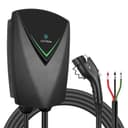 Lectron Nexus 48A J1772 A full 48 amps with nothing to log into. Lectron's Nexus body is IP66-sealed for an outdoor wall, the cable is a heavy 15 mm compound the brand says is built to stay flexible in freezing weather, and the safety paperwork is the real thing — ETL to UL 2594/2231/2251, plus ENERGY STAR. Hardwired only, and there is no app, which is the entire point. | Cheapest honest 48A, hardwired | $449.99 · View on Amazon Price as of October 18, 2026. #ad How we’re funded |
| 2 | 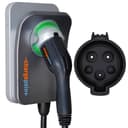 ChargePoint Home Flex The safest default for most homes: you set the amperage in the app to 16, 24, 32, 40, 48 or 50A, so one charger fits whatever circuit your panel can spare today and scales up if you upgrade later. The app is the most mature here, firmware arrives over the air, and the warranty is long. | Adjustable 16-50A and three install types | $516.71 · View on Amazon Price as of October 18, 2026. #ad How we’re funded |
| 3 | 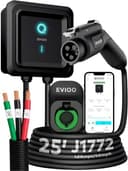 EVIQO 48A Level 2 Charger A lot of charger for the money: a full 48 amps, WiFi with scheduling, ENERGY STAR, and the longest usable reach in this group thanks to a 25 ft cable plus a 40-inch input lead. A strong value alternative to Emporia if you want maximum reach. | 48A with an app and the longest reach | |
| 4 | 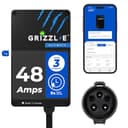 Grizzl-E Ultimate 48A The tank of the 48-amp class: cast-aluminum body, IP67 sealing, a full 11.5 kW, a 25 ft cable built to stay flexible in the cold and a DIP switch instead of a setup wizard. We recorded it as discontinued in August 2026 after its Amazon listing went dark; Grizzl-E sells it and Amazon lists it again as of our 2026-09-28 check, so that record is corrected here. | 48A with a DIP switch instead of an app | $479.99 · View on Amazon Price as of October 18, 2026. #ad How we’re funded |
Frequently asked questions
Is the ChargePoint Home Flex faster than the Lectron Nexus 48A?
Only if you hardwire it. ChargePoint's datasheet publishes a 12 kW maximum (240 V at 50 A) on the hardwired station, against the Lectron's 11.5 kW at 48 A - a difference of about two miles of range per hour by our arithmetic. But ChargePoint's own product page states the plug-in SKUs deliver 'up to 40A of power', so a plug-in Home Flex is slower than the Lectron, not faster.
Why can the Home Flex change its amperage when the Lectron cannot?
Because it has an app. ChargePoint's datasheet lists output adjustable to 16, 24, 32, 40, 48 or 50 A from the mobile app, which is what lets one charger fit whatever circuit your panel can spare and move up later. Lectron publishes no app and no amperage selector for the Nexus 48A, so it is a 48-amp charger on a 60-amp circuit and nothing else.
Does the Lectron Nexus 48A work without WiFi?
It has no WiFi to work without. Lectron publishes no Wi-Fi or app support for this model at all, so there is no account, no firmware and no cloud service in the path between your breaker and your car. For scheduling, you use the car's own charge timer, which almost every EV has.
Which has better weather protection?
On the codes each brand publishes, Lectron. Lectron publishes an IP66 housing - dust-tight and rated against powerful water jets - while ChargePoint's datasheet publishes Type 3R per UL 50E, which NEMA defines as protection against falling dirt and rain, sleet and snow, but not windblown dust or hose-directed water. Note that neither code is convertible to the other, and Lectron publishes no operating-temperature range for this unit while ChargePoint publishes -22F to 122F.
Is the ChargePoint worth the extra money?
It is if the amperage selector solves a problem you actually have - a panel that can only spare 40 amps today, or a plan to upgrade the service later - or if you want the plug-in install option, the longer software support or the mature app. If you are hardwiring a 60-amp circuit for a car that schedules its own charging, you are paying mainly for software you will not open, and the Lectron delivers the same amps.
Sources
- Lectron — NEXUS Level 2 J1772 EV Charging Station, 240V, 48 Amp, Hardwired — Lectron's own product page: up to 48 A continuous at 240 V for 11.5 kW, hardwire-only install by a licensed electrician on a dedicated 240 V circuit, IP66 weatherproof housing for indoor or outdoor use, 23 ft output cable of 15.0 mm (±0.3 mm) heavy-duty compound the brand states is 'engineered to stay flexible and easy to wrap around the wall mount, even in freezing weather', wall-mount J-hook and plug holder included, ETL listed to UL 2594 / UL 2231 / UL 2251 with ENERGY STAR and FCC certification, and a 3-year Lectron warranty. No operating-temperature range and no Wi-Fi or app support are published for this model (accessed August 20, 2026)
- ChargePoint — Home Flex datasheet (PDF) — ChargePoint's own datasheet: enclosure rating Type 3R per UL 50E, operating temperature -22F to 122F, 23 ft cable, plus installer notes that an outdoor plug-in install requires an outdoor-rated GFCI breaker upstream while an external GFCI may conflict with the charger's internal ground-fault protection on a hardwired install. RE-READ September 3, 2026 for the review refresh: the same datasheet also publishes maximum 12 kW (240V AC x 50A) with output amperage adjustable via the mobile app to 16A, 24A, 32A, 40A, 48A or 50A; a required dedicated dual-pole breaker rated for 125% of maximum load; 'Software Updates: Firmware updated over-the-air (OTA)'; 2.4/5 GHz Wi-Fi (802.11 a/b/g/n); local storage of up to 90 days of charging session data (100 sessions) if the network drops; power measurement accuracy +/- 2.0%; ground-fault detection by 20 mA CCID with auto retry; and UL and cUL listing per UL 2594, UL 2231-1 and UL 2231-2, NEC Article 625 compliant. Ordering information lists the plug-in station models CPH50-NEMA6-50-L23 and CPH50-NEMA14-50-L23 (accessed September 3, 2026)
- ChargePoint — Home Flex home charger product page — ChargePoint's own current product page for the Home Flex, read for the 2026-09-03 review refresh: three install configurations are offered — hardwired, NEMA 6-50 plug and NEMA 14-50 plug — with 'up to 50 amps of power delivered to your EV' on the hardwired model and 'up to 40A of power' on the plug-in models. ChargePoint's own range claim is 'up to 37 miles of range per hour' hardwired and '30 miles of range per hour' plug-in. J1772 and NACS connectors are offered across all configurations, and ChargePoint states the unit is 'UL Listed for safety', 'ENERGY STAR certified for efficiency' and carries a '3-year warranty' (accessed September 3, 2026)
- NEMA — Enclosure Types (definitions from NEMA 250) — NEMA's own definitions: Type 3R protects against falling dirt and rain, sleet and snow; Type 4 adds windblown dust, splashing and hose-directed water; Type 4X adds protection against corrosion. NEMA also states its NEMA-to-IP table cannot be used to convert IP designations back to NEMA types (accessed July 20, 2026)
- IEC 60529 — Degrees of protection provided by enclosures (IP Code), full text — The IP code standard (verbatim national adoption, IS/IEC 60529:2001): first numeral 6 = dust-tight; second numeral 6 = protected against powerful water jets; second numeral 7 = protected against temporary immersion, and a 7 alone does not imply water-jet protection unless dual coded (accessed July 20, 2026)
- ENERGY STAR — Electric Vehicle Chargers — ENERGY STAR on EVSE efficiency: certified chargers use about 40% less energy in standby than non-certified units (accessed July 19, 2026)
- UL Solutions — EV Charging Infrastructure Services — UL on EVSE safety certification: ANSI/UL 2594 is the Standard for Electric Vehicle Supply Equipment (accessed July 19, 2026)
- NFPA — Using the Latest NEC for EV Charger Installations — NFPA on NEC (NFPA 70) Article 625: EV charging is a continuous load, so circuits are sized to 125% of load (the 80% rule) (accessed July 19, 2026)
- FuelEconomy.gov — Electric Vehicles: Learn More About the Label — DOE/EPA on EV efficiency: kWh per 100 miles and MPGe, accounting for AC charging losses (accessed July 19, 2026)
Keep reading
Lectron vs Emporia Level 2
The closer fight: two 48-amp chargers at a similar price where the only real difference is energy measurement.
Read the comparisonLectron Nexus 48A review
The full write-up, including the cable spec Lectron publishes and the temperature range it does not.
Read the reviewChargePoint Home Flex review
What the 50-amp ceiling, the adjustable output and the three-year warranty actually get you.
Read the reviewBest chargers for a small panel
Where the Home Flex's amperage selector stops being a feature and becomes the reason to buy it.
See the picks