Portable vs Wall-Mounted EV Charger
If a NEMA 14-50 outlet already exists where you park, buy a portable and keep the money. If you want more than 40 amps, or the charger has to live outdoors permanently, buy a wall unit. Almost every other consideration is smaller than those two.
How this is funded: we earn a commission if you buy through our links, at no extra cost to you. It never changes which product we recommend, and we’ll tell you when we’d skip one. Full disclosure.
Buy a portable if a NEMA 14-50 outlet already exists where you park. Buy a wall unit if you want more than 40 amps, or the charger has to live outdoors permanently. Our pick on the wall side is the ChargePoint Home Flex, because it sets its own output anywhere from 16 to 50 amps and so fits whatever circuit you have. Our pick on the portable side is the ELEGRP 40A, for the full 40 amps and the longest cable in the format we track. If the charger has to do both jobs — garage and road trips — the Ampure Go is the one certified for both, at the cost of eight amps.
The reason this comparison confuses people is that the obvious difference — “one is faster” — is mostly not true. Every plug-in charger in our registry, wall-mounted or portable, caps at 40 amps. A 40-amp portable and a 40-amp wall unit on the same circuit deliver the same 9.6 kW. The real differences are in ownership, weather and amperage ceiling, and they are worth going through in that order.
Where the formats actually differ
| Portable | Wall-mounted | |
|---|---|---|
| Typical max output | 32-40 A (7.7-9.6 kW) | 40-48 A plug-in or hardwired, up to 80 A hardwired |
| What it plugs into | A NEMA 14-50 outlet, usually with a 120 V adapter too | A NEMA 14-50 or 6-50 outlet, or hardwired to the circuit |
| Electrician needed | No, if the outlet already exists | No for plug-in on an existing outlet; yes for hardwired |
| Comes with you when you move | Yes, in minutes | Plug-in yes; hardwired is an electrician's visit |
| Cable length we track | 16-25 ft | 23-25 ft |
| Weather rating | IP67 on the station on two of our picks; one connector is only IP54 | NEMA 3R, NEMA 4, NEMA 4X or IP66 depending on the unit |
| App, scheduling, energy data | Rare — none of the portables we track publishes a WiFi app | Common, on most mid and premium units |
| Published warranty | 2-3 years, and two units publish no term | 3 years on almost everything, 5 on one unit |
The three differences that decide it
One: the 40-amp wall.This is the only hard technical boundary. A charger on a plug cannot exceed 40 amps in our registry — the next step up, 48 amps on a 60-amp circuit, requires hardwiring. So if you want 11.5 kW, the portable conversation is over before it starts. The honest question back is whether you need it: the limit is often not the wall at all but the onboard charger inside your car, and a great many EVs cap at 7.7 or 11 kW. If yours caps at 7.7 kW, a 32-amp portable gives you everything your car can take.
Two: whether the outlet already exists.This decides the money. With a 14-50 in the garage, a portable is the cheapest route to real Level 2 charging that exists — hardware only, no labor. Without one, you are hiring an electrician regardless, and at that point the marginal cost of hardwiring a 48-amp unit rather than fitting a receptacle is small, which tilts the whole decision toward the wall. What that receptacle has to be matters here: an old dryer outlet is not a 14-50, and we wrote about why.
Three: permanence, in both directions.A portable comes with you when you move and makes a warranty replacement a box in the mail. A wall unit gets a holster, a weather-rated enclosure, strain relief and usually an app — and it stays put, tidy, off the floor. Which one you want is genuinely a preference, not a spec: we would take the portable in a rental and the wall unit in a house we owned.
Two things people get wrong
“Portable means I can charge anywhere.”It means you can charge anywhere there is a suitable 240-volt outlet, which in practice is your own garage, a relative’s, and some campsites. It is not a substitute for public charging on a road trip — Level 2 adds tens of miles per hour, not hundreds. What it is genuinely good for is the second home, the long stay at family, and the reassurance of having a charger in the trunk when a wall unit fails.
“The portable is weatherproof, so it can live outside.” Read the station rating and the connector rating separately. The ELEGRP 40A publishes IP67 for the station and IP54 for the connector— splash protection, not immersion. The Ampure Go publishes IP67 and a NEMA 6P watertight rating, which is stronger. Neither is the same proposition as a permanently-mounted NEMA 4X wall unit designed to sit on an exterior wall for a decade. Our ratings explainer unpacks what each label actually promises, and the rain question has the practical version.
The picks on both sides
| Charger | Format | Max | Install | Cable | Enclosure | Warranty |
|---|---|---|---|---|---|---|
| ChargePoint Home Flex | Wall-mounted | 50 A | Hardwired, NEMA 6-50 or NEMA 14-50 | 23 ft | NEMA 3R | 3 yr |
| EVIQO 40A NEMA 14-50 Charger | Wall-mounted | 40 A | NEMA 14-50 plug | 25 ft | IP66 / NEMA 4 | 3 yr |
| ELEGRP 40A Portable Level 2 Charger | Portable | 40 A | NEMA 14-50 plug | 25 ft | IP67 (station), IP54 (connector) | 2 yr |
| Ampure Go Portable Level 2 Charger | Portable | 32 A | NEMA 14-50 cord for 240V, NEMA 5-15 cord for 120V | 20 ft | IP67 (NEMA 6P watertight) | 3 yr |
The ChargePoint Home Flex is the wall pick for the same reason it leads most of our roundups: adjustable 16-50 A, sold hardwired or on a plug, the most mature app, three-year warranty. The EVIQO 40A is the wall pick if you want to use the existing outlet and still get a full app, UL, ETL, FCC and ENERGY STAR, and a 40-inch input lead that decides where it can mount. The ELEGRP 40Ais the portable pick on value — full 40 amps and a 25-foot cable at the lowest price in our registry, with the IP54 connector caveat and a two-year warranty. The Ampure Gois the portable pick if it has to travel: dual-voltage certified for 120 V and 240 V, IP67, three years, and the only charger in our registry an automaker names on its own vehicle pages — at 32 amps rather than 40.
Quick picks
Ranked on published specs, charging speed, electrical fit and value. Select a row to jump to the full write-up. We have not bench-tested these chargers — here is exactly what we do instead.
| # | Product | Best for | Price |
|---|---|---|---|
| 1 | 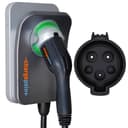 ChargePoint Home Flex The safest default for most homes: you set the amperage in the app to 16, 24, 32, 40, 48 or 50A, so one charger fits whatever circuit your panel can spare today and scales up if you upgrade later. The app is the most mature here, firmware arrives over the air, and the warranty is long. | Best wall-mounted | $516.71 · View on Amazon Price as of October 18, 2026. #ad How we’re funded |
| 2 | 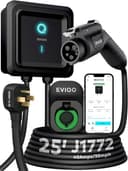 EVIQO 40A NEMA 14-50 Charger The most charger you can get without an electrician's invoice. It plugs into a NEMA 14-50 outlet for a full 40 amps, keeps the WiFi app, the ENERGY STAR listing and the 25 ft cable from EVIQO's hardwired unit, and can be unplugged and taken with you when you move. | Best wall unit on an existing outlet | |
| 3 | 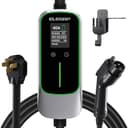 ELEGRP 40A Portable Level 2 Charger The full-speed portable. A genuine 40 amps on a NEMA 14-50, an IP67 station body rated -22F to 122F, and a 25-foot cable - the longest here by five feet - for less than the 32A unit costs. It is the heaviest thing here to coil and there is no app, but if the portable is also going to be your everyday charger, this is the one that does not make you choose. | Best portable value | $209.99 · View on Amazon Price as of October 18, 2026. #ad How we’re funded |
| 4 | 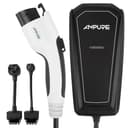 Ampure Go Portable Level 2 Charger The only portable charger we track that is certified like a permanent one. UL 2594 / UL 2231, ENERGY STAR and an IP67 / NEMA 6P body rated from -22F to 122F, in a nine-pound module that ships with a NEMA 14-50 cord for 240V and a standard 5-15 cord for 120V. You give up eight amps against the 40A units and get, in exchange, a charger genuinely rated to live in a trunk and be rained on. | Best portable for travel | $299.00 · View on Amazon Price as of October 18, 2026. #ad How we’re funded |
One last framing that resolves most of these arguments: the two formats are not really competitors for the same slot. A lot of the households we would advise end up owning both— a wall unit doing the nightly work, and a cheap portable in the trunk for the relative’s house and the week the wall unit is away on a warranty claim. At the prices in this category that is a defensible way to spend the money, and our worth-it page runs the arithmetic on whether the wall half earns its keep for your mileage at all.
Frequently asked questions
Is a portable EV charger as good as a wall-mounted one?
For charging speed, usually yes. The portables we track run 32 to 40 amps, which is 7.7 to 9.6 kW, and that is the same as most plug-in wall units -- every plug-in charger in our registry also caps at 40 amps. Where the wall unit genuinely wins is above that: 48 amps and up requires hardwiring, which no portable does. The other wall-unit advantages are an app, a permanently weather-rated enclosure and a holster so the connector is not on the floor.
Can you use a portable EV charger as your only home charger?
Yes, and for a lot of households it is the right answer. A 40-amp portable on an existing NEMA 14-50 outlet adds roughly 34 miles of range per hour by our arithmetic at a reference 3.5 miles per kWh -- about 270 miles overnight, which is more than almost anyone drives in a day. The caveats are practical rather than electrical: there is no app, no holster, the cord gets handled constantly, and you have to be honest about whether you will actually coil it up or leave it on a wet garage floor.
Do portable EV chargers charge slower?
Only if they are rated lower, and some are. The Ampure Go is 32 amps where the ELEGRP and Lectron portables are 40, so the Ampure is about 20% slower by design. But a 40-amp portable and a 40-amp wall unit on the same circuit deliver identical power -- amps times volts is the whole equation, and the format does not enter into it. What makes charging genuinely slow is a 120-volt outlet, which is Level 1, and most portables can do that too if you need it.
Is it safe to leave a portable EV charger plugged in outside?
Read the two ratings separately, because they can differ on the same unit. The ELEGRP 40A publishes IP67 for the station but only IP54 for the connector, while the Ampure Go publishes IP67 and describes a NEMA 6P watertight rating. IP54 is splash protection, not immersion, so a connector lying in a puddle is outside what the maker rates it for. Our general rule: a portable can get rained on, but it should not live permanently outdoors. That is what a NEMA 4 or 4X wall unit is for.
Which is cheaper, a portable or a wall-mounted charger?
The portable, usually twice over -- the hardware is cheaper and, if the outlet exists, the install is free. That second half is the bigger number: on a retrofit the electrical work is often the larger part of the total. The comparison flips if you do not have a 240-volt outlet where you park, because then you are paying an electrician either way, and once an electrician is on site the marginal cost of hardwiring a 48-amp unit instead of fitting a receptacle is small.
Will a portable charger work in an apartment or a rental?
It is the standard answer for both, because nothing is attached to the building and nothing needs a landlord's permission beyond using an existing outlet. The two things to check are whether a 240-volt outlet exists within cable reach of where you park and whether your lease or HOA has anything to say about running a cord. Our apartments-and-renters roundup covers the whole situation, including the Level 1 fallback when no 240-volt outlet exists at all.
Sources
- U.S. DOE Alternative Fuels Data Center — Electric Vehicle Charging Stations — US DOE on charging levels: Level 1 (~1.9 kW, ~5 mi/hr), Level 2 (2.9-19.2 kW, ~7.2 kW typical residential, ~25 mi/hr), and DC fast charging (accessed July 19, 2026)
- U.S. DOE Alternative Fuels Data Center — Charging Electric Vehicles at Home — US DOE on home EV charging: most owners charge overnight on Level 1 or Level 2, installs follow NEC Article 625, with example home-charging costs (accessed July 19, 2026)
- NFPA — Using the Latest NEC for EV Charger Installations — NFPA on NEC (NFPA 70) Article 625: EV charging is a continuous load, so circuits are sized to 125% of load (the 80% rule) (accessed July 19, 2026)
- NEMA — Enclosure Types (definitions from NEMA 250) — NEMA's own definitions: Type 3R protects against falling dirt and rain, sleet and snow; Type 4 adds windblown dust, splashing and hose-directed water; Type 4X adds protection against corrosion. NEMA also states its NEMA-to-IP table cannot be used to convert IP designations back to NEMA types (accessed July 20, 2026)
- IEC 60529 — Degrees of protection provided by enclosures (IP Code), full text — The IP code standard (verbatim national adoption, IS/IEC 60529:2001): first numeral 6 = dust-tight; second numeral 6 = protected against powerful water jets; second numeral 7 = protected against temporary immersion, and a 7 alone does not imply water-jet protection unless dual coded (accessed July 20, 2026)
- ChargePoint — Home Flex datasheet (PDF) — ChargePoint's own datasheet: enclosure rating Type 3R per UL 50E, operating temperature -22F to 122F, 23 ft cable, plus installer notes that an outdoor plug-in install requires an outdoor-rated GFCI breaker upstream while an external GFCI may conflict with the charger's internal ground-fault protection on a hardwired install. RE-READ September 3, 2026 for the review refresh: the same datasheet also publishes maximum 12 kW (240V AC x 50A) with output amperage adjustable via the mobile app to 16A, 24A, 32A, 40A, 48A or 50A; a required dedicated dual-pole breaker rated for 125% of maximum load; 'Software Updates: Firmware updated over-the-air (OTA)'; 2.4/5 GHz Wi-Fi (802.11 a/b/g/n); local storage of up to 90 days of charging session data (100 sessions) if the network drops; power measurement accuracy +/- 2.0%; ground-fault detection by 20 mA CCID with auto retry; and UL and cUL listing per UL 2594, UL 2231-1 and UL 2231-2, NEC Article 625 compliant. Ordering information lists the plug-in station models CPH50-NEMA6-50-L23 and CPH50-NEMA14-50-L23 (accessed September 3, 2026)
- EVIQO — Level 2 EV Charger, 40A (9.6 kW), NEMA 14-50 plug-in (Gen 2) — EVIQO's own product page: 40A / 9.6 kW on a NEMA 14-50 plug, SAE J1772, 25 ft charging cable plus a 40 in input cable, IP66 / NEMA 4 enclosure, UL / ETL / FCC / ENERGY STAR listings, 3-year standard warranty, app-adjustable 6-40A output, and a note that it needs an EV-grade 4-prong 14-50 receptacle rather than a dryer outlet. RE-READ September 15, 2026 for the garage roundup: the page additionally states an operating temperature range of -22F to 122F, that the app needs a 2.4 GHz WiFi connection, that the standard 3-year warranty is extendable to 4, and that the unit ships in 1-2 business days (accessed September 15, 2026)
- ELEGRP Store - 40A Level 2 portable J1772 EV charger (NEMA 14-50) — ELEGRP's own listing: 40 A / 9.6 kW on 240 V AC at 50/60 Hz with selectable output at 16, 20, 24, 32 or 40 A, SAE J1772 connector on a NEMA 14-50 plug ('For NEMA 14-50 Outlets Only'), 25 ft cable (16 ft and 21 ft also offered), IP67 charging station and IP54 connector, operating range -22F to +122F (-30C to +50C), 1-to-12-hour delayed-start timer, 2-year warranty, 'ETL & UL' listed. RE-READ September 5, 2026 for the review: the specification table is unchanged, and the page additionally states 'Fully ETL certified and built with UL-listed components - including the J1772 plug, cable, and NEMA 14-50 connector', a built-in display reporting charging current, voltage, total energy delivered (kWh) and internal temperature with LED fault patterns, a wall-mounted holder plus anchors and a carry bag in the box, Tesla compatibility via a J1772-to-NACS adapter sold separately, a 30-day return window and 60-day price protection. The page does not name the UL standards, publish a weight, publish an ENERGY STAR certification, or publish app support for this SKU, and its marketing copy carries two conflicting range claims ('Up to 37 Miles/H' and '30 Miles Per Hour') plus an operating range ('-21F to 121F') that disagrees with its own specification table (accessed September 5, 2026)
- Ampure - Ampure Go portable Level 2 EV charger product page — Ampure's own specifications for the Go: 32 A / 7.7 kW at 240 V or 12 A / 1.4 kW at 120 V, input range 85-265 VAC at 45-65 Hz, SAE J1772 coupler, NEMA 14-50 and NEMA 5-15 cords, 20 ft (6 m) cable, IP67 rated 'submersible up to 3 feet' with a NEMA 6P watertight enclosure, operating range -30C to +50C (-22F to 122F), 9 lb (4.1 kg) module, and listings to UL, cUL, UL 2594, UL 2231, UL 817, ICES, FCC, ENERGY STAR, REACH and RoHS. Ampure states 'up to 25 miles of range per hour' at 240 V. RE-READ October 10, 2026 for the review: every figure above is unchanged on the page. Confirmed again that this page publishes NO warranty term (that figure is on the store listing), NO app, WiFi or scheduling feature, and NO description of the unit's internal safety protections (no GFCI / CCID figure, no over-temperature behavior). The page describes the unit as an 'IP67-rated IC-CPD', i.e. an in-cable control and protection device, and the specification block gives the plug types as 'NEMA 14-50 & NEMA 5-15' alongside an 'IEC grid plug'. Ampure's current line separates this unit from a distinct 'Go 2 (NACS)' model; the specifications above are the Gen 1 J1772 unit Amazon lists as the 'Go 1' (accessed October 10, 2026)
- Ampure Store - Ampure Go Level 2 plug-in EV charger — Ampure's own store listing for the same unit, read for the warranty term the product page omits: 3-year warranty, 32 A, 20 ft cable, NEMA 14-50 with 120 V/240 V cords, IP67, UL / ENERGY STAR / FCC / RoHS. RE-READ October 10, 2026 for the review: the listing publishes 'up to 32 amps' on 'Level 2, 240V power', a '20-foot premium cable', 'included grid cords for 110V/240V charging', 'IP67 waterproof', 'reliable indoor and outdoor use in any weather', 'UL, and ENERGY STAR certified' plus 'UL Certified', 'FCC Compliant', 'RoHS Compliant' and 'SAE J1772 & NACS Compatible', a '3 Years' warranty, and an 'Ampure Go 2 (NACS)' sold as a separate model. It publishes NO operating-temperature range, NO weight and NO box contents, and - the finding the review is built on - it claims 'up to 35 miles of range per hour' where Ampure's own product page for the same unit claims '25 miles of range per hour'. Neither figure states the vehicle efficiency it assumes (accessed October 10, 2026)
- Lectron — Portable Level 2 J1772 EV Charger (40A) product page — Lectron's own listing: 40A / 240V / 9.6 kW, NEMA 14-50 plug, 16 ft cable, UL 2594 / UL 2231 certified, 2-year warranty, app control on the WiFi version only (accessed July 23, 2026)
- FuelEconomy.gov — Electric Vehicles: Learn More About the Label — DOE/EPA on EV efficiency: kWh per 100 miles and MPGe, accounting for AC charging losses (accessed July 19, 2026)
Keep reading
Best portable EV chargers
The portable side ranked in full -- dual voltage, published enclosure ratings, amps against carryability.
See the picksBest hardwired chargers
The wall side at its strongest: 48 amps and up, where no portable can follow.
See the picksHardwired vs plug-in
The other half of this decision, once you have settled on a wall unit. Eight amps, one electrician and whether it moves with you.
Read the comparisonRenting, or no garage
Where the portable argument is strongest, and the honest Level 1 fallback when there is no 240-volt outlet at all.
See the picks