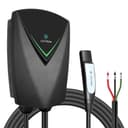
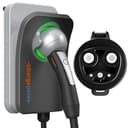
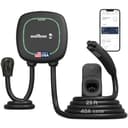
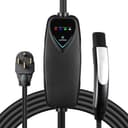
What we ranked on, before any picks
“NACS” narrows the field to a connector and tells you nothing about whether the charger is any good. Five questions do, and every one of them is answerable from a manufacturer’s own published page rather than from an impression.
One: does the maker publish a full warranty term?This sounds like boilerplate and it is the sharpest differentiator in the group. Lectron publishes a flat three years. ChargePoint and Wallbox publish three. Grizzl-E offers a “3 Year” or “5 Year” selector at checkout without stating what either term covers — and a selector is not a published warranty, so we record it as not published.
Two: what safety listing, from which laboratory?The standard number matters less than who tested to it. Lectron publishes ETL listing against UL 2594, UL 2231 and UL 2251 — three standards, including the one that covers the handle. ChargePoint publishes UL and cUL listing. Wallbox publishes UL certification by an NRTL against UL 2594 and UL 2231. Grizzl-E publishes a UL file number, E510712, which is a real listing but a thinner disclosure. Our certifications guide explains why the mark matters more than the number.
Three: is there a published enclosure rating and temperature range? A charger on an exterior wall needs both, and the absence of one is itself a finding. Lectron publishes IP66 on the Nexus and nothing at allon its portable — no enclosure rating, no temperature range, no warranty term for that SKU. Grizzl-E publishes UL Type 4 and -22F to 122F. Wallbox publishes NEMA Type 4 per UL 50E, -22F to 104F operating and -40F to 158F storage.
Four: how does it install, and what does that cap the amps at? Hardwired 48-amp units need a 60-amp circuit and an electrician. Plug-in units are capped at 40 amps by code — and there is no 48-amp NACS charger on a plug, from anyone. If you are weighing those two routes, hardwired versus plug-in is the comparison to read first, because it cascades into everything else.
Five: does the brand publish ENERGY STAR?Not for efficiency reasons — these are near-identical pass-through devices — but because it is the most common eligibility filter in utility rebate programs, and on a few hundred dollars of rebate it can outweigh every price difference on this page.
Which brands actually sell a NACS cable
Before the picks, here is the shape of the field — because the most common way to get this purchase wrong is to assume your preferred brand offers the connector and discover at checkout that it does not.
Which makers publish a NACS output cable, read from each brand’s own lineup and product pages on the dated visits in our sources. “Not published” means the brand does not state it — we do not infer a connector option from a marketplace listing or a reseller. Every charger in this table is the same hardware in its J1772 form, which is the single most useful fact on this page: you are choosing a cable, not a different class of charger.| Brand | Models offered with NACS | NACS on a plug? | Note |
|---|
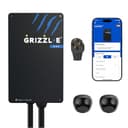
| Grizzl-E | Classic Connect 40A, Duo Connect 40A, Mini Connect 40A, Ultimate 48A, Ultimate 80A | Yes, on the 40A Connect models | The whole connected lineup. The only model with no NACS option named is the unconnected Classic 40A |
|---|
| Lectron | Nexus 48A hardwired, Nexus 40A NEMA 14-50, portable L1/L2 8-40A | Yes, 40A | Also sells a NACS-to-J1772 adapter (80A / 240V) separately |
|---|
| ChargePoint | Home Flex, all three install configurations | Yes, 40A (NEMA 6-50 or 14-50) | ChargePoint states J1772 and NACS are offered across all configurations |
|---|
| Wallbox | Pulsar Plus 40A and 48A | Yes, 40A only | No 48A Pulsar Plus can be unplugged in either connector - the 48A model is hardwired |
|---|
| Autel | AC Elite Home 50A, AC Lite 50A | Not published for the NACS version | Configuration selector offers “Hardwired Connection/50A NACS-Tesla” |
|---|
| EVIQO | A separate NACS product category | Not published | The two units we track are J1772; EVIQO says a NACS-to-J1772 adapter is needed for other EVs |
|---|
| Emporia | Not published | Not published | No NACS option appears on Emporia's own EV-charger pages |
|---|
Three things stand out. Grizzl-E has gone furthest: as of our October 24, 2026 reading, every connected model in its lineup — Classic Connect, Duo Connect, Mini Connect, Ultimate 48A and Ultimate 80A — is listed with a NACS option, and the only model without one is the unconnected Classic 40A. Wallbox publishes the clearest constraint: its part-number structure codes the connector independently of the power and the connection type, and reading it against the electrical table shows there is no 48-amp Pulsar Plus you can unplug in either connector. And Emporia publishes nothing— which is notable, because Emporia is otherwise one of the strongest value brands we track and appears on most of our other roundups.
Autel and EVIQO both now publish NACS versions too, but neither of the specific units this site tracks and prices is the NACS one, so they are listed in the table and are not picks here. The head-to-head between those two brands is a separate page.
Hardwired or plug-in: decide this before the connector
Three of the six picks above are hardwired and three plug in, and that split matters more than anything else on this page.
Hardwired gets you 48 amps. That is 11.5 kW, which at a reference of about 3.5 miles per kWh is roughly 40 miles of range per hour. It needs a 60-amp circuit, because the NEC treats EV charging as a continuous loadand the circuit must be rated at 125% of the charger’s output. It also needs an electrician, a permit in most jurisdictions, and a decision you cannot easily reverse.
Plug-in caps at 40 amps.That is 9.6 kW, about 34 miles of range per hour — six fewer than the hardwired units. Over a ten-hour overnight charge the gap is sixty miles, which is more than most people drive in a day and less than most people imagine. What you get in exchange is a charger you can unplug and take with you, which is the whole argument if you rent. Our renter-focused roundup makes that case properly.
If a NEMA 14-50 outlet already exists where you park, the decision is close to made. If it does not, you are paying an electrician either way, and the hardwired 48-amp route is the better use of the visit.
When a J1772 charger is the smarter buy
We would rather lose a sale than have you buy the wrong connector, so here is the honest case against this entire page.
Buy J1772 if there is any chance of a non-NACS car in the household. A J1772 charger charges a Tesla with the adapter the car came with, and it charges every non-Tesla EV sold in North America natively. A NACS charger charges NACS cars natively and needs an adapter for everything else — and that adapter direction is the problematic one. As we have documented, Volkswagen states in writing not to use its NACS adapter with any Level 2 AC charger, and Kia lists no J1772-to-NACS AC adapter at all while naming a J1772 charger on its own EV6 pages. The adapter that works reliably is the Tesla-supplied J1772 one, and it points the other way.
Buy J1772 if you might sell the house. A hardwired charger is close to a fixture, and a J1772 unit is useful to any buyer with any EV.
Buy NACS if the car is NACS and is likely to stay that way.That is most Tesla households, and an increasing number of Hyundai, Kia, Rivian, Toyota, Lexus and Chevrolet ones. On a charger you are bolting to a wall for a decade, the plug that fits is worth the small premium — and it removes the single most common point of failure on a home charger, which is a connection you make and unmake by hand every night.
What NACS does not do
One correction, because it drives a real amount of mistaken buying. A NACS home charger has nothing to do with Supercharger access.The chargers on this page are AC Level 2 equipment: they pass 240-volt household AC to your car’s onboard charger, and the onboard charger — not the wall box — sets the real ceiling. A Supercharger is DC fast charging, which bypasses that onboard charger entirely at power levels an order of magnitude higher. The plug is the same shape and the two have almost nothing else in common. AC versus DC charging explains it properly, and the onboard-charger guide explains why buying a 48-amp charger for a car with a 7.7 kW onboard charger is money spent on nothing.
Nor does the connector change your charging speed, your electricity bill or your rebate eligibility. Those come from the amperage, your rate planand the certifications respectively — all three of which are identical between a NACS SKU and its J1772 twin.