What Hyundai actually publishes
We build per-vehicle pages only where the manufacturer publishes figures we can read on its own domain, and the IONIQ 6 page is the best-sourced one we have done. Here is everything load-bearing, in Hyundai’s own words.
Hyundai’s own published IONIQ 6 figures, read off its official US model page on November 7, 2026. The quoted strings are Hyundai’s. The first two rows are why this page exists: Hyundai prints an AC charger power in plain text for the IONIQ 6, which it does not do for the IONIQ 5.| What | Figure | In Hyundai’s own words |
|---|
| 240V AC (Level 2) charge time | ~6 hrs 55 min, 10% to 80% | “Approximately 6 hours and 55 minutes to charge from 10% to 80% on a 10.9-kW, 240V AC charger” |
|---|
| AC charger power named by Hyundai | 10.9 kW | Printed inside the charge-time sentence above. There is no separate “onboard charger” row anywhere on the page |
|---|
| Battery | 53.0 kWh or 77.4 kWh | “The available 77.4-kWh battery pack was built for impressive range and power” |
|---|
| DC fast charging, 800V | ~18 min, 10% to 80% | “Approximately 18 minutes to charge from 10% to 80% on a 350-kW, 800V DC ultra-fast charger” |
|---|
| DC fast charging, 50 kW | ~61 min, 10% to 80% | “Approximately 61 minutes to charge from 10% to 80% on a 50-kW fast charger” |
|---|
| Charge port | CCS, with a NACS adapter offered | “Starting in early 2025, Hyundai will offer an NACS adapter to owners of existing and future Hyundai EVs with a CCS port” |
|---|
| What Hyundai recommends for home | A professionally installed Level 2 charger — and it names one | “For home charging, Hyundai recommends purchasing a Level 2 home charger and having it professionally installed… Visit our Hyundai Home page for more and to learn about the Level 2 ChargePoint Home Flex EV charger” |
|---|
| Level 1 (120V) charge time | Not published | Hyundai says only that Level 2 charges “up to 9 times faster than with a conventional 110-volt outlet”. No Level 1 time is given |
|---|
The row that matters is the first one, and it is worth saying why. Hyundai does not publish an “onboard charger” specification for this car — the phrase does not appear. What it publishes instead is a charge time with a charger power named inside it: “6 hours and 55 minutes… on a 10.9-kW, 240V AC charger”. For buying purposes that is the same information. A manufacturer quoting a charge time at 10.9 kW is telling you that 10.9 kW is the figure its own testing used, and on the Kia EV6 and EV9 pages the sibling brand publishes 10.9 kW as a specification in its own right.
The arithmetic, shown
Two steps, both ours, both printed so you can re-run them for your own trim.
Step one: kilowatts to amps.Power equals current times voltage, so current equals power divided by voltage. 10,900 watts ÷ 240 volts = 45.4 amps. Round down and the IONIQ 6 is a car that will accept about 45 amps of AC. There is no standard home charger at 45 amps, so the two settings either side of it are the real choice: 48 amps(11.5 kW, slightly more than the car accepts, so you get Hyundai’s published time) and 40 amps (9.6 kW, about 12% less than the car could take).
Step two: amps to range per hour. At our standard reference of roughly 3.5 miles per kWh, 10.9 kW is about 38 miles of range an hour. A 48-amp charger delivers that. A 40-amp charger delivers about 34. A 32-amp charger — the most a 40-amp circuit allows — delivers about 27. Over a ten-hour night that is 380, 340 and 270 miles respectively, against a 77.4-kWh pack. Every one of those is more than a full charge from empty in a single night.
What that means for spending. The gap between the best case and the cheap case is four miles of range per hour. It is real, and for most owners it is invisible, because the car is plugged in for eight to twelve hours and full either way. The money is better spent on mounting the charger where the cable actually reaches than on the last four miles an hour. Where the gap does matter is a household doing two long trips a day with a short turnaround in between, or a two-EV house sharing a circuit — see the two-car roundup.
Why 50 and 80 amps are wasted on this car
This is the most expensive mistake available on this purchase, and Hyundai’s own number rules it out cleanly.
The wall unit offers current; the car’s onboard charger acceptswhat it can use and no more. At 10.9 kW the IONIQ 6 is already below what a 48-amp charger offers. So a 50-amp charger (12 kW) and an 80-amp charger (19.2 kW) deliver the car exactly the same charge as a 48-amp one — while costing considerably more in circuit.
How much more: 48 amps needs a 60-amp circuit, because the NEC requires a circuit rated for 125% of a continuous load and 48 × 1.25 = 60. Fifty amps needs 62.5, there is no 62.5-amp breaker, and the next standard size is 70. Eighty amps needs 100. So the upgrade path above 48 amps costs a larger breaker, heavier conductors and ten to forty more amps of permanent panel capacity, and returns nothing to this vehicle. Our 50-amp page and 48 versus 80 amps work both cases through in full, and wire size and breaker has the materials.
The one legitimate reason to buy a charger rated above 48 amps is that you want its adjustabilityor expect a different car later — which is a real argument and the reason the ChargePoint and the Autel exist. But buy it for the flexibility, not because the number is bigger; the adjustable roundup makes that case properly.
The connector question, answered from Hyundai’s own page
This is where per-vehicle pages usually go wrong, so here is the reasoning rather than the conclusion alone.
Hyundai states on this page that it will “offer an NACS adapter to owners of existing and future Hyundai EVs with a CCS port”. The IONIQ 6 is in that group. A CCS1 port is a two-part connector: the upper section is a J1772 AC inlet, and the two large DC pins sit below it. So at home, where charging is AC, the cable you want is J1772 — and the adapter Hyundai is offering is about reaching Tesla’s DC fast-charging network on a road trip.
We will not go further than Hyundai does. The IONIQ 6 page says nothing at all about using that adapter with a Level 2 AC charger, so we are not going to tell you it works or that it does not. What we can say is what other manufacturers have published: Volkswagen states in writing not to use its NACS adapter with a Level 2 AC charger, and Kia lists no J1772-to-NACS AC adapter at all. On that evidence, adapting a NACS wall charger to a CCS car is the direction to avoid, and buying the connector your car actually has is always the better purchase. Tesla and non-Tesla charging and are charging cables universal cover the adapter landscape in detail.
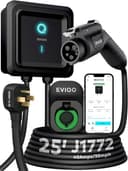
Worth noting for completeness: EVIQO states of its own NACS unit that it is “plug-and-play with all Tesla models and 2025+ Hyundai IONIQ 5/6” — so at least one charger maker believes there are IONIQ 6 model years with a native NACS port. Hyundai’s own page for the car we read describes a CCS port and an adapter. Check the port on your own car before you buy a cable, because that is a five-second check that settles a purchase, and our NACS roundup is the page to read if yours turns out to be NACS.
The one charger Hyundai names itself
Automakers rarely name a specific third-party charger, so when one does it is worth reporting precisely rather than paraphrasing.
Hyundai’s IONIQ 6 page says: “For home charging, Hyundai recommends purchasing a Level 2 home charger and having it professionally installed… Visit our Hyundai Home page for more and to learn about the Level 2 ChargePoint Home FlexEV charger.” Elsewhere on the same page it describes Hyundai Home as offering “solar panels, energy storage systems and a 240-volt (Level 2) charger for your IONIQ 6”.
That is a genuine data point and it is why the Home Flex is our second pick. It is also not the whole argument, which is why it is second rather than first: the Home Flex publishes a 23-foot cable against the Emporia’s 25, and a NEMA 3R enclosure against the Emporia’s NEMA 4, and our registry bands it premium where the Emporia is mid. Its 16-to-50-amp adjustability and over-the-air firmware are real advantages, and so is being the unit an automaker points at on its own website. Our Home Flex review, Home Flex versus Emporia comparison and ChargePoint alternatives page all take the trade-off further.
One more sibling-brand fact worth knowing, because it is the same corporate family and the same 10.9-kW figure: Kia’s EV6 and EV9pages name exactly two chargers — the ChargePoint Home Flex and the Ampure Go portable — and we track both. Neither Kia nor Hyundai publishes a price alongside the recommendation, and neither names a second wall charger.