The nine brands at a glance
The nine brands in our registry. The “Best at” column is ours — an editorial read of each brand’s own published feature set across its range, never a test result, because we own none of these units. Amperage, connectivity and unit counts come from the manufacturers’ own spec sheets on the dated visits recorded with each product.| Brand | Units we track | Best at | Output | App |
|---|
| ChargePoint | 2 | The most mature app, and output adjustable 16-50 A in software | Up to 50 A | Yes, WiFi |
|---|
| Autel | 3 | The widest published temperature range we track, and the only 80 A unit | 40, 50 or 80 A | Yes, WiFi + Ethernet |
|---|
| Grizzl-E | 4 | Cast aluminum and IP67, with a model that has nothing to log into | 40 or 48 A | On two of four units |
|---|
| Emporia | 2 | Energy monitoring, and a Pro that throttles to fit a small panel | 48 A | Yes, WiFi |
|---|
| EVIQO | 2 | The most complete safety paperwork at the price, plus long reach | 40 or 48 A | Yes, WiFi |
|---|
| Lectron | 4 | The cheapest route to 48 hardwired amps, and native NACS options | 40 or 48 A | No |
|---|
| Wallbox | 1 | The smallest body of any 48 A unit, with load balancing | 48 A | Yes, WiFi |
|---|
| Ampure | 1 | A dual-voltage portable an automaker names on its own vehicle pages | 32 A | Not published |
|---|
| ELEGRP | 1 | Full 40 A and the longest cable in a portable, at the lowest price | 40 A | No |
|---|
That table is the short version. Below is the longer one, brand by brand, including the three that did not make the picks above and why.
The brands we would buy from
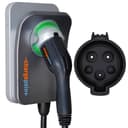
ChargePointis the default. One unit, output adjustable 16 to 50 amps in the app, sold hardwired or on a NEMA 6-50 or 14-50 plug, in J1772 or NACS, with a three-year warranty, a 23-foot cable and over-the-air firmware. The adjustability is the real argument: it is the only brand here where “what size circuit do I have?” stops being a purchase decision. You pay a premium for it, and full 50-amp output needs a 60-amp circuit that older panels often cannot spare. Read the Home Flex review, or the ChargePoint versus Emporia head-to-head if that is the decision you are actually making.
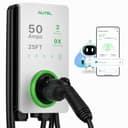
Autelis the weather brand. The MaxiCharger Home publishes an IP65 / NEMA 4X enclosure — 4X being the rating that adds corrosion resistance — and an operating range of -40°F to 131°F, the widest we track, with output adjustable 16 to 50 amps over WiFi, Bluetooth or Ethernet. Autel also builds the only 80-amp unit we track. Two honest cautions: Autel states its 50-amp unit needs a 70-amp circuit for full output, which is a bigger electrical job than the headline suggests, and its smaller 40-amp sibling publishes neither a UL listing nor an ENERGY STAR certification. See the MaxiCharger review and our outdoor roundup.
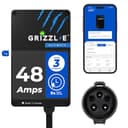
Grizzl-Eis the brand for people who do not want a relationship with a software company. Cast-aluminum bodies, NEMA 4 / IP67 sealing, a 25-foot cold-flexible cable, and a published UL/cUL file — and on the Classic and the Ultimate, no radio at all. Amperage is set with a DIP switch inside the enclosure, which is a non-issue on a charger you install once and an annoyance if you ever move it. Grizzl-E also builds the Duo Connect, the only unit we track that charges two cars from one circuit. See the Ultimate 48A review and the no-app roundup.
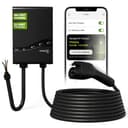
Emporiais the measurement brand, and its Pro is the answer to one specific problem: a panel with nothing left to give. It throttles the charger against whole-home load so a 48-amp unit can live on a service that could not otherwise carry it. Read the footnote honestly though — Emporia states that PowerSmart comes bundled with the Vue 3 energy monitor, so the load management is a two-device system. Our Pro review and small-panel roundup go deeper.
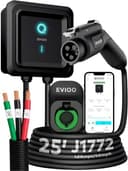
EVIQO is the value brand with the most complete paperwork: UL, ETL, FCC andENERGY STAR published together, an IP66 / NEMA 4 body, a 25-foot cable plus a 40-inch input lead, and app-adjustable output on the 40-amp unit. It is a younger brand than ChargePoint or Wallbox, which is a fair thing to weigh against the saving. Its 48-amp unit is the cheapest fully-certified route to 11.5 kW we track — see the review and EVIQO versus ChargePoint.
Lectron is the cheapest honest route to hardwired 48 amps, with the broadest connector choice of any brand here: the Nexus 48A in J1772, the Nexus NACS for Tesla and NACS cars, and a 40-amp portable in both. No apps, no accounts, no firmware. The trade is that you get no energy data and no remote anything, and the portables carry a two-year warranty rather than three. See the Nexus 48A review.
The three that did not make the picks
Wallboxdid not miss on quality — the Pulsar Plus is the smallest 48-amp body we track, with load balancing and a NEMA 4 enclosure, and it is the right buy in a cramped garage where a big box will not fit. It is kept off the list above only because every job it does well, something else on the list does too at lower cost. Our Pulsar Plus review and the ChargePoint head-to-head cover the case for it.
Ampuremakes one unit we track, the Go: a dual-voltage portable certified for both 120 V and 240 V, in an IP67 watertight body — and the only charger in our registry that an automaker names on its own vehicle pages alongside the ChargePoint. It caps at 32 amps, which is why it is a travel and backup recommendation rather than a primary home charger. See the Ampure Go review.
ELEGRPis the price floor done properly: a full 40 amps and a 25-foot cable in a portable, which is the longest reach in that form factor we track, at the lowest price in the registry. Its connector is rated IP54 against an IP67 station, it has no app, and the warranty is two years. For a trunk backup it is excellent value — see the review and the portable roundup.
What the brand does not decide
Two things, and both are worth knowing before you spend extra on a badge.
Charging speed. It is set by the lower of your circuit and your car’s onboard charger. A 48-amp unit delivers 11.5 kW regardless of whose name is on it, and if your car accepts 7.7 kW that is what you get from all of them. Our amperage guide has the arithmetic.
Installation cost.The electrician charges for the circuit, the run and the panel work, not for the logo on the box — and on most installs that is the larger half of the budget. Our install-cost breakdown and the timeline page cover it. The one brand-adjacent exception is plug-in versus hardwired: a plug-in unit on an existing outlet skips the electrician entirely, which is covered in the hardwired-versus-plug-in comparison.