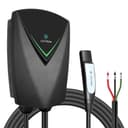
Every NACS charger under $500 right now
Computed at request time from the same daily price check that powers every button on this site, filtered to units whose output cable is a native NACS (SAE J3400) connector. If one rises above the ceiling it leaves this list on its own.
NACS chargers under $500
Built from the same daily price check that powers every price on this site, not written into this page — these are the chargers we track whose live listing price was under $500 as of November 24, 2026, and whose output cable is a native NACS (Tesla-style) connector rather than J1772. Cheapest first. A unit that rises above the band drops out of this list on its own.

Grizzl-E Ultimate 48A NACS
A permanently installed NACS charger built for weather

Lectron Nexus NACS (Tesla) Charger
Tesla / NACS owners who want no adapter at home
2 of the 6 chargers in scope qualify today.
What that list shows, and the reason this page exists, is that the ceiling is a real filter here rather than a decorative one. Half the NACS field sits above it. And the half above is not the faster half — the dearest NACS unit we track is a 40-amp plug-in charger, slower on paper than the cheapest hardwired one on this page.
What we ranked on
With three picks and the connector held constant, the tie-breakers are narrow and specific.
One: does it reach 48 amps, and is it hardwired?This separates the two wall units from the portable immediately. Forty-eight amps is 11.5 kW and roughly 40 miles of range per hour on our arithmetic of 11.5 kW at about 3.5 miles per kWh; forty amps is 9.6 kW and about 34. The reason the portable caps there is the receptacle rather than the charger: the NEC treats EV charging as a continuous load, so a NEMA 14-50 on a 50-amp circuit may carry 40 amps continuously. Reaching 48 means hardwiring onto a 60-amp circuit, because 48 × 1.25 = 60.
Two: whose laboratory, and which standard?This is where the two hardwired picks genuinely differ and why the ordering is not simply by price. Lectron publishes ETL listing to UL 2594, UL 2231 and UL 2251, plus ENERGY STAR and FCC — the most specific disclosure of any brand in our registry. Grizzl-E publishes UL certification E510712 and no ENERGY STAR certification for the NACS Ultimate. Both are listed products; only one of them will satisfy a rebate form that names ENERGY STAR. What the listings certify explains why that is a paperwork difference rather than a safety one.
Three: what is published about the environment it lives in?Grizzl-E publishes a full operating range for the NACS Ultimate — −30°C to +50°C, which is −22°F to 122°F — in a Made-in-Canada aluminum enclosure it gives as 10.25 × 6.25 × 3.75 inches and 24.25 lb, with UL Type 4 indoor/outdoor protection. Lectron publishes IP66 for the Nexus and no temperature range for any unit in its line. For a garage that difference is academic; for an exterior wall in a cold climate it is the whole decision, and the cold-weather roundup ranks on it.
Four: is there anything to log into, and do you want there to be?The Grizzl-E publishes Wi-Fi, the Grizzl-E Connect app, demand-response utility-program support and OCPP. The Lectron Nexus NACS publishes no app at all. For a Tesla that is close to irrelevant, because the car schedules its own charging — which is why we rank the Lectron second on paperwork rather than fourth on features. The case for a charger with no account is made properly on its own page.
What this ceiling does not include
Three capabilities live above $500 in this segment, and each is worth crossing the line for in a specific house.
A mature smart-charging app.The ChargePoint Home Flex NACS puts ChargePoint’s software and its 16-to-50-amp app adjustment behind a native NACS cable. If you want scheduling, usage history and over-the-air firmware from the charger rather than the car, that is the unit, and it is above the ceiling. The smart roundup covers that field.
Two cars from one circuit.The Grizzl-E Duo Connect puts two 25-foot NACS cables on one body and splits one 40-amp supply between them. It costs roughly what two single chargers cost, so the saving is in the wiring — which is exactly the point when the panel cannot give a second circuit. The two-car roundup has the alternatives.
Load management and a tiny footprint.The Wallbox Pulsar Plus 40A NACS is the smallest NACS unit we track — 7.8 × 7.9 × 3.9 inches and 4.4 lb without the cable — and the only one publishing OCPP 1.6j alongside static and dynamic load management, each footnoted as possibly needing a power-meter accessory. It is also the priciest way to get 40 amps in our registry. The compact roundup is the page if wall space is the binding constraint.
Note what is noton that list: speed. The fastest NACS charging available under this ceiling is the same 48 amps as the fastest available over it, because 48 amps is where most cars’ onboard chargers stop mattering anyway. Onboard chargers explained is the page that settles it, and our Wall Connector alternatives page measures this whole field against the 48-amp, 11.52 kW figure the EPA’s certification register publishes for Tesla’s own unit.