Autel MaxiCharger vs EVIQO
These are the only two brands in our registry that put a 50 on the box, and both of them need a 70-amp circuit to honor it. Strip that claim away and you have two very different chargers: one with an Ethernet port and no UL listing, one with a UL listing and three incompatible versions of its own amperage.
How this is funded: we earn a commission if you buy through our links, at no extra cost to you. It never changes which product we recommend, and we’ll tell you when we’d skip one. Full disclosure.
Autel and EVIQO arrive on most shortlists for the same reason: they are the two brands that will sell you something faster than 40 amps without ChargePoint’s or Wallbox’s pricing. They also share a quirk that nobody else in our registry has. Both put a number on the box that their own pages then qualify.
Autel’s AC Elite Home 50A advertises “50A / 12KW FAST HOME CHARGING” and, in the same paragraph, “with a 70A circuit required for full 50A output”. EVIQO’s hardwired unit is titled “48A (50A Max)” and its description explains that the 50 arrives when you set DIP switches 4 and 5, with “a dedicated 70A circuit required”. Two brands, two different mechanisms, the same 70-amp footnote.
That footnote is doing a lot of work, because a 70-amp circuit is not a small ask. So this comparison does the useful thing and settles the 50-amp question first, then compares what is left — which turns out to be four real differences: how the amperage is set, whose laboratory tested the thing, how it gets on a network, and what temperature each maker will stand behind.
| Spec | Autel MaxiCharger Home 50A | Autel MaxiCharger 40A | EVIQO 48A | EVIQO 40A |
|---|---|---|---|---|
| Max output | 50 A | 40 A | 48 A | 40 A |
| Power | 12 kW | 9.6 kW | 11.5 kW | 9.6 kW |
| Install | Hardwired | NEMA 14-50 plug | Hardwired | NEMA 14-50 plug |
| Charging cable | 25 ft | 25 ft | 25 ft | 25 ft |
| Enclosure | IP65 / NEMA 4X | NEMA 4 | IP66 / NEMA 4 | IP66 / NEMA 4 |
| WiFi / app | Yes | Yes | Yes | Yes |
| ENERGY STAR | Yes | Not published | Yes | Yes |
| Listings | CSA certified, ENERGY STAR | Not published | UL, ETL, FCC, ENERGY STAR | UL, ETL, FCC, ENERGY STAR |
| Warranty | 3 years | 3 years | 3 years | 3 years |
Two notes on that table before the argument. The Autel 40A row is mostly blank because Autel genuinely does not publish an enclosure rating, an ENERGY STAR certification or a temperature range for that model — which is a finding, not a gap in our reading. And the kW figures are each maker’s own except where noted in the product records; the miles-per-hour arithmetic everywhere on this page is ours, at a stated reference of about 3.5 miles per kWh.
1. The 50 amps that costs a panel upgrade and buys two miles an hour
Start with the arithmetic, because it is the same for both brands and it is not either brand’s fault. The NEC treats EV charging as a continuous load, so the branch circuit has to be rated at 125% of the charger’s continuous output. At 50 amps that is 62.5, and the next standard breaker above 62.5 is 70. There is no clever wiring that avoids this.
Now the payoff. Fifty amps at 240 volts is 12 kW; forty-eight amps is 11.5 kW. The difference is 0.5 kW, which at a reference 3.5 miles per kWh is about 1.75 miles of range per hour. Over a ten-hour overnight charge you have gained roughly eighteen miles. For that you are buying a 70-amp breaker instead of a 60, heavier conductors to carry it, and ten more amps of headroom out of a panel that may not have ten amps to give — and if it does not, you are in service-upgrade territory, which is the single most expensive line item in home charging.
Our advice on both units is the same: install at 48 amps on a 60-amp circuit and forget the 50-amp setting exists.Do that, and the headline difference between these two brands evaporates — they both deliver 11.5 kW, about 40 miles of range per hour, and the decision moves to everything else.
One honest caveat in Autel’s favor: its 50 is a genuine app setting on a unit whose published steps include 48, so dialing it back is a tap. EVIQO’s 50 is behind a physical DIP switch, which means an installer has to open the unit to change their mind later. If you are the sort of person who might upgrade a panel in three years, that is worth something.
2. How the amps get set, and where EVIQO contradicts itself
This is the difference that shows up every time your circumstances change — a new car, a solar install, a hot tub sharing the panel.
| Charger | How you set it | Published settings | Circuit for the top setting |
|---|---|---|---|
| Autel MaxiCharger Home 50A | In the Autel Charge app | 16, 24, 32, 40, 48, 50 A (six discrete steps) | 50 A needs a 70 A circuit; 48 A needs 60 A |
| Autel MaxiCharger 40A | In the Autel Charge app | Published only as “up to 40 A” | 40 A on the NEMA 14-50 it plugs into |
| EVIQO 48A | DIP switch, then an app slider under it | DIP 16 / 32 / 40 / 48 A; app 6–48 A in 1 A steps | 50 A via DIP 4+5 needs a 70 A circuit; 48 A needs 60 A |
| EVIQO 40A | In the EVIQO app | 6–40 A | 40 A on the NEMA 14-50 it plugs into |
Autel’s list is cleaner than its marketing suggests. The page says “Adjust output from 16A to 50A”, which reads like a continuum, but the electrical line underneath publishes six discrete settings: 16, 24, 32, 40, 48 and 50 amps. That is plenty for matching a circuit, and all of it lives in the app rather than inside the enclosure.
EVIQO gives you two layers — a DIP switch for the hardware ceiling, then a 6-to-48-amp slider in the app under it — which is genuinely more granular, and the slider is useful for charging slower during an expensive rate window. But its own page cannot keep the numbers straight. Three different maxima appear on one product page:the DIP-switch list in the FAQ offers 16, 32, 40 and 48 amps and omits the 50-amp step entirely; the app slider is published as “6-48A”; and the configurator copy says “Easily set power (6-50A) for your home’s capacity”. The same page also carries four incompatible speed claims — “45 MPH CHARGING”, “Up to 50 miles of range per hour”, “up to 46 miles per hour (48A)” and “~23 miles per hour” in its own savings calculator.
None of that makes the charger bad. It makes the paperwork unreliable, which is why every figure in the table above is attributed to the specific surface it came from.
3. Whose laboratory, and why your rebate may care
Here the two brands have genuinely different stories, and the practical consequence is money.
Autel publishes CSA certification and ENERGY STAR, and no UL listing anywhere on the AC Elite Home 50A page.CSA is an accredited testing laboratory and a CSA-certified EVSE is a safety-listed EVSE — this is not a charger with no listing. But it is not the word most people, and some local inspectors, are looking for. Our guide to charger safety certifications explains why the testing mark matters more than the standard number quoted next to it.
EVIQO publishes UL, ETL, FCC and ENERGY STAR — in one place. Its product description says “UL/ETL/FCC/Energy Star certified”; its own FAQ further down the same page says “Certified by ETL, Energy Star, and FCC”, dropping UL; and its comparison table says “UL & ETL listed”. We record all three rather than pick the flattering one. If the listing is load-bearing for your inspector or your utility program, ask for the certificate number in writing before you buy.
Where both brands agree is the one that pays: both publish ENERGY STAR certification, which is the most common eligibility filter in utility rebate programs and appears in the paperwork for the federal 30C credit as well. On this criterion they tie, and both beat several better-known brands.
4. The Ethernet port, and the failure mode nobody markets
Garages are the worst room in the house for WiFi. They sit at the end of the building, often behind masonry or a steel door, and most connected chargers want a 2.4 GHz network specifically. A charger that keeps losing its schedule is worse than a charger with no schedule at all.
Autel publishes Bluetooth, WiFi, Ethernet, CAN and RS485, and states that you can use the charger “with or without an internet connection”. The Ethernet port is the most valuable thing on this page that nobody advertises: if the wall is open during the install, a cable run solves garage connectivity permanently. No other charger in our registry has one, which is also why the Autel is a pick on our smart-home roundup.
EVIQO publishes 2.4 GHz WiFi and nothing else, with an “Enhanced WiFi Antenna” it says “keeps EVIQO EV car charger level 2 online in garage & basement”. That is a claim about an antenna rather than a second route to the network. If your garage WiFi is already fine, this costs you nothing; if it is not, read our connectivity guide before you choose.
On load management the gap is the same shape. Autel publishes Adaptive Load Management and charger-to-charger Dynamic Load Balancing, with the useful honesty that “ALM requires compatible additional hardware, while DLB works between chargers without additional hardware”. EVIQO publishes no load management at all. If your panel is the constraint, that is the roundup to read.
5. Weather: a published range against a tested one
Both units are built for outdoor installation and both publish an enclosure rating: Autel IP65 / NEMA 4X, EVIQO IP66 / NEMA 4. Those are not directly rankable — NEMA says its own comparison table cannot be run backwards to convert an IP code into a NEMA type — so we report both rather than declare a winner. The X on the Autel’s NEMA 4X does mean something specific, though: corrosion resistance, which matters near salt air.
Temperature is where they separate, and it is a difference in the kind of claim. Autel publishes an operating temperature range of -40F to 131F.EVIQO’s FAQ says the unit was “tested against rain, snow, ice, dust, UV, and temperatures from -22F to 122F”. A tested range is a weaker statement than a published operating range: it describes what the unit survived in a laboratory, not the conditions the maker warrants it to work in. For an unheated garage in Minnesota, that is not a technicality. It is the reason the Autel appears on our cold-weather roundup and the EVIQO does not.
6. Reach, and the one place EVIQO wins outright
Both brands ship a 25-foot charging cable, which is generous and ends the usual argument. EVIQO then adds something nobody else does: a 40-inch input cable on the hardwired unit, so the junction box does not have to be directly behind the charger. On a finished garage wall where the conduit comes up in the wrong place, that is the difference between mounting it where you want it and mounting it where the wire lands. Combined, it is the longest usable reach in its class, which is why the EVIQO leads our long-cable roundup.
Autel’s counter is the holster. The AC Elite publishes a separate connector holster that can be mounted away from the charger itself, which is a small thing that makes a 25-foot cable manageable rather than a coil on the floor.
Which one to buy
Buy the EVIQO 48Aif you are hardwiring and want the most charging speed per dollar. At 48 amps on a 60-amp circuit it matches the Autel’s real output, publishes UL alongside ETL and ENERGY STAR, and has the longest reach here. It is also the pick on our 48-amp roundup.
Buy the Autel MaxiCharger Home 50A if the charger lives fully exposed, if your garage WiFi is unreliable, or if there is a second EV coming. The -40F published range, the NEMA 4X enclosure, the Ethernet port and the no-extra- hardware charger-to-charger load balancing are each things EVIQO does not publish at all. It is our pick for exposed installs on the outdoor roundup.
Buy the EVIQO 40A if a NEMA 14-50 outlet already exists where you park. You keep the certifications, the app and the 25-foot cable, skip the electrician, and give up six miles of range per hour you will almost never notice. The plug-in roundup is where it sits in the wider field.
Buy the Autel MaxiCharger 40Aonly if you specifically want Autel’s app and in-body holster on a plug. It is the one unit here whose spec sheet is thin — no published enclosure rating, no ENERGY STAR, no temperature range — so it is hard to recommend over the EVIQO 40A on paper.
And if your car has a NACS port, note that both brands now publish a NACS version of this hardware that neither of these four SKUs is. Our NACS roundup covers the native Tesla-plug field, and the connector guide explains when the adapter is the smarter buy anyway.
Quick picks
Ranked on published specs, charging speed, electrical fit and value. Select a row to jump to the full write-up. We have not bench-tested these chargers — here is exactly what we do instead.
| # | Product | Best for | Price |
|---|---|---|---|
| 1 | EVIQO 48A Level 2 Charger A lot of charger for the money: a full 48 amps, WiFi with scheduling, ENERGY STAR, and the longest usable reach in this group thanks to a 25 ft cable plus a 40-inch input lead. A strong value alternative to Emporia if you want maximum reach. | Best speed per dollar | |
| 2 | 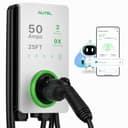 Autel MaxiCharger Home Built for the harshest driveway. The NEMA 4X enclosure is rated to keep charging in extreme cold and heat, it pushes a full 50 amps, and the app is capable. If your charger lives fully exposed to the weather, this is the one. | Best for exposed installs | |
| 3 | 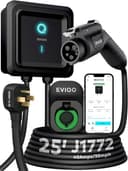 EVIQO 40A NEMA 14-50 Charger The most charger you can get without an electrician's invoice. It plugs into a NEMA 14-50 outlet for a full 40 amps, keeps the WiFi app, the ENERGY STAR listing and the 25 ft cable from EVIQO's hardwired unit, and can be unplugged and taken with you when you move. | Best without an electrician | |
| 4 | 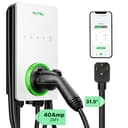 Autel MaxiCharger AC Elite Home 40A Autel's weather-hardened hardware in the install almost everyone can actually have. It is the 50A MaxiCharger's smaller sibling: same 25 ft cable and app, same NEMA 4 body, but it ends in a NEMA 14-50 plug instead of a wire nut — so it goes on an existing outlet, comes off the wall when you move, and needs a 50-amp circuit rather than a 60. The in-body holster is a small thing that stops mattering only if you have never coiled a cold cable. | Best Autel on a plug |
Frequently asked questions
Is the Autel MaxiCharger or the EVIQO better?
For most homes, the EVIQO 48A, and the reason is the circuit rather than the charger. Both brands publish a 50-amp setting that requires a 70-amp circuit, which most panels cannot spare, so in practice you are comparing a 48-amp EVIQO against a 48-amp Autel on a 60-amp circuit - and at that setting they deliver identical power, 11.5 kW, while the EVIQO costs meaningfully less. Buy the Autel instead if your charger lives fully exposed outdoors, because Autel publishes a -40F to 131F operating range where EVIQO publishes -22F to 122F as a tested figure, or if you can run network cable to it, because the Autel has an Ethernet port and nothing else in our registry does.
Do I need a 70-amp circuit for a 50-amp EV charger?
If you want the full 50 amps, yes, and both makers say so on their own pages. The National Electrical Code treats EV charging as a continuous load, so the circuit has to be rated for 125% of the charger's output: 50 x 1.25 is 62.5 amps, and the next standard breaker size above that is 70. Autel's page states 'a 70A circuit required for full 50A output' and EVIQO's states 'a dedicated 70A circuit required' for its DIP-switch 50-amp setting. What you get for that upgrade is about 0.5 kW, or roughly two miles of range per hour. On almost every house, the right answer is to install either unit at 48 amps on a 60-amp circuit and ignore the 50-amp setting.
Is the Autel MaxiCharger UL listed?
Not according to Autel. The AC Elite Home 50A page publishes 'CSA and ENERGY STAR' certifications and makes no UL claim anywhere on it. CSA is a legitimate accredited testing laboratory and a CSA-certified charger is a safety-listed charger, so this is not a red flag - but it is a difference worth knowing, because some utility rebate programs and some local inspectors name UL specifically. EVIQO publishes 'UL/ETL/FCC/Energy Star certified' in its description, though its own FAQ on the same page says only 'Certified by ETL, Energy Star, and FCC' and its comparison table says 'UL & ETL listed'. Three different answers on one page is not reassuring either, so if the listing is the deciding factor for your inspector or your rebate, ask the seller for the certificate number before you buy.
Which one has the better app?
Autel's does more, and it is the only one of the two that can work without WiFi. Autel publishes connectivity as 'Bluetooth, Wi-Fi, Ethernet, CAN, RS485' and says you can 'use the charger anytime, with or without an internet connection', plus Adaptive Load Management and charger-to-charger Dynamic Load Balancing - with ALM footnoted as needing 'compatible additional hardware'. EVIQO publishes a 2.4 GHz WiFi app with start and stop, a 6-to-48-amp current slider, up to three schedules, live energy and cost tracking and over-the-air firmware, which covers everything a one-car household actually opens an app for. If your garage has poor WiFi, the Autel's Ethernet port is worth more than every other difference on this page.
Can either of these charge a Tesla?
Both can, and both now sell a version that does it without an adapter - but neither of the units this page compares is that version. The chargers in the table above are SAE J1772, which means a Tesla needs the J1772 adapter that came with the car, and EVIQO states explicitly that the adapter is not included. As of our October 24, 2026 reading, Autel's configuration selector offers a 'Hardwired Connection/50A NACS-Tesla' option and EVIQO publishes a separate NACS category, so a native NACS unit is available from each brand. If that is what you want, our NACS roundup ranks the ones we track.
Is 48 amps worth it over 40?
Only if you drive a lot, and the gap is smaller than the numbers look. 48 amps is 11.5 kW against 9.6 kW at 40, which at a reference 3.5 miles per kWh is about 40 miles of range per hour versus 34 - six miles an hour. Over a ten-hour overnight charge that is sixty miles, which almost no commute needs. What the 48-amp units cost you is the plug: both brands cap their plug-in models at 40 amps because code does, so 48 amps means hardwiring, an electrician and a 60-amp circuit. If you already have a NEMA 14-50 outlet, the 40-amp models are the cheaper, faster, renter-friendlier buy.
Which is better in cold weather?
Autel, on the published figures, and by a wide margin at the bottom of the range. Autel publishes an operating temperature range of -40F to 131F for the AC Elite Home 50A. EVIQO's FAQ says its unit was 'tested against rain, snow, ice, dust, UV, and temperatures from -22F to 122F' - a test range, which is a weaker claim than a published operating range, because it says what the unit survived rather than what the maker warrants it to work in. For an unheated garage in a cold state that difference is real. Our cold-weather roundup ranks the field on exactly these published numbers.
Sources
- Autel Energy — MaxiCharger AC Elite Home 50A product page — Autel's own listing: compliant with NEMA 4X standards, operating temperature -40F to 131F, 25 ft cable, 3-year warranty. RE-READ October 10, 2026 for the Emporia head-to-head, and the page now publishes materially more: 'Maximum Output | 12 kW / 50 A' with output 'Adjustable 16-50 A'; installation given as 'Hardwired - 70 A Circuit for Full Output'; an 'SAE J1772' connector; an enclosure rating of 'IP65 / NEMA 4X'; an operating range of '-40 to 131 F (-40 to 55 C)'; a '3 Years' warranty quoted as a single term with no component split; 'CSA and ENERGY STAR compliance' (no UL listing is claimed on this page); connectivity listed as 'Bluetooth, Wi-Fi, Ethernet, CAN, RS485'; app control to start, stop and schedule charging, monitor activity and adjust current; dimensions of 13.2 x 7.4 x 3.8 in (336 x 187 x 97 mm) and a weight of 15.4 lbs (7 kg); and the load-management sentence this comparison turns on - 'Supports both Adaptive Load Management (ALM) and charger-to-charger Dynamic Load Balancing (DLB). ALM requires compatible additional hardware, while DLB works between chargers without additional hardware.' The page publishes no solar-specific feature. RE-READ October 24, 2026 for the EVIQO head-to-head, and three things are published that the October reading did not record. (1) The amperage steps are DISCRETE, not a continuum: the electrical line reads '208/240 VAC, 60 Hz, single phase @ 16 A, 24 A, 32 A, 40 A, 48 A, 50 A', so '16-50 A adjustable' means six settings, not every value in between. (2) Autel now publishes NACS variants of this hardware alongside the J1772 one - the configuration selector offers 'Hardwired Connection/50A NACS-Tesla' and the related AC Lite 50A is listed both as 'AC Lite 50A EV Charger' and 'AC Lite 50A EV Charger NACS'. (3) The weight is split by configuration - 'Hardwired model: about 14.8 lbs. (6.7 kg) / NEMA plug-in model: about 15.4 lbs. (7 kg)' - where our October 10 note recorded only the 15.4 lb figure. The 70-amp-circuit sentence, the IP65 / NEMA 4X rating, the -40F to 131F range, the 25 ft J1772 cable and the CSA + ENERGY STAR / no-UL certification picture are all unchanged. Autel's own store price on this visit was $525.00 against a $639.00 list. RE-READ October 31, 2026 for the 50-amp roundup. Every figure above is unchanged — '12 kW / 50 A' maximum output, 'Adjustable 16-50 A' over the six discrete steps '16 A, 24 A, 32 A, 40 A, 48 A, 50 A', 'Hardwired - 70 A Circuit for Full Output', 'SAE J1772', 'IP65 / NEMA 4X', '-40 to 131 F (-40 to 55 C)', a 25 ft cable, '3 Years', CSA and ENERGY STAR with no UL claim, and the ALM/DLB sentence. One addition: the holster is a CONFIGURATION, and it changes the depth — 13.2 x 7.4 x 3.8 in with the in-body holster against 13.2 x 7.4 x 3.3 in with a separate holster, which is the half-inch that decides whether the unit clears a tight garage wall. Autel's own store price was again $525.00 against $639.00, shown as '18% OFF' (accessed October 31, 2026)
- Autel Energy — MaxiCharger AC Elite Home 40A (NEMA 14-50) product page — Autel's own listing: output adjustable up to 40 A / 9.6 kW, SAE J1772 connector on a NEMA 14-50 input cord, 25 ft cable, NEMA 4 enclosure, Wi-Fi / Bluetooth / Ethernet, three-year limited warranty; the page does not publish a UL or ENERGY STAR listing or an operating-temperature range (accessed August 18, 2026)
- Autel Energy — MaxiCharger 80A 19.2kW Residential EV Charger (US store listing) — Autel's own US listing: 19.2 kW (240V AC 80A), 208/240V AC 50/60 Hz, SAE J1772, hardwired, 25 ft (7.5 m) cable, output adjustable from 6A to 80A in the app and 16/24/32/40/48/50/64/72/80 A by DIP switch, UL 2594, UL 2231-1, UL 2231-2, UL 1998, CSA C22.2 No. 280, FCC Part 15 Class B, ENERGY STAR, OpenADR 2.0b, NEC Article 625, Wi-Fi / Ethernet / RS485 with the Autel Charge app and cloud, and a warranty of 5 years on the charger body, backplate and internal components with 1 year on the display screen, charging cable and connector (accessed August 12, 2026)
- EVIQO - Level 2 EV Charger, 48A hardwired (Gen 2), 240V — EVIQO's own product page for the hardwired unit, read for the Grizzl-E head-to-head. The product title reads '48A (50A Max)', and the description states that 50 A is unlocked by setting DIP switches 4 and 5 with 'a dedicated 70A circuit required'; the dedicated circuit for 48 A is given as 60 A. The FAQ's DIP-switch list offers 16A, 32A, 40A and 48A - it does not list the 50A setting - while the app slider is published as '6-48A' in 1 A steps. Other published figures: 240 V, 11.5 kW at 48 A described as '11.5 kW continuous (hardwired)', an SAE J1772 connector with a metal latch, a 25 ft charging cable on a 40 in input cable, an 'IP66/NEMA-4 weatherproof enclosure', a 3-year standard warranty with a 4-year extension offered at checkout, 'UL/ETL/FCC/Energy Star certified' in the description against 'Certified by ETL, Energy Star, and FCC' in the FAQ and 'UL & ETL listed' in its comparison table, enhanced 2.4 GHz WiFi with start/stop, current setting, reminders, consumption and cost tracking, up to three off-peak schedules and over-the-air updates, and FAQ wiring guidance of THWN-2 copper with 6 AWG L1/L2 and a 10 AWG ground. Temperature is given as 'tested' from -22F to 122F rather than as an operating range. The page's own speed claims are inconsistent with each other: '45 MPH CHARGING', 'Up to 50 miles of range per hour', 'up to 46 miles per hour (48A)' and '~23 miles per hour' in its savings calculator. NOT published: weight, dimensions, an explicit operating-temperature range, solar integration, whole-home load management, or any Alexa, Google Home, HomeKit, Matter, Home Assistant or OCPP integration. A J1772-to-NACS adapter is required for a Tesla and is not included. RE-READ October 24, 2026 for the Autel head-to-head and the NACS roundup. Unchanged on every figure above, with three additions. (1) EVIQO now publishes a 'NACS / Tesla Chargers' category of its own, and states of it: 'This NACS version is plug-and-play with all Tesla models and 2025+ Hyundai IONIQ 5/6. For other EVs (Ford, Chevy, BMW, Kia, Rivian, etc.), use a NACS-to-J1772 adapter' - so the brand sells a NACS unit, while the two hardwired and plug-in SKUs this site tracks remain J1772. (2) A fourth, wider current claim appears in the configurator copy - 'Easily set power (6-50A) for your home's capacity' - which contradicts both the app slider EVIQO publishes as '6-48A' and its own DIP list of 16/32/40/48 A. (3) The install requirements are stated plainly: 'Plug-in: NEMA 14-50 outlet on a 50A dedicated circuit. Hardwired: 60A dedicated circuit with THWN-2 copper wires (L1/L2: 6 AWG, Ground: 10 AWG)', and the plug-in route is described as capped at 40A / 9.6 kW against the hardwired unit's 48A - 'gives you 20% more speed'. RE-READ October 31, 2026 for the 50-amp roundup. The product title still reads 'EVIQO Level 2 EV Charger, 48A (50A Max), 240V, Hardwired, J1772 for Non-Tesla EVs', and the two circuit sentences that matter are still published side by side in plain text: 48 A requires 'a dedicated 60A circuit to deliver 48A (National Electrical Code requirements)' and 50 A requires 'a dedicated 70A circuit'. Two further contradictions are now recorded in full, because the 50-amp page turns on them. (1) EVIQO's own comparison table and 'What's in the Box' section describe the unit as 50A and attribute '11.5 kW continuous (hardwired)' to that 50 A - but 11.5 kW at 240 V is 48 A, not 50, which would be 12 kW. The brand's own kilowatt figure therefore describes the 48-amp setting while being labeled 50. (2) The amperage controls still disagree four ways across one page: the DIP list is '16A / 32A / 40A / 48A', the 50 A setting is reached by 'DIP switches to positions 4, 5', the app slider is published as 'set 6-48A current', and the configurator copy says 'Easily set power (6-50A) for your home's capacity'. Also re-confirmed: 'IP66/NEMA-4 weatherproof enclosure', '-22F to 122F' given as tested, THWN-2 copper with 6 AWG L1/L2 and 10 AWG ground, a 3-year warranty extendable to 4 at checkout, and the four mutually inconsistent speed claims ('45 MPH CHARGING', 'up to 46 miles per hour (48A)', 'Up to 50 miles of range per hour', '~23 miles per hour' in the savings calculator) (accessed October 31, 2026)
- EVIQO — Level 2 EV Charger, 40A (9.6 kW), NEMA 14-50 plug-in (Gen 2) — EVIQO's own product page: 40A / 9.6 kW on a NEMA 14-50 plug, SAE J1772, 25 ft charging cable plus a 40 in input cable, IP66 / NEMA 4 enclosure, UL / ETL / FCC / ENERGY STAR listings, 3-year standard warranty, app-adjustable 6-40A output, and a note that it needs an EV-grade 4-prong 14-50 receptacle rather than a dryer outlet. RE-READ September 15, 2026 for the garage roundup: the page additionally states an operating temperature range of -22F to 122F, that the app needs a 2.4 GHz WiFi connection, that the standard 3-year warranty is extendable to 4, and that the unit ships in 1-2 business days (accessed September 15, 2026)
- NFPA — Using the Latest NEC for EV Charger Installations — NFPA on NEC (NFPA 70) Article 625: EV charging is a continuous load, so circuits are sized to 125% of load (the 80% rule) (accessed July 19, 2026)
- ENERGY STAR — Electric Vehicle Chargers — ENERGY STAR on EVSE efficiency: certified chargers use about 40% less energy in standby than non-certified units (accessed July 19, 2026)
- UL Solutions — EV Charging Infrastructure Services — UL on EVSE safety certification: ANSI/UL 2594 is the Standard for Electric Vehicle Supply Equipment (accessed July 19, 2026)
- NEMA — Enclosure Types (definitions from NEMA 250) — NEMA's own definitions: Type 3R protects against falling dirt and rain, sleet and snow; Type 4 adds windblown dust, splashing and hose-directed water; Type 4X adds protection against corrosion. NEMA also states its NEMA-to-IP table cannot be used to convert IP designations back to NEMA types (accessed July 20, 2026)
- IEC 60529 — Degrees of protection provided by enclosures (IP Code), full text — The IP code standard (verbatim national adoption, IS/IEC 60529:2001): first numeral 6 = dust-tight; second numeral 6 = protected against powerful water jets; second numeral 7 = protected against temporary immersion, and a 7 alone does not imply water-jet protection unless dual coded (accessed July 20, 2026)
- U.S. DOE Alternative Fuels Data Center — Utility Incentives — DOE's catalog of utility incentives by customer type: 114 utilities listed offering residential Level 2 charging station purchase rebates and 74 offering Level 2 installation rebates, plus make-ready/pre-wiring rebates, managed-charging programs and EV time-of-use rates. RE-READ September 3, 2026: the residential counts were unchanged at 114 participating utilities for the EV Level 2 Charging Station Purchase Rebate and 74 for the EV Level 2 Charging Station Installation Rebate, alongside 17 for the Make-Ready or Pre-Wiring Rebate for EV Chargers, 109 for the EV Time-of-Use (TOU) Rate and 9 for the EV Managed Charging Program (accessed September 3, 2026)
- FuelEconomy.gov — Electric Vehicles: Learn More About the Label — DOE/EPA on EV efficiency: kWh per 100 miles and MPGe, accounting for AC charging losses (accessed July 19, 2026)
Keep reading
Best 50-amp chargers
Both brands here plus the ChargePoint, ranked — and the 40-amp answer for anyone who already has a 50-amp circuit.
See the picksGrizzl-E vs EVIQO
The other half of the EVIQO question - against the cast-aluminum Canadian box with a switch inside it.
Read the comparisonBest NACS chargers
Both brands now publish a NACS version. Here is the field of native Tesla-plug chargers we actually track.
See the picksWire size and breaker
Why a 50-amp charger needs a 70-amp circuit, and how the 125% continuous-load rule sets every number on this page.
Read the guideBest 48-amp chargers
The whole 48-amp field ranked, including both of these brands against ChargePoint, Wallbox and Lectron.
See the picksBest outdoor chargers
Where the Autel's -40F rating puts it, and what NEMA 4X actually means next to IP66.
See the picks40 amps vs 48 amps
The six-miles-an-hour question in full, including what hardwiring costs to get there.
Read the comparison