Why 48 amps is the ceiling worth paying for
Charging speed at home is set by the lower of two numbers: what the charger can push, and what the car’s onboard charger can accept. Toyota publishes the second number — 11 kW — and that is the end of the argument. A 48-amp charger delivers 11.5 kW, so it saturates the bZ. A 50-amp charger delivers 12 kW, and the extra half kilowatt is thrown away inside the car. The 80-amp MaxiCharger we rank as the fastest Level 2 charger on the market would charge a bZ at exactly the same rate as a unit costing a third as much, while demanding a 100-amp circuit to do it.
It is worth seeing what the step down costs, because for a lot of owners it is the right trade. A 40-amp charger delivers 9.6 kW, which is 87% of what the bZ accepts. Scaling Toyota’s own figure — 10% to 100% in around seven hours at 11 kW — that becomes roughly eight hours on a 40-amp unit. One extra hour, overnight, on a full charge you will rarely do. If you already have a NEMA 14-50 outlet where the car parks, a 40-amp plug-in charger is the cheaper and faster route to being done, and our plug-in roundup covers it.
In miles, the comparison depends on an efficiency figure Toyota does not publish. The page gives EPA-estimated range ratings of 236 miles on the XLE, 314 on the XLE FWD Plus and 288 on the XLE AWD, but it does not publish the battery’s capacity in kilowatt-hours, so there is no way to derive the car’s own miles-per-kWh from Toyota’s numbers. Using this site’s standing reference of about 3.5 miles per kWh, 11 kW is roughly 38 miles of range per hour and 9.6 kW is roughly 34. Those are our figures with our assumption stated, and a bZ driven in winter will beat neither.
The adapter question, answered properly
An adapter sitting between a wall charger and the car is the thing most bZ owners worry about, and the worry is mostly misplaced for AC charging. Toyota supplies the J1772 adapter itself and describes it as expanding your charging options, which is about as clear an endorsement as a manufacturer gives. A Level 2 AC adapter is a passive connector — it does not convert anything, and as Lectron’s own FAQ puts it, adapters “don’t generate power — they only enable compatibility between chargers and vehicles.”
What it does cost you is a daily step and a thing to lose. The adapter lives on the end of the charging cable or in the car, it has to go on and come off every session unless you leave it attached to the handle, and an adapter left attached outdoors is one more unsealed junction in the weather. If the bZ is the only EV in the household and it will live on one charger, a native NACS unit removes all of that for no extra money — which is why our top two picks are NACS. If a second, J1772 car shares the driveway, the calculation flips and a J1772 charger plus the bZ’s own adapter covers both cars from one cable. Our mixed-household guide works through all three routes.
What Toyota puts in the trunk, and whether it is enough
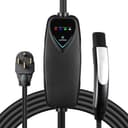
The bZ ships with what Toyota calls a “portable dual-voltage charging cable,” and the page claims that with it “you can take advantage of Level 2 charging capabilities at home without needing additional charging hardware.” Read that carefully before you decide you need nothing. The cable does 240-volt charging, so it is genuinely Level 2 — but Toyota does not publish its amperage, its power in kilowatts, or its cord length anywhere on that page. Our own 120-volt reference for an included cable is around 1.4 kW; Toyota publishes no 240-volt figure at all for this one.
So the honest position is this: the included cable will charge the car at 240 volts, at a rate Toyota has not disclosed, from an outlet you probably do not have yet. You still need a 240-volt outlet installed, which is most of the cost of a charger install anyway — see our NEMA 14-50 guide and our install cost breakdown. Once you are paying an electrician to put a 240-volt circuit where the car parks, the marginal cost of a known-rate 48-amp charger over an unspecified bundled cable is small, and it is the difference between a figure you can plan around and one you cannot.
Picking by where the car parks
Everything above is about speed. The specs that actually decide which of these six you should buy are reach and weather, and they come down to your driveway rather than your car.
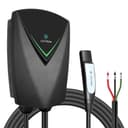
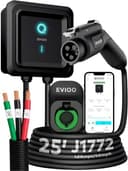
Reach.The charging cables here run from 16 to 25 feet. Measure from where the box will be mounted to the bZ’s charge port in the position it actually parks, along the route the cable will take, with slack so it is never taut. The EVIQO adds a 40-inch input lead on top of its 25-foot cable, which buys the box some freedom from the outlet. Our long-cable roundup ranks on reach alone, and extension cords are not a fix.
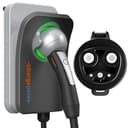
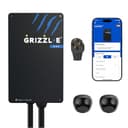
Weather. If the charger lives outside, the enclosure rating matters more than the amperage. Of the picks here, EVIQO publishes IP66 / NEMA 4 and an operating range of -22F to 122F; Lectron publishes IP66 on the Nexus units but no temperature range; ChargePoint publishes Type 3R; the Grizzl-E Duo publishes IP67. The portable Lectron publishes no enclosure rating at all, which is a finding rather than a gap in our research. Our ratings explainer covers what each code protects against, and our outdoor roundup ranks on it.
The circuit.Every 48-amp pick here is hardwired onto a 60-amp circuit, because the NEC treats EV charging as a continuous load and requires the circuit to be sized at 125% of it. If your panel cannot spare 60 amps, that is not the end of the project — read panel capacity and our small-panel picks before you assume you need a service upgrade.
What we did not do on this page
We did not rank the Toyota-branded or dealer-supplied wall charger, because Toyota’s own bZ page does not publish its specifications and we do not fill in a spec table from a dealer blog. We have not driven or instrumented a bZ, and nothing above is a measured charging result — the seven-hour and 30-minute figures are Toyota’s, the amperage and miles-per-hour figures are our arithmetic with the assumption printed, and the charger specs come from each manufacturer’s own documents on the dated visits in our sources. Our methodology page spells out exactly what that means.