The five candidates, on the specs a post changes
Everything that makes a wall install easy — shelter above, a stud to bolt to, a cable run inside the building envelope — is absent on a pedestal. These are the columns that replace it.
The five hardwired, outdoor-rated chargers we track that suit a post mount, on the three columns a pedestal changes. Only one publishes an impact rating at all, which is itself the most useful finding on this page.| Charger | Enclosure | Impact rating | Temperature | Cable | Rated output |
|---|
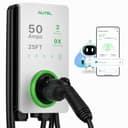
| Autel MaxiCharger Home | IP65 / NEMA 4X | None published | -40F to 131F (published range) | 25 ft | 50 A / 12 kW |
|---|
| Autel MaxiCharger 80A | NEMA 3S (IK10) | IK10 impact rating published | -40F to 131F (published range) | 25 ft | 80 A / 19.2 kW |
|---|
| EVIQO 48A Level 2 Charger | IP66 / NEMA 4 | None published | -22F to 122F, published as tested | 25 ft | 48 A / 11.5 kW |
|---|
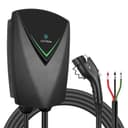
| Lectron Nexus 48A J1772 | IP66 | None published | Not published | 23 ft | 48 A / 11.5 kW |
|---|
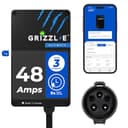
| Grizzl-E Ultimate 48A | NEMA 4 (IP67) | Cast aluminum body; no IK figure published | -22F to 122F (published range) | 25 ft | 48 A / 11.5 kW |
|---|
Three things stand out. First, the impact column is almost empty: one unit publishes a figure and four do not, which means the rest are being bought on faith in that dimension. Second, the temperature column separates sharply — Autel publishes a genuine operating range at both power levels, Grizzl-E publishes one, EVIQO publishes its figures as tested rather than as a range, and Lectron publishes nothing at all. Third, the cable column is tighter than it looks: 25 feet sounds generous until the post is beside the car rather than in front of it.
What we ranked on
One: the published low-temperature figure, not the IP number.A pedestal charger is cold-soaked with no building behind it, so the number that matters is the bottom of the operating range. Autel publishes −40°F for both the 50A and the 80A. Grizzl-E publishes −22°F to 122°F for the Ultimate, in a cast-aluminum body with IP67 sealing. EVIQO gives −22°F to 122°F but describes it as tested rather than rated, which is a weaker claim and we record it as such. Lectron publishes no range for any unit in its line, which is the single reason the Nexus is fourth here rather than second. Our cold-weather roundup ranks the whole registry on exactly this.
Two: impact, where anyone publishes it.Only Autel does, and only on the 80A: NEMA 3S with IK10. We are not going to pretend the other four are fragile — a die-cast aluminum Grizzl-E is obviously a robust object — but there is a difference between a body that looks tough and a manufacturer putting a number next to it. If the post sits where a car manoeuvres, that number is worth paying for, and the 80A can be dialed down to 48 amps so you are not forced into a 100-amp circuit to get it.
Three: how the amperage is set, and by whom.On a pedestal the electrician is already doing a bigger job — trench, conduit, mount, bond — so a unit whose current is set with a screwdriver under a cover is worth real money in labor. Grizzl-E’s DIP switch (16/24/32/40/48 A) is the cleanest version of that. EVIQO offers both a DIP list and a 6-to-48-amp app slider in 1-amp steps, the finest control we have found. Autel does it in the app, from 16 to 50 A on the MaxiCharger Home and 6 to 80 A on the 80A. Lectron publishes no selector at all. Every published setting in one table is the reference page.
Four: cable reach from a post rather than a wall. This is the requirement people get wrong, and it is unfixable afterwards. Work out the furthest realistic case: the car parked at the far edge of the pad, with its charge port on the opposite corner from the post, and the cable routed around rather than over the bodywork. Twenty-five feet covers most of those; 23 covers fewer. The long-cable roundup is the page if your geometry is awkward.
The install is the project, not the charger
It is worth saying this plainly, because a pedestal is the one home-charging scenario where the hardware is reliably the small number.
A post mount usually means a run that leaves the house, which brings in trenching depth, conduit, backfill and — if the run crosses a driveway — either boring under it or cutting and patching it. Then there is the pedestal itself and its footing, which has to resist frost heave if you have frost, and a bonding and grounding arrangement for a metal post. Permits and inspection apply as they would indoors. What the install actually involves walks through the sequence, and what to ask for in a quote is the page that makes two bids comparable.
Two consequences for how you shop. First, the difference between a $350 charger and a $550 charger is small against a trench, so buy on durability rather than price at this end — which is why the budget pick here is a cast-aluminum hardwired unit rather than the cheapest thing that fits. Second, oversize the circuit rather than the charger if you are opening the ground anyway: conductor and conduit are the part you will not want to revisit, and wire size and breaker sizing explains what the 125% continuous-load rule asks for at each amperage.
One last siting note that costs nothing: put the post where the cable can reach the car and where a reversing driver can see it. The most common pedestal complaint is not electrical.
When a pedestal is the wrong answer
If there is any wall within reach of the parking spot — a garage wall, an exterior house wall, the side of a detached garage — mount on it instead. A wall is sheltered, free, structurally sorted and shorter to wire. The post is for the driveway with genuinely nothing beside it, the parking pad set away from the house, or the shared pad where two spaces need one box in the middle.
And if the real constraint is that you rent, or cannot alter the property, neither a post nor a wall box is the answer — the renter roundup and the portable roundup cover the options that do not involve an electrician at all.