Upgrading Your Electrical Service for an EV Charger
Somebody has told you the panel is full. That may be true, and it may be the most expensive true statement in this project — because three cheaper answers usually get ruled out only if you ask for them.
How this is funded: we earn a commission if you buy through our links, at no extra cost to you. It never changes which product we recommend, and we’ll tell you when we’d skip one. Full disclosure.
There is a specific moment in a lot of EV charger projects where the price changes character. An electrician looks at the panel, does some arithmetic, and says the service will not carry it. What was a few hundred dollars of circuit becomes a quote with a comma in it.
Sometimes that is correct and unavoidable. Often it is the first answer rather than the best one. This page is about telling the two apart, and about what the upgrade actually involves if it turns out you do need it.
What is actually being measured
The constraint is not the number of empty slots in your breaker box. It is whether the incoming service can supply everything the house might reasonably draw at once, plus the charger.
And the charger is treated harshly by design. Under the NEC, EV charging is a continuous load: the circuit is sized at 125% of the charger’s current, and the load calculation must assume the charger could be drawing its full amount at any moment. A 48-amp charger is not counted as “a few hours a night”; it is counted as 60 amps, permanently.
This is also why the size of your main breaker is a poor predictor on its own. A 200-amp service in an all-electric house — electric heat, electric water heater, electric range, air conditioning — can have less room than a 100-amp service in a house that heats and cooks with gas. Our panel capacity guide walks the calculation itself.
Three cheaper answers to rule out first
Before accepting an upgrade quote, ask explicitly whether each of these has been considered. A good electrician raises them unprompted; not all do.
1. Install a smaller charger.The simplest and most often overlooked. A 32-amp charger on a 40-amp circuit delivers about 7.7 kW — roughly 27 miles of range an hour at our reference efficiency, which refills a 40-mile commute in an hour and a half. A 24-amp charger on a 30-amp circuit still gives about 20 miles an hour. Neither is a consolation prize; both are genuine Level 2 charging, and both may fit a service that a 48-amp charger will not.
Buy a charger with a wide adjustable range and this costs you nothing long-term: run it at 24 amps today, raise it if the service is ever upgraded, with no new hardware.
2. Use load management.The genuinely clever answer. A load-managing charger watches the whole home’s draw and reduces or pauses the car when other large loads are running, so the total never exceeds what the service can carry. Because the charger is then not an unmanaged full-time load, it can be permitted where a straightforward calculation would have failed — which is precisely what the Emporia Pro’s PowerSmart does with its bundled Vue monitor, and what Wallbox’s Power Boost does on the Pulsar Plus. Our load management guide covers the approaches in detail.
3. Free up capacity elsewhere.Occasionally there is a large load in the calculation that no longer exists — a decommissioned electric range on a gas kitchen, a hot tub that left with the previous owner, an old workshop feed. Removing a dead circuit from the calculation is free capacity, and it is worth asking whether anything in the panel is being counted that should not be.
What a service upgrade actually involves
If none of the above applies, here is what you are buying. It is worth understanding because it explains both the price and the timeline.
- New service conductorsfrom the utility’s connection point to the meter, sized for the new capacity.
- A new meter socket, and on overhead services often a new mast and weatherhead.
- A new main breaker and panel, since the existing one is rated for the old service.
- Grounding and bonding brought to current code, which frequently means new ground rods and a new bonding conductor — a real cost that surprises people because it is invisible.
- Utility coordination to disconnect and reconnect the supply, plus permit and inspection.
That last item is usually what sets the schedule. The electrician’s work may be a day or two; the utility’s availability can be weeks. If you are planning around a car delivery date, start early.
When the upgrade is genuinely the right call
Three situations where we would not fight it:
The panel is obsolete or unsafe. Certain older panel types have known problems and are difficult or impossible to buy breakers for. If your electrician raises this, the charger has simply revealed something that needed doing anyway.
You are electrifying the whole house. A heat pump, an induction range and a heat-pump water heater will each demand capacity, and they will hit the same ceiling within a few years. Doing the service once is meaningfully cheaper than doing it twice, and this is the case where an upgrade prompted by a car is really a decision about the house.
Two EVs, and both need to charge overnight.Load management can carry a second car, but at reduced speed each — a dual-port unit splits its supply rather than doubling it. If both cars are driven hard daily, capacity is the honest answer. Our two-car roundup covers where the line falls.
Chargers that make the upgrade avoidable
If you are trying to get out of this, the hardware choice matters. These three are the ones we would look at, for different reasons: one manages the whole-home load directly, one balances against a shared circuit, and one simply dials down further than most.
Quick picks
Ranked on published specs, charging speed, electrical fit and value. Select a row to jump to the full write-up. We have not bench-tested these chargers — here is exactly what we do instead.
| # | Product | Best for | Price |
|---|---|---|---|
| 1 | 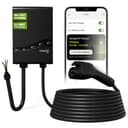 Emporia Pro The answer to a panel that says no. The Pro ships with Emporia's Vue 3 energy monitor in the same box, watches what the rest of the house is drawing, and throttles the car in real time so the total never exceeds what the service can carry — which is how a 48-amp charger ends up on a panel that a load calculation says has no room for one. You pay roughly Home Flex money for it, and only the load management justifies that. | Whole-home load management, monitor included | $599.00 · View on Amazon Price as of October 17, 2026. #ad How we’re funded |
| 2 |  Wallbox Pulsar Plus The one to buy when wall space is tight: it's among the smallest 48A units you can get, with dynamic load management so it can share a circuit without tripping the main. A polished premium charger — and priced like one. | Power Boost balancing in the smallest body | |
| 3 |  ChargePoint Home Flex The safest default for most homes: you set the amperage in the app to 16, 24, 32, 40, 48 or 50A, so one charger fits whatever circuit your panel can spare today and scales up if you upgrade later. The app is the most mature here, firmware arrives over the air, and the warranty is long. | Adjustable from 16A, so almost any circuit works | $516.71 · View on Amazon Price as of October 17, 2026. #ad How we’re funded |
One financial note before you commit. Utility rebate programs sometimes include make-ready or pre-wiring rebatesalongside the charger and installation ones — DOE catalogs those as a separate category — and a service upgrade undertaken to enable EV charging may qualify in some programs. It will not cover the whole bill, but on a job this size it is worth ten minutes of checking. Start with our utility rebate guide— the federal 30C creditended for chargers placed in service after June 30, 2026 — and get the quotes itemized so you can tell which parts are claimable.
Frequently asked questions
Do I need a 200-amp service to charge an EV at home?
No. What you need is enough spare capacity for the charger as a continuous load, which the NEC sizes at 125% of the charger's current. Plenty of 100-amp services have room for a 32 or 40-amp charger, particularly in homes with gas heat, a gas range and a gas water heater. What decides it is the load calculation, not the number on the main breaker.
What is the difference between a panel upgrade and a service upgrade?
A panel upgrade replaces the breaker box, usually because it is full or obsolete, while the incoming supply stays the same. A service upgrade increases the incoming capacity itself — new service conductors, a new meter socket and a new main, and it involves the utility. The second is substantially the bigger job, and quotes sometimes blur the two.
Can I avoid a service upgrade by choosing a smaller charger?
Very often, yes, and it is the first thing to try. A 24 or 32-amp charger still delivers real Level 2 speed — roughly 20 to 27 miles of range per hour — on a much smaller circuit. If your daily driving is under about 40 miles, dialing the charger down costs you nothing you will notice and can save the entire upgrade.
What does load management do instead of an upgrade?
It prevents the total household draw from exceeding what the service can carry, by reducing or pausing the car's charging when other big loads run. Because the charger is then not treated as an unmanaged full-time load, it can be permitted on a service that a straightforward calculation would have failed. It is the single most effective alternative to an upgrade.
Does the utility have to be involved in a service upgrade?
Yes. Increasing service capacity means new service conductors and usually a new meter socket, which means coordinating a disconnection and reconnection with your electric utility. That coordination — not the electrician's labor — is often what sets the timeline, and it varies enormously between utilities.
Is a service upgrade worth doing anyway?
Sometimes, if you were going to need it regardless. A house moving to a heat pump, an induction range and an electric water heater will hit the same ceiling from a different direction, and doing all that work once is cheaper than doing it twice. Treat the EV charger as the trigger for a decision about the whole house rather than as the reason on its own.
Sources
- NFPA — Using the Latest NEC for EV Charger Installations — NFPA on NEC (NFPA 70) Article 625: EV charging is a continuous load, so circuits are sized to 125% of load (the 80% rule) (accessed July 19, 2026)
- U.S. DOE Alternative Fuels Data Center — Charging Electric Vehicles at Home — US DOE on home EV charging: most owners charge overnight on Level 1 or Level 2, installs follow NEC Article 625, with example home-charging costs (accessed July 19, 2026)
- U.S. DOE Alternative Fuels Data Center — Electric Vehicle Charging Stations — US DOE on charging levels: Level 1 (~1.9 kW, ~5 mi/hr), Level 2 (2.9-19.2 kW, ~7.2 kW typical residential, ~25 mi/hr), and DC fast charging (accessed July 19, 2026)
- U.S. DOE Alternative Fuels Data Center — Utility Incentives — DOE's catalog of utility incentives by customer type: 114 utilities listed offering residential Level 2 charging station purchase rebates and 74 offering Level 2 installation rebates, plus make-ready/pre-wiring rebates, managed-charging programs and EV time-of-use rates. RE-READ September 3, 2026: the residential counts were unchanged at 114 participating utilities for the EV Level 2 Charging Station Purchase Rebate and 74 for the EV Level 2 Charging Station Installation Rebate, alongside 17 for the Make-Ready or Pre-Wiring Rebate for EV Chargers, 109 for the EV Time-of-Use (TOU) Rate and 9 for the EV Managed Charging Program (accessed September 3, 2026)
Keep reading
Does your panel have room?
The load calculation that decides this question, worked through so you can follow the answer.
Run the numbersLoad management
The feature that most often makes an upgrade unnecessary, and how it satisfies the calculation.
See how it worksDo you need a subpanel?
The middle option — more breaker space without more incoming capacity.
Compare the optionsChargers for small panels
Units that dial down gracefully, and the load-sharing features that avoid the upgrade entirely.
See small-panel picks