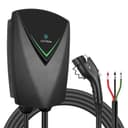
Everything under $400 right now
This list is not written into the page. It is built at request time from the same daily price check that powers every buy button on the site, so a unit that rises above the ceiling leaves the table on its own and a unit that falls into the band joins it without anyone editing this file.
Tracked chargers under $400
Built from the same daily price check that powers every price on this site, not written into this page — these are the chargers we track whose live listing price was under $400 as of November 24, 2026. Cheapest first. A unit that rises above the band drops out of this list on its own.

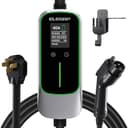
ELEGRP 40A Portable Level 2 Charger
Full 40-amp speed and the longest reach in a portable

Lectron 40A Portable Level 2 Charger
The lowest-cost route to real Level 2, and portability

Ampure Go Portable Level 2 Charger
One charger for the garage and the road, certified for both

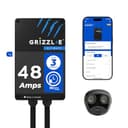
Grizzl-E Classic
Outdoor and cold-climate installs where nothing should need an app

Grizzl-E Classic Connect 40A
A tough plug-in charger that still schedules from an app

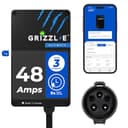
Grizzl-E Ultimate 48A
A hardwired 48-amp charger built for weather, with nothing to log into

Grizzl-E Ultimate 48A NACS
A permanently installed NACS charger built for weather

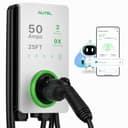
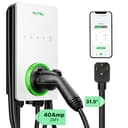
Autel MaxiCharger AC Elite Home 40A
A weather-rated smart charger on an existing 14-50 outlet

Lectron Nexus 48A J1772
48 amps, hardwired, with no account and no firmware

Autel MaxiCharger Home
Fully exposed outdoor installs and extreme climates
10 of the 22 chargers in scope qualify today.
Compare the shape of that list with the same table at $300 and the argument of this page is visible in one glance: the $300 list is portables and plug-in units, and the additions here are hardwiredstations. That is the whole difference. It is also why this band rewards a decision you make before you shop — whether an electrician is coming at all.
What we ranked on
With a ceiling this close to the middle of the market, value stops being the interesting question and four sharper ones replace it.
One: can it be hardwired, and at how many amps?This is what the band is for. Four of our six picks are hardwired or hardwire-capable: the Lectron Nexus and both Grizzl-E Ultimates at 48 A on a 60-amp circuit, and the Autel 50A MaxiCharger at 50 A, which Autel’s own page says needs a 70-amp circuit for full output. The two plug-in picks are capped at 40 amps by the receptacle, not by the product. Hardwired versus plug-in works through the trade properly.
Two: what safety paperwork does the maker publish, and does it name the standard?A badge in a product photo is not a listing. Lectron publishes ETL listing to UL 2594, UL 2231 and UL 2251 plus ENERGY STAR and FCC on the Nexus. Grizzl-E publishes “UL tested and certified” on the Ultimate. ELEGRP publishes ETL certification and states its J1772 plug, cable and 14-50 connector are built with UL-listed components. Autel publishes CSA and ENERGY STAR on the 50A unit and, on the 40A SKU specifically, noUL or ENERGY STAR listing at all — an absence we report rather than borrow from its bigger sibling.
Three: is there a published enclosure rating with a temperature range beside it?A rating on its own is half a claim. Autel’s 50A publishes IP65 / NEMA 4X with −40°F to 131°F, the widest range we have recorded. Grizzl-E publishes UL Type 4 with IP67 sealing and −22°F to 122°F. ELEGRP publishes IP67 on the station, IP54 on the connector, and the same −22°F to 122°F. Lectron publishes IP66 and no temperature range for the Nexus, which is why that unit is deliberately absent from our cold-weather roundup even though it tops this page.
Four: how do you set the amperage, and is the step list published? Every pick here except the ELEGRP can be dialed down to fit a smaller circuit, and the mechanism splits the field: Grizzl-E uses a DIP switch at 16/24/32/40/48 A, Autel sets it in the app over six discrete steps, and the ELEGRP uses a selector at 16/20/24/32/40 A. That matters more than it sounds, because a charger you can set down is a charger that fits the circuit your panel can spare today. The adjustable-amperage roundup has the published step list for every unit we track.
Who should buy at the top of this band, and who should not
Buy the hardwired 48-amp unit if an electrician is coming anyway. When a new circuit is being run, the charger is the small number in the quote. Going from a 50-amp circuit and a plug-in 40-amp charger to a 60-amp circuit and a hardwired 48-amp one adds copper and a bigger breaker, and buys about six more miles of range per hour permanently. If the walls are open, go further and read what to rough in before anyone pulls wire.
Buy the budget pick if the outlet already exists. A NEMA 14-50 on a correctly installed 50-amp circuit caps every charger on earth at 40 amps. At that point the ELEGRP delivers the same current as a unit costing twice as much, on a longer cable than most, and can be unplugged and taken with you. Our 14-50 pagecovers how to tell whether the outlet you have was built for continuous duty — which is the real risk in this scenario, and a bigger one than the charger.
Do not buy at this ceiling to get a smart charger.The Autel 40A is genuinely connected and genuinely good, but if the app is the reason you are shopping, the mature ones — ChargePoint’s and Emporia’s — sit above this band, and your car almost certainly schedules charging for free. The scheduling roundup makes that argument with each maker’s own published feature list.
Where the money you did not spend should go
If a complete 48-amp charger costs under $400, the budget question moves to the parts of the job that are not the charger.
The circuit, specified properly. Six-gauge copper, a 60-amp two-pole breaker, a permit and an inspection are what make a 48-amp charger safe to run at 48 amps for eight hours a night, every night. Wire size and breaker covers what to ask for, and permits and inspection covers what gets checked.
Surge protection. A hardwired charger is a permanently connected electronic device, and recent code editions require surge protection on new and replaced dwelling service equipment anyway. The surge page has the detail; it costs a fraction of the difference between the cheapest and dearest pick here.
Where it goes on the wall.Mounting height, the gap between the wall and the car door, and whether a 23- or 25-foot cable actually reaches your charge port from where the box will live — placement and mounting height has the measuring routine, and the compact roundup has the published dimensions for the few makers that print them.