Level Two Club

Best EV Chargers for Plug-In Hybrids

A plug-in hybrid asks a much smaller question of a charger than a full EV does — a small battery, a modest onboard charger, and a nightly refill that a fraction of a Level 2 unit can handle. Here's how to buy for that without overpaying, and when to overbuy on purpose.

By Stephen V.Last updated How we pick

Almost every “best home charger” list is written for a full battery electric vehicle with a large pack and an onboard charger that can accept 11.5 kW. A plug-in hybrid is a different problem in two ways at once: the battery is a fraction of the size, and the car’s onboard charger— the piece of hardware inside the vehicle that actually converts AC to DC — is usually much smaller too. Buy a 48-amp charger for a PHEV and you will very likely never see 48 amps flow.

So the ranking criteria change. One: the right amperage, not the biggest amperage— a unit that costs less and installs on a smaller circuit is the correct answer when the car cannot use more. Two: install simplicity, because the cheapest way to charge a PHEV is on a receptacle you already have rather than a new hardwired circuit. Three: scheduling, which matters disproportionately here: a PHEV charges quickly, so it is easy to fit the whole session inside a cheap off-peak window. Four: portability, since a plug-in hybrid owner is often testing whether electric driving suits them at all and may not want a fixture bolted to the wall. And five: headroom— the honest case for buying more charger than the current car needs, because the next car probably will.

We own none of these units and have not tested them; the specs below are manufacturer figures from dated visits. Before anything else, find one number: your car’s maximum AC charging power, in kilowatts. It is in the owner’s manual and the manufacturer’s specification page, and it is the number that decides this entire page.

How this is funded: we earn a commission if you buy through our links, at no extra cost to you. It never changes which product we recommend, and we’ll tell you when we’d skip one. Full disclosure.

Quick picks

Ranked on published specs, charging speed, electrical fit and value. Select a row to jump to the full write-up. We have not bench-tested these chargers — here is exactly what we do instead.

#ProductBest forPrice
1
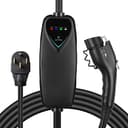
Lectron 40A Portable Level 2 Charger

Lectron 40A Portable Level 2 Charger

One of the cheapest honest ways into real Level 2 charging. Plug it into a NEMA 14-50 outlet, get a genuine 40A / 9.6 kW, and unplug it to take on a trip. No app and a shorter warranty are the trade-offs for the price.

Best budget
$269.99 · View on Amazon

Price as of September 2, 2026. #ad How we’re funded

2
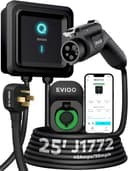
EVIQO 40A NEMA 14-50 Charger

EVIQO 40A NEMA 14-50 Charger

The most charger you can get without an electrician's invoice. It plugs into a NEMA 14-50 outlet for a full 40 amps, keeps the WiFi app, the ENERGY STAR listing and the 25 ft cable from EVIQO's hardwired unit, and can be unplugged and taken with you when you move.

Best overall
$395.98 · View on Amazon

$469.9916% off

Price as of September 2, 2026. #ad How we’re funded

3
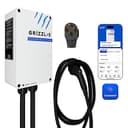
Grizzl-E Smart 40A

Grizzl-E Smart 40A

Grizzl-E's cast-aluminum build with a WiFi radio bolted on. You get the IP67 body and the cold-flexible 25 ft cable that made the brand's name, plus scheduling and usage history in the Grizzl-E Connect app — in a plug-in unit that comes off the wall when you move. The amperage is still set with a DIP switch, which is either charmingly honest or annoyingly analog depending on your taste.

Best build
4
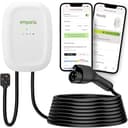
Emporia Level 2 EV Charger

Emporia Level 2 EV Charger

The value pick that doesn't feel cheap: a full 48 amps, ENERGY STAR listing, WiFi with genuine energy monitoring, and a 25 ft cable — for well under what the big names charge. It's the one we point most people to first.

Best energy tracking
$449.00 · View on Amazon

Price as of September 2, 2026. #ad How we’re funded

5
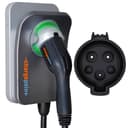
ChargePoint Home Flex

ChargePoint Home Flex

The safest default for most homes: you set the amperage in the app anywhere from 16A to 50A, so one charger fits whatever circuit your panel can spare today and scales up if you upgrade later. The app is the most mature here, and the warranty is long.

Best future-proof
$456.74 · View on Amazon

Price as of September 2, 2026. #ad How we’re funded

The picks in full

#1Best budget

Lectron 40A Portable Level 2 Charger

One of the cheapest honest ways into real Level 2 charging. Plug it into a NEMA 14-50 outlet, get a genuine 40A / 9.6 kW, and unplug it to take on a trip. No app and a shorter warranty are the trade-offs for the price.

Strengths

  • A real 40A / 9.6 kW at a budget price
  • Plug-in and portable — take it with you, no hardwiring
  • ETL listed to UL 2594 / UL 2231 safety standards

Trade-offs

  • No WiFi or app on the base model — the smart version is a separate SKU
  • Shorter 16 ft cable and a 2-year warranty
  • Brand doesn't publish an outdoor/IP enclosure rating
Max output
40 A
Power
9.6 kW
Connector
J1772
Install
NEMA 14-50 plug
Cable length
16 ft
Warranty
2 years
WiFi + app
No
Certifications
ETL listed (UL 2594 / UL 2231)

Our charging-speed math. At 40A (9.6 kW) and ~3.5 miles per kWh it adds roughly 34 miles of range per hour.

Build note. Portable plug-in unit — no hardwiring needed; the base model has no WiFi or app.

Specs read from the manufacturer spec sheet, on July 19, 2026. “Not published” means the brand does not state that figure.

#2Best overall

EVIQO 40A NEMA 14-50 Charger

The most charger you can get without an electrician's invoice. It plugs into a NEMA 14-50 outlet for a full 40 amps, keeps the WiFi app, the ENERGY STAR listing and the 25 ft cable from EVIQO's hardwired unit, and can be unplugged and taken with you when you move.

Strengths

  • Plugs into an existing NEMA 14-50 outlet — no hardwiring, and it comes with you
  • Real WiFi app with 6-40A adjustment, scheduling and energy tracking
  • 25 ft charging cable plus a 40 in input lead, in an IP66 / NEMA 4 body

Trade-offs

  • 40 amps is the plug-in ceiling — for 48A you need the hardwired version
  • Needs a proper EV-grade 14-50 receptacle (an old dryer outlet is not the same thing)
  • Smaller brand with a shorter track record than ChargePoint or Wallbox
Max output
40 A
Power
9.6 kW
Connector
J1772
Install
NEMA 14-50 plug
Cable length
25 ft
Warranty
3 years
WiFi + app
Yes
Certifications
UL, ETL, FCC, ENERGY STAR

Our charging-speed math. At 40A (9.6 kW) and ~3.5 miles per kWh it adds roughly 34 miles of range per hour — an overnight charge for almost any daily commute.

Build note. Plug-in Gen-2 unit: 25 ft charging cable plus a 40 in NEMA 14-50 input lead, with app-adjustable output from 6 to 40 amps.

Specs read from the manufacturer spec sheet, on August 11, 2026. “Not published” means the brand does not state that figure.

#3Best build

Grizzl-E Smart 40A

Grizzl-E's cast-aluminum build with a WiFi radio bolted on. You get the IP67 body and the cold-flexible 25 ft cable that made the brand's name, plus scheduling and usage history in the Grizzl-E Connect app — in a plug-in unit that comes off the wall when you move. The amperage is still set with a DIP switch, which is either charmingly honest or annoyingly analog depending on your taste.

Strengths

  • Cast-aluminum NEMA 4 / IP67 body rated -22F to 122F, in a plug-in unit
  • WiFi and the Grizzl-E Connect app for scheduling, usage history and remote lockout
  • 25 ft output cable, and OCPP 1.6J support if you ever want third-party software

Trade-offs

  • 40 amps is the plug-in ceiling — no 48A option in this model
  • Amperage is set by a physical DIP switch, not in the app
  • Grizzl-E's own pages don't publish an ENERGY STAR certification for this model
Max output
40 A
Power
9.6 kW
Connector
J1772
Install
NEMA 14-50 plug
Cable length
25 ft
Warranty
3 years
WiFi + app
Yes
Certifications
UL tested and certified

Our charging-speed math. At 40A (9.6 kW) and ~3.5 miles per kWh it adds roughly 34 miles of range per hour. The DIP switch also sets 32, 24 or 16 amps if your circuit is smaller.

Build note. Cast-aluminum enclosure with IP67 sealing, rated -30C to +50C (-22F to 122F); 25 ft output cable on an 18 in input lead, current set by DIP switch (16/24/32/40 A), status on an LED, and WiFi to the Grizzl-E Connect app.

Specs read from the manufacturer spec sheet, on August 12, 2026. “Not published” means the brand does not state that figure.

#4Best energy tracking

Emporia Level 2 EV Charger

The value pick that doesn't feel cheap: a full 48 amps, ENERGY STAR listing, WiFi with genuine energy monitoring, and a 25 ft cable — for well under what the big names charge. It's the one we point most people to first.

Strengths

  • 48A output and ENERGY STAR at a value price
  • The app actually tracks energy use, not just on/off
  • Long 25 ft cable and a remote holster in the box

Trade-offs

  • 48A hardwired needs a 60A circuit; on a NEMA 14-50 plug it's limited to 40A
  • App polish trails ChargePoint's, and support is smaller
Max output
48 A
Power
11.5 kW
Connector
J1772
Install
Hardwired or NEMA 14-50 plug
Cable length
25 ft
Warranty
3 years
WiFi + app
Yes
Certifications
UL listed, ENERGY STAR

Our charging-speed math. At 48A (11.5 kW) and ~3.5 miles per kWh it adds about 40 miles of range per hour hardwired; on a 40A plug-in circuit, about 34.

Build note. 48A hardwired, or 40A on a NEMA 14-50 outlet, with a 25 ft cable and remote holder.

Specs read from the manufacturer spec sheet, on July 19, 2026. “Not published” means the brand does not state that figure.

#5Best future-proof

ChargePoint Home Flex

The safest default for most homes: you set the amperage in the app anywhere from 16A to 50A, so one charger fits whatever circuit your panel can spare today and scales up if you upgrade later. The app is the most mature here, and the warranty is long.

Strengths

  • Adjustable 16-50A means it fits a small panel now and a bigger circuit later
  • The most mature app of the group — scheduling, reminders, usage history
  • 3-year warranty and a long 23 ft cable

Trade-offs

  • You pay a premium over value 48A chargers for the app and brand
  • Full 50A output needs a 60A circuit most older panels don't have to spare
Max output
50 A
Power
12 kW
Connector
J1772
Install
Hardwired (plug-in NEMA 14-50 SKU also sold)
Cable length
23 ft
Warranty
3 years
WiFi + app
Yes
Certifications
UL/cUL listed, ENERGY STAR

Our charging-speed math. At its 50A max (12 kW) and a typical 3.5 miles per kWh, the Home Flex adds roughly 42 miles of range per hour. Dial it down to 40A to fit a 50A circuit and you get about 34.

Build note. Flexible amperage is adjustable in the app from 16A up to 50A.

Specs read from the manufacturer spec sheet, on July 19, 2026. “Not published” means the brand does not state that figure.

The number that decides everything: your car’s onboard charger

There are two chargers involved in charging any plug-in vehicle. The box on the wall is not really one of them — as we explain in how Level 2 charging works, that unit is a safety-controlled switch that offers AC power. The actual charger is inside the car, and its rating is a hard ceiling.

On full battery-electric vehicles, onboard chargers are usually generous, which is why 48-amp home units make sense. Plug-in hybrids are built to a different brief: a small battery that needs to be refilled overnight, not quickly, so manufacturers fit a smaller and cheaper onboard charger. The practical consequence is blunt — a plug-in hybrid connected to a 48-amp charger will draw exactly as much as its onboard charger permits and not one amp more.

So find the figure for your specific model, in kilowatts, from the owner’s manual or the manufacturer’s specification page. Then:

  • Amps the car will draw = kilowatts ÷ 240 × 1,000. A car rated at 3.6 kW draws about 15 amps; one rated at 7.2 kW draws about 30.
  • Circuit you need = that amperage × 1.25, because EV charging is a continuous load under the NEC. A 15-amp draw wants a 20-amp circuit; a 30-amp draw wants a 40-amp circuit.
  • Everything above that is unusable.Not wasted energy — there is no efficiency penalty — just capacity you paid to install and will never see.
Published maximum output and install type. For a plug-in hybrid the charger’s maximum is almost never the limit — the car’s onboard charger is.
ChargerMax ampsInstallCableApp
Lectron 40A Portable Level 2 Charger40 ANEMA 14-50 plug16 ftNo
EVIQO 40A NEMA 14-50 Charger40 ANEMA 14-50 plug25 ftYes
Grizzl-E Smart 40A40 ANEMA 14-50 plug25 ftYes
Emporia Level 2 EV Charger48 AHardwired or NEMA 14-50 plug25 ftYes
ChargePoint Home Flex50 AHardwired (plug-in NEMA 14-50 SKU also sold)23 ftYes

Be honest about whether you need Level 2 at all

This is the part of the page that costs us money to write, so here it is plainly. DOE puts Level 1 charging at 2 to 5 miles of range added per hour. Across a ten-hour overnight window that is roughly 20 to 50 miles— which for a great many plug-in hybrids is the entire electric range, replenished from a standard household outlet using the cable that came in the trunk, for nothing.

If that describes your car and your driving, you may not need anything on this page. The case for Level 2 on a plug-in hybrid is real but specific:

  • You want to top up during the day. A PHEV that refills in 90 minutes on Level 2 can do the school run electric, recharge, and do the evening trip electric too. On Level 1 it does one of those.
  • You have no convenient 120-volt outlet.Detached garage, on-street parking, an extension-cord arrangement you are not comfortable with — a proper 240-volt circuit solves a safety problem, not just a speed one.
  • You are on a time-of-use rate with a narrow cheap window. If the off-peak period is five hours long, you want the car to finish inside it. See our time-of-use guide.
  • A full EV is coming. Then you are really buying for that car, and you should read our 40-amp roundup instead.

The picks, and who each suits

The Lectron 40A portableis the budget answer and, for a lot of PHEV owners, the correct one. It plugs into a NEMA 14-50 receptacle, delivers a real 40 amps for a car that can take it, and unplugs to travel. No app, a shorter 16-foot cable and a two-year warranty are the trade-offs, and Lectron does not publish an outdoor enclosure rating — so keep it indoors or sheltered. For a small battery that cannot use fancy features anyway, that is a lot of function for a little money. Read the Lectron 40A review.

The EVIQO 40A is our overall pick here because of one specification that is unusually well matched to plug-in hybrids: its output is app-adjustable from 6 to 40 amps. That low floor means it can be set to exactly what your car draws and installed on a correspondingly small circuit — which is how you get a proper, weather-rated, ENERGY STAR-listed charger onto a modest panel without an expensive new run. It keeps the 25-foot cable and IP66/NEMA 4 body of EVIQO’s hardwired unit and plugs into a 14-50. See the EVIQO 40A review.

The Grizzl-E Smartis the pick if the charger is going somewhere exposed. It is a cast-aluminum, NEMA 4 / IP67 unit rated from -22°F to 122°F with a 25-foot cable, and it plugs in rather than hardwiring — a rare combination. Amperage is set on a DIP switch at 16, 24, 32 or 40 amps, which fits the “set it to what the car takes and forget it” approach perfectly. Grizzl-E does not publish an ENERGY STAR certification for this model. Read the Grizzl-E Smart review.

The Emporia Level 2earns its place on energy monitoring. Plug-in hybrid owners are, by definition, running an experiment in how much of their driving can be electric — and a charger that tells you exactly how many kilowatt-hours went into the car each night turns that from a feeling into a number. Combine it with our cost-to-charge calculatorand you can see precisely what you are saving against gasoline. It runs at 40 amps on a 14-50 plug or 48 hardwired — more than a PHEV needs, at a value price. See the Emporia review.

The ChargePoint Home Flexis the deliberate overbuy: 16 to 50 amps set in the app, so it can run at 16 amps for the plug-in hybrid today and 48 for whatever replaces it, with no new hardware. That only makes sense if you install the bigger circuit now, which is where the cost lives — but doing the electrical work once instead of twice is a genuine saving if a full EV is on the horizon. Read the Home Flex review.

Charging habits that matter more for a PHEV than an EV

Two behaviors are worth more to a plug-in hybrid owner than any hardware choice on this page.

Plug in every single time.A PHEV’s economics depend entirely on how many of your miles are electric. Because the battery is small, a single missed charge costs a much larger share of your electric driving than it would on a full EV — and unlike an EV, the car will simply burn gasoline instead and never tell you off. The convenience argument for Level 2 is really an argument about making it easy enough that you always bother.

Charge in the cheap window. A short session is easy to schedule entirely inside an off-peak rate, which is where the real running-cost savings are. Every charger here except the Lectron can schedule from its own app; every modern plug-in hybrid can schedule from the car. Use one or the other, and see our electric bill guide for what it does to the monthly total.

One last note on connectors. DOE states that Level 1 and Level 2 charging both use the SAE J1772connector, and that most plug-in hybrids cannot DC fast charge at all — so the NACS transition that dominates EV charging conversations is largely beside the point for a PHEV. Buy a standard J1772 charger and ignore the connector debate; our J1772 vs NACS guide has the full picture if you want it.
Frequently asked questions

Do plug-in hybrids need a Level 2 charger?

Need is a strong word — most PHEVs will refill overnight from an ordinary 120-volt outlet, because the battery is small. DOE puts Level 1 at 2 to 5 miles of range added per hour, which across ten hours is 20 to 50 miles, and that covers a typical PHEV's entire electric range. Level 2 is a convenience upgrade for PHEVs rather than a necessity: it lets you top up between trips during the day, which for a plug-in hybrid can mean several electric commutes instead of one.

What size charger does a plug-in hybrid need?

Whatever matches your car's onboard charger, which on plug-in hybrids is typically far below what a 40-amp unit can supply. Find the maximum AC charging power in kilowatts in your owner's manual, divide by 240 volts, and that is the amperage the car will actually draw. Anything above that is capacity you paid for and cannot use. If the manual says the car accepts 3.6 kW, it will draw about 15 amps regardless of whether the charger on the wall can supply 16 or 80.

Can I use a Level 2 charger on a PHEV without damaging the battery?

Yes. The car controls the charging session, not the charger — the wall unit offers a maximum current and the vehicle draws only what its onboard charger and battery management system permit. That negotiation is defined in the J1772 standard and is why any listed Level 2 charger is safe on any J1772 vehicle. Plugging a small PHEV into a 48-amp charger does not force 48 amps into it any more than a large water main forces water into a small cup.

Is it worth buying a 48-amp charger for a plug-in hybrid?

Only as a bet on your next car. For the PHEV itself, the extra amps are unusable and the bigger circuit costs real money — a 60-amp circuit instead of a 50 or 30 amp one, with heavier conductors. If you expect to replace the PHEV with a full EV within a few years and the panel has room, buying the bigger charger now and running it at a lower setting can save doing the job twice. If not, buy for the car you have.

Do plug-in hybrids use the same charging connector as EVs?

For home charging, yes. DOE states that Level 1 and Level 2 charging both use the SAE J1772 connector, which is what nearly every plug-in hybrid sold in North America accepts. The NACS transition affects DC fast charging and Tesla-derived connectors; it is largely irrelevant to PHEVs, because DOE notes most plug-in hybrids cannot DC fast charge at all. A standard J1772 home charger is the right buy.

Should I get a portable charger or a wall-mounted one for a PHEV?

Portable is a genuinely strong option for plug-in hybrid owners. A plug-in unit on an existing NEMA 14-50 receptacle costs nothing to install, comes with you if you move or change cars, and can travel to a holiday rental. Because a PHEV's charging demands are modest, you are giving up very little by choosing the portable route. Renters and anyone unsure how long they will keep the car should start there.

Sources

Keep reading