Level Two Club

Best EV Chargers for the Cadillac LYRIQ

Most EVs make the home-charger question easy: one onboard charger, one connector, buy the 48-amp unit. The LYRIQ is not most EVs. Cadillac fits two different onboard chargers depending on trim, and the 2027 car moved to a NACS port. Get those two facts about your own car first, and the right charger follows.

By Stephen V.Last updated How we pick

Two things about the LYRIQ decide this purchase, and both are on Cadillac’s own trim sheet. First, the onboard charger: the Luxury and LYRIQ-V trims list an 11.5 kW AC onboard charging module, while the Premium Luxury, Signature and LYRIQ-V Premium trims list a 19.2 kW module alongside the dual-motor all-wheel-drive system. That is the difference between a 48-amp home charger and an 80-amp one — and between a 60-amp circuit and a 100-amp one. Second, the port: the 2027 LYRIQ lists a North American Charging System (NACS) onboard charge port as standard, which changes which cable plugs in without an adapter.

So this roundup is organized around those two facts rather than around a single “best.” We ranked on: whether the charger can feed your trim’s onboard module at its full rate; whether its cable matches your port or needs an adapter; what circuit it demands, because 19.2 kW is a 100-amp circuit and that is a real electrical decision; and the usual rails — a named safety listing, a published enclosure rating and, where it exists, an ENERGY STAR mark. Every speed figure is our own arithmetic from the charger’s rated amps, and the LYRIQ figures are Cadillac’s.

One honest limit: Cadillac’s page does not publish the battery capacity, a Level 2 charging time, or whether a charge cord or adapter is in the box. We do not fill those gaps. Check what came with your car, and check which port shape it has — a LYRIQ from an earlier model year may carry the J1772-shaped port, in which case the J1772 picks below plug in directly and the NACS picks need an adapter, the reverse of the 2027 car.

How this is funded: we earn a commission if you buy through our links, at no extra cost to you. It never changes which product we recommend, and we’ll tell you when we’d skip one. Full disclosure.

Quick picks

Ranked on published specs, charging speed, electrical fit and value. Select a row to jump to the full write-up. We have not bench-tested these chargers — here is exactly what we do instead.

#ProductBest forPrice
1
ChargePoint Home Flex NACS

ChargePoint Home Flex NACS

The Home Flex smarts with a factory NACS cable. Tesla owners who want ChargePoint's mature app and adjustable 16-50A amperage — rather than a plain no-app NACS unit — pay a premium for exactly that.

Best overall for a NACS-port LYRIQ
$516.71 · View on Amazon

Price as of September 20, 2026. #ad How we’re funded

2
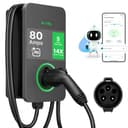
Autel MaxiCharger 80A

Autel MaxiCharger 80A

The ceiling of home AC charging: 19.2 kW on a 100-amp circuit, which is roughly double what a 48-amp charger does. Almost no car can actually take it — most cap their onboard charger somewhere between 7.7 and 11.5 kW — so buy this for a specific vehicle that accepts 80 amps, or for a future-proofed circuit you already have. Otherwise it is a very good, very expensive 48-amp charger.

Best for the 19.2 kW trims
$1,299.00 · View on Amazon

Price as of September 20, 2026. #ad How we’re funded

3
Lectron Nexus NACS (Tesla) Charger

Lectron Nexus NACS (Tesla) Charger

For a Tesla owner who doesn't want to babysit an adapter: a native NACS (J3400) connector plugs straight into the car, at a full 48 amps, with the safety listings you want. No app, but Teslas schedule charging in the car anyway.

Best NACS charger without an app
$429.99 · View on Amazon

$459.997% off

Price as of September 20, 2026. #ad How we’re funded

4
ChargePoint Home Flex

ChargePoint Home Flex

The safest default for most homes: you set the amperage in the app to 16, 24, 32, 40, 48 or 50A, so one charger fits whatever circuit your panel can spare today and scales up if you upgrade later. The app is the most mature here, firmware arrives over the air, and the warranty is long.

Best for a J1772-port LYRIQ
$538.02 · View on Amazon

Price as of September 20, 2026. #ad How we’re funded

5
EVIQO 48A Level 2 Charger

EVIQO 48A Level 2 Charger

A lot of charger for the money: a full 48 amps, WiFi with scheduling, ENERGY STAR, and the longest usable reach in this group thanks to a 25 ft cable plus a 40-inch input lead. A strong value alternative to Emporia if you want maximum reach.

Best value at 48 amps
$429.99 · View on Amazon

$479.0010% off

Price as of September 20, 2026. #ad How we’re funded

6
Grizzl-E Duo Connect 40A

Grizzl-E Duo Connect 40A

One box, two cables, one circuit. The Duo Connect lets a two-EV household charge both cars overnight without a second charger, a second breaker or a panel upgrade — because it splits one 40-amp supply between the connectors rather than doubling it. That is the whole trade: convenience and a much cheaper install, at half the speed each when both cars are plugged in.

Best for a LYRIQ plus a second EV
$899.99 · View on Amazon

Price as of September 20, 2026. #ad How we’re funded

The picks in full

#1Best overall for a NACS-port LYRIQ

ChargePoint Home Flex NACS

The Home Flex smarts with a factory NACS cable. Tesla owners who want ChargePoint's mature app and adjustable 16-50A amperage — rather than a plain no-app NACS unit — pay a premium for exactly that.

Strengths

  • Native NACS cable with ChargePoint's flexible 16-50A amperage
  • The most mature app of the NACS options here
  • 3-year warranty and outdoor-rated NEMA 3R body

Trade-offs

  • Priciest NACS pick — you're paying for the app and brand
  • 50A output needs a 60A circuit to use fully
Max output
50 A
Power
12 kW
Connector
NACS
Install
Hardwired
Cable length
23 ft
Warranty
3 years
WiFi + app
Yes
Certifications
UL/cUL listed, ENERGY STAR

Our charging-speed math. At its 50A max (12 kW) and ~3.5 miles per kWh, roughly 42 miles of range per hour into a Tesla.

Build note. Same Home Flex hardware with a factory NACS cable for Tesla and NACS EVs.

Specs read from the manufacturer spec sheet, on July 19, 2026. “Not published” means the brand does not state that figure.

#2Best for the 19.2 kW trims

Autel MaxiCharger 80A

The ceiling of home AC charging: 19.2 kW on a 100-amp circuit, which is roughly double what a 48-amp charger does. Almost no car can actually take it — most cap their onboard charger somewhere between 7.7 and 11.5 kW — so buy this for a specific vehicle that accepts 80 amps, or for a future-proofed circuit you already have. Otherwise it is a very good, very expensive 48-amp charger.

Strengths

  • 80 A / 19.2 kW — the fastest AC charging you can install at a house
  • Output adjustable from 6 A to 80 A in the app, so it can be dialed to any circuit
  • NEMA 3S / IK10 enclosure rated -40F to 131F, with UL and CSA listings and ENERGY STAR

Trade-offs

  • Needs a 100-amp circuit for full output — a service upgrade for most homes
  • Very few EVs accept more than 11.5 kW on AC, so the extra amps often go unused
  • Autel's own pages disagree on the warranty term (5 years on the body vs 3 extendable to 5)
Max output
80 A
Power
19.2 kW
Connector
J1772
Install
Hardwired
Cable length
25 ft
Warranty
5 years
WiFi + app
Yes
Certifications
UL 2594, UL 2231-1/2, UL 1998, CSA C22.2 No. 280, ENERGY STAR

Our charging-speed math. At its full 80A (19.2 kW) and ~3.5 miles per kWh it would add roughly 67 miles of range per hour — but only into a car that accepts 19.2 kW on AC. Dialed to 48A (11.5 kW) it is about 40 miles per hour, the same as any other 48-amp charger.

Build note. Hardwired 19.2 kW unit with a 25 ft cable; output is adjustable 6-80 A in the Autel Charge app and by DIP switch (16/24/32/40/48/50/64/72/80 A), in a NEMA 3S / IK10 enclosure rated -40F to 131F, with WiFi, Ethernet and RS485.

Specs read from the manufacturer spec sheet, on August 12, 2026. “Not published” means the brand does not state that figure.

#3Best NACS charger without an app

Lectron Nexus NACS (Tesla) Charger

For a Tesla owner who doesn't want to babysit an adapter: a native NACS (J3400) connector plugs straight into the car, at a full 48 amps, with the safety listings you want. No app, but Teslas schedule charging in the car anyway.

Strengths

  • Native NACS connector — no J1772-to-Tesla adapter to lose
  • Full 48A output and a weather-rated IP66 body
  • UL/ETL safety listings plus ENERGY STAR

Trade-offs

  • No WiFi app — you schedule in the Tesla app instead
  • NACS connector is best for Tesla/NACS cars; other EVs need a NACS-to-J1772 adapter
Max output
48 A
Power
11.5 kW
Connector
NACS
Install
Hardwired
Cable length
23 ft
Warranty
3 years
WiFi + app
No
Certifications
UL 2594/2231/2251 (ETL listed), ENERGY STAR, FCC

Our charging-speed math. At 48A (11.5 kW) and ~3.5 miles per kWh, about 40 miles of range per hour into a Tesla.

Build note. Native NACS (J3400) connector plugs straight into a Tesla with no adapter; includes a holster.

Specs read from the manufacturer spec sheet, on July 19, 2026. “Not published” means the brand does not state that figure.

#4Best for a J1772-port LYRIQ

ChargePoint Home Flex

The safest default for most homes: you set the amperage in the app to 16, 24, 32, 40, 48 or 50A, so one charger fits whatever circuit your panel can spare today and scales up if you upgrade later. The app is the most mature here, firmware arrives over the air, and the warranty is long.

Strengths

  • Adjustable 16-50A means it fits a small panel now and a bigger circuit later
  • The most mature app of the group — scheduling, reminders, usage history, over-the-air firmware
  • 3-year warranty and a long 23 ft cable
  • Sold hardwired or on a NEMA 6-50 or NEMA 14-50 plug, in J1772 or NACS

Trade-offs

  • You pay a premium over value 48A chargers for the app and brand
  • Full 50A output needs a 60A circuit most older panels don't have to spare
  • The plug-in SKUs cap at 40A, so the top speed is a hardwired-only feature
Max output
50 A
Power
12 kW
Connector
J1772
Install
Hardwired, NEMA 6-50 or NEMA 14-50
Cable length
23 ft
Warranty
3 years
WiFi + app
Yes
Certifications
UL/cUL listed, ENERGY STAR

Our charging-speed math. At its 50A max (12 kW) and a typical 3.5 miles per kWh, the Home Flex adds roughly 42 miles of range per hour. Dial it down to 40A to fit a 50A circuit and you get about 34. ChargePoint's own, more conservative claim is up to 37 miles per hour hardwired and 30 on the plug-in SKUs.

Build note. Amperage is set in the app to 16, 24, 32, 40, 48 or 50A. The plug-in SKUs are capped at 40A, so the full 50A is a hardwired-only figure. UL and cUL listed per UL 2594 and UL 2231; firmware updates over the air, and the station stores up to 90 days of session data locally if the network drops.

Specs read from the manufacturer spec sheet, on September 3, 2026. “Not published” means the brand does not state that figure.

#5Best value at 48 amps

EVIQO 48A Level 2 Charger

A lot of charger for the money: a full 48 amps, WiFi with scheduling, ENERGY STAR, and the longest usable reach in this group thanks to a 25 ft cable plus a 40-inch input lead. A strong value alternative to Emporia if you want maximum reach.

Strengths

  • 48A output with WiFi scheduling at a value price
  • 25 ft charging cable plus a 40 in input cable — excellent reach
  • UL, ETL, FCC and ENERGY STAR listings

Trade-offs

  • Hardwired version needs a 60A circuit and an electrician
  • Smaller brand with a shorter track record than ChargePoint or Wallbox
Max output
48 A
Power
11.5 kW
Connector
J1772
Install
Hardwired
Cable length
25 ft
Warranty
3 years
WiFi + app
Yes
Certifications
UL, ETL, FCC, ENERGY STAR

Our charging-speed math. At 48A (11.5 kW) and ~3.5 miles per kWh, about 40 miles of range per hour.

Build note. Ships with a 25 ft charging cable plus a 40 in input cable — among the longest reach in class.

Specs read from the manufacturer spec sheet, on July 19, 2026. “Not published” means the brand does not state that figure.

#6Best for a LYRIQ plus a second EV

Grizzl-E Duo Connect 40A

One box, two cables, one circuit. The Duo Connect lets a two-EV household charge both cars overnight without a second charger, a second breaker or a panel upgrade — because it splits one 40-amp supply between the connectors rather than doubling it. That is the whole trade: convenience and a much cheaper install, at half the speed each when both cars are plugged in.

Strengths

  • Charges two EVs from one 40 A circuit — no second breaker, no panel upgrade
  • Grizzl-E's cast-aluminum, IP67-sealed body with two 25 ft cold-flexible cables
  • Per-connector current limits and scheduling in the Grizzl-E Connect app

Trade-offs

  • 40 A is the TOTAL, not per car — two cars charging at once get about 4.8 kW each
  • Costs roughly what two single chargers cost, so the saving is in the wiring, not the box
  • This Amazon SKU is NACS-to-NACS; a mixed-fleet household needs a different cable pairing
Max output
40 A
Power
9.6 kW
Connector
NACS
Install
NEMA 14-50 plug or hardwired
Cable length
25 ft
Warranty
Not published
WiFi + app
Yes
Certifications
UL tested and certified

Our charging-speed math. The 40 A / 9.6 kW rating is for the whole unit. One car alone gets the full 9.6 kW — about 34 miles of range per hour at ~3.5 mi/kWh. Two cars at once split it: roughly 4.8 kW, or about 17 miles per hour, each.

Build note. Two 25 ft output cables from a single cast-aluminum, IP67-sealed body rated -30C to +50C, with an LED per connector and a DIP-switch current selector (16/24/32/40 A). Grizzl-E states dual charging automatically splits the available current in half, or you can set each connector's current in the Grizzl-E Connect app.

Specs read from the manufacturer spec sheet, on August 12, 2026. “Not published” means the brand does not state that figure.

Each pick against the LYRIQ’s published onboard chargers. Rated amps are the brand’s; the kW and circuit figures are our arithmetic (amps x 240 V; NEC 125% continuous-load rule). “Adapter on a NACS port” means a J1772 cable needs a J1772-to-NACS adapter on the 2027 car.
ChargerRated ampsWhat it feedsPortCircuit needed
ChargePoint Home Flex NACS50 A11.5 kW module in full (12 kW at 50 A)NACS - plugs straight in70 A hardwired (60 A at 48 A)
Autel MaxiCharger 80A80 A19.2 kW module in full (19.2 kW at 80 A)J1772 cable - adapter on a NACS port100 A hardwired
Lectron Nexus NACS (Tesla) Charger48 A11.5 kW module in full (11.5 kW at 48 A)NACS - plugs straight in60 A hardwired
ChargePoint Home Flex50 A11.5 kW module in full (12 kW at 50 A)J1772 cable - adapter on a NACS port70 A hardwired / 50 A plug-in at 40 A
EVIQO 48A Level 2 Charger48 A11.5 kW module in full (11.5 kW at 48 A)J1772 cable - adapter on a NACS port60 A hardwired
Grizzl-E Duo Connect 40A40 A9.6 kW to one car; ~4.8 kW each to twoNACS x2 (this SKU)50 A plug-in or hardwired

Step one: which onboard charger does your LYRIQ have?

The charger on your wall is a switch; the device that actually converts AC to the DC the battery stores is inside the car, and its rating is the ceiling on home charging speed. Cadillac publishes two for the LYRIQ. The Luxury trim’s standard features list an 11.5 kW AC onboard charging module; the LYRIQ-V lists the same. The Premium Luxury, Signature Luxury, Signature Sport and LYRIQ-V Premium trims list a 19.2 kW AC onboard charging module together with the dual-motor all-wheel-drive system. If you are not sure which you have, the window sticker or the vehicle’s own charging screen will say; our onboard charger explainer covers where to look.

The arithmetic is simple. 11.5 kW at 240 V is 48 amps, which under the NEC 125% continuous-load rule needs a 60-amp circuit. 19.2 kW is 80 amps, which needs a 100-amp circuit. A 48-amp charger on a 19.2 kW LYRIQ charges it at 11.5 kW and wastes nothing but potential; an 80-amp charger on an 11.5 kW LYRIQ charges it at 11.5 kW and wastes the price difference. Buy for the module you have.

What that means in miles: by our reference arithmetic at about 3.5 miles per kWh, 11.5 kW adds roughly 40 miles of range per hour and 19.2 kW roughly 67. The LYRIQ is a large SUV and will do worse than that reference figure in practice; Cadillac publishes an EPA-estimated 326 miles of range for RWD models but not an efficiency figure, so treat both numbers as an upper bound and scale them by your own car’s displayed consumption. Even at a pessimistic figure, an overnight window on 11.5 kW covers a full day’s driving for almost anyone, which is the honest case against the 100-amp circuit.

Step two: which port?

Cadillac lists a NACS onboard charge port as standard on the 2027 LYRIQ. A NACS charger plugs straight in. A J1772 charger — still the majority of home units sold, and every J1772 pick below — needs a J1772-to-NACS adapter on that car. Adapters are passive: as Lectron’s FAQ puts it, they “don’t generate power — they only enable compatibility between chargers and vehicles,” and Lectron rates its J1772-to-Tesla adapter — the same NACS shape — to 80 amps, so a listed adapter is not a bottleneck even for the 19.2 kW trims. Confirm the adapter maker lists your vehicle before buying one, and check whether Cadillac included one with your car, which its page does not state either way.

If your LYRIQ has the J1772-shaped port instead, the picture flips: the J1772 picks plug in directly and the NACS picks would need the opposite adapter. Our connector guide explains the two shapes and the transition between them.

Step three: what will the panel allow?

A 60-amp circuit for a 48-amp charger is routine on a 200-amp service and often possible on 150. A 100-amp circuit for an 80-amp charger is half a 200-amp service on one breaker, and a proper load calculation will frequently say no without a service upgrade. That is the hidden cost of the 19.2 kW module: the charger is the smaller line on the bill. If the panel says no, the Autel 80A below can be dialed down to 48 amps in its app and run on a 60-amp circuit today, then turned up after an upgrade — which is the one good argument for buying it before the circuit exists. Our install cost guide covers what each tier adds.

How we separated them

ChargePoint Home Flex NACS takes the top slot for the 2027 car: a factory NACS cable, 50 amps hardwired (12 kW, comfortably over the 11.5 kW module), output set in the app to 16, 24, 32, 40, 48 or 50 amps so it can start on a 60-amp circuit, UL/cUL listed to UL 2594 and 2231 with ENERGY STAR, and the most established app in the category. The cons are the premium price, the 23 ft cable and a Type 3R enclosure that is the lowest sealing rating on this page. It cannot feed the 19.2 kW module; if you have one, read the next pick.

Autel MaxiCharger 80Ais the only charger in our registry that can feed a 19.2 kW LYRIQ at its full rate: 80 amps, adjustable from 6 to 80 in the app and by DIP switch, in a NEMA 3S enclosure rated to -40°F, with UL 2594 and CSA listings and ENERGY STAR. Two honest cons. The Amazon unit we link carries a J1772 cable, so on a NACS-port LYRIQ it needs an 80-amp-rated adapter (Autel’s own product page lists a NACS cable option, but that is not the SKU we link). And Autel’s two pages disagree on the warranty term — five years on the store listing, three extendable to five on the product page. It is also, by a wide margin, the most expensive charger here, and the 100-amp circuit is a second bill.

Lectron Nexus NACSis the no-app NACS answer: 48 amps, 11.5 kW — exactly the standard module’s rating — in an IP66 housing with a 23 ft cable, ETL listed to UL 2594 / 2231 / 2251 with ENERGY STAR, and a 3-year warranty, in a lower price tier than the ChargePoint. The con is that there is no app and Lectron publishes no operating-temperature range; the LYRIQ itself schedules charging, so for many owners the app was never load-bearing.

ChargePoint Home Flex (J1772) is the pick for a LYRIQ with the J1772-shaped port, and a reasonable one for a 2027 car if you already own the adapter or expect to share the charger with a J1772 car. Same 50-amp hardware, same app, plus plug-in versions on a NEMA 14-50 or 6-50 that ChargePoint caps at 40 amps. On a NACS port it is an adapter-every-time proposition, which is why it ranks below the NACS version here.

EVIQO 48Ais the value 48-amp unit: 11.5 kW hardwired, a 25 ft cable plus a 40-inch input lead for the longest reach on this page, IP66 / NEMA 4, UL / ETL / FCC listings and ENERGY STAR, 3-year warranty extendable to four. J1772 cable, so the adapter note applies on a 2027 car. The Emporia Level 2 would normally sit beside it as the other value 48-amp unit; on the day we published, its Amazon listing read “Currently unavailable,” and we do not feature a product we cannot verify is purchasable. (The listing has since been re-resolved to an in-stock SKU; it remains on our 48-amp page.)

Grizzl-E Duo Connectis for the household adding a LYRIQ to an existing EV. Two 25 ft cables from one cast-aluminum IP67 body on one 40-amp supply; Grizzl-E states the current splits in half automatically or per connector in the app. The SKU we link is the NACS-to-NACS pairing — right for two NACS-port cars, wrong for a mixed pair, which Grizzl-E sells direct. The con is built into the design: 40 amps total means each car gets about 4.8 kW when both charge, and one LYRIQ alone gets 9.6 kW, under either module’s rating. Our two-car roundup works the amps.

What we left off, and why

Every 40-amp plug-in unit — EVIQO 40A, Grizzl-E Classic Connect, the Lectron and ELEGRP portables — because 9.6 kW under-feeds even the standard LYRIQ module and a hardwired 48-amp unit costs about the same; they are on our 40-amp page for owners whose panel limits them to a 50-amp circuit. The Wallbox Pulsar Plus and Emporia Pro, both 48-amp smart units that would feed the standard module and add nothing over the picks here for a LYRIQ specifically. And the Emporia Level 2, for the availability reason above.

The short version, by LYRIQ

2027 LYRIQ, 11.5 kW module: ChargePoint Home Flex NACS if you want the app, Lectron Nexus NACS if you do not. A 60-amp circuit either way. 2027 LYRIQ, 19.2 kW module:the Autel 80A on a 100-amp circuit with an 80-amp-rated adapter — or, if the load calculation says no, any 48-amp pick and accept 11.5 kW, which is still a full charge overnight. J1772-port LYRIQ: the ChargePoint Home Flex or the EVIQO 48A, straight in. Two EVs: the Grizzl-E Duo in the cable pairing that matches both cars.
Frequently asked questions

What Level 2 charger does a Cadillac LYRIQ need?

A 48-amp (11.5 kW) hardwired charger on a 60-amp circuit feeds the standard 11.5 kW onboard module Cadillac lists on the Luxury and LYRIQ-V trims at its full rate. The Premium Luxury, Signature and LYRIQ-V Premium trims list a 19.2 kW module, which only an 80-amp charger on a 100-amp circuit can feed in full. Match the charger to the module your trim has.

Does the Cadillac LYRIQ use NACS or J1772?

Cadillac lists a North American Charging System (NACS) onboard charge port as standard on the 2027 LYRIQ. A NACS charger plugs straight in; a J1772 charger needs a J1772-to-NACS adapter. If your LYRIQ has the J1772-shaped port instead, the reverse applies. Check the port on your own car rather than assuming from the model year.

What is the LYRIQ 19.2 kW charging module?

An optional higher-capacity onboard AC charger that Cadillac lists on the dual-motor trims. It accepts up to 80 amps at 240 V, which is 19.2 kW — roughly 67 miles of range per hour by our reference arithmetic, against about 40 for the standard 11.5 kW module. Using it needs an 80-amp home charger on a 100-amp circuit; on an ordinary 48-amp charger it simply charges at 11.5 kW.

How many amps should a LYRIQ home charger be?

48 amps for the 11.5 kW module (a 60-amp circuit under the NEC 125% rule); 80 amps for the 19.2 kW module (a 100-amp circuit). A 40-amp plug-in charger on a NEMA 14-50 works but delivers 9.6 kW, below either module's rating.

How long does it take to charge a LYRIQ at home on Level 2?

Cadillac's page does not publish a Level 2 charging time or the battery's kWh capacity, so we do not state one. By our reference arithmetic, 11.5 kW adds roughly 40 miles of range per hour and 19.2 kW roughly 67, and a large SUV will do somewhat worse than that reference. On either module an overnight window covers a normal day's driving with room to spare.

Does the Cadillac LYRIQ come with a Level 2 charger?

Cadillac's vehicle page does not state what charging equipment or adapters are included, and we do not guess. Check the window sticker or the dealer. Whatever is in the trunk, a hardwired 48-amp wall unit is the normal route to charging the standard module at full speed at home.

Can I plug a LYRIQ into a NEMA 14-50 outlet with a portable charger?

Yes, at 40 amps or less — the plug-in ceiling under the NEC 80% rule on a 50-amp circuit — which is 9.6 kW, under the standard 11.5 kW module. It works and it charges overnight; it just does not use everything the car can accept. The hardwired 48-amp picks on this page exist to close that gap.

Sources

  • Cadillac - 2027 LYRIQ (official vehicle page, trim features)Cadillac's own LYRIQ page, read with the 2027 model year selected. Under 'Choose your LYRIQ', the Luxury trim's key standard features list 'Single motor Rear-Wheel Drive propulsion system', '11.5 kW AC onboard charging module', '190 kW DC Fast Charging' and 'North American Charging System (NACS) onboard charge port'; the Premium Luxury, Signature Luxury, Signature Sport and LYRIQ-V Premium trims list '19.2 kW AC onboard charging module' alongside 'Dual motor All-Wheel Drive propulsion system' under available or included features, while the LYRIQ-V lists the 11.5 kW module. The page states 'an EPA-estimated 326 miles of range in RWD models' and, for public DC fast charging, 'Up to 86 miles of range in about 10 minutes'. It does not publish the battery capacity in kWh, a Level 2 charging time, or whether a charge cord or adapter is included, and it carries the note 'Previous model year shown' on some imagery. Trim prices shown on the page are not reprinted (accessed September 20, 2026)
  • ChargePoint — Home Flex datasheet (PDF)ChargePoint's own datasheet: enclosure rating Type 3R per UL 50E, operating temperature -22F to 122F, 23 ft cable, plus installer notes that an outdoor plug-in install requires an outdoor-rated GFCI breaker upstream while an external GFCI may conflict with the charger's internal ground-fault protection on a hardwired install. RE-READ September 3, 2026 for the review refresh: the same datasheet also publishes maximum 12 kW (240V AC x 50A) with output amperage adjustable via the mobile app to 16A, 24A, 32A, 40A, 48A or 50A; a required dedicated dual-pole breaker rated for 125% of maximum load; 'Software Updates: Firmware updated over-the-air (OTA)'; 2.4/5 GHz Wi-Fi (802.11 a/b/g/n); local storage of up to 90 days of charging session data (100 sessions) if the network drops; power measurement accuracy +/- 2.0%; ground-fault detection by 20 mA CCID with auto retry; and UL and cUL listing per UL 2594, UL 2231-1 and UL 2231-2, NEC Article 625 compliant. Ordering information lists the plug-in station models CPH50-NEMA6-50-L23 and CPH50-NEMA14-50-L23 (accessed September 3, 2026)
  • ChargePoint — Home Flex home charger product pageChargePoint's own current product page for the Home Flex, read for the 2026-09-03 review refresh: three install configurations are offered — hardwired, NEMA 6-50 plug and NEMA 14-50 plug — with 'up to 50 amps of power delivered to your EV' on the hardwired model and 'up to 40A of power' on the plug-in models. ChargePoint's own range claim is 'up to 37 miles of range per hour' hardwired and '30 miles of range per hour' plug-in. J1772 and NACS connectors are offered across all configurations, and ChargePoint states the unit is 'UL Listed for safety', 'ENERGY STAR certified for efficiency' and carries a '3-year warranty' (accessed September 3, 2026)
  • Autel Energy — MaxiCharger 80A 19.2kW Residential EV Charger (US store listing)Autel's own US listing: 19.2 kW (240V AC 80A), 208/240V AC 50/60 Hz, SAE J1772, hardwired, 25 ft (7.5 m) cable, output adjustable from 6A to 80A in the app and 16/24/32/40/48/50/64/72/80 A by DIP switch, UL 2594, UL 2231-1, UL 2231-2, UL 1998, CSA C22.2 No. 280, FCC Part 15 Class B, ENERGY STAR, OpenADR 2.0b, NEC Article 625, Wi-Fi / Ethernet / RS485 with the Autel Charge app and cloud, and a warranty of 5 years on the charger body, backplate and internal components with 1 year on the display screen, charging cable and connector (accessed August 12, 2026)
  • Autel Energy — MaxiCharger AC 80A product pageAutel's own product page for the MaxiCharger AC 80A: NEMA 3S / IK10 enclosure, operating temperature -40F to 131F (-40C to +55C) with derating above 113F, 19 ft or 25 ft cable options, SAE J1772 or NACS connector, hardwired with wall or pedestal mounting, output adjustable 6A to 80A via the mobile app, and a stated warranty of 3 years extendable up to 5 — a figure that differs from the 5-year term on Autel's own US store listing for the same unit (accessed August 12, 2026)
  • Lectron — NEXUS Level 2 J1772 EV Charging Station, 240V, 48 Amp, HardwiredLectron's own product page: up to 48 A continuous at 240 V for 11.5 kW, hardwire-only install by a licensed electrician on a dedicated 240 V circuit, IP66 weatherproof housing for indoor or outdoor use, 23 ft output cable of 15.0 mm (±0.3 mm) heavy-duty compound the brand states is 'engineered to stay flexible and easy to wrap around the wall mount, even in freezing weather', wall-mount J-hook and plug holder included, ETL listed to UL 2594 / UL 2231 / UL 2251 with ENERGY STAR and FCC certification, and a 3-year Lectron warranty. No operating-temperature range and no Wi-Fi or app support are published for this model (accessed August 20, 2026)
  • EVIQO — Level 2 EV Charger, 40A (9.6 kW), NEMA 14-50 plug-in (Gen 2)EVIQO's own product page: 40A / 9.6 kW on a NEMA 14-50 plug, SAE J1772, 25 ft charging cable plus a 40 in input cable, IP66 / NEMA 4 enclosure, UL / ETL / FCC / ENERGY STAR listings, 3-year standard warranty, app-adjustable 6-40A output, and a note that it needs an EV-grade 4-prong 14-50 receptacle rather than a dryer outlet. RE-READ September 15, 2026 for the garage roundup: the page additionally states an operating temperature range of -22F to 122F, that the app needs a 2.4 GHz WiFi connection, that the standard 3-year warranty is extendable to 4, and that the unit ships in 1-2 business days (accessed September 15, 2026)
  • United Chargers — Grizzl-E Duo Connect 40A technical specificationsGrizzl-E's own spec table for the Duo Connect 40A: two output cables, Type 1 (J1772) and NACS Level 2 connections, aluminum enclosure, operating temperature -30C to +50C, IP67 protection, 25 ft output cable length, 18 in input cable, 208-240 VAC, nominal input current 16/24/32/40 A, maximum output current 40 A, one LED indicator per connector, DIP-switch power selector, 40 lb unit weight (accessed August 12, 2026)
  • United Chargers — Grizzl-E Duo Connect 40A product overviewGrizzl-E's own overview for the Duo Connect 40A: a dual-port Wi-Fi connected 40A plug-in charger whose dual charging 'automatically splits the available current in half, or you can set individual charging currents for each connector with the Grizzl-E Connect app', with scheduling, usage history, remote lockout, monitoring and diagnostics in the app (accessed August 12, 2026)
  • Lectron - EV Charging FAQLectron's own FAQ, read for its plug-and-cord guidance: 'It's recommended to plug the charger directly into a dedicated outlet without extension cords', with a safety list that reads 'Always match plug and outlet ratings (volts/amps)', 'Use GFCI protection for outdoor plugs', 'Avoid extension cords or daisy-chaining', 'Inspect plugs and cables regularly' and 'Hire a licensed electrician for installation'. Its NEMA table publishes 5-15 as 120V / 15A, 5-20 as 120V / 20A, 6-20 as 240V / 20A, 10-30 / 14-30 as 240V / 30A ('Common in older dryers') and 14-50 as 240V / 50A, and states that Lectron offers NEMA 5-15, 14-50 and 10-30 plug options for portable charging. Also states that a Tesla owner can use the J1772-to-Tesla adapter 'included with most Tesla', and that adapters 'don't generate power - they only enable compatibility between chargers and vehicles' (accessed September 17, 2026)
  • SAE International — J3400 North American Charging System (NACS)The SAE J3400 / NACS standard (the Tesla-derived connector) now being adopted industry-wide (accessed July 19, 2026)
  • SAE International — J1772 Conductive Charge CouplerThe SAE J1772 connector standard for AC Level 1 and Level 2 charging in North America (accessed July 19, 2026)
  • NFPA — Using the Latest NEC for EV Charger InstallationsNFPA on NEC (NFPA 70) Article 625: EV charging is a continuous load, so circuits are sized to 125% of load (the 80% rule) (accessed July 19, 2026)
  • U.S. DOE Alternative Fuels Data Center — Electric Vehicle Charging StationsUS DOE on charging levels: Level 1 (~1.9 kW, ~5 mi/hr), Level 2 (2.9-19.2 kW, ~7.2 kW typical residential, ~25 mi/hr), and DC fast charging (accessed July 19, 2026)
  • FuelEconomy.gov — Electric Vehicles: Learn More About the LabelDOE/EPA on EV efficiency: kWh per 100 miles and MPGe, accounting for AC charging losses (accessed July 19, 2026)
  • NEMA — Enclosure Types (definitions from NEMA 250)NEMA's own definitions: Type 3R protects against falling dirt and rain, sleet and snow; Type 4 adds windblown dust, splashing and hose-directed water; Type 4X adds protection against corrosion. NEMA also states its NEMA-to-IP table cannot be used to convert IP designations back to NEMA types (accessed July 20, 2026)
  • UL Solutions — EV Charging Infrastructure ServicesUL on EVSE safety certification: ANSI/UL 2594 is the Standard for Electric Vehicle Supply Equipment (accessed July 19, 2026)

Keep reading