Every published size figure in our registry
This table is the research behind the page. It quotes what each maker publishes, labels what kind of figure it is, and flags the one case where the source does not say which number is which.
Every size figure any maker in our registry publishes, quoted from its own sheet. Emporia, EVIQO, Lectron and ELEGRP publish no dimension or weight for any unit we track, which is why they are absent rather than last.| Charger | Published size | Published weight | Kind of figure |
|---|
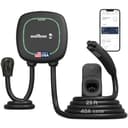
| Wallbox Pulsar Plus (40A and 48A) | 7.8" x 7.9" x 3.9" | 4.4 lb | Labeled datasheet row, excluding the cable |
|---|
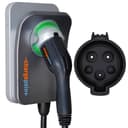
| ChargePoint Home Flex | 7.06" / 7.07" / 5.20" / 11.19" | 13.8 lb | Unlabeled dimension drawing — see the note below |
|---|
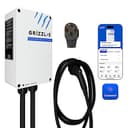
| Grizzl-E Classic Connect 40A | 10.25" x 6.25" x 3.75" | 21 lb | Labeled 'Enclosure dimensions' spec row |
|---|
| Autel MaxiCharger AC Elite Home 50A | 13.2" x 7.4" x 3.8" (3.3" with a separate holster) | 14.8 lb hardwired / 15.4 lb plug-in | Labeled spec row; depth varies by holster |
|---|
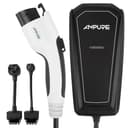
| Ampure Go portable | Package 320 x 320 x 100 mm | 9 lb module | Package size, not an enclosure size |
|---|
Three of those five figures are labeled spec rows, which is the strongest form a published dimension takes. The ChargePoint row is weaker and we would rather say so: its datasheet prints four numbers on a dimension drawing without naming which is width, height or depth. Read against the drawing it is a roughly seven-inch-square body about 5.2 inches deep, with 11.19 inches the overall height — our reading of an unlabeled drawing rather than a figure ChargePoint publishes as such. The Ampure row is weaker again, because 320 x 320 x 100 mm is the size of the box it ships in, not of the unit, and Ampure publishes no enclosure dimension at all. And the Autel figure is the only one that changes with how you buy it: the in-body holster costs half an inch of depth over the separate-holster configuration.
Read it and the ranking almost writes itself. One unit is small in every dimension at once. One is small in footprint and deep front-to-back. One is tall, narrow and slim. One is large and the most weatherproof thing we track. And one is not a wall box at all. Nothing else in the category publishes a number, which is why this list is five rows rather than twenty-two.
What we ranked on
One: is the size published at all?This was the gate, and it eliminated most of the field. We will not rank a charger as compact on the strength of a product photograph — the same rule that keeps estimated prices and invented temperature ratings off this site keeps estimated dimensions off it too.
Two: depth before footprint.Depth is the dimension that decides whether a charger is a problem to live with, because it is the one that occupies the space you and your car doors move through. The spread here is a full inch and a half — 3.75 to 5.2 inches among the wall units — and the Autel is the only one whose depth you can choose, because its in-body holster adds half an inch over the separate-holster configuration.
Three: weight, because someone has to hold it up.The published weights run from 4.4 pounds to 21, and that range changes the install. A 4.4-pound unit goes on almost any wall with the backplate it ships with; a 21-pound cast aluminum box wants real fixings and a second pair of hands, and Grizzl-E’s own manual warns that the enclosure’s water rating cannot be guaranteed if the unit is mounted upside down. Drywall, plasterboard over studs, block and concrete are all different problems at 21 pounds and none of them at 4.4.
Four: what the small body costs in amps, weather or money.A compact page is only useful if it says what compactness costs. On the Wallbox it costs money — it is among the priciest units in our registry — and it costs a little heat tolerance, because its published upper operating limit is 104°F against 122°F for Grizzl-E and ChargePoint and 131°F for Autel. On the plug-in Wallbox it costs eight amps. On the Grizzl-E it costs the 48-amp option entirely. Nobody gets small for free.
The dimension nobody publishes, and how to work around it
The figure that decides most installs is not on any datasheet: how far the unit sits from where the cable has to reach. A 25-foot output cable sounds generous until it has to leave a charger mounted at four feet, travel along a wall, come round the back of the car and reach a port on the far side.
Two published figures help, and both are easy to miss. The first is the input lead on a plug-in unit: Grizzl-E publishes an 18-inch input cable on the Classic Connect, which means the box can only sit about a foot and a half from its receptacle, while EVIQO publishes a 40-inch input lead that buys three feet of freedom. The second is where the connector parks. Autel’s in-body holster is the reason its depth is 3.8 inches rather than 3.3, and it is also the reason nothing dangles; a separate holster is slimmer on the wall and needs its own patch of it.
If reach rather than size is your real constraint, our long-cable roundup ranks the field on exactly that, and placement and mounting height has the measuring routine we would use before buying anything.
When the honest answer is “don’t mount anything”
Some of the people searching for a small charger do not have a wall problem; they have a permission problem or a temporary problem. A condo garage, a rented house, a charger that has to come off the wall when the lease ends.
For those cases the smallest charger is the one that is not mounted. The Ampure Go is our pick on this page for that: a 9-pound module on a NEMA 14-50 cord, with a second cord for a standard 120-volt outlet, UL and cUL listings to UL 2594 and UL 2231, and an IP67 / NEMA 6P enclosure Ampure describes as submersible up to three feet. It gives up eight amps against a 40-amp portable and has no app at all, and in exchange nothing on your wall ever has to be explained to a landlord. The renters’ roundup covers that whole situation, and the portable roundup ranks the travel field properly.
And if the wall is fine but the panelis the thing with no room, size is the wrong axis entirely — the load-management roundup and the small-panel roundup are the pages for that, and the Wallbox at the top of this one happens to publish both static and dynamic load management as well.