Can You Use an Extension Cord With an EV Charger?
It is the most tempting shortcut in home charging: the outlet is over there, the car is over here, and a cord is twenty dollars. The manufacturers' answer is no. This page explains why that is not caution for its own sake, and what to do instead when the cable will not reach.
How this is funded: we earn a commission if you buy through our links, at no extra cost to you. It never changes which product we recommend, and we’ll tell you when we’d skip one. Full disclosure.
The question usually arrives in one of two forms. A homeowner has a NEMA 14-50 in the garage and a car that parks in the driveway. Or a renter has a portable Level 1 cord and an outlet on the wrong side of the carport. In both cases the cheapest-looking answer is a heavy extension cord, and in both cases the people who make the chargers say the same thing: do not.
We will take that instruction seriously rather than repeat it, because the reasons are physical and worth understanding. Then we will cover the two fixes that actually solve the problem.
What the manufacturers say
Lectron’s own charging FAQ is the clearest statement we could cite from a brand we link. It recommends plugging the charger “directly into a dedicated outlet without extension cords,” and its safety list reads, in full: always match plug and outlet ratings, use GFCI protection for outdoor plugs, avoid extension cords or daisy-chaining, inspect plugs and cables regularly, and hire a licensed electrician for installation. That is a maker of portable, plug-in chargers — the products most tempting to put on a cord — telling you not to.
The logic is the same across the install documents we cite. Charger listings under ANSI/UL 2594 cover the unit as sold, plugged into the receptacle it was designed for. An extension cord adds a length of conductor and two connections that the listing never saw.
Why a charger is not like anything else you plug in
An extension cord is sold for intermittent loads: a drill that runs for a minute, a heater that cycles on and off, a lawnmower. An EV charger is the opposite. The NEC classifies it as a continuousload — one that runs for hours at a stretch — and requires its circuit to be sized at 125% of the current for exactly that reason. A Level 2 charger on a 14-50 draws 32 or 40 amps, without pause, for as long as the battery is filling. A Level 1 charger draws around 12 amps at 120 V for eight to twelve hours.
Heat is the whole problem. Current through resistance makes heat, and a cord’s resistance rises with length and with thinner wire. Under an intermittent load the cord warms and cools; under a continuous one it only warms. Then there are the connections. A plug in a receptacle is never a perfect contact, and a slightly loose or worn one has higher resistance than the wire on either side, so the heat concentrates at that point. That is why the scorched part is almost always the plug or the outlet, not the middle of the cord. A Level 2 charger’s own plug and cable are built and listed for this. A hardware-store cord is not.
Two smaller reasons compound it. Voltage drop along a long thin cord reduces what the charger sees, and a charger that sees low voltage may fault, charge slowly, or in the worst case keep going while the cord degrades. And outdoors, a cord-to-plug junction lying on a driveway is an unsealed connection in the rain, which is why Lectron’s list puts GFCI protection next to the extension-cord line.
Level 1 is not exempt
The 120 V cord that came with the car feels harmless, and it is the one most often put on an extension. It draws far less current than Level 2, but it draws it for far longer — overnight, every night — and the cords people reach for are the thin ones. If the gap is unavoidable and short, the cord must be rated well above the charger’s draw, kept off the ground and out of the weather, and inspected every time it is used; that is the manufacturers’ advice reduced to its minimum, not an endorsement. The proper answer at 120 V is the same as at 240: an outlet where the car parks. Our Level 1 guide covers what that outlet should be.
What about extending the charging cable instead?
Car-side J1772 and NACS extension cables are sold. They move the extra connection from the supply side to the vehicle side, which avoids the plug-in-a-receptacle problem, but they still add a coupling that the charger’s listing did not include and that none of the manufacturers we cite publish support for. We do not list one. If the charging cable is the thing that will not reach, the answer is a charger with a longer one — and that is a solvable problem, because the market goes to 25 feet.
Fix one: buy the reach
Measure first: from the proposed mounting point to the car’s charge port, in the position it actually parks, along the path the cable will take, plus a few feet of slack so the cable is never taut. Charge ports live on different corners of different cars, so a second car may need the opposite route. Then compare the number to published cable lengths. Sixteen feet is the short end of our registry; 25 feet is the long end, and several brands offer it. EVIQO adds a 40-inch input lead on top of its 25-foot cable, which lets the box itself sit some distance from the outlet. Our long-cable roundup ranks on this alone; the four below are the ones most buyers land on.
Quick picks
Ranked on published specs, charging speed, electrical fit and value. Select a row to jump to the full write-up. We have not bench-tested these chargers — here is exactly what we do instead.
| # | Product | Best for | Price |
|---|---|---|---|
| 1 | 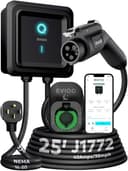 EVIQO 40A NEMA 14-50 Charger The most charger you can get without an electrician's invoice. It plugs into a NEMA 14-50 outlet for a full 40 amps, keeps the WiFi app, the ENERGY STAR listing and the 25 ft cable from EVIQO's hardwired unit, and can be unplugged and taken with you when you move. | 25 ft cable plus a 40 in input lead | |
| 2 |  Emporia Level 2 EV Charger The value pick that doesn't feel cheap: a full 48 amps, ENERGY STAR listing, WiFi with genuine energy monitoring, and a 25 ft cable — for well under what the big names charge. It's the one we point most people to first. | 25 ft, hardwired 48 A or plug-in 40 A | $449.00 · View on Amazon Price as of September 18, 2026. #ad How we’re funded |
| 3 | 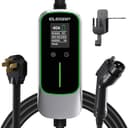 ELEGRP 40A Portable Level 2 Charger The full-speed portable. A genuine 40 amps on a NEMA 14-50, an IP67 station body rated -22F to 122F, and a 25-foot cable - the longest here by five feet - for less than the 32A unit costs. It is the heaviest thing here to coil and there is no app, but if the portable is also going to be your everyday charger, this is the one that does not make you choose. | 25 ft portable (16 and 21 ft also sold) | $209.99 · View on Amazon Price as of September 18, 2026. #ad How we’re funded |
| 4 | 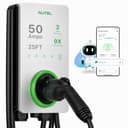 Autel MaxiCharger Home Built for the harshest driveway. The NEMA 4X enclosure is rated to keep charging in extreme cold and heat, it pushes a full 50 amps, and the app is capable. If your charger lives fully exposed to the weather, this is the one. | 25 ft hardwired, rated to -40°F |
Fix two: move the outlet, or the charger
If no cable reaches, the outlet is in the wrong place, and the honest fix is to put one where the car parks. For a garage that is a short extension of the existing circuit by an electrician — a fraction of the original install. For a driveway or a carport with no wall it means a post or pedestal, which is a real job but a standard one; our pedestal guide covers the options and the buried-conduit run that comes with them. And if the whole problem is a car that parks in the wrong bay, our placement guide has the measuring method that avoids the mistake at the start.
The short version
A charger is a continuous, high-current load, and extension cords are not made for one; the brands that make chargers say not to, and the failure mode is heat at a plug. The two fixes are a charger with a longer published cable, or an outlet where the car actually parks. Both cost more than a cord. Both are the answer.
Frequently asked questions
Can I use an extension cord with a Level 2 EV charger?
The manufacturers say not to. Lectron's own FAQ, for example, recommends plugging the charger 'directly into a dedicated outlet without extension cords' and lists 'avoid extension cords or daisy-chaining' among its safety rules. The reason is the load: a Level 2 charger draws 24 to 40 amps continuously for hours, far beyond what ordinary extension cords are built for, and heat at an undersized cord or a loose connection is the failure mode.
What about an extension cord for Level 1 charging?
Same advice, smaller numbers. A Level 1 charger draws around 12 amps for many hours — the Ampure Go, for instance, publishes 12 A at 120 V — which is a continuous load most household cords are not rated for and which heats a thin cord noticeably. If you must bridge a short gap at 120 V, the cord must be rated well above the charger's draw and inspected every time; the better answer is an outlet where the car parks.
Is a J1772 extension cable (on the car side) any different?
It moves the extension from the supply side to the car side, but it still adds a connection that the charger's safety listing did not cover — the listing applies to the charger as sold. We do not list one, and none of the manufacturers we cite publish support for them. If the charging cable is too short, the fixes below are a longer-cable charger or a better mounting point.
Why does an extension cord get hot with an EV charger?
Because current through resistance makes heat, and a cord's resistance rises with length and with thinner wire. A charger draws its rated current continuously — 32 or 40 amps for hours — so any heating never gets a rest. Add a plug connection that is not perfectly tight and the resistance concentrates there, which is where cords and receptacles scorch.
What should I do if the charger's cable won't reach the car?
Two proper fixes. Buy a charger with a longer published cable — 25 feet is the top of the market, and EVIQO adds a 40-inch input lead on top of that — or move the charger or the outlet closer to where the car parks, which for an open driveway may mean a post or pedestal mount. Both are covered on this site; neither involves a cord.
How long can an EV charger's own cable be?
The longest published charging cables in our registry are 25 feet, which several brands offer — Emporia, EVIQO, Autel, Grizzl-E and ELEGRP among them. Measure from the mounting point to the car's charge port in its real parked position, along the route the cable will take, with slack, before deciding whether that is enough.
Sources
- Lectron - EV Charging FAQ — Lectron's own FAQ, read for its plug-and-cord guidance: 'It's recommended to plug the charger directly into a dedicated outlet without extension cords', with a safety list that reads 'Always match plug and outlet ratings (volts/amps)', 'Use GFCI protection for outdoor plugs', 'Avoid extension cords or daisy-chaining', 'Inspect plugs and cables regularly' and 'Hire a licensed electrician for installation'. Its NEMA table publishes 5-15 as 120V / 15A, 5-20 as 120V / 20A, 6-20 as 240V / 20A, 10-30 / 14-30 as 240V / 30A ('Common in older dryers') and 14-50 as 240V / 50A, and states that Lectron offers NEMA 5-15, 14-50 and 10-30 plug options for portable charging. Also states that a Tesla owner can use the J1772-to-Tesla adapter 'included with most Tesla', and that adapters 'don't generate power - they only enable compatibility between chargers and vehicles' (accessed September 17, 2026)
- Lectron — Portable Level 2 J1772 EV Charger (40A) product page — Lectron's own listing: 40A / 240V / 9.6 kW, NEMA 14-50 plug, 16 ft cable, UL 2594 / UL 2231 certified, 2-year warranty, app control on the WiFi version only (accessed July 23, 2026)
- Ampure - Ampure Go portable Level 2 EV charger product page — Ampure's own specifications for the Go: 32 A / 7.7 kW at 240 V or 12 A / 1.4 kW at 120 V, input range 85-265 VAC at 45-65 Hz, SAE J1772 coupler, NEMA 14-50 and NEMA 5-15 cords, 20 ft (6 m) cable, IP67 rated 'submersible up to 3 feet' with a NEMA 6P watertight enclosure, operating range -30C to +50C (-22F to 122F), 9 lb (4.1 kg) module, and listings to UL, cUL, UL 2594, UL 2231, UL 817, ICES, FCC, ENERGY STAR, REACH and RoHS. Ampure states 'up to 25 miles of range per hour' at 240 V (accessed August 25, 2026)
- NFPA — Using the Latest NEC for EV Charger Installations — NFPA on NEC (NFPA 70) Article 625: EV charging is a continuous load, so circuits are sized to 125% of load (the 80% rule) (accessed July 19, 2026)
- EVIQO — Level 2 EV Charger, 40A (9.6 kW), NEMA 14-50 plug-in (Gen 2) — EVIQO's own product page: 40A / 9.6 kW on a NEMA 14-50 plug, SAE J1772, 25 ft charging cable plus a 40 in input cable, IP66 / NEMA 4 enclosure, UL / ETL / FCC / ENERGY STAR listings, 3-year standard warranty, app-adjustable 6-40A output, and a note that it needs an EV-grade 4-prong 14-50 receptacle rather than a dryer outlet. RE-READ September 15, 2026 for the garage roundup: the page additionally states an operating temperature range of -22F to 122F, that the app needs a 2.4 GHz WiFi connection, that the standard 3-year warranty is extendable to 4, and that the unit ships in 1-2 business days (accessed September 15, 2026)
- Emporia — Classic Level 2 EV Charger spec sheet (PDF) — Emporia's own spec sheet: watertight NEMA Type 4 indoor/outdoor enclosure, operating temperature -22F to 122F, 25 ft cable (accessed July 20, 2026)
- ELEGRP Store - 40A Level 2 portable J1772 EV charger (NEMA 14-50) — ELEGRP's own listing: 40 A / 9.6 kW on 240 V AC at 50/60 Hz with selectable output at 16, 20, 24, 32 or 40 A, SAE J1772 connector on a NEMA 14-50 plug ('For NEMA 14-50 Outlets Only'), 25 ft cable (16 ft and 21 ft also offered), IP67 charging station and IP54 connector, operating range -22F to +122F (-30C to +50C), 1-to-12-hour delayed-start timer, 2-year warranty, 'ETL & UL' listed. RE-READ September 5, 2026 for the review: the specification table is unchanged, and the page additionally states 'Fully ETL certified and built with UL-listed components - including the J1772 plug, cable, and NEMA 14-50 connector', a built-in display reporting charging current, voltage, total energy delivered (kWh) and internal temperature with LED fault patterns, a wall-mounted holder plus anchors and a carry bag in the box, Tesla compatibility via a J1772-to-NACS adapter sold separately, a 30-day return window and 60-day price protection. The page does not name the UL standards, publish a weight, publish an ENERGY STAR certification, or publish app support for this SKU, and its marketing copy carries two conflicting range claims ('Up to 37 Miles/H' and '30 Miles Per Hour') plus an operating range ('-21F to 121F') that disagrees with its own specification table (accessed September 5, 2026)
- Autel Energy — MaxiCharger AC Elite Home 50A product page — Autel's own listing: compliant with NEMA 4X standards, operating temperature -40F to 131F, 25 ft cable, 3-year warranty (accessed July 20, 2026)
- U.S. DOE Alternative Fuels Data Center — Charging Electric Vehicles at Home — US DOE on home EV charging: most owners charge overnight on Level 1 or Level 2, installs follow NEC Article 625, with example home-charging costs (accessed July 19, 2026)
- UL Solutions — EV Charging Infrastructure Services — UL on EVSE safety certification: ANSI/UL 2594 is the Standard for Electric Vehicle Supply Equipment (accessed July 19, 2026)
Keep reading
Best chargers with long cables
The roundup that ranks on reach alone — 25-foot cables and the input leads that add to them.
See the long-cable picksWhere to mount the charger
The measuring method, the height, and the mistakes that leave a cable three feet short.
Plan the placementPedestals and posts
When the outlet should come to the car: mounting a charger where there is no wall.
Read the pedestal guideThe NEMA 14-50 outlet
What it takes to put a proper outlet where the car actually parks.
Read the outlet guide