32-Amp vs 40-Amp EV Charger
This is the amperage comparison that actually decides something for most households — not because the speeds differ much, but because it is the step where the circuit in your wall may or may not already be enough.
How this is funded: we earn a commission if you buy through our links, at no extra cost to you. It never changes which product we recommend, and we’ll tell you when we’d skip one. Full disclosure.
Most amperage comparisons are about speed. This one is not, really — seven miles of range per hour is not the sort of difference anyone notices across a night. This one is about which circuit you need, and that is a question with a price attached.
| Spec | 32 amps | 40 amps |
|---|---|---|
| Charger current | 32 A | 40 A |
| Circuit required | 40 A breaker | 50 A breaker |
| Power delivered | 7.7 kW | 9.6 kW |
| Range added per hour | ~27 miles | ~34 miles |
| Added over a 10-hour night | ~270 miles | ~340 miles |
| Typical conductor | 8 AWG copper | 6 AWG copper |
| Plug-in option | Yes — 14-50 or 6-50, dialed down | Yes — NEMA 14-50 or 6-50 |
| Hardwire required? | No | No |
The 80% rule is the whole story
Under the NEC, EV charging is a continuous load, so the circuit is sized at 125% of the charger’s current. Thirty-two amps needs a 40-amp breaker; forty amps needs a 50.
Read backwards, that is the most useful shopping rule on this site: breaker rating × 0.8 = charging amps. If your panel can spare a 40-amp double-pole breaker, you can have 32 amps of charging. If it can spare 50, you can have 40.
Which is why this comparison matters more than the speed gap suggests. Going from 32 to 40 amps means a bigger breaker, usually a heavier conductor — 6 AWG rather than 8 for a typical copper run — and one more slice of your panel’s capacity committed permanently. Our panel capacity guide covers whether that slice is available.
What the speed difference actually looks like
Thirty-two amps is 7.7 kW, about 27 miles of range per hour at our reference efficiency. Forty amps is 9.6 kW, about 34.
Across a ten-hour overnight window that is roughly 270 miles against 340. Both numbers are far beyond what an average day consumes, which is the honest framing: for the great majority of households, both chargers finish the job while you are asleep and the difference is invisible.
It becomes visible in four situations, and only four:
- Very high daily mileage— over roughly 250 miles a day, where you start to consume the whole window.
- Two cars sharing one charger, where the window is split. See our two-car roundup.
- A short window at home— shift work, or a car that leaves early.
- A narrow off-peak rate window, where fitting the entire session inside the cheap hours is worth money. That case is in time-of-use charging.
Check the car before you decide anything
The comparison is moot if the vehicle cannot use the difference. Your car’s onboard chargersets an absolute ceiling on AC charging, and a great many EVs and nearly all plug-in hybrids are rated at or below 7.7 kW — which is exactly 32 amps.
If that is your car, a 40-amp charger delivers identical sessions to a 32-amp one and the extra circuit capacity buys nothing at all. Look the rating up in the owner’s manual first; the reasoning is in the charger is inside your car.
The answer most people should take
Buy an adjustable charger and let the circuit decide.
Almost every good charger now sets its output over a wide range — EVIQO’s plug-in 40A adjusts from 6 to 40 amps in the app, Grizzl-E’s Smart offers 16, 24, 32 and 40 on a DIP switch, and ChargePoint’s Home Flex spans 16 to 50. Any of them runs at 32 amps on a 40-amp circuit today and moves to 40 later with a setting change and, if the circuit is upgraded, an electrician’s visit.
That is the correct way to buy headroom. What is not correct is installing a larger circuit than you need on the strength of a hypothetical future car. Conductors and breakers are where the money is; the setting is free. Install what you can justify, buy a charger that can be raised, and revisit it if the second EV actually arrives.
Quick picks
Ranked on published specs, charging speed, electrical fit and value. Select a row to jump to the full write-up. We have not bench-tested these chargers — here is exactly what we do instead.
| # | Product | Best for | Price |
|---|---|---|---|
| 1 | 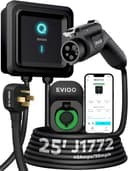 EVIQO 40A NEMA 14-50 Charger The most charger you can get without an electrician's invoice. It plugs into a NEMA 14-50 outlet for a full 40 amps, keeps the WiFi app, the ENERGY STAR listing and the 25 ft cable from EVIQO's hardwired unit, and can be unplugged and taken with you when you move. | Adjustable 6-40A, plug-in, best all-rounder here | |
| 2 | 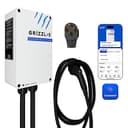 Grizzl-E Classic Connect 40A Grizzl-E's cast-aluminum build with a WiFi radio in it. You get the IP67 body and the cold-flexible 25 ft cable that made the brand's name, plus scheduling, usage history and utility demand-response programs in the Grizzl-E Connect app — in a plug-in unit that comes off the wall when you move. The amperage is still set with a DIP switch, which is either charmingly honest or annoyingly analog depending on your taste. | 16/24/32/40A on a DIP switch, cast-aluminum body | $349.99 · View on Amazon Price as of October 18, 2026. #ad How we’re funded |
| 3 | 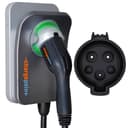 ChargePoint Home Flex The safest default for most homes: you set the amperage in the app to 16, 24, 32, 40, 48 or 50A, so one charger fits whatever circuit your panel can spare today and scales up if you upgrade later. The app is the most mature here, firmware arrives over the air, and the warranty is long. | Widest range of all — 16A to 50A | $516.71 · View on Amazon Price as of October 18, 2026. #ad How we’re funded |
The verdict, by situation
- Your panel can spare 50 amps and the car accepts it: take the 40. The extra costs little at install time and the headroom is genuinely there.
- Your panel can spare 40 amps: 32 amps, without regret. It is real Level 2 charging and it will not slow your life down.
- Your car caps at 7.7 kW: 32 amps. Anything more is capacity you install and never use.
- You are not sure yet: buy adjustable, install the circuit you can justify today. This is the answer for most people.
- Two EVs, or very high mileage: neither — look at 48 amps and read 40 vs 48, remembering that 48 amps must be hardwired.
And if the panel answer came back discouraging, do not assume Level 2 is off the table. A 24-amp charger on a 30-amp circuit still adds around 20 miles of range an hour, several times what Level 1 manages — our small-panel roundup covers that ground.
Frequently asked questions
What is the difference between a 32-amp and a 40-amp EV charger?
About 1.9 kW of power and one breaker size. A 32-amp charger delivers 7.7 kW on a 40-amp circuit; a 40-amp charger delivers 9.6 kW on a 50-amp circuit. At a reference 3.5 miles per kWh that is roughly 27 miles of range per hour against 34 — about seven miles an hour apart.
Is 32 amps enough for an EV?
For most households, comfortably. Over a ten-hour overnight window 32 amps adds around 270 miles of range, which is several times what an average day consumes. It stops being enough if you drive very long distances daily, share the charger between two cars, or have only a short window at home.
What size breaker does a 32-amp charger need?
A 40-amp breaker. The NEC treats EV charging as a continuous load and sizes the circuit at 125% of the charger's current, so 32 x 1.25 = 40. Run it the other way to shop: whatever breaker you can spare, multiply by 0.8 to get the charging current it supports.
Can I plug a 32-amp charger into a NEMA 14-50 outlet?
Yes. A 14-50 is a 50-amp receptacle, so it supports 40 amps of continuous charging and anything below that. Running a 32-amp charger from one is perfectly normal — and many adjustable chargers on a 14-50 are set to 32 or lower to suit the circuit behind the outlet.
Will 40 amps charge my car noticeably faster?
Only if the car accepts more than 32 amps. If its onboard charger is rated 7.7 kW, both chargers deliver identical sessions — the extra amps go unused. Look the rating up in the owner's manual before paying for headroom you cannot reach.
Should I just buy an adjustable charger?
In most cases, yes. A charger with a wide adjustable range runs at 32 amps on today's circuit and can be raised to 40 later with no new hardware — only a setting and, if the circuit changes, an electrician. That turns an irreversible-feeling decision into a reversible one for no extra money.
Sources
- NFPA — Using the Latest NEC for EV Charger Installations — NFPA on NEC (NFPA 70) Article 625: EV charging is a continuous load, so circuits are sized to 125% of load (the 80% rule) (accessed July 19, 2026)
- U.S. DOE Alternative Fuels Data Center — Electric Vehicle Charging Stations — US DOE on charging levels: Level 1 (~1.9 kW, ~5 mi/hr), Level 2 (2.9-19.2 kW, ~7.2 kW typical residential, ~25 mi/hr), and DC fast charging (accessed July 19, 2026)
- FuelEconomy.gov — Electric Vehicles: Learn More About the Label — DOE/EPA on EV efficiency: kWh per 100 miles and MPGe, accounting for AC charging losses (accessed July 19, 2026)
- EVIQO — Level 2 EV Charger, 40A (9.6 kW), NEMA 14-50 plug-in (Gen 2) — EVIQO's own product page: 40A / 9.6 kW on a NEMA 14-50 plug, SAE J1772, 25 ft charging cable plus a 40 in input cable, IP66 / NEMA 4 enclosure, UL / ETL / FCC / ENERGY STAR listings, 3-year standard warranty, app-adjustable 6-40A output, and a note that it needs an EV-grade 4-prong 14-50 receptacle rather than a dryer outlet. RE-READ September 15, 2026 for the garage roundup: the page additionally states an operating temperature range of -22F to 122F, that the app needs a 2.4 GHz WiFi connection, that the standard 3-year warranty is extendable to 4, and that the unit ships in 1-2 business days (accessed September 15, 2026)
- United Chargers — Grizzl-E Classic Connect 40A technical specifications — Grizzl-E's own spec table for the Classic Connect: Type 1 (J1772) or NACS Level 2, aluminum enclosure, operating temperature -30C to +50C (-22F to 122F), IP67 protection, 25 ft output cable on an 18 in input lead, 208-240 VAC, nominal input current 16/24/32/40 A set by a DIP-switch power selector, maximum output current 40 A, LED indicator, 21 lb unit weight (accessed September 3, 2026)
- ChargePoint — Home Flex datasheet (PDF) — ChargePoint's own datasheet: enclosure rating Type 3R per UL 50E, operating temperature -22F to 122F, 23 ft cable, plus installer notes that an outdoor plug-in install requires an outdoor-rated GFCI breaker upstream while an external GFCI may conflict with the charger's internal ground-fault protection on a hardwired install. RE-READ September 3, 2026 for the review refresh: the same datasheet also publishes maximum 12 kW (240V AC x 50A) with output amperage adjustable via the mobile app to 16A, 24A, 32A, 40A, 48A or 50A; a required dedicated dual-pole breaker rated for 125% of maximum load; 'Software Updates: Firmware updated over-the-air (OTA)'; 2.4/5 GHz Wi-Fi (802.11 a/b/g/n); local storage of up to 90 days of charging session data (100 sessions) if the network drops; power measurement accuracy +/- 2.0%; ground-fault detection by 20 mA CCID with auto retry; and UL and cUL listing per UL 2594, UL 2231-1 and UL 2231-2, NEC Article 625 compliant. Ordering information lists the plug-in station models CPH50-NEMA6-50-L23 and CPH50-NEMA14-50-L23 (accessed September 3, 2026)
Keep reading
One step further down
If even 32 amps is more than the panel can spare, what a 30-amp circuit supports and which chargers publish the setting.
See the picks40 amps vs 48 amps
The next step up, and the one where the plug disappears and hardwiring becomes compulsory.
Compare the next tierWhat size do I need?
Three numbers — panel, car, mileage — taken in the right order. The method behind this page.
Work it outWire and breaker sizing
What each amperage needs upstream, and why a long run can change the conductor.
See the sizingBest 40-amp chargers
If 40 is the answer, these are the units — including several that dial down to 32.
See the picks