Each pick against the 10.9 kW onboard charger Kia publishes on every EV9 trim. Rated amps are the brand’s; the kW and circuit figures are our arithmetic (amps x 240 V; NEC 125% continuous-load rule). “Adapter on a NACS port” means a J1772 cable needs a J1772-to-NACS adapter on the 2026 car.| Charger | Rated amps | What the EV9 gets | Port | Circuit needed |
|---|
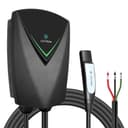
| Lectron Nexus NACS (Tesla) Charger | 48 A | The full 10.9 kW (11.5 kW available) | NACS - plugs straight in | 60 A hardwired |
|---|
| EVIQO 48A Level 2 Charger | 48 A | The full 10.9 kW (11.5 kW available) | J1772 - adapter on a NACS port | 60 A hardwired |
|---|
| Emporia Level 2 EV Charger | 48 A | 10.9 kW hardwired; 9.6 kW on the 14-50 plug | J1772 - adapter on a NACS port | 60 A hardwired / 50 A plug-in |
|---|
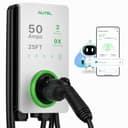
| Autel MaxiCharger Home | 50 A | The full 10.9 kW (12 kW available) | J1772 - adapter on a NACS port | 60 A hardwired |
|---|
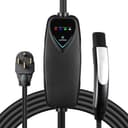
| Lectron Portable Level 2 Tesla Charger (NACS) | 40 A | 9.6 kW - about 88% of the module | NACS - plugs straight in | 50 A for the NEMA 14-50 |
|---|
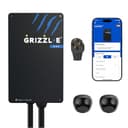
| Grizzl-E Duo Connect 40A | 40 A | 9.6 kW alone; about 4.8 kW each with two cars | NACS x2 (this SKU) | 50 A plug-in or hardwired |
|---|
The one number that settles it: 10.9 kW
The box on your wall is a switch and a safety device. The part that actually converts household AC into the DC your battery stores lives inside the car, and its rating is the hard ceiling on home charging speed. For the EV9 that rating is 10.9 kW, published identically on every trim — a refreshing change from cars like the Cadillac LYRIQ, where the module changes with the trim and the right charger changes with it. Our onboard charger explainercovers why this number, not the charger’s, is the one that matters.
Work the arithmetic and the shopping list gets short. 10.9 kW at 240 V is about 45 amps. A 48-amp charger offers 11.5 kW, so the car takes its full 10.9 kW and leaves a little on the table. A 50-amp charger offers 12 kW — same result. A 40-amp charger offers 9.6 kW, which is about 88% of what the car can accept: a real difference, but a small one. An 80-amp charger offers 19.2 kW and the EV9 still takes 10.9 kW, so you would be paying roughly three times as much, plus a 100-amp circuit, for nothing. If you want that argument in full, our fastest Level 2 chargers page ranks the tiers and explains where the ceiling bites.
In miles: using Kia’s published EPA range against its published battery capacity — 305 miles on 99.8 kWh for the Light Long Range RWD, down to 280 miles on 99.8 kWh for the GT-Line AWD — the EV9 works out at roughly 2.8 to 3.1 miles per kWh. At 10.9 kW that is about 31 to 33 miles of range per hour. At 9.6 kW it is about 27 to 29. Both numbers are ours, not Kia’s, and both assume EPA-condition efficiency you will not see in February with three rows of passengers and the heat on.
What the cable in the trunk already does — and what it costs you
Kia lists a Dual Level 120V / 240V Portable Charging Cableamong the EV9’s standard convenience features, so most owners already have something that will charge at 240 volts. This is the part of the decision that usually goes unexamined, and Kia publishes the answer in its own charge-time rows.
On the 99.8 kWh battery, a 10–100% charge takes approximately 8 hours and 45 minuteson a 240 V, 11 kW supply — in other words, on a proper 48-amp wall unit. The same charge with the in-cable control box takes approximately 14 hours and 35 minutes. That is five hours and fifty minutes of difference. On the 76.1 kWh battery in the Light RWD it is 6 hours 45 minutes against 11 hours 15 minutes — a four-and-a-half hour gap. Kia does not publish the cable’s amperage; its own times imply roughly 6 kW, which is our arithmetic from Kia’s numbers rather than a Kia figure.
That gap is the honest case for buying a charger. Under nine hours fits inside an overnight window and inside most time-of-use off-peak windows. Nearly fifteen hours does not, which means paying peak rates for the tail of the charge, or waking up short. If you drive 30 or 40 miles a day and can plug in every night, the bundled cable genuinely is enough and you should keep your money. If you use the third row, tow, or run the battery down on weekends, the wall unit pays for itself in convenience within a month.
The port: NACS on the 2026 car
Kia lists a NACS charge port on every 2026 EV9 trim, alongside the 800-volt architecture and a Tesla Supercharger-compatible DC story. For home charging that means a NACS-cabled unit — the Lectron Nexus NACS and the Grizzl-E Duo below — plugs in with nothing in between. A J1772 charger needs a J1772-to-NACS adapter. Adapters are passive: as Lectron’s own FAQ puts it, they “don’t generate power — they only enable compatibility between chargers and vehicles,” and Lectron rates its J1772-to-Tesla adapter — the same NACS shape — to 80 amps, so a listed adapter is not the bottleneck at 45. It is one more thing to keep in the frunk and one more thing to lose.
If your EV9 is an earlier model year, check the port on your own car rather than trusting the year. The J1772 picks here plug directly into a J1772-shaped port, and the NACS picks would be the ones needing an adapter — exactly the reverse of the 2026 car. Our connector guidecovers both shapes and the transition between them. And it is worth knowing that the adapter logic is not universal: Volkswagen tells ID.4 owners in writing not to use its NACS adapter on any Level 2 charger, which makes the NACS units above the wrong buy for that car — our Volkswagen ID.4 picks are J1772 throughout for that reason.
Reach, because this is a 197-inch SUV
Kia publishes the EV9 at 197.2 inches long (197.4 for the GT-Line), 77.9 inches wide, on a 122-inch wheelbase, weighing between 5,106 and 5,851 pounds. That matters for one boring reason: a vehicle this long parks deep in a garage or hangs off the end of a driveway, and the charger has to reach it from wherever the panel and the conduit allow. Four of our six picks ship a 25-foot cable for that reason, and the EVIQO adds a 40-inch input lead on top, which buys real flexibility in where the box itself lands. Our placement and mounting guide is worth ten minutes before the electrician quotes, because this is the decision you live with for a decade.
How we separated them
Lectron Nexus NACStakes the top slot because it is the cheapest honest way to give a 2026 EV9 everything it can take with nothing in between: a native NACS connector, a full 48 amps (11.5 kW against the car’s 10.9 kW ceiling), an IP66 body, a 23-foot cable, ETL listing to UL 2594 / 2231 / 2251 plus ENERGY STAR, and a 3-year warranty. The cons are real. There is no app, so scheduling has to live in the car’s own charge settings or your utility’s program instead — which is where many owners set it anyway. Lectron publishes no operating-temperature range for the unit, which is a genuine gap if the charger is going on an exterior wall in a cold climate. And 23 feet is the shortest cable of the four wall units here.
EVIQO 48A is the value 48-amp unit and the one we would pick on reach alone: a 25-foot charging cable plus a 40-inch input lead, an IP66 / NEMA 4 enclosure, UL / ETL / FCC listings with ENERGY STAR, WiFi scheduling and a 3-year warranty. Cons: the cable is J1772, so a 2026 EV9 needs the adapter every time; it is hardwired, so it needs a 60-amp circuit and an electrician; and EVIQO is a smaller brand with a shorter track record than the names above it in the category. Read the full EVIQO review if the reach is what sells you.
Emporia Level 2is the pick if you want to see the energy, not just schedule it. A full 48 amps hardwired, ENERGY STAR, a 25-foot cable, a remote holster in the box, and an app that tracks consumption rather than just toggling the charger. Its quiet advantage on this page is the dual install: Emporia sells one unit as “NEMA plug or hardwire,” so the same charger does 48 amps on a 60-amp circuit or plugs into a NEMA 14-50 at 40 amps if your panel can only spare a 50-amp circuit today. Cons: on the plug it is capped at 40 amps and gives up that 88% figure; the app is less polished than ChargePoint’s; and the connector is J1772, so the adapter note applies.
Autel MaxiCharger Homeis the one to buy if the charger lives fully outside. A NEMA 4X enclosure rated for operation down to about -40°F is the toughest weather specification on this page, it pushes 50 amps (12 kW, comfortably over the EV9’s ceiling) down a 25-foot cable, and it is CSA certified with ENERGY STAR and a 3-year warranty. Cons: 50 amps needs a 60-amp circuit and a hardwired install, so there is no plug-in shortcut; Autel’s app and ecosystem are newer than ChargePoint’s; and it is the most expensive wall unit here. Our cold-weather picks compare the published low-temperature ratings side by side.
Lectron Portable Level 2 Tesla Charger (NACS)is the no-electrician route with a native plug. If there is already a NEMA 14-50 in the garage — or you can have one added, which is a far smaller job than a hardwired 60-amp circuit — this gives an EV9 40 amps, 9.6 kW, about 88% of the car’s maximum, with a NACS connector that needs no adapter. It is ETL listed to UL 2594 / 2231 with a UL 2251 handle and an ENERGY STAR listing. Three honest cons. Lectron publishes no enclosure rating, no temperature range and no warranty term for this SKU, which is a documentation gap we will not paper over. The cable is 16 feet, which is short for a 197-inch SUV. And the base unit has no app; the WiFi version is a separate, dearer model.
Grizzl-E Duo Connect 40Ais for the household adding an EV9 to an EV that is already there. Two 25-foot cold-flexible cables run from one cast-aluminum IP67 body rated to -22°F, on a single 40-amp supply, with per-connector current limits in the Grizzl-E Connect app. The trade is arithmetic and Grizzl-E is open about it: 40 amps is the total, so one car alone gets 9.6 kW and two cars charging together get roughly 4.8 kW each — about 17 miles of range per hour into an EV9. The Amazon SKU we link is the NACS-to-NACS pairing, which is right for two NACS-port cars and wrong for a mixed pair (Grizzl-E sells other cable combinations direct). It also costs about what two single chargers cost; the saving is in the wiring, not the box. Our two-car roundup works through the amps properly.
The two chargers Kia itself names
Kia’s EV9 page has a home-charging section that names exactly two products, and both are worth addressing directly because buyers will see them.
The first is the ChargePoint Home Flex, which Kia describes as “available with J1772 or NACS connectors and backed by a 3-year limited warranty.” It is a genuinely excellent charger and normally near the top of our own lists — adjustable 16 to 50 amps in the app, the most mature app in the category, and a factory NACS cable option that would suit a 2026 EV9 perfectly. We have not ranked it here for one reason: on the day we published, both Amazon listings we track for it, the J1772 and the NACS version, returned “Currently unavailable” with no price from the retailer feed we use. We do not feature a product we cannot verify is purchasable. Our ChargePoint Home Flex review and NACS review stay up, and Kia points at a dealer rather than a price, so a dealer may well have one.
The second is the Ampure Goportable, which Kia describes as delivering “dependable Level 1 and Level 2 charging using standard 120V or 240V outlets.” It is the best-documented portable we track — UL 2594 / 2231 listed, ENERGY STAR, an IP67 body rated -22°F to 122°F, nine pounds — and it is in stock. But it is a 32-amp unit, 7.7 kW, roughly 70% of what the EV9 can take, which on a 99.8 kWh battery means about 22 to 24 miles of range an hour. For a renter, a second home or a road trip it is the right answer, and our portable charger picks rank it as such. As the everyday charger for a three-row electric SUV, it is slower than the car deserves.
What else we left off, and why
The Autel MaxiCharger 80A and every other high-amp unit, because 80 amps into a 10.9 kW module is 10.9 kW. You would pay a premium and a 100-amp circuit for a number the car ignores. The one scenario where it makes sense is a household planning a second, faster-charging EV on the same wall, and even then a 48-amp unit plus a future second circuit is usually cheaper. The 40-amp portables from Lectron and ELEGRP, which are fine chargers but carry J1772 cables, so on a NACS-port EV9 you get the adapter hassle and the 9.6 kW ceiling at the same time; the Lectron NACS portable above solves half of that. The Wallbox Pulsar Plus and Emporia Pro, both capable 48-amp smart units that would feed the EV9 in full but add nothing EV9-specific over the picks here — and the Wallbox listing showed only two units left when we checked, which is not a supply we want to send a reader at. And the Tesla Wall Connector, which comes up constantly for NACS cars: Tesla’s own pages do not return specifications to us, and we will not compare against a spec sheet we cannot read.
The short version
2026 EV9, one EV, garage wall: the Lectron Nexus NACS on a 60-amp circuit. Native plug, full speed, no app you did not ask for. Want the app and the energy data:the Emporia Level 2, or the EVIQO 48A if reach is the problem — both J1772, so budget for an adapter. Charger going outside in a real winter: the Autel MaxiCharger Home. No appetite for an electrician: the Lectron NACS portable on a NEMA 14-50, and accept 88% of the speed. Two EVs, one circuit: the Grizzl-E Duo in the cable pairing that matches both cars. And if you drive 30 miles a day:the cable Kia already gave you is genuinely fine — just know it is nearly six hours slower on a full charge.