What we ranked on
“Adjustable” is not one feature, it is four, and brands publish very different amounts about each. These are the questions that produced the order above.
One: how wide is the published span, floor and ceiling? A ceiling is what gets printed on the box; the floor is what makes a charger installable in a difficult house. A unit that goes down to 6 amps fits a circuit nothing else fits. The EVIQO 48A publishes a 6-amp floor in its app and the Autel 80A publishes the same; the DIP-switch units mostly stop at 16.
Two: how many steps are there in between?This is where spec sheets mislead, and it is the reason the table below publishes steps rather than ranges. Both ChargePoint and Autel publish six discrete settings for what reads in marketing copy as a continuous 16-to-50 range. Six settings is plenty for most houses — but if your circuit is an awkward size, or you are trimming a charger to fit alongside a heat pump, 1-amp increments are a genuinely different product.
Three: what is the mechanism, and who can change it?An app setting is convenient and lives behind an account and a firmware version. A DIP switch is permanent, offline, and requires a screwdriver and the cover off. Neither is better in the abstract: the app is better if you expect to change it, and the switch is better if you expect never to think about it again. What we will not do is call a charger “adjustable” without saying which it is.
Four: does the circuit requirement scale honestly with the setting? The best adjustable chargers publish what each setting needs. Autel publishes “Hardwired · 70 A Circuit for Full Output” in plain text. EVIQO publishes 60 amps for 48 and 70 for 50. ChargePoint publishes a range — “circuits rated from 20 to 80A” — plus a 125%-of-maximum-load breaker rule you apply yourself. All three are defensible; only two let you price the electrician before you buy.
How each unit actually sets its amps
This is the table we wanted when we started researching this page and could not find anywhere, because every brand publishes its control scheme in a different place and in different words.
How each unit’s output is actually set, from each maker’s own published pages on the dated visits in our sources. Quoted strings are theirs. Read the “steps” column before the range column: “adjustable 16-50 A” almost always means six fixed settings, not a dial.| Unit | How it is set | Steps the maker publishes | Floor to ceiling | The catch |
|---|
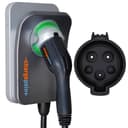
| ChargePoint Home Flex | App | Six discrete settings: 16, 24, 32, 40, 48, 50 A | 16 A to 50 A hardwired | The plug-in SKUs are capped at 40 A, so the top two steps are a hardwired-only feature. Full 50 A needs a 70 A circuit by ChargePoint's own 125% breaker rule |
|---|
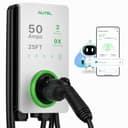
| Autel MaxiCharger AC Elite Home 50A | App | Six discrete settings, published in the electrical line as “16 A, 24 A, 32 A, 40 A, 48 A, 50 A” | 16 A to 50 A | Autel publishes “Adjustable 16-50 A”, which reads like a continuum and is not. The 50 A setting is published as needing a 70 A circuit |
|---|
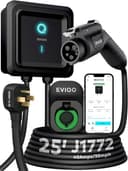
| EVIQO 48A hardwired | DIP switch sets the ceiling, app fine-tunes below it | DIP list is 16 / 32 / 40 / 48 A; the app slider is published as “6-48A” in 1 A steps | 6 A to 48 A (50 A via DIP positions 4 and 5, on a 70 A circuit) | The finest control here, and the most self-contradictory page: EVIQO's configurator copy says “Easily set power (6-50A)”, its DIP list omits 50 and its app slider stops at 48. We publish the inconsistency rather than resolve it |
|---|
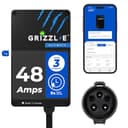
| Grizzl-E Ultimate 48A | Physical DIP switch | 16 / 24 / 32 / 40 / 48 A | 16 A to 48 A | Nothing to log into, and nothing you can change from the sofa — it is a screwdriver and the cover plate. Grizzl-E's own overview page lists the adjustable set as 40/32/24/16 A, which does not include 48 |
|---|
| EVIQO 40A plug-in | App | Published as adjustable from 6 to 40 A | 6 A to 40 A | 40 A is the plug-in ceiling on a 50 A circuit regardless of what the app offers, so the range here is entirely about setting it LOWER |
|---|
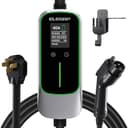
| ELEGRP 40A portable | On-unit selector | 16 / 20 / 24 / 32 / 40 A, plus a 1-12 hour delayed-start timer | 16 A to 40 A | The cheapest adjustable charger we track, and the only one offering a 20 A step — useful on a 25 A circuit, which nothing else here fits |
|---|
| Grizzl-E Classic Connect 40A | Physical DIP switch (the app does not set current) | 16 / 24 / 32 / 40 A | 16 A to 40 A | A connected charger whose amperage is still analog. Grizzl-E is explicit about it, which we prefer to a vague “smart” claim |
|---|
| Wallbox Pulsar Plus | Hardware selector, with software control below it | Hardware selector from 16 A to the rated current; software from 6 A | 6 A to 48 A | Load management can also move the figure on its own while charging — static and dynamic, each footnoted “May require power meter accessory” |
|---|
| Autel MaxiCharger 80A | App and DIP switch | DIP list of 16 / 24 / 32 / 40 / 48 / 50 / 64 / 72 / 80 A; app from 6 A | 6 A to 80 A | The widest span in the registry by a distance, and almost entirely theoretical at home: very few cars accept more than 48 A on AC |
|---|
Three findings fall out of it. “Adjustable 16-50 A” means six settings on both units that publish it — a fact neither brand hides, exactly, but neither leads with. Both print the six in the electrical specifications and the range in the marketing copy.
The finest control belongs to the cheaper unit.EVIQO’s 48A hardwired publishes a 6-to-48-amp app slider in 1-amp steps on top of a DIP-set ceiling, which is more granular than either flagship. It is also the page with the most internal contradictions we have catalogued: the DIP list omits the 50-amp setting its own description explains how to reach, and the configurator copy offers a range (“6-50A”) that neither the DIP list nor the app slider supports. We rank it third on control and publish the inconsistency rather than pretending the page is coherent.
Adjustability and connectivity are independent.The Grizzl-E Classic Connect has Wi-Fi, an app, scheduling and utility demand-response programmes — and sets its current with a physical switch. The ELEGRP has no network at all and sets five amperage steps and a delay timer on the unit. If you have been assuming “dumb charger” means “fixed charger”, the two cheapest picks on this page are the counter-example, and our no-app roundup goes further into it.
Matching the setting to your circuit
The 125% continuous-load rule runs in both directions, and read backwards it tells you your charger setting from your breaker. Multiply the circuit by 0.8:
A 20-amp circuit supports 16 amps (3.8 kW, about 13 miles of range an hour by our arithmetic). A 30-amp circuit supports 24 amps (5.8 kW, about 20 miles an hour). A 40-amp circuit supports 32 amps (7.7 kW, about 27 miles an hour). A 50-amp circuit supports 40 amps(9.6 kW, about 34 miles an hour) — the most common case, because that is what a NEMA 14-50 outlet sits on. A 60-amp circuit supports 48 amps (11.5 kW, about 40 miles an hour). And a 70-amp circuit supports 50, which buys half a kilowatt over 48 and is almost never worth the copper — the full argument is on our 50-amp page.
Two things to note about that list. The miles-per-hour figures are ours, from amps × 240 volts and a stated reference of roughly 3.5 miles per kWh, not manufacturer marketing claims — and they are linear, which means halving the amps doubles the charge time and nothing else changes. And the gap that actually matters to most drivers is at the bottom of the range, not the top: going from 16 to 32 amps doubles your overnight range, while going from 40 to 50 adds under two miles an hour.
Then the constraint nobody shops for: your car has a ceiling too.The wall unit offers current and the vehicle’s onboard charger accepts what it can use. Many EVs cap at 48 amps, plenty at 32 or 40, and a plug-in hybrid may stop at 14. Against a 32-amp car, a 50-amp charger set to 50 and the same charger set to 32 charge at exactly the same speed. Onboard chargers explained covers how to find your figure, and the plug-in hybrid roundup is the page for the low end of it.
When a fixed charger is the better buy
We would rather talk you out of a feature than sell it to you, so here are the three cases where adjustability is not worth paying for.
The circuit is settled and generous. If a 60-amp circuit is already in and the car accepts 48 amps, a fixed 48-amp charger does everything an adjustable one would do at that setting, for less. Several of our hardwired picks under $500 are exactly that, and the 48-amp roundup is the field in full.
You are plugging into a 14-50 and that is permanent. On a 50-amp receptacle the ceiling is 40 amps whatever the app says, so the adjustable range only goes downward and you are paying for headroom you cannot reach. Our 14-50 picks rank that case on its own terms.
The car is the limit and will stay the limit.If you drive a plug-in hybrid or an older EV with a 3.3 to 7.2 kW onboard charger, an adjustable 50-amp unit is a very expensive 16-amp charger. Buy for the car you have, and revisit when it changes — which, in fairness, is the one argument that brings you back to adjustability.