Level Two Club

Best Portable Level 2 EV Chargers

A portable charger is not just a plug-in charger you happen to be able to lift. It is a unit designed to be unplugged, coiled and carried — and the specs that make that work are not the ones a wall charger is sold on.

By Stephen V.Last updated How we pick

Every plug-in charger is technically removable. A portable one is designed for it: a smaller body, a cable that coils without a fight, often a second cord so it can fall back to a standard household outlet, and an enclosure sealed well enough to survive a trunk, a campsite and a rainy driveway rather than a dry garage wall.

So we ranked these on four things, in this order. One: does it do 120V as well as 240V, because a travel charger that only works where a NEMA 14-50 exists is not really a travel charger. Two: what the body is actually sealed against, published as an IP or NEMA code rather than the word “weatherproof.” Three: amps against carryability— a 25-foot cable is wonderful in a garage and heavy in a bag. Four: a safety listing we can name, with the standard number, not a certification badge in a product photo.

That last filter did most of the work. The portable shelf on Amazon is deep and mostly anonymous, and a large share of it publishes no enclosure rating, no temperature range and no named safety standard anywhere its own brand controls. Four units cleared the bar.

How this is funded: we earn a commission if you buy through our links, at no extra cost to you. It never changes which product we recommend, and we’ll tell you when we’d skip one. Full disclosure.

Quick picks

Ranked on published specs, charging speed, electrical fit and value. Select a row to jump to the full write-up. We have not bench-tested these chargers — here is exactly what we do instead.

#ProductBest forPrice
1
Ampure Go Portable Level 2 Charger

Ampure Go Portable Level 2 Charger

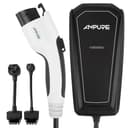
The only portable charger we track that is certified like a permanent one. UL 2594 / UL 2231, ENERGY STAR and an IP67 / NEMA 6P body rated from -22F to 122F, in a nine-pound module that ships with a NEMA 14-50 cord for 240V and a standard 5-15 cord for 120V. You give up eight amps against the 40A units and get, in exchange, a charger genuinely rated to live in a trunk and be rained on.

Best overall portable
$299.00 · View on Amazon

Price as of September 2, 2026. #ad How we’re funded

2
ELEGRP 40A Portable Level 2 Charger

ELEGRP 40A Portable Level 2 Charger

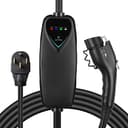
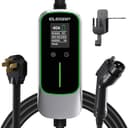
The full-speed portable. A genuine 40 amps on a NEMA 14-50, an IP67 station body rated -22F to 122F, and a 25-foot cable - the longest here by five feet - for less than the 32A unit costs. It is the heaviest thing here to coil and there is no app, but if the portable is also going to be your everyday charger, this is the one that does not make you choose.

Best at a full 40 amps
$209.99 · View on Amazon

Price as of September 2, 2026. #ad How we’re funded

3
Lectron 40A Portable Level 2 Charger

Lectron 40A Portable Level 2 Charger

One of the cheapest honest ways into real Level 2 charging. Plug it into a NEMA 14-50 outlet, get a genuine 40A / 9.6 kW, and unplug it to take on a trip. No app and a shorter warranty are the trade-offs for the price.

Easiest 40 amps to carry
$269.99 · View on Amazon

Price as of September 2, 2026. #ad How we’re funded

4
Lectron Portable Level 2 Tesla Charger (NACS)

Lectron Portable Level 2 Tesla Charger (NACS)

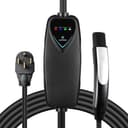
The portable to buy if your car has a NACS port and you would rather not travel with an adapter. It is the Lectron 40A portable with a Tesla connector on the end: a full 40 amps on a NEMA 14-50, a 16-foot cable, ETL to UL 2594 / UL 2231 and an ENERGY STAR listing. The gap is documentation - Lectron publishes no enclosure rating, temperature range or warranty term for this SKU.

Best for Tesla and NACS
$279.89 · View on Amazon

Price as of September 2, 2026. #ad How we’re funded

The picks in full

#1Best overall portable

Ampure Go Portable Level 2 Charger

The only portable charger we track that is certified like a permanent one. UL 2594 / UL 2231, ENERGY STAR and an IP67 / NEMA 6P body rated from -22F to 122F, in a nine-pound module that ships with a NEMA 14-50 cord for 240V and a standard 5-15 cord for 120V. You give up eight amps against the 40A units and get, in exchange, a charger genuinely rated to live in a trunk and be rained on.

Strengths

  • Dual voltage: 32A / 7.7 kW on a 240V NEMA 14-50, or 12A / 1.4 kW on any standard 120V outlet
  • UL and cUL listed (UL 2594 / UL 2231 / UL 817) and ENERGY STAR certified - rare on a portable
  • IP67 / NEMA 6P watertight body rated -22F to 122F, and the module weighs 9 lb

Trade-offs

  • 32 amps, not 40 - about 27 miles of range an hour against 34 from a 40A unit
  • No app or scheduling is published, so the charging schedule has to live in the car
  • Costs more than 40A portables that publish far less about themselves
Max output
32 A
Power
7.7 kW
Connector
J1772
Install
NEMA 14-50 cord for 240V, NEMA 5-15 cord for 120V
Cable length
20 ft
Warranty
3 years
WiFi + app
Not published
Certifications
UL and cUL listed (UL 2594 / UL 2231 / UL 817), ENERGY STAR, FCC

Our charging-speed math. At 32A (7.7 kW) and ~3.5 miles per kWh it adds roughly 27 miles of range per hour; on the 120V cord (1.4 kW), roughly 5. Ampure's own page claims up to 25 mi/hr, so our arithmetic is the slightly more generous of the two.

Build note. Dual-voltage portable: 32A / 7.7 kW at 240V or 12A / 1.4 kW at 120V, input range 85-265 VAC, 20 ft cable, IP67 / NEMA 6P enclosure rated -30C to +50C (-22F to 122F), 9 lb module.

Specs read from the manufacturer spec sheet, on August 25, 2026. “Not published” means the brand does not state that figure.

#2Best at a full 40 amps

ELEGRP 40A Portable Level 2 Charger

The full-speed portable. A genuine 40 amps on a NEMA 14-50, an IP67 station body rated -22F to 122F, and a 25-foot cable - the longest here by five feet - for less than the 32A unit costs. It is the heaviest thing here to coil and there is no app, but if the portable is also going to be your everyday charger, this is the one that does not make you choose.

Strengths

  • A real 40A / 9.6 kW, selectable down to 32, 24, 20 or 16 amps for a smaller circuit
  • 25 ft cable - the longest here, and enough to cross a garage
  • IP67 station body rated -22F to 122F, with a 1-to-12-hour delayed-start timer built in

Trade-offs

  • A 25 ft cable is the heaviest thing here to coil and carry - portability is relative
  • The connector is rated IP54, well below the station's IP67, so keep it off wet ground
  • No app, and ELEGRP does not publish an ENERGY STAR listing for this SKU
Max output
40 A
Power
9.6 kW
Connector
J1772
Install
NEMA 14-50 plug
Cable length
25 ft
Warranty
2 years
WiFi + app
No
Certifications
ETL listed

Our charging-speed math. At 40A (9.6 kW) and ~3.5 miles per kWh it adds roughly 34 miles of range per hour - the same speed as any 40A wall unit.

Build note. Portable plug-in unit with selectable output at 16, 20, 24, 32 or 40 amps and a 1-to-12-hour delayed-start timer, on a 25 ft cable; IP67 station and IP54 connector, rated -22F to 122F.

Specs read from the manufacturer spec sheet, on August 25, 2026. “Not published” means the brand does not state that figure.

#3Easiest 40 amps to carry

Lectron 40A Portable Level 2 Charger

One of the cheapest honest ways into real Level 2 charging. Plug it into a NEMA 14-50 outlet, get a genuine 40A / 9.6 kW, and unplug it to take on a trip. No app and a shorter warranty are the trade-offs for the price.

Strengths

  • A real 40A / 9.6 kW at a budget price
  • Plug-in and portable — take it with you, no hardwiring
  • ETL listed to UL 2594 / UL 2231 safety standards

Trade-offs

  • No WiFi or app on the base model — the smart version is a separate SKU
  • Shorter 16 ft cable and a 2-year warranty
  • Brand doesn't publish an outdoor/IP enclosure rating
Max output
40 A
Power
9.6 kW
Connector
J1772
Install
NEMA 14-50 plug
Cable length
16 ft
Warranty
2 years
WiFi + app
No
Certifications
ETL listed (UL 2594 / UL 2231)

Our charging-speed math. At 40A (9.6 kW) and ~3.5 miles per kWh it adds roughly 34 miles of range per hour.

Build note. Portable plug-in unit — no hardwiring needed; the base model has no WiFi or app.

Specs read from the manufacturer spec sheet, on July 19, 2026. “Not published” means the brand does not state that figure.

#4Best for Tesla and NACS

Lectron Portable Level 2 Tesla Charger (NACS)

The portable to buy if your car has a NACS port and you would rather not travel with an adapter. It is the Lectron 40A portable with a Tesla connector on the end: a full 40 amps on a NEMA 14-50, a 16-foot cable, ETL to UL 2594 / UL 2231 and an ENERGY STAR listing. The gap is documentation - Lectron publishes no enclosure rating, temperature range or warranty term for this SKU.

Strengths

  • Native NACS connector - no adapter to lose in a hotel parking lot
  • A genuine 40A / 9.6 kW on a NEMA 14-50, and ENERGY STAR certified
  • ETL listed to UL 2594 / UL 2231, with a UL 2251 handle

Trade-offs

  • Lectron publishes no enclosure rating, temperature range or warranty term for this SKU
  • A 16 ft cable is short if the charger has to reach across a garage
  • The base unit has no app - the WiFi version is a separate, dearer SKU
Max output
40 A
Power
9.6 kW
Connector
NACS
Install
NEMA 14-50 plug
Cable length
16 ft
Warranty
Not published
WiFi + app
No
Certifications
ETL listed (UL 2594 / UL 2231), ENERGY STAR, FCC; UL 2251 handle

Our charging-speed math. At 40A (9.6 kW) and ~3.5 miles per kWh it adds roughly 34 miles of range per hour.

Build note. Portable NACS unit on a NEMA 14-50 plug with a 16 ft cable and LED status indicators; Lectron describes it as weather-resistant for indoor or outdoor use while advising against extreme weather exposure, and publishes no enclosure rating for it.

Specs read from the manufacturer spec sheet, on August 25, 2026. “Not published” means the brand does not state that figure.

The four specs that decide whether a charger travels well: how much power it makes, how far the cable reaches, what it plugs into, and what the body is sealed against. Every figure is as published by the brand; blanks read “Not published” because that is what the source says, not because we stopped looking.
ChargerMax ampsCablePlugs intoEnclosureENERGY STAR
Ampure Go Portable Level 2 Charger32 A20 ftNEMA 14-50 cord for 240V, NEMA 5-15 cord for 120VIP67 (NEMA 6P watertight)Yes
ELEGRP 40A Portable Level 2 Charger40 A25 ftNEMA 14-50 plugIP67 (station), IP54 (connector)Not published
Lectron 40A Portable Level 2 Charger40 A16 ftNEMA 14-50 plugNot publishedNot published
Lectron Portable Level 2 Tesla Charger (NACS)40 A16 ftNEMA 14-50 plugNot publishedYes

What makes a charger portable, and what doesn’t

The industry uses “portable” for two different things, and conflating them is how people end up disappointed. The first is a plug-in wall charger: it terminates in a NEMA 14-50 plug instead of a wire nut, so it comes off the wall when you move. It is not designed to be handled weekly. The second is a portable, or travel, charger: a control module on a cord, meant to be unplugged, coiled and put back in a bag, with a bracket as an option rather than an assumption.

Both plug into the same outlet and both are honest about it. The difference shows up in the details — module mass, cable stiffness, whether a second cord for a standard household socket is in the box, and whether the enclosure is rated for water it will actually meet. If you want the wall-first version of this decision, that is our plug-in (NEMA 14-50) roundup; this page is the carry-it version.

The four criteria, in full

1. Dual voltage is the whole point

A charger that only speaks 240V is only useful where somebody has already installed a 240V outlet. A dual-voltage unit ships with a second cord terminating in a standard NEMA 5-15 — the ordinary three-prong household socket — and drops to Level 1 speed when that is all there is.

Level 1 is slow: around 1.4 kW, or roughly five miles of range an hour at our reference efficiency. It is also the difference between leaving a friend’s house with 60 miles more range and leaving with none. Of the four here, the Ampure Go is the only one that ships both cords. The other three are 240V-only. Our Level 1 charging guide covers what that fallback speed really buys you overnight.

2. Publish the enclosure rating, or we record it as unknown

A charger that lives outdoors permanently is judged on its enclosure. A portable one arguably faces worse: it gets set down on wet gravel, packed damp, and carried through weather no wall unit ever sees. So the rating matters more here, not less.

Two of these publish a real one. The Ampure Go is IP67 in a NEMA 6P watertight body, rated -22°F to 122°F. The ELEGRP is IP67 at the station— but IP54 at the connector, a genuine gap worth knowing before you leave the handle in a puddle. Lectron publishes no enclosure rating for either of its portables, which is a finding rather than a gap in our research, and we record it as Not published rather than inferring one from marketing imagery. What the codes actually promise is in our NEMA and IP ratings guide.

3. Amps are cheap; carrying the cable is not

The temptation is to buy the biggest number. Forty amps is 9.6 kW, about 34 miles of range an hour; thirty-two amps is 7.7 kW, about 27. Over a ten-hour night that is roughly 340 miles against 270 — a difference that matters to almost nobody, because almost nobody drives 270 miles a day.

What you pay for those eight amps is mass. The 40A units here run 25 feet and 16 feet of cable respectively, and cable is most of the weight and nearly all of the bulk in a portable charger. A 25-foot cable is the right answer if the charger will spend most of its life on a garage wall and travel occasionally. A shorter one is the right answer if it genuinely lives in the trunk.

4. Name the standard, not the badge

Every EVSE sold in the US should be listed to UL 2594 (electric vehicle supply equipment) and UL 2231 (personnel protection), by UL itself or by a competing lab such as Intertek, whose mark is ETL. That listing is what an electrician and an inspector look for, and it is the one specification we will not accept as an unsourced claim.

All four picks name it. The Ampure Go is UL and cUL listed to UL 2594 / 2231 / 817 and ENERGY STAR certified — unusual on a portable, and the same certification that gates most utility rebate programs. Both Lectrons are ETL listed to UL 2594 / 2231, and the NACS unit adds ENERGY STAR. The ELEGRP states an ETL listing without naming the standards, so that is exactly what we record. Our certifications guide explains what each mark covers.

What you can actually plug into away from home

This is the part the product photos skip. A portable Level 2 charger needs a 240V receptacle, and away from your own garage those are less common than the marketing suggests.

NEMA 14-50 is the good case, and the reason it exists in the wild at all is RV travel: most full-hookup campground and RV-park sites have one. That is a genuinely useful fact if you road-trip, and it is why an RV-park pedestal is the most reliable place to find Level 2 power outside a home.

A dryer outlet is usually not a 14-50. A NEMA 14-30 is a 30-amp receptacle supporting 24 amps of charging, and an older NEMA 10-30 has no separate ground at all. Neither is something to adapt casually, and a hardware-store adapter that lets a 40-amp charger draw from a 30-amp circuit is a fire risk, not a convenience. Our plug and outlet reference lays out every type and what each one can safely deliver.

The 120V socket is the universal fallback. Anywhere with power has a 5-15. On a fifteen-amp household circuit a Level 1 charge draws about 12 amps continuously for hours, so the circuit should be one nothing else is sharing, and an extension cord is not the right tool. That is the real argument for a dual-voltage unit: the fallback is always available.

The 40-amp ceiling, and why 32 is often enough

No portable charger delivers more than 40 amps, and that is not a manufacturing limitation. Under the National Electrical Code, EV charging is a continuous load, so a circuit is sized at 125% of the load — which read backwards means a receptacle supports 80% of its rating. A NEMA 14-50 is a 50-amp receptacle, so 40 amps is the maximum anything that plugs into one can draw. Every 48-amp charger on the market is hardwired for exactly this reason; the reasoning is laid out in hardwired vs plug-in.

Choosing 32 amps instead costs you about seven miles of range per hour and buys you a lighter unit that will also run happily on a 40-amp circuit — useful, given that not every 14-50 you find on the road is on a full 50-amp breaker. If your panel is the constraint rather than the outlet, our chargers for small panels covers the adjustable-output route.

How we separated them

Ampure Go wins because it is the only one that treats portability as an engineering brief rather than a marketing word. It ships both cords, so it works at a 14-50 and at any household socket. It is IP67 in a NEMA 6P watertight body rated -22°F to 122°F, which is a better seal than most permanently mounted chargers carry. It is UL listed to the named standards and ENERGY STAR certified. The module weighs nine pounds. The cost is speed: 32 amps rather than 40, about 27 miles of range an hour by our arithmetic. Ampure’s own page claims up to 25, so we are, unusually, the more optimistic of the two.

ELEGRP 40A is the pick if the portable is also going to be the everyday charger. A full 40 amps, selectable down to 32, 24, 20 or 16 for a smaller circuit, a 25-foot cable, an IP67 station body rated -22°F to 122°F, and a built-in one-to-twelve-hour delayed start so overnight charging can follow a time-of-use ratewithout an app or an account. Two honest caveats: the connector is rated only IP54 against the station’s IP67, and 25 feet of 40-amp cable is the least pleasant thing here to coil.

Lectron 40A is the one to buy if the charger really does live in the trunk. It makes the same 40 amps as the ELEGRP on nine feet less cable, which is the difference between coiling it in ten seconds and wrestling with it, and it is the only 40A unit here from a brand whose whole line we already track. It is ETL listed to UL 2594 / 2231 with a two-year warranty, and it sits in the same value bracket that puts it on our budget roundup. Lectron publishes no outdoor or IP rating for it, so treat it as an indoor unit until the brand says otherwise. Full detail is in our Lectron 40A review.

Lectron Portable Level 2 Tesla Charger is the same idea with a native NACS connector, which matters more on a portable than on a wall unit: an adapter you have to remember to pack is an adapter you will eventually leave at home. It is ETL listed to UL 2594 / 2231 with a UL 2251 handle and carries ENERGY STAR. Its documentation is the weak point — no published enclosure rating, no temperature range, no warranty term — and Lectron’s own imagery cites enclosure figures that disagree with each other, which is why we record Not published rather than pick one. If a NACS charger is going to live on a wall instead, our Tesla and NACS roundup is the better page.

What we left off, and why

Most of the category, honestly. Search “portable EV charger” and you get dozens of 32A and 40A units at low prices from brands whose own websites either do not exist or do not publish an enclosure rating, an operating-temperature range or a named safety standard. Some of them are probably fine. We cannot tell you which, and neither can they, so they are not here.

We also left off two units we wanted to include. Lectron’s dual-plug Level 1 and Level 2 portable — the closest J1772 competitor to the Ampure Go — reads “Currently unavailable” on Amazon as of our check on 25 August 2026, and we do not list chargers you cannot buy. And the Tesla Mobile Connector, the unit that defined this category, is sold primarily through Tesla’s own store; Tesla’s specification pages are not machine-readable for us, so we will not publish specs for it we cannot verify at source. If you own one already, it is a 32-amp-class travel charger and it does the job.

Portable, plug-in or hardwired?

Buy portableif the charger has to move — a rental you will leave, a second home, a road trip, a car you are not sure you are keeping. Buy plug-inif it will live on one wall but you want it to be your property rather than the building’s. Buy hardwired if you own the house and want the 48 amps a plug cannot deliver.

One caution that applies to all three: if a suitable 240V outlet does not already exist, installing one is electrical work with a permit, and the outlet — not the charger — is where the money goes. A portable charger does not change that arithmetic on the first install, only on every move afterwards. Our installation cost guide has the real breakdown, and chargers for renters covers what to ask a landlord before you spend anything.
Frequently asked questions

What is the difference between a portable EV charger and a plug-in one?

Both connect through a plug rather than being hardwired, so both are removable. A plug-in wall charger is designed to be mounted and left there, and comes off when you move. A portable charger is designed to be handled routinely: a lighter control module, a cable meant to be coiled, often a second cord for a standard 120V socket, and a wall bracket treated as optional. If you will unplug it more than once a year, buy the portable one.

How fast is a portable Level 2 charger?

The same speed as a wall charger at the same amperage — a 40-amp portable delivers 9.6 kW and adds roughly 34 miles of range per hour at a typical 3.5 miles per kWh; a 32-amp unit delivers 7.7 kW and adds about 27. Being portable costs you nothing in charging speed. What caps it is the outlet: 40 amps is the maximum any charger on a NEMA 14-50 can draw, because the NEC limits a continuous load to 80% of a 50-amp receptacle.

Can I use a portable EV charger outside?

Only if the manufacturer publishes an enclosure rating that covers it. Two of our picks do: the Ampure Go is IP67 in a NEMA 6P watertight body rated -22F to 122F, and the ELEGRP is IP67 at the station, though only IP54 at the connector. Lectron publishes no enclosure rating for either of its portables, so we record that as not published and would keep them under cover. The receptacle also needs a weatherproof in-use cover regardless of the charger.

Where can I plug in a portable Level 2 charger when traveling?

Realistically, RV parks and campgrounds. Full-hookup sites almost always have a NEMA 14-50, which is the same receptacle a home Level 2 install uses. Beyond that, a friend's garage if they have a 14-50 or a welder outlet, and some vacation rentals. Everywhere else you fall back to a standard 120V socket, which is why a dual-voltage charger that ships with both cords is worth the premium if you actually travel.

Can I plug a portable charger into a dryer outlet?

Not without knowing exactly which outlet it is. A NEMA 14-30 dryer receptacle is a 30-amp circuit supporting 24 amps of charging, not 40, and an older NEMA 10-30 has no separate ground. Adapters that let a 40-amp charger draw from a 30-amp circuit exist and are genuinely dangerous unless the charger's output is dialed down to match. Check the receptacle type and the breaker first, and set the charger's amperage to 80% of the circuit rating.

Is a portable charger safe to use as an everyday home charger?

Yes, if it carries a real safety listing to UL 2594 and UL 2231 and the outlet behind it is EV-grade. All four picks here name that listing. The two variables to get right are the receptacle, which sees hours of near-maximum continuous draw and is the component that fails in cheap installs, and the GFCI protection that a receptacle-fed charger usually requires, which is the most common source of nuisance tripping.

Sources

  • NFPA — Using the Latest NEC for EV Charger InstallationsNFPA on NEC (NFPA 70) Article 625: EV charging is a continuous load, so circuits are sized to 125% of load (the 80% rule) (accessed July 19, 2026)
  • Ampure - Ampure Go portable Level 2 EV charger product pageAmpure's own specifications for the Go: 32 A / 7.7 kW at 240 V or 12 A / 1.4 kW at 120 V, input range 85-265 VAC at 45-65 Hz, SAE J1772 coupler, NEMA 14-50 and NEMA 5-15 cords, 20 ft (6 m) cable, IP67 rated 'submersible up to 3 feet' with a NEMA 6P watertight enclosure, operating range -30C to +50C (-22F to 122F), 9 lb (4.1 kg) module, and listings to UL, cUL, UL 2594, UL 2231, UL 817, ICES, FCC, ENERGY STAR, REACH and RoHS. Ampure states 'up to 25 miles of range per hour' at 240 V (accessed August 25, 2026)
  • Ampure Store - Ampure Go Level 2 plug-in EV chargerAmpure's own store listing for the same unit, read for the warranty term the product page omits: 3-year warranty, 32 A, 20 ft cable, NEMA 14-50 with 120 V/240 V cords, IP67, UL / ENERGY STAR / FCC / RoHS (accessed August 25, 2026)
  • ELEGRP Store - 40A Level 2 portable J1772 EV charger (NEMA 14-50)ELEGRP's own listing: 40 A / 9.6 kW on 240 V AC with selectable output at 16, 20, 24, 32 or 40 A, SAE J1772 connector on a NEMA 14-50 plug, 25 ft cable (16 ft and 21 ft also offered), IP67 charging station and IP54 connector, operating range -22F to +122F (-30C to +50C), 1-to-12-hour delayed-start timer, 2-year warranty, 'ETL & UL' listed. The page does not name the UL standards, publish a weight, or publish app support for this SKU (accessed August 25, 2026)
  • Lectron — Portable Level 2 J1772 EV Charger (40A) product pageLectron's own listing: 40A / 240V / 9.6 kW, NEMA 14-50 plug, 16 ft cable, UL 2594 / UL 2231 certified, 2-year warranty, app control on the WiFi version only (accessed July 23, 2026)
  • Lectron - Portable Level 2 Tesla (NACS) EV Charger, 240V, 40 Amp, NEMA 14-50Lectron's own product page: 40 A / 240 V / 9.6 kW on a NEMA 14-50 plug with a native NACS connector for Tesla Models S/3/X/Y/Cybertruck and any NACS EV, 16 ft cable, ETL listed to UL 2594 / UL 2231 with a UL 2251 handle plus ENERGY STAR and FCC, LED status indicators on the base SKU with app control only on the separate WiFi version. Lectron describes the unit as weather-resistant for indoor or outdoor use while advising against extreme weather exposure, and its spec block publishes no enclosure rating, no operating-temperature range and no warranty term (accessed August 25, 2026)
  • UL Solutions — EV Charging Infrastructure ServicesUL on EVSE safety certification: ANSI/UL 2594 is the Standard for Electric Vehicle Supply Equipment (accessed July 19, 2026)
  • IEC 60529 — Degrees of protection provided by enclosures (IP Code), full textThe IP code standard (verbatim national adoption, IS/IEC 60529:2001): first numeral 6 = dust-tight; second numeral 6 = protected against powerful water jets; second numeral 7 = protected against temporary immersion, and a 7 alone does not imply water-jet protection unless dual coded (accessed July 20, 2026)
  • NEMA — Enclosure Types (definitions from NEMA 250)NEMA's own definitions: Type 3R protects against falling dirt and rain, sleet and snow; Type 4 adds windblown dust, splashing and hose-directed water; Type 4X adds protection against corrosion. NEMA also states its NEMA-to-IP table cannot be used to convert IP designations back to NEMA types (accessed July 20, 2026)
  • ENERGY STAR — Electric Vehicle ChargersENERGY STAR on EVSE efficiency: certified chargers use about 40% less energy in standby than non-certified units (accessed July 19, 2026)
  • U.S. DOE Alternative Fuels Data Center — Electric Vehicle Charging StationsUS DOE on charging levels: Level 1 (~1.9 kW, ~5 mi/hr), Level 2 (2.9-19.2 kW, ~7.2 kW typical residential, ~25 mi/hr), and DC fast charging (accessed July 19, 2026)

Keep reading