Emporia Level 2 vs Wallbox Pulsar Plus
Identical on the one spec everyone shops on — 48 amps, 11.5 kW, 25 feet of cable — and separated by everything else: how they install, how big they are, and what they do when the panel is already busy.
How this is funded: we earn a commission if you buy through our links, at no extra cost to you. It never changes which product we recommend, and we’ll tell you when we’d skip one. Full disclosure.
On the headline numbers these two are the same charger. Both deliver 48 amps and about 11.5 kW. Both ship with a 25-foot cable. Both are WiFi-connected, ENERGY STAR certified and carry a three-year warranty. And then one of them costs considerably more.
Which means this comparison is entirely about the things that are not on the front of the box.
| Spec | Emporia Level 2 | Wallbox Pulsar Plus |
|---|---|---|
| Max output | 48 A | 48 A |
| Power | 11.5 kW | 11.5 kW |
| Install | Hardwired or NEMA 14-50 plug | Hardwired (40A model plugs in) |
| Charging cable | 25 ft | 25 ft |
| Enclosure | NEMA 4 | NEMA 4 |
| WiFi / app | Yes | Yes |
| ENERGY STAR | Yes | Yes |
| Listings | UL listed, ENERGY STAR | UL 2594/2231, ENERGY STAR |
| Warranty | 3 years | 3 years |
Where they genuinely differ
Install flexibility.The clearest practical split. Emporia is a dual-mode unit: hardwire it for the full 48 amps, or fit it on a NEMA 14-50 plug and accept a 40-amp cap. Wallbox splits that across two products — the 48-amp Pulsar Plus reviewed here is hardwired only, and plugging in means stepping down to its separate 40-amp model. If you rent, if there is already a 14-50 in the garage, or if you would like to take the charger with you when you move, Emporia does it in one box and the Wallbox does not. Our hardwired vs plug-in guide covers why that trade exists.
Physical size. The Pulsar Plus is among the most compact 48-amp chargers available, and in a narrow garage where the charger sits beside a car door that is not a cosmetic point. It is the reason a certain group of buyers pays the difference without hesitation.
Load balancing.Wallbox’s Power Boost watches the home’s total draw and throttles the charger to keep it within what the service can carry. That can be the difference between installing a 48-amp charger and being told you need a service upgrade — a several-thousand-dollar difference, which reframes the price gap entirely. Our load management guide explains how that satisfies the load calculation.
Energy data.Emporia’s answer to the same broad problem is measurement rather than control: the app tracks what each session actually consumed. That is what makes cost-per-session real rather than estimated, and it pairs well with a time-of-use rate where you want to verify the scheduling is working.
Bluetooth. A small Wallbox advantage that matters in exactly one situation: a garage where WiFi does not reach. Bluetooth lets you configure and control the unit standing next to it, with no network at all. If your garage is a dead spot, read getting WiFi to your charger before you buy either.
What is the same, and worth saying plainly
Charging speed. Both deliver 48 amps, and at our reference 3.5 miles per kWh that is about 40 miles of range per hour — roughly 400 miles across a ten-hour night. Neither is faster than the other in any circumstance, and any review implying otherwise is describing something else.
Reach, too. Twenty-five feet each, which is the long end of the market and usually enough to cross a garage. If reach is your binding constraint, the segment to read is our long-cable roundup.
And the circuit. Forty-eight amps is a continuous load under the NEC, so both require a 60-amp circuitand both must be hardwired to reach full output. That requirement is identical, and it is the thing most likely to disqualify both of them — check with our panel capacity guide first.
Quick picks
Ranked on published specs, charging speed, electrical fit and value. Select a row to jump to the full write-up. We have not bench-tested these chargers — here is exactly what we do instead.
| # | Product | Best for | Price |
|---|---|---|---|
| 1 | 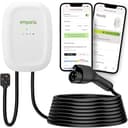 Emporia Level 2 EV Charger The value pick that doesn't feel cheap: a full 48 amps, ENERGY STAR listing, WiFi with genuine energy monitoring, and a 25 ft cable — for well under what the big names charge. It's the one we point most people to first. | Best value, and the only one you can plug in | |
| 2 | 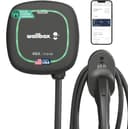 Wallbox Pulsar Plus The one to buy when wall space is tight: it's among the smallest 48A units you can get, with dynamic load management so it can share a circuit without tripping the main. A polished premium charger — and priced like one. | Smallest body, with load balancing |
The verdict, by situation
- You rent, or want a plug-in install: Emporia. The Pulsar Plus cannot do it.
- Your panel is tight and a service upgrade is on the table:Wallbox, for Power Boost — or Emporia’s own Pro model, which solves the same problem with a bundled energy monitor. That in-brand comparison is in Classic vs Pro.
- Wall space is genuinely tight:Wallbox. Measure before dismissing this — it is the most common reason people choose it.
- You want to know what each session cost: Emporia, for the energy monitoring.
- Your garage has no usable WiFi:Wallbox’s Bluetooth, or reconsider whether you need a smart charger at all — see our no-app picks.
- You want the best app and deepest support: neither. That is ChargePoint, and you will pay for it.
One last check before either: confirm your car actually accepts 48 amps. A vehicle capped at 7.7 kW draws 32 amps from both of these, and a 40-amp charger on a 50-amp circuit would have given identical results for a cheaper install — the reasoning is in the charger is inside your car.
Frequently asked questions
Is the Wallbox Pulsar Plus worth the extra over Emporia?
Only for two specific reasons: physical size and Power Boost load balancing. The Pulsar Plus is among the smallest 48-amp chargers made, which matters in a tight garage, and its load balancing can let a busy panel host a big charger. If neither applies to you, Emporia delivers the same 48 amps and the same 25-foot cable for meaningfully less.
Can either of these be plugged in rather than hardwired?
Emporia can — it is sold as hardwired or on a NEMA 14-50 plug, capped at 40 amps on the plug. Wallbox is the same story but split across two models: its 48-amp Pulsar Plus is hardwired only, while its 40-amp model is listed as NEMA 14-50 or hardwired. So a renter can have either brand at 40 amps; the difference is that Emporia gets you there with one SKU that also hardwires at 48.
What does Wallbox Power Boost actually do?
It balances the charger's draw against the rest of the home's consumption so the total stays within what the service can carry, throttling the car when other large loads run. That is the feature that can avoid a service upgrade — the same job Emporia's separate Pro model does with its bundled energy monitor.
Which has the better app?
Neither is the class leader — that is ChargePoint. Wallbox offers Bluetooth as well as WiFi, which is genuinely useful in a garage with poor signal because you can still control the unit standing next to it. Emporia's strength is energy data: it tracks what each session actually consumed rather than just switching on and off.
Do both qualify for utility rebates?
Both publish ENERGY STAR certification, which is the most common eligibility filter in utility rebate programs. Always verify against your specific program's list rather than assuming, and keep the manufacturer's own documentation rather than a retail listing badge as evidence.
Do I need 48 amps at all?
Only if your car accepts it and your panel can carry a 60-amp circuit. A great many EVs cap their onboard charger at 7.7 or 9.6 kW, in which case a 40-amp charger on a 50-amp circuit gives identical sessions for a cheaper install. Check the car's rating before shopping either of these.
Sources
- Emporia — Classic Level 2 EV Charger spec sheet (PDF) — Emporia's own spec sheet: watertight NEMA Type 4 indoor/outdoor enclosure, operating temperature -22F to 122F, 25 ft cable (accessed July 20, 2026)
- Wallbox — Pulsar Plus (North America) datasheet (PDF) — Wallbox's own datasheet: NEMA Type 4 per UL 50E for indoor and outdoor installation, operating temperature -22F to 104F, 25 ft cable (accessed July 20, 2026)
- NFPA — Using the Latest NEC for EV Charger Installations — NFPA on NEC (NFPA 70) Article 625: EV charging is a continuous load, so circuits are sized to 125% of load (the 80% rule) (accessed July 19, 2026)
- ENERGY STAR — Electric Vehicle Chargers — ENERGY STAR on EVSE efficiency: certified chargers use about 40% less energy in standby than non-certified units (accessed July 19, 2026)
- FuelEconomy.gov — Electric Vehicles: Learn More About the Label — DOE/EPA on EV efficiency: kWh per 100 miles and MPGe, accounting for AC charging losses (accessed July 19, 2026)
- U.S. DOE Alternative Fuels Data Center — Utility Incentives — DOE's catalog of utility incentives by customer type: 114 utilities listed offering residential Level 2 charging station purchase rebates and 74 offering Level 2 installation rebates, plus make-ready/pre-wiring rebates, managed-charging programs and EV time-of-use rates. RE-READ September 3, 2026: the residential counts were unchanged at 114 participating utilities for the EV Level 2 Charging Station Purchase Rebate and 74 for the EV Level 2 Charging Station Installation Rebate, alongside 17 for the Make-Ready or Pre-Wiring Rebate for EV Chargers, 109 for the EV Time-of-Use (TOU) Rate and 9 for the EV Managed Charging Program (accessed September 3, 2026)
Keep reading
Emporia Level 2 review
The full write-up on the value 48-amp charger, including where the app falls short.
Read the reviewWallbox Pulsar Plus review
The compact premium unit in detail — size, Power Boost, and what you pay for them.
Read the reviewEmporia Classic vs Pro
If load balancing is what drew you to Wallbox, Emporia's own Pro does it a different way.
Compare in-brandBest 48-amp chargers
The whole segment ranked, including the two on this page and the cheaper alternatives.
See the segment