Emporia Level 2 vs Emporia Pro
Identical charging, identical cable, identical listings — and a price gap that only one feature has to justify. Whether PowerSmart earns it depends entirely on what a load calculation says about your panel.
How this is funded: we earn a commission if you buy through our links, at no extra cost to you. It never changes which product we recommend, and we’ll tell you when we’d skip one. Full disclosure.
In-brand comparisons are usually about trim levels. This one is not. The Emporia Pro is not a nicer Emporia Level 2 — it is the same charging hardware attached to a different electrical argument, and whether it is worth the money depends on one piece of arithmetic done in your panel.
| Spec | Emporia Level 2 | Emporia Pro |
|---|---|---|
| Max output | 48 A | 48 A |
| Power | 11.5 kW | 11.5 kW |
| Install | Hardwired or NEMA 14-50 plug | Hardwired or NEMA 14-50 plug |
| Charging cable | 25 ft | 25 ft |
| Enclosure | NEMA 4 | NEMA 4 |
| WiFi / app | Yes | Yes |
| ENERGY STAR | Yes | Yes |
| Listings | UL listed, ENERGY STAR | UL listed, ENERGY STAR |
| Whole-home load management | No | Yes — PowerSmart, with the bundled Vue 3 monitor |
| Warranty | 3 years | 3 years |
Everything that is the same
Worth being blunt about this, because the price gap invites the assumption that the Pro charges faster or is better built. It does not and it is not.
Both are rated to 48 amps hardwired on a 60-amp circuit, or 40 amps on a NEMA 14-50 plug— the plug-in ceiling being a limitation of receptacles rather than of either charger. Both ship with a 25-foot cable. Both are NEMA 4 rated for indoor or outdoor installation, UL listed and ENERGY STAR certified, with a three-year warranty. Both connect to WiFi and the Emporia app with no subscription.
At 48 amps that is about 11.5 kW by our arithmetic, roughly 40 miles of range per hour at a reference 3.5 miles per kWh. Identical on both.
The one difference, and what it is for
The Pro adds PowerSmart, and ships with Emporia’s Vue 3 energy monitorin the same box. The monitor installs in your electrical panel and reports the whole home’s real-time draw; the charger uses that to raise or lower its own current so the total never exceeds what the service can carry.
Cook dinner while the dryer runs and the car quietly slows down. Go to bed and it speeds back up. Over a full overnight window the energy delivered is usually much the same, because the heavy household loads are short and the charging window is long.
Two things follow from this that are easy to miss. First, it is a two-device system— the install involves work inside the panel as well as mounting the charger, which is a conversation to have with your electrician when quoting. Second, and this is the point of the product: because the charger is no longer an unmanaged full-time load, the load calculation changes.
Why that calculation is the whole decision
Under the NEC, EV charging is a continuous load and the calculation must assume the charger could draw its full current at any moment. A 48-amp charger is counted as 60 amps, permanently, whether or not you ever use it that way.
That single rule is what fails so many panels. And it is exactly what a managed charger addresses — not by creating capacity, but by guaranteeing the total stays inside what exists. Where that turns a failed load calculation into a passed one, the Pro has just saved you a service upgrade, which costs several times the price difference between these two chargers.
Where your panel had spare capacity all along, PowerSmart has nothing to manage. Same charging, more money.
So the honest decision procedure is: get the load calculation done first, then choose. Not the other way round.
How it compares with other load-management approaches
Emporia is not alone here, and the approaches differ in ways that matter.
Wallbox Power Boost on the Pulsar Plusdoes a similar job, and the Pulsar Plus is also the most compact 48-amp unit on the market — so if wall space is tight as well as panel space, it is the alternative to weigh. We compare the standard Emporia against it in Emporia vs Wallbox.
Simply dialing a charger down is the free version. A ChargePoint Home Flexset to 24 or 32 amps presents a smaller fixed load to the calculation, permanently. Less clever than dynamic management, and for a household whose driving does not need 48 amps, entirely sufficient — see 32 amps vs 40 amps.
The full survey of approaches is in our load management guide, and the segment roundup is chargers for small panels.
Quick picks
Ranked on published specs, charging speed, electrical fit and value. Select a row to jump to the full write-up. We have not bench-tested these chargers — here is exactly what we do instead.
| # | Product | Best for | Price |
|---|---|---|---|
| 1 |  Emporia Level 2 EV Charger The value pick that doesn't feel cheap: a full 48 amps, ENERGY STAR listing, WiFi with genuine energy monitoring, and a 25 ft cable — for well under what the big names charge. It's the one we point most people to first. | Best value when the panel has room | |
| 2 | 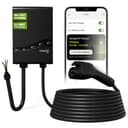 Emporia Pro The answer to a panel that says no. The Pro ships with Emporia's Vue 3 energy monitor in the same box, watches what the rest of the house is drawing, and throttles the car in real time so the total never exceeds what the service can carry — which is how a 48-amp charger ends up on a panel that a load calculation says has no room for one. You pay roughly Home Flex money for it, and only the load management justifies that. | Worth it when the load calculation fails | $599.00 · View on Amazon Price as of October 18, 2026. #ad How we’re funded |
| 3 |  Wallbox Pulsar Plus The one to buy when wall space is tight: it's among the smallest 48A units you can get, with dynamic load management so it can share a circuit without tripping the main. A polished premium charger — and priced like one. | The alternative when space is tight too |
The verdict
- Your panel has clear spare capacity: the standard Emporia. The Pro solves a problem you do not have.
- An electrician has told you the service will not carry 48 amps: the Pro, before you accept a service-upgrade quote. Confirm the approach with them and with your inspector.
- You are borderline and want the headroom: the Pro, and treat the price difference as insurance against a much larger bill.
- You want energy data but not load management: the standard Emporia already tracks session energy. That is not what the Pro adds.
- You do not need 48 amps at all: neither. A 40-amp charger on a 50-amp circuit is a cheaper install and, for most cars and most driving, an identical experience.
Frequently asked questions
What is the difference between the Emporia Level 2 and the Emporia Pro?
PowerSmart load management, and the Vue 3 energy monitor that makes it work. Both are 48-amp chargers with a 25-foot cable, a NEMA 4 body, UL listing and ENERGY STAR certification, and both can be hardwired or run at 40 amps on a NEMA 14-50 plug. The Pro adds real-time whole-home load management; the charging itself is the same.
What does PowerSmart actually do?
It reads your home's total electricity draw from the bundled Vue 3 monitor installed in your panel, and raises or lowers the charger's output so the combined load stays inside what your service can carry. When the dryer and the oven are running, the car charges more slowly; when the house is quiet, it charges at full speed.
Do I need the Vue monitor for PowerSmart to work?
Yes. Emporia states the Pro comes bundled with the Vue 3 Energy Monitor, and PowerSmart depends on that monitor's real-time panel data. It is a two-device system, not a feature of the charger alone — which means the install involves work inside the panel as well as mounting the charger.
Can PowerSmart let me skip an electrical service upgrade?
Often, and that is the whole case for the Pro. Because the charger is no longer an unmanaged full-time load, a load calculation that would fail with a plain 48-amp charger can pass with a managed one. Where that avoids a service upgrade, the price difference is repaid several times over. Confirm the approach with your electrician and your inspector before buying.
Is the Pro faster than the Classic?
No — and in one sense it is slower. Both deliver up to 48 amps hardwired. The Pro will deliberately deliver less than that when the rest of the house is drawing heavily, which is exactly what you are paying it to do. Over a full night the difference in energy delivered is usually negligible.
If my panel has plenty of capacity, should I still buy the Pro?
No. With genuine spare capacity, PowerSmart has nothing useful to do and the standard Emporia gives you the same 48 amps, the same cable and the same certifications for meaningfully less. Spend the difference on the installation, or on nothing at all.
Sources
- Emporia — Classic Level 2 EV Charger spec sheet (PDF) — Emporia's own spec sheet: watertight NEMA Type 4 indoor/outdoor enclosure, operating temperature -22F to 122F, 25 ft cable (accessed July 20, 2026)
- Emporia Energy — Pro EV Charger product page — Emporia's own listing for the Pro: up to 48 A hardwired on a 60-amp circuit or up to 40 A on a NEMA 14-50 outlet, 25 ft cable, NEMA 4 rated for indoor or outdoor, UL listed and ENERGY STAR certified, 3-year warranty, and PowerSmart load management that requires the bundled Vue 3 energy monitor (accessed August 18, 2026)
- NFPA — Using the Latest NEC for EV Charger Installations — NFPA on NEC (NFPA 70) Article 625: EV charging is a continuous load, so circuits are sized to 125% of load (the 80% rule) (accessed July 19, 2026)
- ENERGY STAR — Electric Vehicle Chargers — ENERGY STAR on EVSE efficiency: certified chargers use about 40% less energy in standby than non-certified units (accessed July 19, 2026)
- U.S. DOE Alternative Fuels Data Center — Utility Incentives — DOE's catalog of utility incentives by customer type: 114 utilities listed offering residential Level 2 charging station purchase rebates and 74 offering Level 2 installation rebates, plus make-ready/pre-wiring rebates, managed-charging programs and EV time-of-use rates. RE-READ September 3, 2026: the residential counts were unchanged at 114 participating utilities for the EV Level 2 Charging Station Purchase Rebate and 74 for the EV Level 2 Charging Station Installation Rebate, alongside 17 for the Make-Ready or Pre-Wiring Rebate for EV Chargers, 109 for the EV Time-of-Use (TOU) Rate and 9 for the EV Managed Charging Program (accessed September 3, 2026)
- FuelEconomy.gov — Electric Vehicles: Learn More About the Label — DOE/EPA on EV efficiency: kWh per 100 miles and MPGe, accounting for AC charging losses (accessed July 19, 2026)
Keep reading
Emporia Pro review
The full write-up on the load-managing model, including what the bundled monitor adds to the install.
Read the reviewEmporia Level 2 review
The value 48-amp charger that made the brand's name, in detail.
Read the reviewDo you need a service upgrade?
The expensive alternative this comparison exists to avoid — and when it is genuinely unavoidable.
Check firstHow load management works
The approaches across the market, and how they satisfy the load calculation.
See the methods