What we ranked on, before any picks
A nameplate number is the weakest piece of evidence in this category, because every unit here is adjustable and almost none of them ships at its headline figure. Five questions decide the purchase instead, and each one is answerable from a manufacturer’s own published page rather than from an impression.
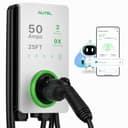
One: does the maker publish the circuit its top setting needs?This is the question that separates an honest spec sheet from a marketing number, and it is the first thing we checked. Autel states “Hardwired · 70 A Circuit for Full Output”. EVIQO states “a dedicated 70A circuit required” for its 50-amp DIP setting, alongside 60 amps for 48. ChargePoint publishes neither a 70 nor a 60 — it publishes a range, “circuits rated from 20 to 80A”, and tells you to ask your electrician. All three are defensible; only two let you price the job before you buy.
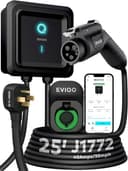
Two: how is the amperage actually set, and in what increments? “Adjustable 16–50 A” sounds like a dial and is not. Autel’s electrical line reads “208/240 VAC, 60 Hz, single phase @ 16 A, 24 A, 32 A, 40 A, 48 A, 50 A” — six discrete settings, not every value between. ChargePoint’s datasheet gives the same six. EVIQO splits it: a DIP switch sets the ceiling and the app slides from 6 amps upward in 1-amp steps, which is the finest control in the group. That matters when your circuit is an awkward size, and it matters even more in a house doing load management.
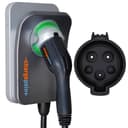
Three: what safety listing, from which laboratory? The standard number matters less than who tested to it, and in this group the picture is uneven. ChargePoint publishes UL and cUL listing per UL 2594 and UL 2231. EVIQO publishes three differentcertification strings on one page — “UL/ETL/FCC/Energy Star certified” in the description, “Certified by ETL, Energy Star, and FCC” in the FAQ, and “UL & ETL listed” in its own comparison table. Autel publishes CSA and ENERGY STAR and makes no UL claim anywhereon the page, which is a documentation difference between two accredited laboratories rather than a safety gap — but it is worth knowing before you fill in a rebate form. Our certifications guide explains what each mark is worth.
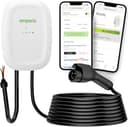
Four: is there a published temperature range?At these power levels the unit runs warm and usually lives on an exterior wall or in an uninsulated garage, and the absence of a published range is itself a finding. Autel publishes “-40 to 131 °F”, the widest of any charger we track. Emporia publishes -22°F to 122°F. EVIQO publishes -22°F to 122°F as tested rather than as an operating range, which is a weaker claim worded carefully.
Five: does it fit the install you can actually have?Fifty amps is hardwired-only from everyone, with no exceptions — no residential plug is rated for a 62.5-amp continuous load. If you rent, if your panel is full, or if there is already a 14-50 outlet where you park, the 50-amp tier is not a tier you can buy into, and hardwired versus plug-in is the decision to settle first.
What each maker actually publishes about fifty amps
Before the picks, here is the field in each brand’s own words — because the most common way to get this purchase wrong is to buy a 50-amp charger and discover at the quote stage that the circuit it wants is a bigger job than the charger was.
What each maker publishes about its own 50-amp setting, read off that maker’s own page on October 31, 2026. The quoted strings are theirs; the 62.5-amp arithmetic in the last row is ours, from ChargePoint’s own 125%-of-maximum-load rule. All three roads lead to a 70-amp circuit, and not one of these units ships at 50 amps out of the box.| Unit | What the nameplate claims | How you reach 50 A | Circuit the maker publishes |
|---|
| Autel MaxiCharger AC Elite Home 50A | “Maximum Output | 12 kW / 50 A” | App, six discrete steps: “16 A, 24 A, 32 A, 40 A, 48 A, 50 A”. Fifty is a setting you select, not a default | “Hardwired · 70 A Circuit for Full Output” — published in plain text |
|---|
| EVIQO 48A hardwired | Title reads “48A (50A Max)”; 50 A is not in its own DIP list | Hardware: “set the DIP switches to positions 4, 5 to unlock 50A output”. The DIP list the same page publishes is 16/32/40/48 A, and the app slider is “6-48A” | “a dedicated 70A circuit required” for 50 A; 60 A for 48 A |
|---|
| ChargePoint Home Flex (hardwired) | “up to 50A of power for fastest charging”; datasheet gives 12 kW | App, six discrete steps: 16, 24, 32, 40, 48 or 50 A. Plug-in SKUs are capped at 40 A, so 50 is hardwired-only | Not published as a single figure. The page gives a range — “circuits rated from 20 to 80A” — and the datasheet requires a breaker “rated for 125% of maximum load”, which is 62.5 A and therefore 70 |
|---|
Three things stand out. The 70 is unanimous, even where it is not printed: two of three brands publish it outright, and the third arrives at the same number through its own 125%-of-maximum-load breaker rule. We corrected our own ChargePoint entry on this page’s research — it had carried a 60-amp figure since launch that no ChargePoint document supports. Nobody ships at fifty. On all three units the top setting is something you select after installation, which means the 50-amp figure describes a capability rather than a product. And the EVIQO contradicts itself: its own comparison table attributes “11.5 kW continuous” to 50 amps, but 11.5 kW at 240 volts is48 amps — 50 would be 12 kW. The brand’s own kilowatt figure describes the 48-amp setting while wearing a 50-amp label, which is the clearest available sign of what that setting is really for.
The 0.5 kW question, worked out
It is worth doing this arithmetic once, because it ends the argument.
Fifty amps at 240 volts is 12,000 watts. Forty-eight amps at 240 volts is 11,520 watts. The gap is 480 watts — under half a kilowatt, or about 4% more power. At our standard reference of roughly 3.5 miles of range per kWh, that is about 1.7 miles of range per hour. Over a ten-hour overnight charge, 17 miles. Over a year of charging every night, you would notice it if you measured it and never if you did not.
What it costs: a 70-amp breaker instead of a 60, conductors sized for it, and ten more amps of panel capacity committed permanently. In a house with a 100-amp service — still common — that ten amps is a material fraction of everything you have left, and the small-panel problem is the one that actually stops EV charger installs.
And then the part that makes the whole question moot for most buyers: your car decides.The wall unit offers power and the vehicle’s onboard charger takes what it can use. Most EVs on the road accept 48 amps or less on AC — many accept 32 or 40 — and against a 40-amp onboard charger a 50-amp wall unit and a 40-amp one deliver identical charging. Our onboard-charger guide is the one to read before spending money on amps, and what size charger do I need works it through for a specific car.
If you have a 50-amp circuit: buy 40 amps
This is the other half of the search, and it deserves a direct answer rather than a footnote.
A 50-amp circuit — the one behind a NEMA 14-50 outlet, the one your dryer or range or RV hookup might already be on — legally supports a 40-ampcharger, by the same 125% rule running the other way: 40 × 1.25 = 50. That is why every plug-in charger sold in North America caps at 40 amps, from every brand, with no exceptions. It is not a derating or a cost-saving. It is the code.
Forty amps is 9.6 kW, about 34 miles of range per hourby our arithmetic — six fewer than a 48-amp unit and eight fewer than fifty. If you drive 40 miles a day, you are replacing it in a little over an hour either way. What you get in exchange for those amps is substantial: no electrician if the outlet exists, a charger you can unplug and take when you move, and several hundred dollars you did not spend. Three of the six picks above are that charger. Our plug-in roundup is the segment in full, and the 14-50 outlet guidecovers what to check on an outlet you did not install yourself — which is worth doing, because an old range outlet on an undersized circuit is the most common hidden problem in this whole category.
The one case where fifty is worth buying
We would rather talk you out of a sale than sell you a breaker you do not need, so here is the narrow case where the 50-amp tier genuinely earns it.
You are already upgrading the panel, and the car can use it. If an electrical service upgrade is happening anyway — or the house is new constructionwith an open wall and a panel you are specifying from scratch — the difference between running a 60-amp circuit and a 70-amp one is a modest increment on a job whose cost is dominated by labor and permits. Do it then, while the wall is open. Doing it later means paying for the visit twice.
You want the adjustability more than the maximum.This is the stronger argument, and it is the real reason to buy an Autel or a ChargePoint. A charger that spans 16 to 50 amps fits whatever circuit your panel can spare today and scales up without new hardware if your situation changes — our adjustable roundupranks the field on that axis alone, and publishes the step list behind every “16-50 A” claim. The 50 at the top of that range is less useful than the fact that the range exists — which is why the ChargePoint remains our most-recommended charger on this site despite the 70-amp footnote, and why “best 50-amp charger” is, in the end, a question about flexibility wearing the clothes of a question about speed.
You are future-proofing for a specific car.A small number of EVs accept more than 48 amps on AC, and if you own one and know its figure, the top of this range is yours to use. If you are not certain what your car accepts, that uncertainty is itself an argument for the adjustable units rather than for the bigger breaker. For the tier above this one — and the reasons it is almost always the wrong buy at home — see 48 amps versus 80 amps.