Level Two Club

Fastest Level 2 EV Chargers for Home

Everyone asks which home charger is fastest. The honest answer has two halves: the fastest box you can hang on a wall, and the fastest your car will let it go. This page ranks the first and shows you how to look up the second before you spend the difference.

By Stephen V.Last updated How we pick

“Fastest” is a real question with a real answer, and it is not the one most roundups give. The fastest AC charger sold for a house delivers 80 amps and 19.2 kilowatts — roughly twice what the 48-amp units most people buy will do. It exists, it is UL listed, and we rank it first below. The catch is that almost no car can drink that fast. Every EV has an onboard charger with a fixed ceiling, and for most of them that ceiling sits between 7.7 and 11.5 kW. Above it, the extra amps on the wall do exactly nothing.

So we ranked these on rated output first, because that is what the query asks, and then on what it takes to reach it: the circuit each one needs, whether the full figure is hardwired-only, and what the unit does when dialed down to a smaller breaker. Every speed figure below is our own arithmetic from the brand’s published amperage — amps times 240 volts, then a reference efficiency of about 3.5 miles per kWh — and the assumption is printed so you can swap in your own car’s number.

If your onboard charger tops out at 11.5 kW, the right page is our best 48-amp chargers; nothing here will beat them into that car. If you are not sure what your car accepts, read onboard chargers explainedfirst — it is a five-minute lookup that can save several hundred dollars.

How this is funded: we earn a commission if you buy through our links, at no extra cost to you. It never changes which product we recommend, and we’ll tell you when we’d skip one. Full disclosure.

Quick picks

Ranked on published specs, charging speed, electrical fit and value. Select a row to jump to the full write-up. We have not bench-tested these chargers — here is exactly what we do instead.

#ProductBest forPrice
1
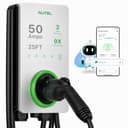
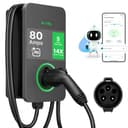
Autel MaxiCharger 80A

Autel MaxiCharger 80A

The ceiling of home AC charging: 19.2 kW on a 100-amp circuit, which is roughly double what a 48-amp charger does. Almost no car can actually take it — most cap their onboard charger somewhere between 7.7 and 11.5 kW — so buy this for a specific vehicle that accepts 80 amps, or for a future-proofed circuit you already have. Otherwise it is a very good, very expensive 48-amp charger.

Fastest home charger sold
$908.98 · View on Amazon

$1,069.0015% off

Price as of September 18, 2026. #ad How we’re funded

2
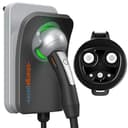
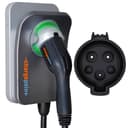
ChargePoint Home Flex

ChargePoint Home Flex

The safest default for most homes: you set the amperage in the app to 16, 24, 32, 40, 48 or 50A, so one charger fits whatever circuit your panel can spare today and scales up if you upgrade later. The app is the most mature here, firmware arrives over the air, and the warranty is long.

Fastest with a mainstream app
$549.00 · View on Amazon

Price as of September 18, 2026. #ad How we’re funded

3
Autel MaxiCharger Home

Autel MaxiCharger Home

Built for the harshest driveway. The NEMA 4X enclosure is rated to keep charging in extreme cold and heat, it pushes a full 50 amps, and the app is capable. If your charger lives fully exposed to the weather, this is the one.

Fastest value at 50 amps
$499.00 · View on Amazon

$568.0012% off

Price as of September 18, 2026. #ad How we’re funded

4
ChargePoint Home Flex NACS

ChargePoint Home Flex NACS

The Home Flex smarts with a factory NACS cable. Tesla owners who want ChargePoint's mature app and adjustable 16-50A amperage — rather than a plain no-app NACS unit — pay a premium for exactly that.

Fastest native NACS
$516.71 · View on Amazon

Price as of September 18, 2026. #ad How we’re funded

5
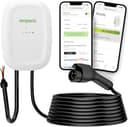
Emporia Level 2 EV Charger

Emporia Level 2 EV Charger

The value pick that doesn't feel cheap: a full 48 amps, ENERGY STAR listing, WiFi with genuine energy monitoring, and a 25 ft cable — for well under what the big names charge. It's the one we point most people to first.

Fastest per dollar
$449.00 · View on Amazon

Price as of September 18, 2026. #ad How we’re funded

6
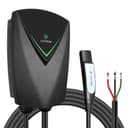
Lectron Nexus NACS (Tesla) Charger

Lectron Nexus NACS (Tesla) Charger

For a Tesla owner who doesn't want to babysit an adapter: a native NACS (J3400) connector plugs straight into the car, at a full 48 amps, with the safety listings you want. No app, but Teslas schedule charging in the car anyway.

Fastest NACS without an app
$429.99 · View on Amazon

$459.997% off

Price as of September 18, 2026. #ad How we’re funded

The picks in full

#1Fastest home charger sold

Autel MaxiCharger 80A

The ceiling of home AC charging: 19.2 kW on a 100-amp circuit, which is roughly double what a 48-amp charger does. Almost no car can actually take it — most cap their onboard charger somewhere between 7.7 and 11.5 kW — so buy this for a specific vehicle that accepts 80 amps, or for a future-proofed circuit you already have. Otherwise it is a very good, very expensive 48-amp charger.

Strengths

  • 80 A / 19.2 kW — the fastest AC charging you can install at a house
  • Output adjustable from 6 A to 80 A in the app, so it can be dialed to any circuit
  • NEMA 3S / IK10 enclosure rated -40F to 131F, with UL and CSA listings and ENERGY STAR

Trade-offs

  • Needs a 100-amp circuit for full output — a service upgrade for most homes
  • Very few EVs accept more than 11.5 kW on AC, so the extra amps often go unused
  • Autel's own pages disagree on the warranty term (5 years on the body vs 3 extendable to 5)
Max output
80 A
Power
19.2 kW
Connector
J1772
Install
Hardwired
Cable length
25 ft
Warranty
5 years
WiFi + app
Yes
Certifications
UL 2594, UL 2231-1/2, UL 1998, CSA C22.2 No. 280, ENERGY STAR

Our charging-speed math. At its full 80A (19.2 kW) and ~3.5 miles per kWh it would add roughly 67 miles of range per hour — but only into a car that accepts 19.2 kW on AC. Dialed to 48A (11.5 kW) it is about 40 miles per hour, the same as any other 48-amp charger.

Build note. Hardwired 19.2 kW unit with a 25 ft cable; output is adjustable 6-80 A in the Autel Charge app and by DIP switch (16/24/32/40/48/50/64/72/80 A), in a NEMA 3S / IK10 enclosure rated -40F to 131F, with WiFi, Ethernet and RS485.

Specs read from the manufacturer spec sheet, on August 12, 2026. “Not published” means the brand does not state that figure.

#2Fastest with a mainstream app

ChargePoint Home Flex

The safest default for most homes: you set the amperage in the app to 16, 24, 32, 40, 48 or 50A, so one charger fits whatever circuit your panel can spare today and scales up if you upgrade later. The app is the most mature here, firmware arrives over the air, and the warranty is long.

Strengths

  • Adjustable 16-50A means it fits a small panel now and a bigger circuit later
  • The most mature app of the group — scheduling, reminders, usage history, over-the-air firmware
  • 3-year warranty and a long 23 ft cable
  • Sold hardwired or on a NEMA 6-50 or NEMA 14-50 plug, in J1772 or NACS

Trade-offs

  • You pay a premium over value 48A chargers for the app and brand
  • Full 50A output needs a 60A circuit most older panels don't have to spare
  • The plug-in SKUs cap at 40A, so the top speed is a hardwired-only feature
Max output
50 A
Power
12 kW
Connector
J1772
Install
Hardwired, NEMA 6-50 or NEMA 14-50
Cable length
23 ft
Warranty
3 years
WiFi + app
Yes
Certifications
UL/cUL listed, ENERGY STAR

Our charging-speed math. At its 50A max (12 kW) and a typical 3.5 miles per kWh, the Home Flex adds roughly 42 miles of range per hour. Dial it down to 40A to fit a 50A circuit and you get about 34. ChargePoint's own, more conservative claim is up to 37 miles per hour hardwired and 30 on the plug-in SKUs.

Build note. Amperage is set in the app to 16, 24, 32, 40, 48 or 50A. The plug-in SKUs are capped at 40A, so the full 50A is a hardwired-only figure. UL and cUL listed per UL 2594 and UL 2231; firmware updates over the air, and the station stores up to 90 days of session data locally if the network drops.

Specs read from the manufacturer spec sheet, on September 3, 2026. “Not published” means the brand does not state that figure.

#3Fastest value at 50 amps

Autel MaxiCharger Home

Built for the harshest driveway. The NEMA 4X enclosure is rated to keep charging in extreme cold and heat, it pushes a full 50 amps, and the app is capable. If your charger lives fully exposed to the weather, this is the one.

Strengths

  • NEMA 4X enclosure rated for very cold and hot conditions
  • Full 50A output with a 25 ft cable
  • WiFi, Bluetooth and a capable app

Trade-offs

  • 50A needs a 60A circuit and typically a hardwired install
  • App and ecosystem are newer than ChargePoint's
Max output
50 A
Power
12 kW
Connector
J1772
Install
Hardwired
Cable length
25 ft
Warranty
3 years
WiFi + app
Yes
Certifications
CSA certified, ENERGY STAR

Our charging-speed math. At its 50A max (12 kW) and ~3.5 miles per kWh it adds roughly 42 miles of range per hour.

Build note. NEMA 4X weatherproof enclosure rated for operation down to about -40 degrees F.

Specs read from the manufacturer spec sheet, on July 19, 2026. “Not published” means the brand does not state that figure.

#4Fastest native NACS

ChargePoint Home Flex NACS

The Home Flex smarts with a factory NACS cable. Tesla owners who want ChargePoint's mature app and adjustable 16-50A amperage — rather than a plain no-app NACS unit — pay a premium for exactly that.

Strengths

  • Native NACS cable with ChargePoint's flexible 16-50A amperage
  • The most mature app of the NACS options here
  • 3-year warranty and outdoor-rated NEMA 3R body

Trade-offs

  • Priciest NACS pick — you're paying for the app and brand
  • 50A output needs a 60A circuit to use fully
Max output
50 A
Power
12 kW
Connector
NACS
Install
Hardwired
Cable length
23 ft
Warranty
3 years
WiFi + app
Yes
Certifications
UL/cUL listed, ENERGY STAR

Our charging-speed math. At its 50A max (12 kW) and ~3.5 miles per kWh, roughly 42 miles of range per hour into a Tesla.

Build note. Same Home Flex hardware with a factory NACS cable for Tesla and NACS EVs.

Specs read from the manufacturer spec sheet, on July 19, 2026. “Not published” means the brand does not state that figure.

#5Fastest per dollar

Emporia Level 2 EV Charger

The value pick that doesn't feel cheap: a full 48 amps, ENERGY STAR listing, WiFi with genuine energy monitoring, and a 25 ft cable — for well under what the big names charge. It's the one we point most people to first.

Strengths

  • 48A output and ENERGY STAR at a value price
  • The app actually tracks energy use, not just on/off
  • Long 25 ft cable and a remote holster in the box

Trade-offs

  • 48A hardwired needs a 60A circuit; on a NEMA 14-50 plug it's limited to 40A
  • App polish trails ChargePoint's, and support is smaller
Max output
48 A
Power
11.5 kW
Connector
J1772
Install
Hardwired or NEMA 14-50 plug
Cable length
25 ft
Warranty
3 years
WiFi + app
Yes
Certifications
UL listed, ENERGY STAR

Our charging-speed math. At 48A (11.5 kW) and ~3.5 miles per kWh it adds about 40 miles of range per hour hardwired; on a 40A plug-in circuit, about 34.

Build note. 48A hardwired, or 40A on a NEMA 14-50 outlet, with a 25 ft cable and remote holder.

Specs read from the manufacturer spec sheet, on July 19, 2026. “Not published” means the brand does not state that figure.

#6Fastest NACS without an app

Lectron Nexus NACS (Tesla) Charger

For a Tesla owner who doesn't want to babysit an adapter: a native NACS (J3400) connector plugs straight into the car, at a full 48 amps, with the safety listings you want. No app, but Teslas schedule charging in the car anyway.

Strengths

  • Native NACS connector — no J1772-to-Tesla adapter to lose
  • Full 48A output and a weather-rated IP66 body
  • UL/ETL safety listings plus ENERGY STAR

Trade-offs

  • No WiFi app — you schedule in the Tesla app instead
  • NACS connector is best for Tesla/NACS cars; other EVs need a NACS-to-J1772 adapter
Max output
48 A
Power
11.5 kW
Connector
NACS
Install
Hardwired
Cable length
23 ft
Warranty
3 years
WiFi + app
No
Certifications
UL 2594/2231/2251 (ETL listed), ENERGY STAR, FCC

Our charging-speed math. At 48A (11.5 kW) and ~3.5 miles per kWh, about 40 miles of range per hour into a Tesla.

Build note. Native NACS (J3400) connector plugs straight into a Tesla with no adapter; includes a holster.

Specs read from the manufacturer spec sheet, on July 19, 2026. “Not published” means the brand does not state that figure.

Rated output as published by each brand; the miles-per-hour and breaker columns are our arithmetic (amps x 240 V, ~3.5 mi/kWh, NEC 125% rule), printed so you can re-run them for your own car’s efficiency.
ChargerRated ampsPowerMiles / hourCircuit neededConnector
Autel MaxiCharger 80A80 A19.2 kW~67100 AJ1772
ChargePoint Home Flex50 A12 kW~4270 A (hardwired)J1772
Autel MaxiCharger Home50 A12 kW~4270 AJ1772
ChargePoint Home Flex NACS50 A12 kW~4270 ANACS
Emporia Level 2 EV Charger48 A11.5 kW~4060 A (hardwired)J1772
Lectron Nexus NACS (Tesla) Charger48 A11.5 kW~4060 ANACS

The number that actually limits you

The box on the wall is not the charger. It is a smart switch that hands 240-volt AC to the car; the actual charger — the electronics that turn AC into the DC a battery stores — is inside the vehicle, and its rating is the ceiling on everything. A car with a 7.2 kW onboard charger plugged into the 19.2 kW Autel will charge at 7.2 kW. The Autel will sit there at a third of its capacity for the life of the car.

The US Department of Energy puts the Level 2 range at 2.9 to 19.2 kW, with a typical residential install around 7.2 kW — which tells you how far above the norm the top of this list sits. The 80-amp tier exists for a small set of vehicles, mostly large trucks and a few luxury models, whose makers fit a bigger onboard charger. If yours is one of them, the manufacturer’s spec sheet will say so explicitly, usually as “19.2 kW onboard charger” or “80 A AC charging.” If it does not say so, assume it is not.

The practical shortcut: find your car’s onboard charger figure in kW, then divide by 240 and by 0.8 to get the breaker it needs. An 11.5 kW car wants 48 amps on a 60-amp breaker. A 7.7 kW car wants 32 amps on a 40-amp breaker, and every charger on this page is overkill for it. Our sizing guide walks through the arithmetic with examples.

What each speed tier costs to install

Speed is bought with copper. The NEC treats EV charging as a continuous load, so the circuit must be rated at 125% of the charger’s current — the 80% rule from the other direction. That produces three tiers with very different install bills.

  • 48 A on a 60 A circuitis the top of what most homes can add without a service upgrade, and it is hardwired-only — no residential plug is rated for it. The Emporia and Lectron here, and the Home Flex dialed to 48, live in this tier.
  • 50 A on a 70 A circuitbuys two more amps than 48 for a slightly heavier wire gauge. The ChargePoint and Autel Home units publish 50 A as their maximum. It is a marginal gain — about two miles of range per hour by our arithmetic — and most owners run these at 48 or 40 anyway.
  • 80 A on a 100 A circuitis a different job. On a 200-amp service it is half the panel’s rating on one breaker, and a proper load calculation will often say no. Many 80-amp installs end up bundled with a service upgrade, which is where the real cost of the fastest charger hides.

None of that is a reason not to buy fast. It is a reason to price the circuit before the charger. Our install cost breakdown and the wire and breaker table cover what each tier adds to the quote.

How we separated them

Autel MaxiCharger 80Ais first because it is, by a wide margin, the fastest home charger you can buy: 80 amps and 19.2 kW, adjustable from 6 to 80 amps in the app and by DIP switch, in a NEMA 3S enclosure rated to -40°F. The honest note from its own listing is that Autel’s two pages disagree on the warranty term. The honest note from us is that unless your car accepts 19.2 kW, you are paying a large premium for a very good 48-amp charger. Buy it for a specific vehicle, or for a 100-amp circuit you are running anyway.

ChargePoint Home Flextakes second on 50 amps plus the most mature app in the category. Its amperage is set in the app to 16, 24, 32, 40, 48 or 50, the full 50 is a hardwired-only figure, and ChargePoint’s own datasheet is unusually candid about the 40-amp cap on the plug-in SKUs. If you want the fastest charger that also has a large support organization behind it, this is the one.

Autel MaxiCharger Home 50Amatches the Home Flex on paper — 50 amps, 12 kW, a 25 ft cable — in a NEMA 4X enclosure rated to -40°F, typically for less. Its app is less polished. On raw speed per dollar at the 50-amp tier it is the pick.

ChargePoint Home Flex NACS is the same 50-amp hardware with a factory Tesla plug. If you drive a Tesla or a NACS-port EV and want the fastest native connector without an adapter in the loop, it is the top of that list; our Tesla roundup covers the rest of the field.

Emporia Level 2 is 48 amps hardwired or 40 on a NEMA 14-50 plug, and it consistently sells for less than the 50-amp units. The two amps it gives up are worth about two miles of range per hour. For most buyers whose car maxes out at 11.5 kW, this is the fastest charger they can actually use, at the lowest price on this page.

Lectron Nexus NACS is the 48-amp native-Tesla unit with no app to configure and an IP66 housing. It is here for the Tesla owner who wants full speed and nothing to maintain. Lectron publishes no operating-temperature range for it, which we note rather than fill in.

What we left off, and why

Every 40-amp unit in our registry — the EVIQO 40A, the Grizzl-E Classic Connect, the Lectron and ELEGRP portables — because 9.6 kW is the plug-in ceiling, not the fast tier; they are ranked on our 40-amp page. The Wallbox Pulsar Plus and EVIQO 48A both reach 48 amps and would slot in beside the Emporia, but they add nothing on speed and cost more here; they earn their places on the smart-charger and 48-amp pages instead. And the Emporia Pro, whose whole point is throttling down to protect a full panel, belongs on the small-panel page, not a speed ranking.

Before you pay for speed

Ask what problem you are solving. A 48-amp charger adds about 40 miles of range an hour by our arithmetic; over an eight-hour overnight window that is roughly 320 miles, which is more than any current EV battery holds. The case for faster is specific: a car that takes 19.2 kW and a routine that needs a big top-up in an hour or two — a truck towing, a shift worker with two short windows, a household that splits one charger between two cars in the same evening. If that is you, the Autel 80A is a rational purchase. If it is not, the Emporia charges the same car just as fast for a fraction of the install.
Frequently asked questions

What is the fastest Level 2 charger you can install at home?

An 80-amp, 19.2 kW unit on a 100-amp circuit — the Autel MaxiCharger 80A is the one in our registry with live pricing. That is the top of the Level 2 (AC) range the US DOE describes, at roughly 2.9 to 19.2 kW. It is about twice the output of a 48-amp charger, but only into a car whose onboard charger accepts 19.2 kW.

Is a 48-amp or a 50-amp charger faster?

The 50-amp unit, by about two amps — roughly two miles of range per hour by our arithmetic (amps x 240 V at ~3.5 mi/kWh). The 50-amp figure also needs a 70-amp circuit instead of a 60, which is a heavier wire gauge. Most owners of 50-amp units run them at 48 or 40 anyway.

How many miles per hour does a fast home charger add?

By our arithmetic at ~3.5 miles per kWh: about 40 miles an hour at 48 amps (11.5 kW), about 42 at 50 amps (12 kW), and about 67 at 80 amps (19.2 kW). Your real number depends on your car's efficiency and, above all, on its onboard charger's ceiling — a car limited to 7.7 kW gets about 27 miles an hour from any of these.

Why doesn't my car charge faster on a bigger charger?

Because the charger that sets the speed is inside the car. A home Level 2 unit supplies AC; the vehicle's onboard charger converts it to DC and has a fixed maximum, commonly 7.2, 7.7, 9.6, 11 or 11.5 kW. The wall unit cannot push past that. Check your car's spec sheet for 'onboard charger' or 'AC charging' in kW before paying for amps you cannot use.

Does the fastest charger need a panel upgrade?

An 80-amp charger needs a 100-amp circuit under the NEC 125% continuous-load rule, which is a large share of a 200-amp service and usually more than a 100- or 150-amp service can spare. A load calculation decides it. A 48-amp unit needs a 60-amp circuit, which many 200-amp panels can add without an upgrade.

Can I plug in the fastest chargers?

No. Every unit above 40 amps on this page is hardwired-only, because no residential plug is rated for the 60-amp-and-up circuits they need. Plug-in (NEMA 14-50) installs are capped at 40 amps, or 9.6 kW. ChargePoint's own datasheet states the 40-amp cap on its plug-in Home Flex models explicitly.

Is a faster charger worth it for overnight charging?

Usually not. A 48-amp charger adds about 40 miles of range an hour by our arithmetic, so an eight-hour overnight window covers more range than any current EV battery holds. Faster earns its cost for a car that accepts 19.2 kW and a routine that needs a big charge in an hour or two — towing, short turnaround windows, or two cars sharing one charger in one evening.

Sources

  • Autel Energy — MaxiCharger 80A 19.2kW Residential EV Charger (US store listing)Autel's own US listing: 19.2 kW (240V AC 80A), 208/240V AC 50/60 Hz, SAE J1772, hardwired, 25 ft (7.5 m) cable, output adjustable from 6A to 80A in the app and 16/24/32/40/48/50/64/72/80 A by DIP switch, UL 2594, UL 2231-1, UL 2231-2, UL 1998, CSA C22.2 No. 280, FCC Part 15 Class B, ENERGY STAR, OpenADR 2.0b, NEC Article 625, Wi-Fi / Ethernet / RS485 with the Autel Charge app and cloud, and a warranty of 5 years on the charger body, backplate and internal components with 1 year on the display screen, charging cable and connector (accessed August 12, 2026)
  • Autel Energy — MaxiCharger AC 80A product pageAutel's own product page for the MaxiCharger AC 80A: NEMA 3S / IK10 enclosure, operating temperature -40F to 131F (-40C to +55C) with derating above 113F, 19 ft or 25 ft cable options, SAE J1772 or NACS connector, hardwired with wall or pedestal mounting, output adjustable 6A to 80A via the mobile app, and a stated warranty of 3 years extendable up to 5 — a figure that differs from the 5-year term on Autel's own US store listing for the same unit (accessed August 12, 2026)
  • ChargePoint — Home Flex datasheet (PDF)ChargePoint's own datasheet: enclosure rating Type 3R per UL 50E, operating temperature -22F to 122F, 23 ft cable, plus installer notes that an outdoor plug-in install requires an outdoor-rated GFCI breaker upstream while an external GFCI may conflict with the charger's internal ground-fault protection on a hardwired install. RE-READ September 3, 2026 for the review refresh: the same datasheet also publishes maximum 12 kW (240V AC x 50A) with output amperage adjustable via the mobile app to 16A, 24A, 32A, 40A, 48A or 50A; a required dedicated dual-pole breaker rated for 125% of maximum load; 'Software Updates: Firmware updated over-the-air (OTA)'; 2.4/5 GHz Wi-Fi (802.11 a/b/g/n); local storage of up to 90 days of charging session data (100 sessions) if the network drops; power measurement accuracy +/- 2.0%; ground-fault detection by 20 mA CCID with auto retry; and UL and cUL listing per UL 2594, UL 2231-1 and UL 2231-2, NEC Article 625 compliant. Ordering information lists the plug-in station models CPH50-NEMA6-50-L23 and CPH50-NEMA14-50-L23 (accessed September 3, 2026)
  • ChargePoint — Home Flex home charger product pageChargePoint's own current product page for the Home Flex, read for the 2026-09-03 review refresh: three install configurations are offered — hardwired, NEMA 6-50 plug and NEMA 14-50 plug — with 'up to 50 amps of power delivered to your EV' on the hardwired model and 'up to 40A of power' on the plug-in models. ChargePoint's own range claim is 'up to 37 miles of range per hour' hardwired and '30 miles of range per hour' plug-in. J1772 and NACS connectors are offered across all configurations, and ChargePoint states the unit is 'UL Listed for safety', 'ENERGY STAR certified for efficiency' and carries a '3-year warranty' (accessed September 3, 2026)
  • Autel Energy — MaxiCharger AC Elite Home 50A product pageAutel's own listing: compliant with NEMA 4X standards, operating temperature -40F to 131F, 25 ft cable, 3-year warranty (accessed July 20, 2026)
  • Emporia — Classic Level 2 EV Charger spec sheet (PDF)Emporia's own spec sheet: watertight NEMA Type 4 indoor/outdoor enclosure, operating temperature -22F to 122F, 25 ft cable (accessed July 20, 2026)
  • Lectron — NEXUS Level 2 J1772 EV Charging Station, 240V, 48 Amp, HardwiredLectron's own product page: up to 48 A continuous at 240 V for 11.5 kW, hardwire-only install by a licensed electrician on a dedicated 240 V circuit, IP66 weatherproof housing for indoor or outdoor use, 23 ft output cable of 15.0 mm (±0.3 mm) heavy-duty compound the brand states is 'engineered to stay flexible and easy to wrap around the wall mount, even in freezing weather', wall-mount J-hook and plug holder included, ETL listed to UL 2594 / UL 2231 / UL 2251 with ENERGY STAR and FCC certification, and a 3-year Lectron warranty. No operating-temperature range and no Wi-Fi or app support are published for this model (accessed August 20, 2026)
  • U.S. DOE Alternative Fuels Data Center — Electric Vehicle Charging StationsUS DOE on charging levels: Level 1 (~1.9 kW, ~5 mi/hr), Level 2 (2.9-19.2 kW, ~7.2 kW typical residential, ~25 mi/hr), and DC fast charging (accessed July 19, 2026)
  • NFPA — Using the Latest NEC for EV Charger InstallationsNFPA on NEC (NFPA 70) Article 625: EV charging is a continuous load, so circuits are sized to 125% of load (the 80% rule) (accessed July 19, 2026)
  • FuelEconomy.gov — Electric Vehicles: Learn More About the LabelDOE/EPA on EV efficiency: kWh per 100 miles and MPGe, accounting for AC charging losses (accessed July 19, 2026)
  • UL Solutions — EV Charging Infrastructure ServicesUL on EVSE safety certification: ANSI/UL 2594 is the Standard for Electric Vehicle Supply Equipment (accessed July 19, 2026)

Keep reading