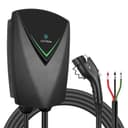
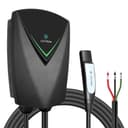
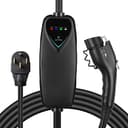
The whole Lectron line in one table
Four units, two products. Read it across and the pattern is immediate: the connector column is the only one that separates each pair.
The four Lectron chargers in our registry, on figures from Lectron’s own product pages. Note the two columns that read “Not published” — those are findings, not gaps in our research.| Charger | Connector | Rated output | Install | Cable | Enclosure | Warranty | App |
|---|
| Lectron Nexus 48A J1772 | J1772 | 48 A / 11.5 kW | Hardwired | 23 ft | IP66 | 3 years | No |
|---|
| Lectron Nexus NACS (Tesla) Charger | NACS | 48 A / 11.5 kW | Hardwired | 23 ft | IP66 | 3 years | No |
|---|
| Lectron Portable Level 2 Tesla Charger (NACS) | NACS | 40 A / 9.6 kW | NEMA 14-50 plug | 16 ft | Not published | Not published | No |
|---|
| Lectron 40A Portable Level 2 Charger | J1772 | 40 A / 9.6 kW | NEMA 14-50 plug | 16 ft | Not published | 2 years | No |
|---|
Two columns in that table deserve a second look. The enclosurecolumn shows IP66 on both wall units and “Not published” on both portables — Lectron describes the NACS portable as weather-resistant for indoor or outdoor use while advising against extreme exposure, and publishes no rating to back either half of that. The warranty column shows three years on the Nexus pair, two on the J1772 portable, and nothing at all on the NACS portable. Where a brand does not publish a term, we do not invent one.
What we ranked on
Within one brand the usual cross-brand arguments collapse, so four narrower questions did the work.
One: how specific is the safety paperwork?This is where Lectron is genuinely best in class among the brands we track, and it is why the Nexus units rank above the portables. Both Nexus SKUs and the NACS portable publish ETL listing to named standards — UL 2594 for the charging system, UL 2231 for personnel protection, UL 2251 for the connector itself — plus ENERGY STAR and FCC. Most brands publish “UL listed” or “ETL certified” and leave the standard unstated. What those listings actually certify is the guide behind that ranking.
Two: what does the cable do in January? Cable length is on every spec sheet; cable behavioralmost never is. Lectron publishes a 15.0 mm (±0.3 mm) output cable on the Nexus and states it is engineered to stay flexible and easy to wrap in freezing weather. That is a claim about the one part of a charger you touch every day, and nobody else in our registry makes it. The flip side is the figure that would let us verify the environment it works in: Lectron publishes no operating-temperature range for any unit in the line, which is a real gap on a brand that otherwise documents well. Our cold-weather roundup ranks on published ranges, which is why no Lectron leads it.
Three: does the connector match the car, without an adapter?Lectron has quietly done the most sensible thing in this market: it sells the same hardware in both connectors at both power levels, so you never have to choose between the right plug and the right unit. The NACS SKUs are SAE J3400, and the Nexus NACS page carries something no other source in our registry publishes — a named list of cars with native NACS ports, including the Chevrolet Bolt (2027), Hyundai IONIQ 5 (2025), Kia EV6 (2025), Lexus RZ (2026), Rivian R2 (2026) and Toyota bZ4X (2026) alongside the Tesla range. The two connectors explained is the page if you are unsure which one is on your car.
Four: what is in the box, and what does the electrician still have to supply?Both Nexus units ship with a wall-mount J-hook and a plug holster, which sounds trivial until you are standing in a garage improvising somewhere to hang a 23-foot cable. Neither has an adjustable-amperage selector, which is the single biggest functional omission in the line — it means the Nexus cannot be dialed down to fit a smaller circuit, so the 60-amp circuit is a requirement rather than a target. Sizing the circuit is the page to read first if your panel is tight, and the small-panel roundup is the one to buy from instead.
The two portables are not the same product
It is tempting to treat Lectron’s 40-amp portables as one unit with two plugs, and the registry says otherwise in two places.
The J1772 portable publishes a two-year warranty and no enclosure rating. The NACS portablepublishes a UL 2251 handle and an ENERGY STAR certification the J1772 unit’s page does not, and publishes no warranty term at all. Both have 16-foot cables, both are a genuine 40 A / 9.6 kW on a NEMA 14-50, and both are the version without Wi-Fi.
On the arithmetic they are identical: 9.6 kW at roughly 3.5 miles per kWh is about 34 miles of range per hour, which covers any ordinary commute overnight with room to spare. The reason to choose the NACS one is the same reason to choose any native connector — one fewer adapter to lose in a hotel parking lot. The reason to choose the J1772 one is that it is the cheapest real Level 2 charger we track, and our budget roundup makes that case at length.
A practical note for either: 16 feet is short. If the charger has to cross a garage, or if the car parks nose-out some nights and nose-in others, measure before you buy. The long-cable roundup exists because this is the most common regret in the category, and why an extension cord is not the fix explains the tempting wrong answer.
Where Lectron is the wrong brand
Three cases, named rather than glossed.
If you need the charger to fit a circuit you cannot change.No Lectron we track publishes an amperage selector. On a panel that can spare 40 amps but not 60, buy an adjustable unit instead — the adjustable roundup has every published setting in the registry in one table.
If off-peak scheduling has to come from the charger. None of these four has an app. In a Tesla, scheduling lives in the car and this is a non-issue; in most other EVs it is either a car feature or a charger feature, and here it is neither. What time-of-use rates are actually worth is the page that tells you whether that matters on your tariff.
If you need a published cold rating rather than a cable claim.For a charger that will spend February on an exterior wall in the upper Midwest, buy the brand that publishes a number. The Autel MaxiCharger publishes −40°F to 131°F; the Grizzl-E publishes −22°F to 122°F. Lectron publishes neither, and our outdoor roundup ranks accordingly.