Wallbox Pulsar Plus vs Autel MaxiCharger
Both are premium, app-connected, hardwired chargers. One is the smallest body in the class with the best load management on paper; the other has the widest published temperature range of anything we list. The gap between their published climate limits is 27 degrees, and that is the decision.
How this is funded: we earn a commission if you buy through our links, at no extra cost to you. It never changes which product we recommend, and we’ll tell you when we’d skip one. Full disclosure.
Buy the Autel MaxiCharger if the charger lives outdoors in a climate with real extremes. Buy the Wallbox Pulsar Plus if it lives in a tight indoor space, or if load management is the reason you are spending premium money. These two rarely get compared, which is odd, because they are the two premium hardwired units most buyers end up weighing against the ChargePoint. They are close on amps, close on price band and close on app capability. Where they are not close at all is the environment each brand is willing to warrant.
| Spec | Wallbox Pulsar Plus | Autel MaxiCharger Home |
|---|---|---|
| Max output | 48 A | 50 A |
| Power | 11.5 kW | 12 kW |
| Connector | J1772 | J1772 |
| Install | Hardwired (40A model plugs in) | Hardwired |
| Charging cable | 25 ft | 25 ft |
| Enclosure | NEMA 4 | IP65 / NEMA 4X |
| Operating range (published) | -22F to 104F | -40F to 131F |
| WiFi / app | Yes | Yes |
| ENERGY STAR | Yes | Yes |
| Listings | UL 2594/2231, ENERGY STAR | CSA certified, ENERGY STAR |
| Warranty | 3 years | 3 years |
The 27-degree gap
Autel’s own listing for the MaxiCharger AC Elite Home 50A publishes an operating temperature of -40F to 131F alongside a NEMA 4X enclosure. Wallbox’s current North America datasheet for the Pulsar Plus publishes -22F to 104F operating, with a separate storage range of -40F to 158F. Those are the two brands’ own numbers, and the difference at the top end is 27 degrees.
One hundred and four degrees Fahrenheit is not an exotic temperature. It is a normal July afternoon across a large part of the American Southwest, and the air temperature is not what the charger experiences — a dark enclosure on a south- or west-facing wall in direct sun runs hotter than the shade reading. We have not instrumented either unit and will not invent a figure for how much hotter, but the direction is not in doubt, and it is the reason this comparison exists. If the Pulsar Plus is going on a sun-struck exterior wall in Phoenix or Las Vegas, you are installing it to the edge of its published envelope. The MaxiCharger is specified with 27 degrees of headroom over it.
Note also what happens near the limit even on the tougher brand. Autel’s own product page for its 80-amp model publishes -40F to 131F with derating above 113F— meaning the charger protects itself by reducing output rather than shutting down. That is the behaviour you want, and it is also a reminder that a published ceiling is where the manufacturer stops guaranteeing full performance, not where the plastic melts. Our cold-weather roundupmakes the same argument at the other end of the thermometer, where the cable’s flexibility matters more than the electronics.
At the cold end the two are much closer: -40F for Autel against -22F for Wallbox. Both numbers are below anything most of the country sees, and in genuine cold the bottleneck stops being the charger and becomes the car’s battery conditioning.
Enclosure: 4X versus 4
Autel publishes NEMA 4X; Wallbox publishes NEMA Type 4 per UL 50E. Using NEMA’s own definitions, Type 4 adds windblown dust, splashing water and hose-directed water to the rain, sleet and snow of Type 3R — and the X on 4X adds protection against corrosion. That is a coastal and road-salt spec more than a rain spec. If the charger is within reach of sea air, or on a driveway that gets salted every winter, the X is the part of the label doing the work. Our ratings explainer covers what each code does and does not promise, including why you cannot convert a NEMA type into an IP code.
Both publish a 25-foot cable, which is the top of the market, and both are rated for outdoor installation. Neither is the reason to choose between them.
Load management, and the accessory in the footnote
Load management is Wallbox’s strongest claim and the reason it appears on our small-panel roundup. Its datasheet lists Static Load Management and Dynamic Load Management, and its US product page describes the latter as maximising charging speed “while staying within your home’s power limit.” For a house whose panel genuinely cannot spare a full circuit, a charger that throttles itself against real-time household demand can save a service upgrade, which dwarfs the price of any charger.
The footnote matters though. Wallbox marks both load-management entries “May require power meter accessory,” and its own US page lists that Power Meter as a separately priced item. Solar charging carries the same requirement, with the additional caveat that it “is not compatible with multiple-charger installations and OCPP.” So the capability is real and documented, but it is a two-part purchase, and that should be in your budget from the start rather than discovered after install. Our load-management guide covers the alternatives, including units that bundle the monitor.
Autel does not publish a comparable dynamic-load feature on the Home 50A. What it does publish on its 80-amp sibling is OpenADR 2.0b, a utility demand-response protocol — useful if your utility runs such a programme, irrelevant otherwise. On the app itself, both brands ship scheduling, monitoring and over-the-air updates; Wallbox additionally publishes a release-notes archive with dated firmware versions, which is a small but genuine transparency point in a category where most brands publish nothing about their software history.
Size, and the thing spec sheets rarely decide
Wallbox publishes the Pulsar Plus at 7.8 by 7.9 by 3.9 inches and 4.4 pounds without the cable, which makes it one of the smallest Level 2 chargers sold in North America. In a single-car garage where the charger shares a wall with a water heater, a workbench and a bicycle, that is not a vanity spec — it is the difference between a clean install and a knuckle-scraper. Autel does not publish comparable dimensions for the Home 50A on the listing we cite, so we are not going to state a figure for it. Our placement guide has the measuring routine that catches this before the electrician arrives.
So which one
Buy the Autel MaxiCharger if it is going outside and your climate has a real summer or a real winter, if salt air or road salt is in the picture, or if you simply want the widest published environmental envelope in the category and 50 amps with it. Buy the Wallbox Pulsar Plusif it is going inside a tight space, if dynamic load management is solving a panel constraint and you have budgeted for the power meter, or if you want the NACS option on a compact body. Both are premium chargers that will deliver more amps than most cars can accept — check your car’s onboard chargerbefore you pay for either one’s top figure.
Quick picks
Ranked on published specs, charging speed, electrical fit and value. Select a row to jump to the full write-up. We have not bench-tested these chargers — here is exactly what we do instead.
| # | Product | Best for | Price |
|---|---|---|---|
| 1 | 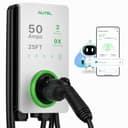 Autel MaxiCharger Home Built for the harshest driveway. The NEMA 4X enclosure is rated to keep charging in extreme cold and heat, it pushes a full 50 amps, and the app is capable. If your charger lives fully exposed to the weather, this is the one. | Widest published temperature range, 50A | |
| 2 | 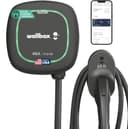 Wallbox Pulsar Plus The one to buy when wall space is tight: it's among the smallest 48A units you can get, with dynamic load management so it can share a circuit without tripping the main. A polished premium charger — and priced like one. | Smallest body, dynamic load management | |
| 3 | 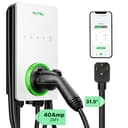 Autel MaxiCharger AC Elite Home 40A Autel's weather-hardened hardware in the install almost everyone can actually have. It is the 50A MaxiCharger's smaller sibling: same 25 ft cable and app, same NEMA 4 body, but it ends in a NEMA 14-50 plug instead of a wire nut — so it goes on an existing outlet, comes off the wall when you move, and needs a 50-amp circuit rather than a 60. The in-body holster is a small thing that stops mattering only if you have never coiled a cold cable. | Autel hardware on a 14-50 plug | |
| 4 | 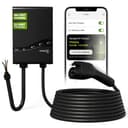 Emporia Pro The answer to a panel that says no. The Pro ships with Emporia's Vue 3 energy monitor in the same box, watches what the rest of the house is drawing, and throttles the car in real time so the total never exceeds what the service can carry — which is how a 48-amp charger ends up on a panel that a load calculation says has no room for one. You pay roughly Home Flex money for it, and only the load management justifies that. | Load management with the monitor included | $599.00 · View on Amazon Price as of October 18, 2026. #ad How we’re funded |
Frequently asked questions
Which is faster, the Wallbox Pulsar Plus or the Autel MaxiCharger?
The Autel, marginally. Autel publishes 50 amps and 12 kW for the MaxiCharger Home; Wallbox's current North America datasheet publishes a 48-amp model at 11.5 kW. That is about two miles of range per hour by our arithmetic at a typical 3.5 miles per kWh - a difference you will never notice overnight, and one your car may not accept anyway if its onboard charger caps below 11.5 kW.
Can the Wallbox Pulsar Plus be plugged in instead of hardwired?
The 40-amp model can. Wallbox's datasheet lists the 40 A model at 9.6 kW with connection type 'NEMA 14-50 or hardwired', while the 48 A model is 11.5 kW and hardwired only. The Autel MaxiCharger Home we compare here is hardwired; Autel sells a separate 40-amp AC Elite Home on a NEMA 14-50 cord if you want the plug-in route from that brand.
Is the Autel MaxiCharger better for hot climates?
On published figures, yes - substantially. Autel's own listing for the AC Elite Home 50A publishes an operating temperature of -40F to 131F. Wallbox's North America datasheet publishes -22F to 104F operating, with storage from -40F to 158F. If your charger will hang on a south-facing wall in a desert summer, that 104F number is the one to take seriously.
Does the Wallbox Pulsar Plus support dynamic load management out of the box?
Not necessarily. Wallbox lists both Static Load Management and Dynamic Load Management on its datasheet, but footnotes both with 'May require power meter accessory', and its US product page prices that Power Meter separately. Solar charging carries the same requirement, plus a caveat that it 'is not compatible with multiple-charger installations and OCPP'. Budget for the accessory if load management is why you are buying.
Which one has the better warranty?
Both publish three years on the units compared here. Note that Autel's figures differ between its own channels on other models - its US store listing for the 80-amp MaxiCharger says five years on the body with one year on the cable and connector, while its product page for the same unit says three years extendable to five. Where a brand's own documents disagree, we publish both rather than pick one.
Sources
- Wallbox — Pulsar Plus North America technical datasheet (NACS edition, version 10/25, PDF) — Wallbox's own current North America datasheet (document version Wallbox_Datasheet_PulsarPlus_NA_NACS_EN_b, 10/25) for the Pulsar Plus, model PUP2. Two electrical models: the 40A model is 9.6 kW with connection type 'NEMA 14-50 or hardwired', and the 48A model is 11.5 kW and hardwired. Charging protocol 'SAE J1772 or NACS'; connector type 'SAE J1772 Type 1 and NACS'; 25 ft cable; 7.8 x 7.9 x 3.9 in and 4.4 lbs without cable; environmental rating 'Indoor & Outdoor: NEMA Type 4 per UL 50E'; operating temperature -22F to 104F and storage -40F to 158F; rated voltage 208/240V (Level 2) 60Hz; configurable current by hardware selector 16A to rated current and by software 6A to rated current; connectivity WiFi and Bluetooth with the Wallbox App and Portal; OCPP 1.6j; energy management listing 'Static Load Management, Dynamic Load Management' and 'Solar Charging supported', both footnoted 'May require power meter accessory'; electrical safety 'UL Certification (NRTL) UL 2594 - UL 2231'; integrated CCID20 plus ground monitoring per UL 2231; ENERGY STAR certification: Yes. The part-number structure confirms both a Type 1 and a NACS EVC code and both a hardwired and a NEMA 14-50P version code (accessed September 3, 2026)
- Wallbox — Pulsar Plus (US) product page — Wallbox's own US product page for the Pulsar Plus: sold in '40 and 48 Amps', with the 40A variant offering 'easy NEMA 14-50 plug installation'; 'Up to 11.5kW'; available with 'J1772 or NACS connectors' and 'No adapters needed'; 25 ft cable; Bluetooth and WiFi controlled through the Wallbox app; 'Dynamic Load Management' described as 'Maximize charging speed while staying within your home's power limit'; solar charging supported with the separately sold Power Meter accessory, with the caveat that 'Solar charging is not compatible with multiple-charger installations and OCPP'. Wallbox's own listed starting price on this page was $649.99 and the Power Meter accessory $299.00 on the date accessed (accessed September 3, 2026)
- Wallbox — Pulsar Plus (North America) datasheet (PDF) — Wallbox's own datasheet: NEMA Type 4 per UL 50E for indoor and outdoor installation, operating temperature -22F to 104F, 25 ft cable (accessed July 20, 2026)
- Wallbox — Pulsar Plus software release notes archive — Wallbox's own published release-notes archive for the Pulsar Plus family. The current North America firmware listed for the Pulsar Plus NA (PUP1) is software version 6.8.14, released 18/02/2026; version 6.11.26, released 22/04/2026, is listed for the Pulsar Plus e (PUP2) and Pulsar Pro NA (PUP3); and version 6.7.41, released 16/06/2026, is listed for the Pulsar Plus PLP1. Wallbox ships these updates over the air through the Wallbox app (accessed September 3, 2026)
- Autel Energy — MaxiCharger AC Elite Home 50A product page — Autel's own listing: compliant with NEMA 4X standards, operating temperature -40F to 131F, 25 ft cable, 3-year warranty. RE-READ October 10, 2026 for the Emporia head-to-head, and the page now publishes materially more: 'Maximum Output | 12 kW / 50 A' with output 'Adjustable 16-50 A'; installation given as 'Hardwired - 70 A Circuit for Full Output'; an 'SAE J1772' connector; an enclosure rating of 'IP65 / NEMA 4X'; an operating range of '-40 to 131 F (-40 to 55 C)'; a '3 Years' warranty quoted as a single term with no component split; 'CSA and ENERGY STAR compliance' (no UL listing is claimed on this page); connectivity listed as 'Bluetooth, Wi-Fi, Ethernet, CAN, RS485'; app control to start, stop and schedule charging, monitor activity and adjust current; dimensions of 13.2 x 7.4 x 3.8 in (336 x 187 x 97 mm) and a weight of 15.4 lbs (7 kg); and the load-management sentence this comparison turns on - 'Supports both Adaptive Load Management (ALM) and charger-to-charger Dynamic Load Balancing (DLB). ALM requires compatible additional hardware, while DLB works between chargers without additional hardware.' The page publishes no solar-specific feature (accessed October 10, 2026)
- Autel Energy — MaxiCharger AC 80A product page — Autel's own product page for the MaxiCharger AC 80A: NEMA 3S / IK10 enclosure, operating temperature -40F to 131F (-40C to +55C) with derating above 113F, 19 ft or 25 ft cable options, SAE J1772 or NACS connector, hardwired with wall or pedestal mounting, output adjustable 6A to 80A via the mobile app, and a stated warranty of 3 years extendable up to 5 — a figure that differs from the 5-year term on Autel's own US store listing for the same unit (accessed August 12, 2026)
- NEMA — Enclosure Types (definitions from NEMA 250) — NEMA's own definitions: Type 3R protects against falling dirt and rain, sleet and snow; Type 4 adds windblown dust, splashing and hose-directed water; Type 4X adds protection against corrosion. NEMA also states its NEMA-to-IP table cannot be used to convert IP designations back to NEMA types (accessed July 20, 2026)
- ENERGY STAR — Electric Vehicle Chargers — ENERGY STAR on EVSE efficiency: certified chargers use about 40% less energy in standby than non-certified units (accessed July 19, 2026)
- UL Solutions — EV Charging Infrastructure Services — UL on EVSE safety certification: ANSI/UL 2594 is the Standard for Electric Vehicle Supply Equipment (accessed July 19, 2026)
- NFPA — Using the Latest NEC for EV Charger Installations — NFPA on NEC (NFPA 70) Article 625: EV charging is a continuous load, so circuits are sized to 125% of load (the 80% rule) (accessed July 19, 2026)
- FuelEconomy.gov — Electric Vehicles: Learn More About the Label — DOE/EPA on EV efficiency: kWh per 100 miles and MPGe, accounting for AC charging losses (accessed July 19, 2026)
Keep reading
Best chargers for cold weather
What a published low-temperature rating actually promises, and the units built for a driveway that freezes solid.
See the picksBest outdoor chargers
Ranked on what the enclosure actually protects against - the roundup this comparison sits inside.
See the picksLoad management explained
What load sharing does, when it saves a panel upgrade, and what it costs to add.
Read the guideWallbox vs ChargePoint Home Flex
The Pulsar Plus against the category default, where the compact body and the app maturity trade off.
Read the comparison