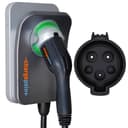
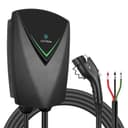
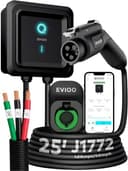
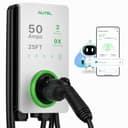
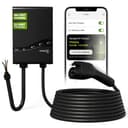
Each pick against the 11 kW maximum AC acceptance rate Volkswagen publishes for the ID.4. Rated amps and cable lengths are the brands’ own; the kW and circuit figures are our arithmetic (amps x 240 V, then the NEC’s 125% continuous-load rule). Every charger here carries a J1772 cable, which is what an ID.4 needs.| Charger | Rated amps | What the ID.4 draws | Cable | Install | Circuit needed |
|---|
| ChargePoint Home Flex | 50 A | The full 11 kW (12 kW available at 50 A) | 23 ft | Hardwired, or a 14-50 / 6-50 plug at 40 A | 70 A at 50 A, 60 A set to 48 A, 50 A plug-in |
|---|
| Lectron Nexus 48A J1772 | 48 A | The full 11 kW (11.5 kW available) | 23 ft | Hardwired only | 60 A hardwired |
|---|
| Emporia Level 2 EV Charger | 48 A | The full 11 kW hardwired; 9.6 kW on the plug | 25 ft | Hardwired or a NEMA 14-50 plug | 60 A hardwired / 50 A plug-in |
|---|
| EVIQO 48A Level 2 Charger | 48 A | The full 11 kW (11.5 kW available) | 25 ft | Hardwired only | 60 A hardwired |
|---|
| Autel MaxiCharger Home | 50 A | The full 11 kW (12 kW available at 50 A) | 25 ft | Hardwired only | 70 A at 50 A, 60 A set to 48 A |
|---|
| Emporia Pro | 48 A | The full 11 kW, throttled when the house needs it | 25 ft | Hardwired or a NEMA 14-50 plug | 60 A hardwired / 50 A plug-in |
|---|
The one number that settles it: 11 kW
The box on your wall is a switch and a safety device. The part that actually converts household AC into the DC your battery stores lives inside the car, and its rating is the hard ceiling on home charging speed. Volkswagen publishes the ID.4’s as 11 kW, with no trim exception offered: the same disclaimer sits under the home-charging answer whether you are looking at an ID.4 Pro, a Pro S, or any of the AWD trims. Our onboard charger explainer covers why this figure, not the charger’s, is the one that decides your overnight charge.
Work the arithmetic and the shopping list gets short. 11 kW at 240 V is about 46 amps. A 48-amp charger offers 11.5 kW, so the car takes its full 11 kW and leaves a sliver on the table. A 50-amp charger offers 12 kW — same result, and under the National Electrical Code’s 125% continuous-load rule it wants a 70-amp circuit instead of a 60, which is heavier wire for nothing. A 40-amp charger offers 9.6 kW, which is about 87% of what the car can accept: a real difference, but a modest one. An 80-amp charger offers 19.2 kW and the ID.4 still draws 11 kW, so you would pay roughly three times as much, plus a 100-amp circuit, for a number the car ignores. Our fastest Level 2 chargers page ranks the tiers and explains exactly where that ceiling bites.
In miles, we use Volkswagen’s own figure rather than the site’s usual reference. VW states that the ID.4’s included cable on a 240-volt outlet delivers “approx. 9.6kW for up to 27 miles per hour.” Scale that to 11 kW and you get roughly 31 miles of range per hour from a 48-amp wall charger. That is our arithmetic from VW’s pair of numbers, and it is deliberately more conservative than the ~3.5 miles per kWh this site normally quotes, which would put 9.6 kW nearer 34 miles per hour. When the manufacturer publishes a figure for its own car, we use theirs.
Volkswagen also publishes the whole-charge number: with home charging “at up to 11 kW with the available home wall charger” the 2026 ID.4 “typically takes up to 8 hours to go from a completely empty battery to a full charge.” Eight hours at 11 kW. Run the same charge at 9.6 kW and it takes about 9 hours 10 minutes by our arithmetic — roughly seventy minutes longer. Hold onto that number; it is the honest size of what a wall charger buys an ID.4 owner, and it is smaller than most roundups imply.
The adapter trap: why a NACS charger is the wrong buy here
This is the part of ID.4 charger shopping that goes wrong most often, and it goes wrong because the advice is correct for other cars. A Kia EV9 or a 2027 Cadillac LYRIQhas a NACS port, so a NACS wall charger plugs straight in and a J1772 charger needs a passive adapter. For an ID.4, the direction reverses. Volkswagen never names the AC connector type anywhere on its ID.4 page — a small documentation gap we are not going to paper over — but it is unambiguous about what you cannot do: the approved NACS adapter is “for use with compatible DC chargers only,” and the footnote goes on to say do not use it with any Level 1 or Level 2 AC charger, naming “home chargers with NACS connectors” specifically, and adding that “the use of any third-party adapters is at your own risk.”
Read that as a purchasing instruction and it is simple. The NACS adapter in the frunk is a DC fast-charging tool for Supercharger stops. It is not the thing that lets you buy whichever charger is on sale. If you want a sanctioned home install, buy a charger with a J1772 cable. Our connector guide explains both shapes and why the industry is mid-transition between them, and the guide to charging a Tesla and a non-Tesla covers the mixed-household version of this problem, which is the one case where adapters earn their keep.
The practical upside: J1772 is still most of what is sold, so this restriction costs you nothing in choice. Every pick on this page is a J1772 unit, and the best chargers in the category — the ones with the longest cables, the toughest enclosures and the real safety paperwork — are all available that way.
What the cable in the trunk already does — and when that is enough
Volkswagen does something here that most manufacturers do not, and it changes the recommendation for a lot of readers. The ID.4 ships with what VW calls a 2-in-1 EV Charge Cable, and VW publishes exactly what it does: “capable of charging from standard 120v household outlets (approx. 1.2kW for about 3 miles per hour), or 240v outlets for quicker charging (approx. 9.6kW for up to 27 miles per hour).”
Read that again, because 9.6 kW is not a token figure. It is 40 amps — the same output as every plug-in wall charger we rank on our 40-amp page, and 87% of everything the car can accept. An ID.4 owner who has a 240-volt receptacle installed and uses the bundled cable is not making do. They are getting about 27 miles of range an hour by VW’s own reckoning, and a full charge in roughly nine hours instead of eight.
That reframes the whole purchase. The honest case for one of the chargers below is notspeed — it is about seventy minutes on a full charge, and far less on a typical overnight top-up. It is everything else: a cable you are not coiling into the trunk every morning, a holster, a sealed enclosure rated for a wall rather than a bag, scheduling that survives without your phone, energy data you can put against a time-of-use rate, and a 60-amp circuit that will still be right if your next car accepts more than 11 kW. Those are real reasons. “It charges much faster” is not one of them, and we are not going to pretend otherwise to sell you a box.
So: if you drive 40 miles a day, park in a garage with a 14-50 already on the wall, and plug in most nights, keep your money.Have an electrician confirm the receptacle is EV-grade and move on — our NEMA 14-50 guide covers what that means and outlet versus charger settles the terminology. If you are getting an electrician out anyway, if the charger is going outside, if two people share the car, or if you want the thing on the wall to look and behave like permanent infrastructure, then buy once and buy at 48 amps.
The circuit is the real cost, not the charger
Every 48-amp charger on this page needs a 60-amp circuit, because the NEC treats EV charging as a continuous load and sizes the branch circuit at 125% of the charger’s current. That is 6 AWG copper and a 60-amp double-pole breaker with space for it in the panel. A 40-amp charger runs on a 50-amp circuit, which is a cheaper install and far more likely to fit an older service. Our wire size and breaker guide has the full table, and panel capacity shows you how to check whether yours can carry it before anyone quotes.
This is why “buy the biggest number” is bad advice even when the car can use it. A 48-amp charger on a panel that can only spare a 40-amp circuit runs at 40 amps — you paid for headroom you cannot reach. If a load calculation says your service has no room, you have three routes: dial a 48-amp unit down and accept 9.6 kW, use a charger with real load management (the Emporia Pro below), or upgrade the service. Our small-panel picks and load management guide work through all three. Volkswagen itself points ID.4 buyers at Qmerit for installation pricing rather than publishing a figure, which tells you how much this varies by house — our installation cost breakdown explains what actually moves the number.
How we separated them
ChargePoint Home Flextakes the top slot because it is the charger an ID.4 owner is least likely to regret. Amperage is set in the app — 16, 24, 32, 40, 48 or 50 — so one unit fits whatever circuit your panel can spare today and scales up if you upgrade later, and at 48 it covers the ID.4’s 11 kW completely. It is UL and cUL listed and ENERGY STAR certified, which matters if you are chasing a utility rebate, the app is the most mature in the category, firmware arrives over the air, and the warranty is three years. The cons are real. You pay a premium over the value 48-amp units below for the app and the brand. Its full 50-amp setting needs a 70-amp circuit, so the headline number is not the one most people will actually run. The enclosure is NEMA 3R, the weakest rating on this page, which is fine for a garage wall and marginal for a fully exposed one. And the 23-foot cable is shorter than the 25 feet several rivals ship. Our full Home Flex review goes deeper, and Home Flex versus Emporia is the head-to-head most ID.4 buyers end up running.
Lectron Nexus 48Ais the cheapest honest way to give an ID.4 everything it can take. A full 48 amps, an IP66-sealed body, a 23-foot cable Lectron builds in a heavy 15 mm compound it says stays flexible in freezing weather, ETL listing to UL 2594 / 2231 / 2251, ENERGY STAR, and the wall-mount J-hook and plug holder in the box. There is no app, which is the entire point — and worth noting for an ID.4 specifically, because the car schedules its own charging, so the function a cheap charger’s app duplicates is one you already have. Cons: hardwired only, so there is no plug-in shortcut and you are committing to the 60-amp circuit; 23 feet is on the short side; and Lectron publishes no operating-temperature range for the Nexus, which is a genuine gap if this is going on an exterior wall in a cold climate. See the Lectron Nexus 48A review for the full spec read.
Emporia Level 2is the pick if you want to see the energy rather than just schedule it. A full 48 amps hardwired, ENERGY STAR, a NEMA 4 body, a 25-foot cable, a remote holster in the box, and an app that tracks consumption instead of merely toggling the charger. Its quiet advantage for an ID.4 is the dual install: Emporia sells one unit as “NEMA plug or hardwire,” so the same charger does 48 amps on a 60-amp circuit or plugs into a NEMA 14-50 at 40 amps if your panel can only spare a 50-amp circuit for now. Cons: on the plug it is capped at 40 amps, which is exactly what the bundled VW cable already does, so the plug-in route only makes sense for the convenience and not the speed; the app is less polished than ChargePoint’s; and support is a smaller operation. The Emporia review has the detail.
EVIQO 48Ais the one we would pick on reach alone, and reach deserves more attention than it usually gets: the panel is wherever the builder put it, the car parks wherever the garage allows, and the inlet is on one specific corner of the vehicle — so walk the distance with a tape measure before you buy, not after. EVIQO ships a 25-foot charging cable plus a 40-inch input lead, which buys real freedom in where the box itself lands, inside an IP66 / NEMA 4 enclosure with UL, ETL, FCC and ENERGY STAR listings, WiFi scheduling and a 3-year warranty. Cons: hardwired, so a 60-amp circuit and an electrician; and EVIQO is a smaller brand with a shorter track record than the names above it. Our long-cable roundup ranks the field on reach alone if that is the binding constraint, and the EVIQO review covers the unit itself.
Autel MaxiCharger Homeis the one to buy if the charger lives fully outside. A NEMA 4X enclosure rated for operation down to about -40°F is the toughest weather specification on this page, it pushes 50 amps down a 25-foot cable, and it is CSA certified with ENERGY STAR and a 3-year warranty. For an ID.4 you would sensibly set it to 48 and run a 60-amp circuit rather than chase the 50-amp rating the car cannot use. Cons: hardwired only; Autel’s app and ecosystem are newer than ChargePoint’s; and it is among the pricier wall units here. Our cold-weather pickscompare the published low-temperature ratings side by side, which is the only way to shop this honestly — two of the units on this page publish no temperature range at all.
Emporia Prois the answer to a panel that says no. It ships with Emporia’s Vue 3 energy monitor in the same box, watches what the rest of the house is drawing, and throttles the car in real time so the total never exceeds what the service can carry — which is how a 48-amp charger ends up on a panel a load calculation says has no room for one. It is UL listed, ENERGY STAR certified and NEMA 4 rated, with a 25-foot cable, and it installs hardwired at 48 amps or on a NEMA 14-50 at 40. Cons, and they are the reason it is last rather than higher: PowerSmart depends on the bundled Vue 3 monitor being installed in your panel too, so this is a two-device install, not a charger feature; it costs meaningfully more than Emporia’s own 48-amp unit, which charges an ID.4 at exactly the same rate; and 48 amps still needs a 60-amp circuit — PowerSmart manages load, it does not create capacity. Compare it against its cheaper sibling in Emporia Classic versus Pro.
What we left off, and why
Every NACS charger we rank elsewhere— the Lectron Nexus NACS, the ChargePoint Home Flex NACS, the NACS portables, the Grizzl-E Duo in its NACS pairing. They are good chargers and they are the right answer for a NACS-port car. Volkswagen’s own instruction not to use its adapter on a Level 2 AC charger takes them off the table for an ID.4, and we are not going to route around a manufacturer’s written warning with a third-party adapter VW explicitly disclaims.
The Autel MaxiCharger 80A and the high-amp tier, because 80 amps into an 11 kW acceptance rate is 11 kW. You would pay a large premium and a 100-amp circuit for nothing the car can use. The only scenario that justifies it is a household planning a second EV that accepts far more, and even then a 48-amp unit plus a future second circuit is usually cheaper — our 48 versus 80 amps page works the economics.
The 40-amp plug-in units and portables— EVIQO’s 14-50 model, the ELEGRP and Lectron portables, the Ampure Go. Not because they are bad; several are excellent, and our portable picks rank them properly. They are off this page because the ID.4 already comes with a 9.6 kW cable, so buying a second 9.6 kW cable adds convenience and no speed. If that is the trade you want, the Emporia units above do it on a plug too.
The Wallbox Pulsar Plus and the Grizzl-E Ultimate 48A, both capable 48-amp J1772 units that would feed an ID.4 in full and both currently purchasable. The Wallbox sits a long way above this group on price without offering an ID.4 owner anything the Home Flex does not; the Grizzl-E Ultimate is a genuinely tough cast-aluminum IP67 box rated to -22°F, but it publishes no WiFi or app support for this SKU and its Amazon listing went dark for five weeks earlier this year, so we would rather point an outdoor install at the Autel. Both are reviewed on the site if you want to weigh them yourself.
The short version
ID.4, garage wall, one circuit, buy once: the ChargePoint Home Flex set to 48 amps on a 60-amp circuit. Same thing for less money, no app: the Lectron Nexus 48A. You want the energy data:the Emporia Level 2 — and it is the one to buy if you might start on a 14-50 and hardwire later. The car parks a long way from the panel: the EVIQO 48A, for the 25-foot cable plus the 40-inch input lead. The charger is going outside in a real winter: the Autel MaxiCharger Home. A load calculation says your panel has no room: the Emporia Pro, and read the load-management guide first. And if you drive 40 miles a day with a 14-50 already on the wall: the cable Volkswagen gave you does 9.6 kW and about 27 miles of range an hour. Buying a wall box will save you roughly seventy minutes on a full charge. Buy it for the convenience, not the speed — or do not buy it at all.