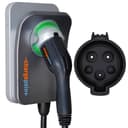
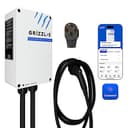
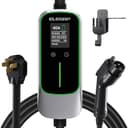
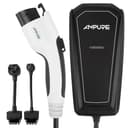
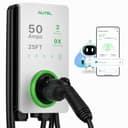
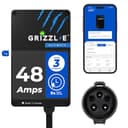
Every charger we track with a published 32-amp setting
The column that matters is the second one. It records what the manufacturer prints, not what we assume an adjustable charger can do — a unit sold as “adjustable” with no published list of steps is not on this table.
The chargers in our registry whose makers publish a 32-amp setting — the most a 40-amp circuit may carry continuously. One of them is natively 32 A; the other five are larger units with a published step at 32. Where a maker publishes no amperage list, the unit is left off this table rather than credited with a setting.| Charger | Published amp settings | Rated max | Install | Cable | Enclosure |
|---|
| ChargePoint Home Flex | In the app: 16 / 24 / 32 / 40 / 48 / 50 A | 50 A | Hardwired, NEMA 6-50 or NEMA 14-50 | 23 ft | NEMA 3R |
|---|
| Grizzl-E Classic Connect 40A | DIP switch: 16 / 24 / 32 / 40 A | 40 A | NEMA 14-50 plug | 25 ft | NEMA 4 (IP67) |
|---|
| ELEGRP 40A Portable Level 2 Charger | Selector: 16 / 20 / 24 / 32 / 40 A | 40 A | NEMA 14-50 plug | 25 ft | IP67 (station), IP54 (connector) |
|---|
| Ampure Go Portable Level 2 Charger | Native 32 A — no setting to make | 32 A | NEMA 14-50 cord for 240V, NEMA 5-15 cord for 120V | 20 ft | IP67 (NEMA 6P watertight) |
|---|
| Autel MaxiCharger Home | In the app: 16 / 24 / 32 / 40 / 48 / 50 A | 50 A | Hardwired | 25 ft | IP65 / NEMA 4X |
|---|
| Grizzl-E Ultimate 48A | DIP switch: 16 / 24 / 32 / 40 / 48 A | 48 A | Hardwired | 25 ft | NEMA 4 (IP67) |
|---|
Two things stand out from that table. The first is how rarely 32 amps is a product: only the Ampure Go is built to it, and it is a portable module rather than a wall box. The second is that the way you set 32 amps splits the field cleanly in half — ChargePoint and Autel do it in software, Grizzl-E and ELEGRP with a physical switch under a cover. That difference outlives the charging speed, because one of them needs an account and a network and the other needs a screwdriver, once.
What we ranked on
With the amperage fixed by your circuit, the usual “how fast is it” question disappears and four better ones replace it.
One: is the 32-amp step published, and where?This was the gate. ChargePoint’s datasheet lists output amperage “adjustable via mobile app to 16A, 24A, 32A, 40A, 48A, 50A.” Autel’s own store page for the 50A MaxiCharger gives six discrete settings at “16 A, 24 A, 32 A, 40 A, 48 A, 50 A” — discrete, which is worth knowing, because “adjustable 16–50 A” reads like a continuum and is not one. Grizzl-E publishes DIP steps and, uniquely, the breaker each one is for. ELEGRP publishes a five-position selector. Ampure publishes a single figure because there is nothing to set.
Two: can the same unit go faster later?A 40-amp circuit is often a waypoint rather than a destination — the range circuit you borrowed, or the most the panel could spare this year. Four of our six picks are rated well above 32 amps (the Home Flex to 50, the Ultimate 48A and the MaxiCharger to 48 and 50), so the day a bigger circuit arrives you change a setting instead of buying a charger. That is the main reason the native 32-amp unit is not our top pick.
Three: how does it install, and is that honest about your circuit? Three of the picks are plug-in or portable units that end in a NEMA 14-50 plug, which belongs on a 50-amp circuit; three can be hardwired, which is the clean route on a 40-amp circuit. If the 40-amp circuit is the one you intend to use, have the conversation about hardwiring with your electrician before you buy — it decides which half of this list applies to you. Hardwired versus plug-in covers the trade in full.
Four: what else does the unit publish?Amperage settles the speed, and then every other spec decides whether you like living with it. We weighted the same four we always do: a published enclosure rating with a temperature range beside it (Grizzl-E’s IP67 cast aluminum at −22°F to 122°F, Autel’s IP65 / NEMA 4X at −40°F to 131°F, Ampure’s IP67 / NEMA 6P), cable length, an accredited safety listing, and whether the maker publishes the figures at all.
Who should run 32 amps on purpose
Plenty of people arrive at this page because of a circuit. Four other groups should choose 32 amps even with a bigger circuit available.
Plug-in hybrid drivers.A PHEV’s onboard charger is small, and the DOE’s own consumer page puts Level 2 charging at 10 to 30 miles of range per hour with DC fast charging unavailable on most PHEVs. At 7.7 kW you are already past the top of that band, and the car will cap what it draws regardless. Our PHEV roundup is the page for that case.
Anyone whose panel is close to full. A lower fixed ceiling is the cheapest load management in existence: it costs nothing, it cannot fail in software, and it lowers the number your electrician has to fit into the load calculation. Our panel-capacity page explains that calculation, and the load-management roundup covers the chargers that do it dynamically instead.
Two-car households sharing one circuit. Split a 40-amp circuit between two cars and 32 amps becomes the figure the pair of them share rather than the figure each one gets. The two-car roundup covers both routes — one dual-port box, or two chargers that talk to each other.
Anyone on a time-of-use rate with a long overnight window. If the cheap window is eight hours and your commute is forty miles, 32 amps refills it in under two hours. The faster charger finishes sooner and costs the same to run; the only thing it buys is slack you are not using. Time-of-use charging has the arithmetic.
What 32 amps costs you
Two real losses, stated plainly, because the whole point of a page like this is to let you decide whether they matter.
About seven miles of range per hour against 40 amps, and thirteen against 48.By our arithmetic at a stated 3.5 miles per kWh: 32 A is roughly 27 miles per hour, 40 A roughly 34, 48 A roughly 40. Over a ten-hour night that is 270 miles against 340 and 400 — a difference that matters if you routinely arrive home nearly empty and leave early, and that almost nobody else will ever notice. The fastest chargers page is the counter-argument if you are in the first group.
The chance that the circuit, not the charger, is the thing to fix. If you are already paying an electrician to run new wire, the price gap between a 40-amp and a 60-amp circuit is small against the labor, conduit and permit, and the charger on the end can be set to anything afterwards. Running a 40-amp circuit to save a hundred dollars on copper, and finding in three years that it caps a new car, is the one regret this page can actually prevent. The install-cost breakdown has the line items, and the new-construction page covers what to rough in when the walls are open.