Start with amps, not chargers
Everything in this category follows from one number: the spare capacity in your service. EV charging is a continuous load, so the NEC sizes the circuit at 125% of the charger’s current — the “80% rule”. A 40-amp charger therefore occupies a 50-amp circuit, and a 48-amp charger occupies a 60-amp one. Two 48-amp chargers is 120 amps of circuit on a service that is often only 100 or 200 amps in total, before the range, dryer, water heater and air conditioning have had their share.
That is why the interesting engineering in two-car charging is all about not demanding both cars at full output simultaneously. Work out what you have first, using our panel capacity guide, and then pick the arrangement that fits it:
- One charger, two cars, moved by hand. Cost: zero. Works for the large majority of two-EV households.
- One dual-port charger on one circuit. Both cars plugged in overnight, each getting half the current. One breaker, one run.
- Two chargers with load sharing. Full speed when only one car is charging, automatically throttled when both are. Needs chargers that support it.
- Two independent circuits.Fastest, simplest to understand, most expensive — and the one most likely to trigger a service upgrade.
Published maximum output and install type, read from each maker’s own spec sheet. On the Duo Connect the amperage figure is the totalfor the unit, shared between two connectors — every other row is per car.| Charger | Max amps | Ports | Install | App |
|---|
| Grizzl-E Duo Connect 40A | 40 A | 2 (shared) | NEMA 14-50 plug or hardwired | Yes |
|---|
| Wallbox Pulsar Plus | 48 A | 1 | Hardwired (40A model plugs in) | Yes |
|---|
| ChargePoint Home Flex | 50 A | 1 | Hardwired, NEMA 6-50 or NEMA 14-50 | Yes |
|---|
| Emporia Level 2 EV Charger | 48 A | 1 | Hardwired or NEMA 14-50 plug | Yes |
|---|
| EVIQO 40A NEMA 14-50 Charger | 40 A | 1 | NEMA 14-50 plug | Yes |
|---|
| Autel MaxiCharger 80A | 80 A | 1 | Hardwired | Yes |
|---|
The free option nobody sells you
Before spending anything, do this arithmetic. A 40-amp charger delivers 9.6 kW, which at a reference efficiency of about 3.5 miles per kWh is roughly 34 miles of range per hour. Work out your own daily mileage — the odometer at the end of a normal week, divided by seven — and divide it by 34. For most commutes the answer is about an hour.
Two cars, two ordinary commutes, one overnight window of eight or ten hours: you need two or three hours of charging total, and you have three or four times that. The constraint is not the charger. It is whether someone is willing to walk out and swap a cable at bedtime. Households that alternate nights — car A on odd days, car B on even — often never think about it again.
The free option stops working in three specific situations: when one or both cars are driven far enough daily to need most of the night; when the second vehicle is a large truck or SUV whose consumption per mile is much higher; or when nobody in the house will reliably move the cable. If you are in one of those cases, keep reading. If you are not, buy nothing and revisit it in a year. Our charging-time guide has the formula for your own numbers.
The dual-port option, and its honest cost
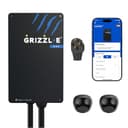
The Grizzl-E Duo Connect 40A is the cleanest hardware answer: one cast-aluminum, IP67-sealed box, two 25-foot cables, one 40-amp supply. Grizzl-E states plainly that dual charging automatically splits the available current in half, with per-connector currents settable in the Grizzl-E Connect app. So both cars can be plugged in all night and each receives about 4.8 kW — roughly 17 miles of range per hour each, or about 140 miles across an eight-hour window between them.
That is plenty for two commuters and not enough for two road-trippers. The trade you are making is explicit: you are buying the convenience of never moving a cable, at half speed each, for the price of a premium charger. What you are notpaying for is a second circuit, a second breaker, a second conductor run, or the load that second circuit would add to your panel calculation — and on a tight panel or a long run to a detached garage, that avoided cost is the whole argument. Our Duo Connect review goes deeper, and the subpanel guide covers the detached-garage case.
One caveat we won’t bury: the Amazon SKU we track for the Duo is the NACS-to-NACS variant, built for two Tesla or NACS vehicles. Grizzl-E builds other cable pairings, but check the listing you are actually buying before you assume it fits a mixed fleet.
Load sharing: the feature that saves a panel upgrade
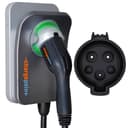
The Wallbox Pulsar Plus earns its place here on Power Boost, Wallbox’s load-balancing feature. The principle is simple and genuinely valuable: the system watches total household draw and reduces the charger’s output when the rest of the house gets busy, so the main breaker never sees more than it should. In a home where the load calculation says there is no room for a 48-amp charger, a managed charger may still fit — because the calculation can be based on the managed maximum instead of the nameplate one.
For two cars, that logic extends to a pair of chargers coordinating with each other: full output when one car is home, split output when both are. It is the arrangement that gets you closest to “two chargers, no compromise” without touching the panel. The Pulsar Plus is also the most compact 48-amp unit here, which matters if you are mounting two boxes in a garage that already has bikes on the wall. It is hardwired only and the priciest per unit — see the Pulsar Plus review and our load management guide for what to ask an electrician.
The adjustable-amperage route
If you plan to run two chargers on a panel with limited headroom, buying units whose output you can set is the quiet solution. The ChargePoint Home Flexadjusts from 16 to 50 amps in the app, which means two of them can be configured at, say, 24 amps each — two cars charging simultaneously at about 5.8 kW each, on circuits your panel can actually carry, with the option to raise either one later if you upgrade. It also has the most mature app of anything here, which matters more when you are managing two vehicles and two schedules. Read the Home Flex review.
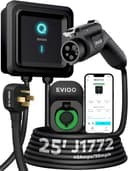
The Emporia Level 2is the value way to do the same thing, and the obvious “second charger” when you already own something good: 48 amps hardwired or 40 on a NEMA 14-50 plug, real energy monitoring in the app so you can see what each car actually costs you, and a 25-foot cable. The EVIQO 40Aplug-in is the same idea one step cheaper to install — if there is already a 14-50 receptacle in the garage from a previous project, a plug-in second charger can be a same-afternoon job with no electrician at all. Its output is app-adjustable from 6 to 40 amps, which is exactly the flexibility a shared panel wants. See the Emporia review and the EVIQO 40A review.
The one-big-circuit approach
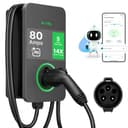
The Autel MaxiCharger 80Ais here for a specific and fairly rare household: one with a large service, a 100-amp circuit available, and a reason to want 19.2 kW at a single point. Its output is adjustable from 6 to 80 amps in the app, so it can be the one charger that never limits anything — full speed for whichever car is on it, dialed down when the house needs the capacity elsewhere.
We are being deliberately cautious about this one. Very few EVs accept more than 11.5 kW on AC, so the top of its range is unusable for most cars, and a 100-amp circuit is a service upgrade for many homes. If you are shopping for two cars on a normal panel, this is the wrong end of the catalog — but if you already have the capacity, it is a genuinely future-proof box. The full argument is in 48 amps vs 80 amps and the Autel 80A review.
What to tell your electrician
Whichever route you take, the quote gets much more accurate if you arrive with four pieces of information rather than “I want to charge two cars”:
- Your service size and current load. The number on the main breaker, plus what else is electric in the house. This drives everything.
- The output you actually want, in amps— and that you are willing to configure the chargers lower if that avoids a service upgrade. Say this out loud; many quotes assume maximum nameplate output because nobody said otherwise.
- Whether you want load management, and that you would like the load calculation done both ways — managed and unmanaged — so you can see what the feature is worth in dollars.
- Where both cars park, including the awkward case. Mounting position decides conductor length, which decides a large share of the bill; our placement guide covers how to work it out before the visit.
Then compare that against the installation cost breakdown. The gap between the cheapest and the most expensive way to charge two cars in the same house is far wider than the gap between any two chargers on this page — and it is decided almost entirely by how many amps you insisted on having at once.