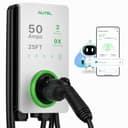
What “smart” has to mean to count
“Smart” is a marketing word, so here is the definition this page uses. A charger qualifies if it has a WiFi radio and a manufacturer app that does at least one of three jobs: schedule a charge for an off-peak window, measure the energy it has delivered, or lockthe unit so someone else cannot use it. Bluetooth-only setup does not count — that is a configuration tool, not a connected charger. Nor does a phone app whose only function is a firmware update.
Judged that way, the field thins out fast. In our registry of twenty chargers, exactly nine publish a WiFi radio and an app, and most of those are premium hardware. The five on this page are the ones where the price is the point.
One honest note on where the ranking comes from. Scheduling is the headline feature of every charger app on the market, and it is also the feature your car almost certainly already has. So we have deliberately ranked the other two jobs higher: measurement, which cars do badly or not at all, and lockout, which matters on a shared driveway or an Airbnb charger. If scheduling is all you want, read this first— you may not need this page at all.
What the money actually buys
What you actually get for the money. The “App does” and “Amps set by” columns are ours, derived from each maker’s own published feature list; every other cell is read off the spec sheet on a dated visit. A spec a maker does not publish reads “Not published” rather than being filled in.| Charger | App does | Amps set by | Max | Install | Listings | ENERGY STAR |
|---|
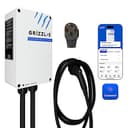
| Grizzl-E Classic Connect 40A | Scheduling, usage history, remote lockout, utility demand response | DIP switch (16/24/32/40 A) | 40 A | NEMA 14-50 plug | UL/cUL listed (file E510712) | Not published |
|---|
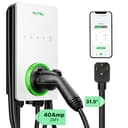
| Autel MaxiCharger AC Elite Home 40A | Scheduling plus output set in the app, over WiFi, Bluetooth or Ethernet | In the app, up to 40 A | 40 A | NEMA 14-50 plug | Not published | Not published |
|---|
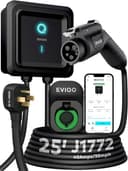
| EVIQO 40A NEMA 14-50 Charger | Scheduling plus output set 6-40 A in the app | In the app, 6-40 A | 40 A | NEMA 14-50 plug | UL, ETL, FCC, ENERGY STAR | Yes |
|---|
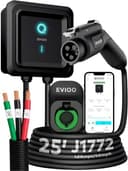
| EVIQO 48A Level 2 Charger | Scheduling over WiFi | Not published | 48 A | Hardwired | UL, ETL, FCC, ENERGY STAR | Yes |
|---|
| Autel MaxiCharger Home | Scheduling plus output set 16-50 A, over WiFi, Bluetooth or Ethernet | In the app, 16-50 A | 50 A | Hardwired | CSA certified, ENERGY STAR | Yes |
|---|
Three things in that table are worth dwelling on, because they are the real differences between these five units.
How you set the amperage. This is the most practical difference and the one buyers notice last. The Autel and EVIQO units set current in the app, so moving the charger to a different circuit is a tap. The Grizzl-E Classic Connectuses a physical DIP switch — four positions, 16, 24, 32 or 40 amps — which means opening the unit to change it. For a charger you install once, that is a non-issue. For a renter who may move it, or anyone who might later downsize it onto a smaller circuit, it is a mild annoyance worth knowing about up front. For the EVIQO 48A, no adjustable range is published at all, so our table says so.
The paperwork gaps.Two cells in that table are the reason we built it. Autel’s own store page for the AC Elite Home 40A publishes the enclosure, the cable, the connectivity and the warranty but does notpublish a UL or ENERGY STAR listing, or an operating-temperature range — unlike Autel’s pages for the 50-amp and 80-amp MaxiChargers, which publish all three. We have deliberately notlet it inherit its siblings’ certifications, which is why it is kept off our ENERGY STAR roundup and why the gap appears on its card. Separately, marketplace listings for the Grizzl-E Classic Connectcarry an ENERGY STAR badge, but Grizzl-E’s own pages do not state the certification, so we record it as not published rather than guessing in either direction. Grizzl-E does publish a UL/cUL file for it, which is the listing that matters most.
Plug-in versus hardwired.Three of these plug into a NEMA 14-50 outlet and two are hardwired. If the outlet already exists, the plug-in units save you an electrician entirely and come off the wall when you move — which in this price band is often a bigger saving than the difference between the chargers. Our hardwired versus plug-in comparison weighs the whole trade, and the NEMA 14-50 guide covers what that receptacle needs to be legal.
The picks, in plain terms
The Grizzl-E Classic Connect 40Awins because nothing else at its price gives you both halves. The app does the most actual work of any unit here — scheduling, usage history, remote lockout, and enrollment in utility demand-response programs, which is the one app feature that can pay you money. The body is the cast-aluminum, IP67-sealed design that made the brand’s name, rated -22°F to 122°F, on a 25-foot cold-flexible cable. The honest limits: 40 amps is the ceiling in this model, the DIP switch is analog, and no ENERGY STAR certification is published. Our Classic Connect review has the full picture, and the Classic comparison shows exactly what the radio adds over the no-app version.
The Autel MaxiCharger AC Elite Home 40A is the pick if app control is what you are paying for. Output is adjustable in the Autel Charge app, with WiFi, Bluetooth andEthernet on board — a wired option that very few chargers at any price offer, and the right answer in a garage where WiFi does not reach. It is a NEMA 4 body with a 25-foot cable and an in-body holster so nothing dangles. Set against that: the missing listings above, and the fact that it needs a genuine EV-grade 14-50 receptacle — an old dryer outlet is not one. The full review covers it.
The EVIQO 40A is the pick for anyone who wants the paperwork complete. It is the only unit on this page publishing UL, ETL, FCC andENERGY STAR together, in an IP66 / NEMA 4 body, with output adjustable from 6 to 40 amps in the app and the longest reach here — a 25-foot charging cable plus a 40-inch input lead, which is the detail that decides where you can mount it. The brand is younger and less proven than ChargePoint or Wallbox, which is a fair thing to weigh. See the EVIQO 40A review.
The EVIQO 48A is the same hardware story hardwired, and it is the cheapest route to a genuine 48 amps with an app that we track. Buy it only if your panel can carry a 60-amp circuitand your car can actually use 11.5 kW — many cannot, and the limit is inside the car, not on the wall. It publishes no adjustable amperage range, so treat 48 amps as the configuration you are buying. The 48A review and our 48-amp roundup both go deeper.
The Autel MaxiCharger Home(the 50-amp hardwired unit) is the stretch pick, and the one to take if the charger has to live fully outdoors. Unlike its smaller sibling, Autel publishes the full set for this one: CSA certification, ENERGY STAR, an IP65 / NEMA 4X enclosure — 4X being the rating that adds corrosion resistance — and an operating range from -40°F to 131°F, the widest we track. Output is adjustable 16 to 50 amps in the app. One number to read carefully: Autel states a 70-amp circuit is required for full output, so the headline 50 amps is a bigger electrical job than people expect. Dial it to 40 amps on a 50-amp circuit and it is a straightforward install. Our MaxiCharger review and the Grizzl-E versus Autel head-to-head set the two philosophies on this page against each other directly.
How to choose between these five
Start with the outlet. If you already have a NEMA 14-50, buy a plug-in unit and stop — the Grizzl-E if you want the toughest body, the Autel 40A if you want app control, the EVIQO 40A if you want the certifications and the reach. You will spend nothing on labor and keep the ability to take the charger with you.
If you are paying an electrician anyway, the calculation changes. The hardwired units are in play, and the question becomes whether your car can use 48 amps and whether the charger lives outside. If yes to the first, the EVIQO 48A is the cheapest way there; if yes to the second, the Autel 50A’s NEMA 4X body is the one built for it.
And one honest exit. If scheduling is the only feature you want, your car already does it, and you should probably be on our no-app roundupinstead — a charger with nothing to log into cannot be orphaned when a company changes its mind about an app, and the money goes into the cable and the enclosure instead. The only reason to buy a radio is that you want the measurement, the lockout, or a utility program that pays for it. Our utility rebates page is the place to check whether that last one applies where you live, and the cost-to-charge calculator shows what the overnight kilowatt-hours are actually worth on your rate.