Measure before you buy anything
Most cable-length regret comes from measuring the wrong distance. The number you need is not the straight line from the wall to the car — it is the path the cable actually travels. Take a tape measure and walk it:
- Down from the mounting height. A charger at shoulder height means three or four feet of cable spent getting to floor level before it goes anywhere.
- Along the ground to the car’s parked position, following the route it would take — not through the vehicle.
- Around the body to the charge port. Ports live in wildly different places: front fender, rear quarter, behind the front wheel. If your port is on the far side from the wall, add the width of the car twice over.
- Plus two to three feet of slack. A cable under tension is a cable being damaged, and a taut cable is a trip hazard.
- Then check the other way round. If you ever back in, or your partner parks in the other bay, measure that case too — it is usually the one that decides the answer.
Do that and the required length is usually obvious. Most single-car garages with the charger on the port side are comfortable at 18–20 feet. Two bays, an awkward port position, or both parking directions push you to 25. If the charger is going on a garage wall specifically, our best chargers for a garage weighs reach against the rest of what a garage install changes.
Published charging-cable lengths, read from each maker’s own spec sheet. “Usable reach” is always less than the number on the box — see the measuring section below.| Charger | Cable | Install | Enclosure | Max amps |
|---|
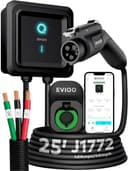
| EVIQO 48A Level 2 Charger | 25 ft | Hardwired | IP66 / NEMA 4 | 48 A |
|---|
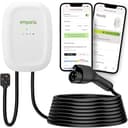
| Emporia Level 2 EV Charger | 25 ft | Hardwired or NEMA 14-50 plug | NEMA 4 | 48 A |
|---|
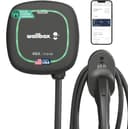
| Wallbox Pulsar Plus | 25 ft | Hardwired (40A model plugs in) | NEMA 4 | 48 A |
|---|
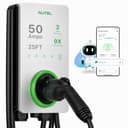
| Autel MaxiCharger Home | 25 ft | Hardwired | IP65 / NEMA 4X | 50 A |
|---|
| Grizzl-E Classic Connect 40A | 25 ft | NEMA 14-50 plug | NEMA 4 (IP67) | 40 A |
|---|
| ChargePoint Home Flex | 23 ft | Hardwired, NEMA 6-50 or NEMA 14-50 | NEMA 3R | 50 A |
|---|
Why the answer is never an extension cord
This deserves its own section — and now its own page— because it is the most common dangerous shortcut in home charging. A Level 2 charger draws 40 amps continuously for hours — that is a load unlike anything else you plug in at home. Ordinary extension cords are not built for continuous high current: undersized conductors heat up along their whole length, the plug-and-socket junction becomes a hot spot, and outdoors the connection is an open invitation for water to enter a circuit carrying 240 volts. Charger manufacturers generally prohibit it outright, and doing it will typically void your warranty.
The factory cable is different because it is engineered as part of a listed product: conductor size, insulation and strain relief are all specified for that unit’s rated current and certified to the UL 2594 EVSE standard as a system. That is why a 25-foot factory cable delivers exactly the same amps as a 16-foot one, and a home-made extension does not deliver the same safety.
If your cable won’t reach, the fix is on the other end: move the charger. Having the electrician run conductors ten feet further along the wall is a modest addition to a job you are already paying for — see the installation cost breakdown — and it solves the problem permanently and safely.
The picks, by what their reach is good for
The EVIQO 48A takes the reach crown on total usable length: a 25-foot charging cable plus a 40-inch input lead, which is the longest combined span in this group. That input cable is the underrated part — it means the box can sit further from where the conductors terminate, giving the electrician and you more freedom about position. It also brings 48 amps, WiFi with scheduling, an IP66 / NEMA 4 body and UL/ETL/FCC/ENERGY STAR listings at a value price. The trade is brand track record and a hardwired-only install at full output. Our EVIQO review has the full picture.
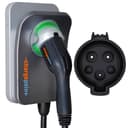
The Emporia Level 2 is the value long-cable pick: the same 25 feet of cable, a watertight NEMA 4 enclosure, ENERGY STAR, real energy monitoring in the app, and the flexibility of running hardwired at 48 amps or plugged into a NEMA 14-50 at 40. It also ships with a remote holster in the box, which sounds trivial until you own 25 feet of cable and need somewhere for it to live. The app trails ChargePoint’s for polish. See our Emporia review.
The Wallbox Pulsar Plus pairs a 25-foot cable with the smallest body here, which is a genuinely useful combination: the box takes almost no wall, so you can put it in the awkward spot that happens to be electrically convenient, and let the cable do the work. Add Power Boost load balancing for homes with a full panel. It is the priciest pick and hardwired only. Read the Pulsar Plus review.
The Autel MaxiCharger is the one to pick when the long cable is going outdoors, because reach and exposure usually arrive together — if you need 25 feet, the box is often going somewhere less sheltered. Its NEMA 4X enclosure adds corrosion resistance to dust and hose-directed water protection, and Autel publishes an operating range down to about -40°F. A full 50 amps needs a 60-amp hardwired circuit. See the Autel review and our outdoor picks.
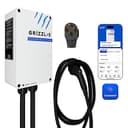
The Grizzl-E Classic Connect 40A deserves a specific mention here because of how its 25 feet behaves rather than how far it goes: Grizzl-E builds the cable to stay flexible in cold weather, which is the difference between coiling it onto the holster in January and fighting a frozen hose. It runs the cable off an 18-inch input lead in a cast-aluminum, IP67 body rated to -22°F. The trade is that it caps at 40 amps and plugs into a NEMA 14-50 rather than hardwiring. Read the Grizzl-E Classic Connect review or our cold-weather picks.
This entry was the Grizzl-E Ultimate 48A until we recorded it as discontinued in August 2026 after its Amazon listing went dark. We corrected that on 28 September 2026 — Grizzl-E sells the Ultimate 48A at $383.99 in J1772 or NACS and Amazon lists it again, so its review carries a buy link once more. The Classic Connect keeps the entry here because it carries the same 25-foot cold-flexible cable, so the reason it earned a place is unchanged — only the amps and the install method are.
The ChargePoint Home Flex is the shortest cable here at 23 feet — still long, but the one place it gives ground to the others. You accept that for adjustable 16–50A output, the most mature app in the category and a three-year warranty. If your measurement came out at 22 feet, this is fine; if it came out at 24, buy one of the 25-foot units instead. Our Home Flex review has more.
Getting the most out of the cable you buy
Two units with identical 25-foot cables can behave completely differently depending on how they’re installed. A few things that cost nothing and buy you reach:
- Mount at the right height. Chest to shoulder height, roughly level with the charge port when the car is parked. Too high wastes cable getting down; too low leaves the connector in the dirt.
- Mount centrally if you have two bays. A charger at one end of a two-car garage needs to cross the whole space; one in the middle halves the worst case.
- Use a proper holster or hook. Twenty-five feet of cable coiled on a purpose-made hook stays out of the way and lasts longer; the same cable dumped on the floor gets driven over.
- Avoid tight bends at the box. The cable exit is where strain concentrates. Let it loop rather than kink.
- Think about the second car. Households usually end up with two EVs eventually. Mounting for the harder parking position now saves a re-install later — and if you might share one charger between two cars, that is also an argument for 48 amps.
Get the position right and cable length stops being a constraint at all. Once it’s installed, our cost-to-charge calculator tells you what those overnight kilowatt-hours cost on your electricity rate — the number that actually recurs every month.