Emporia vs Autel MaxiCharger
One of these is the only charger on the page that goes past 48 amps, and its own documentation asks for a 70-amp circuit to get there. The other is the only one you can put on a plug. Everything that actually separates them is in a footnote on a manufacturer's own page.
How this is funded: we earn a commission if you buy through our links, at no extra cost to you. It never changes which product we recommend, and we’ll tell you when we’d skip one. Full disclosure.
These two brands get shortlisted together constantly, and almost always for the wrong reason: they look like similarly priced 48-ish-amp smart chargers with weatherproof bodies and three-year warranties. They are, and on a mild wall feeding a car that accepts 11 kW they will charge identically.
The differences that matter are all in the fine print, and there are four of them: what the Autel’s extra two amps actually cost, whether you can use a plug, what each brand publishes about weather, and the near-identical footnote both brands attach to load management. Here are the published specs, then each of those four in turn.
| Spec | Emporia Classic | Emporia Pro | Autel MaxiCharger 50A |
|---|---|---|---|
| Max output | 48 A | 48 A | 50 A |
| Power | 11.5 kW | 11.5 kW | 12 kW |
| Connector | J1772 | J1772 | J1772 |
| Install | Hardwired or NEMA 14-50 plug | Hardwired or NEMA 14-50 plug | Hardwired |
| Charging cable | 25 ft | 25 ft | 25 ft |
| Enclosure | NEMA 4 | NEMA 4 | IP65 / NEMA 4X |
| WiFi / app | Yes | Yes | Yes |
| ENERGY STAR | Yes | Yes | Yes |
| Listings | UL listed, ENERGY STAR | UL listed, ENERGY STAR | CSA certified, ENERGY STAR |
| Warranty | 3 years | 3 years | 3 years |
One note on the table before we argue about it. Emporia publishes less about the Pro than it does about the Classic — its comparison page gives the Pro feature checkmarks where the Classic gets a spec sheet — so some of the Pro’s figures come from Emporia’s separate Pro product page. Neither brand publishes a kW figure for a 48-amp unit, so the 11.5 kW on this page is ours (48 × 240).
1. Autel’s 50 amps is the weakest upgrade on this page
The Autel AC Elite Home 50A is the only charger either brand sells that exceeds 48 amps, and on a spec sheet that reads like a straightforward win. Run the numbers and it is the opposite.
Fifty amps at 240 volts is 12 kW. Forty-eight amps is 11.5 kW. The difference is about half a kilowatt, which at our stated reference of roughly 3.5 miles per kWh is about two miles of range per hour. Over a ten-hour overnight charge that is twenty miles — on a car that almost certainly cannot use it anyway, since the common onboard-charger ratings are 11 kW and 11.5 kW. Our Kia EV6 and Volkswagen ID.4guides both land on the same conclusion from the car’s side: at 10.9 and 11 kW respectively, everything above 48 amps is thrown away inside the vehicle.
And it is not free. Autel’s own store page specifies the install as “Hardwired · 70 A Circuit for Full Output”. That follows from the NEC’s continuous-load rule — 50 amps at 125% is 62.5, and the next standard breaker above that is 70 — and it is a figure we had previously carried as 60 amps on this site, which we have now corrected to match Autel’s documentation. A 70-amp circuit means heavier conductors and more panel capacity than a 48-amp charger’s 60-amp circuit, and on a tight panel it can be the step that triggers a service upgrade. Our wire size and breaker guide walks the whole ladder.
The practical answer: buy the Autel for its enclosure, not its amperage, and set it to 48 on a 60-amp circuit if that is what your panel can carry. Autel publishes the output as adjustable from 16 to 50 amps, so this is a setting rather than a compromise — the same flexibility that puts the ChargePoint Home Flex at the top of our small-panel picks.
2. Emporia is the only one of the two you can plug in
Both of Emporia’s units are sold as “NEMA Plug or Hardwire”, and the Classic delivers up to 48 amps hardwired or 40 amps on a NEMA 14-50 outlet. That is a genuinely useful piece of flexibility: one purchase covers a household that has a 240-volt receptacle today and might hardwire later, or a household that expects to move. Our guide to moving a charger explains why that matters more than people expect.
The Autel AC Elite Home 50A is hardwired only. Autel does sell a plug-in sibling, the AC Elite Home 40A on a NEMA 14-50 cord, and it is a good unit — but it is a different product with a thinner spec sheet. Its own page publishes the enclosure, the cable, the connectivity and the warranty, and does notpublish a UL or ENERGY STAR listing or an operating-temperature range, all three of which the 50-amp page does publish. So “Autel, but on a plug” costs you eight amps and three published specs, and the missing ENERGY STAR listing is the one that can cost actual money if your utility rebate requires one.
If a plug is non-negotiable, Emporia wins this comparison on that basis alone. If you are hardwiring anyway, the point is moot, and our hardwired versus plug-in comparison makes the case for the permanent install.
3. Weather: Autel publishes more, and more of it is useful
This is the row where the two brands genuinely diverge, and it is the reason the Autel leads our picks below.
Autel publishes IP65 / NEMA 4X and an operating range of -40°F to 131°F (-40°C to 55°C). Emporia publishes NEMA 4, and the Classic’s spec sheet publishes -22°F to 122°F. Two things follow.
First, the letter. Under NEMA’s own enclosure-type definitions, Type 4 covers windblown dust, rain, splashing and hose-directed water; Type 4X adds corrosion resistance. That is not a marketing flourish — it is the designation that matters within a few miles of salt water or on a driveway that gets road salt every winter. If your wall is neither, Type 4 is already more than a sheltered garage needs, and our ratings explainer is blunt about how much of this spec most buyers are over-purchasing.
Second, the temperature. Eighteen degrees more headroom at the cold end and nine at the hot end is a real margin, and the cold end is the one that bites: a charger in an unheated Minnesota driveway can see -30°F, which is inside Autel’s published range and outside Emporia’s. Our cold-weather roundup covers what actually happens at the edges, and the honest short version is that the charger usually survives conditions in which the car charges slowly.
One caveat we will not skip: NEMA states explicitly that its NEMA-to-IP comparison table cannot be used to convert IP designations back into NEMA types. Autel publishes both codes, Emporia publishes one, and we are not going to translate between them to manufacture a cleaner comparison.
4. Both brands gate load management behind a second device
Load management is the feature people buy these chargers for, and the footnotes are where the honest comparison lives.
Emporia.On its own Classic-versus-Pro page, four of the five headline features carry a condition. Home Energy Monitoring and Solar Charging Integration are footnoted “Requires Vue Home Energy Monitor.” Peak Demand Management and PowerSmart Load Management read “Requires Vue Home Energy Monitor and PowerSmart upgrade.” PowerSmart is standard on the Pro; for the Classic, Emporia’s own store listing says it “can also be added… for an additional cost.” Smart Scheduling, notably, carries no footnote — that works on either unit as bought.
Autel.One sentence on its own page covers the same ground: “Supports both Adaptive Load Management (ALM) and charger-to-charger Dynamic Load Balancing (DLB). ALM requires compatible additional hardware, while DLB works between chargers without additional hardware.”
Read those together and the real distinction appears, and it is not the one the marketing implies. If you want whole-home load management— a charger that watches the panel and backs off when the dryer starts — both brands sell you a second device to do it, and the Emporia Pro at least ships that device in the box. If you want two chargers to share one circuit, Autel does it with no extra hardware and Emporia does not publish an equivalent. That is the difference worth choosing on, and it maps cleanly onto two of our pages: small panels for the first case, two cars for the second. The underlying mechanics are in our load-management guide.
Where the money goes
We do not print prices in prose, because prices move and a stale number is worse than none — the live figures are on the buy rows below. What we can say about the shape of the pricing is this: the Autel 50A and the Emporia Classic sit in the same part of the list, the Emporia Pro sits above both, and the Autel 40A sits below all three. The Pro’s premium buys the bundled Vue 3 monitor and PowerSmart, so it is only good value if you actually need whole-home load management. If you do not, you are paying ChargePoint money for features you will never switch on.
One availability note for the day this page published: the Emporia Classic’s Amazon listing read “Currently unavailable” with no price when we checked on October 10, 2026, which is why the buy rows below carry the Pro rather than the Classic. That is a listing state, not a discontinuation — the Classic is still on Emporia’s own site, and this charger has gone in and out of stock on Amazon repeatedly through 2026.
The verdict
Buy the Autel MaxiChargerif the charger lives outdoors and the weather is real — the NEMA 4X corrosion rating and the -40°F floor are the best-documented in this pair — or if you may eventually run two chargers off one circuit, where its charger-to-charger load balancing needs no extra hardware. Set it to 48 amps on a 60-amp circuit unless you have a car that can genuinely use 50 and a panel that can carry 70.
Buy an Emporiaif you want a plug-in install, if you want a published UL listing alongside ENERGY STAR, or if your panel is the binding constraint and you want the load-management hardware in one box — which is the Pro, not the Classic. Buy the Classic over the Pro if PowerSmart is not the reason you are shopping, because the two charge at the same rate.
Buy neitherif value is the priority. Both of these brands are mid-to-premium, and the 48-amp field has cheaper units with comparable published specs — the EVIQO 48A below is the one we rank for reach, and our 48-amp roundup ranks the whole segment.
Quick picks
Ranked on published specs, charging speed, electrical fit and value. Select a row to jump to the full write-up. We have not bench-tested these chargers — here is exactly what we do instead.
| # | Product | Best for | Price |
|---|---|---|---|
| 1 | 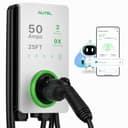 Autel MaxiCharger Home Built for the harshest driveway. The NEMA 4X enclosure is rated to keep charging in extreme cold and heat, it pushes a full 50 amps, and the app is capable. If your charger lives fully exposed to the weather, this is the one. | Best for a wall that takes real weather | |
| 2 | 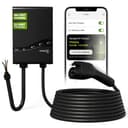 Emporia Pro The answer to a panel that says no. The Pro ships with Emporia's Vue 3 energy monitor in the same box, watches what the rest of the house is drawing, and throttles the car in real time so the total never exceeds what the service can carry — which is how a 48-amp charger ends up on a panel that a load calculation says has no room for one. You pay roughly Home Flex money for it, and only the load management justifies that. | Best when the panel is the constraint | $599.00 · View on Amazon Price as of October 18, 2026. #ad How we’re funded |
| 3 | 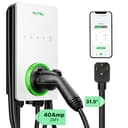 Autel MaxiCharger AC Elite Home 40A Autel's weather-hardened hardware in the install almost everyone can actually have. It is the 50A MaxiCharger's smaller sibling: same 25 ft cable and app, same NEMA 4 body, but it ends in a NEMA 14-50 plug instead of a wire nut — so it goes on an existing outlet, comes off the wall when you move, and needs a 50-amp circuit rather than a 60. The in-body holster is a small thing that stops mattering only if you have never coiled a cold cable. | Best Autel if you want a plug | |
| 4 | 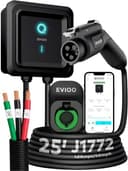 EVIQO 48A Level 2 Charger A lot of charger for the money: a full 48 amps, WiFi with scheduling, ENERGY STAR, and the longest usable reach in this group thanks to a 25 ft cable plus a 40-inch input lead. A strong value alternative to Emporia if you want maximum reach. | Best value alternative to both |
Frequently asked questions
Is the Autel MaxiCharger faster than the Emporia?
Marginally, and only if you pay for the circuit. Autel publishes 50 A / 12 kW for the AC Elite Home 50A; Emporia publishes 'Up to 48A' for both the Classic and the Pro, which is 11.5 kW by our arithmetic. The gap is about half a kilowatt, or roughly two miles of range an hour at a stated 3.5 miles per kWh. To collect it you need the circuit Autel specifies for full output, which its own page gives as 70 amps rather than the 60 a 48-amp charger needs.
Which one is better for an outdoor install?
Autel, on published evidence. Autel publishes IP65 / NEMA 4X and an operating range of -40F to 131F for the 50A unit. Emporia publishes NEMA 4, and its Classic spec sheet publishes -22F to 122F. The 4X in Autel's rating is the corrosion designation, which is the one that matters near the coast or on a road-salt route, and it has 18 degrees more headroom at the cold end. One honest caveat: NEMA states its own NEMA-to-IP comparison table cannot be run backwards to convert an IP code into a NEMA type, so we report both figures rather than reconciling them.
Can you install either of these on a NEMA 14-50 outlet?
Emporia, yes - both the Classic and the Pro are sold as 'NEMA Plug or Hardwire', and on the plug the Classic is capped at 40 A rather than 48. The Autel AC Elite Home 50A is hardwired only. Autel does sell a separate 40A NEMA 14-50 model, but that SKU's own page publishes neither a UL or ENERGY STAR listing nor an operating-temperature range, so choosing the plug-in Autel means stepping down a documentation tier as well as eight amps.
Does Emporia's load management need extra hardware?
Yes, and Emporia says so itself. On its own Classic-versus-Pro page, Home Energy Monitoring and Solar Charging Integration are footnoted 'Requires Vue Home Energy Monitor', while Peak Demand Management and PowerSmart Load Management read 'Requires Vue Home Energy Monitor and PowerSmart upgrade'. PowerSmart comes standard on the Pro and is a paid add-on for the Classic. Scheduling is not gated - that works on either unit out of the box.
Does Autel's load management need extra hardware?
It depends which kind. Autel's own page states: 'Supports both Adaptive Load Management (ALM) and charger-to-charger Dynamic Load Balancing (DLB). ALM requires compatible additional hardware, while DLB works between chargers without additional hardware.' So whole-home load management - the kind that watches your panel - needs a second device, exactly as Emporia's does. Two Autel chargers sharing one circuit do not. That is the clearest functional difference between the brands.
Which has the better warranty?
They are level on paper: both publish three years. Worth knowing that Autel's warranty wording is not consistent across its own range - its US store listing for the 80A MaxiCharger gives five years on the body, backplate and internal components but only one year on the display, charging cable and connector, while another Autel page for the same unit says three years extendable to five. The 50A page we cite publishes a single three-year term with no component split.
Is either one UL listed?
Emporia publishes a UL listing for both units ('UL Certified' for the Classic, 'UL Listed' in the Pro's feature table) alongside ENERGY STAR. Autel's own page for the 50A publishes 'CSA and ENERGY STAR compliance' and does not claim a UL listing. Both UL and CSA are Nationally Recognized Testing Laboratories, so this is a difference in what is published rather than a safety gap - but we report the words on the page rather than treating the two marks as interchangeable.
Sources
- Autel Energy — MaxiCharger AC Elite Home 50A product page — Autel's own listing: compliant with NEMA 4X standards, operating temperature -40F to 131F, 25 ft cable, 3-year warranty. RE-READ October 10, 2026 for the Emporia head-to-head, and the page now publishes materially more: 'Maximum Output | 12 kW / 50 A' with output 'Adjustable 16-50 A'; installation given as 'Hardwired - 70 A Circuit for Full Output'; an 'SAE J1772' connector; an enclosure rating of 'IP65 / NEMA 4X'; an operating range of '-40 to 131 F (-40 to 55 C)'; a '3 Years' warranty quoted as a single term with no component split; 'CSA and ENERGY STAR compliance' (no UL listing is claimed on this page); connectivity listed as 'Bluetooth, Wi-Fi, Ethernet, CAN, RS485'; app control to start, stop and schedule charging, monitor activity and adjust current; dimensions of 13.2 x 7.4 x 3.8 in (336 x 187 x 97 mm) and a weight of 15.4 lbs (7 kg); and the load-management sentence this comparison turns on - 'Supports both Adaptive Load Management (ALM) and charger-to-charger Dynamic Load Balancing (DLB). ALM requires compatible additional hardware, while DLB works between chargers without additional hardware.' The page publishes no solar-specific feature (accessed October 10, 2026)
- Autel Energy — MaxiCharger AC Elite Home 40A (NEMA 14-50) product page — Autel's own listing: output adjustable up to 40 A / 9.6 kW, SAE J1772 connector on a NEMA 14-50 input cord, 25 ft cable, NEMA 4 enclosure, Wi-Fi / Bluetooth / Ethernet, three-year limited warranty; the page does not publish a UL or ENERGY STAR listing or an operating-temperature range (accessed August 18, 2026)
- Autel Energy — MaxiCharger 80A 19.2kW Residential EV Charger (US store listing) — Autel's own US listing: 19.2 kW (240V AC 80A), 208/240V AC 50/60 Hz, SAE J1772, hardwired, 25 ft (7.5 m) cable, output adjustable from 6A to 80A in the app and 16/24/32/40/48/50/64/72/80 A by DIP switch, UL 2594, UL 2231-1, UL 2231-2, UL 1998, CSA C22.2 No. 280, FCC Part 15 Class B, ENERGY STAR, OpenADR 2.0b, NEC Article 625, Wi-Fi / Ethernet / RS485 with the Autel Charge app and cloud, and a warranty of 5 years on the charger body, backplate and internal components with 1 year on the display screen, charging cable and connector (accessed August 12, 2026)
- Emporia - EV Chargers (Classic vs Pro) — Emporia's own Classic-vs-Pro comparison page: both units publish a 25 ft cable, 'NEMA Plug or Hardwire' installation, 'Up to 48A' and a 3-year warranty. The feature rows list Smart Scheduling, Home Energy Monitoring, Solar Charging Integration, Peak Demand Management and PowerSmart Load Management, footnoted for the Classic as 'Requires Vue Home Energy Monitor' and for the Pro as 'Requires Vue Home Energy Monitor and PowerSmart upgrade'. The Classic section states 'Add the Vue Home Energy Monitor and we'll manage Peak Demand and automatically charge with your excess solar power', and Emporia's platform lists 'Excess Solar Management' as a named feature. The page also states 'PowerSmart comes standard with the Emporia Pro, but can be added to the Emporia Classic for an extra cost'. Emporia's own listed prices on the date accessed are not reprinted here. RE-READ October 17, 2026 for the smart-home roundup: every figure above is unchanged, the page additionally publishes 'Intelligent Load Sharing' for multiple chargers on one circuit and an in-app assistant ('Ask questions about your energy usage and get instant answers'), and it names NO third-party or smart-home integration of any kind - no Alexa, Google Home, Apple Home / HomeKit, Matter, Home Assistant, IFTTT, OCPP or public API appears anywhere on it (accessed October 17, 2026)
- Emporia — Classic Level 2 EV Charger spec sheet (PDF) — Emporia's own spec sheet: watertight NEMA Type 4 indoor/outdoor enclosure, operating temperature -22F to 122F, 25 ft cable (accessed July 20, 2026)
- Emporia Energy — Pro EV Charger product page — Emporia's own listing for the Pro: up to 48 A hardwired on a 60-amp circuit or up to 40 A on a NEMA 14-50 outlet, 25 ft cable, NEMA 4 rated for indoor or outdoor, UL listed and ENERGY STAR certified, 3-year warranty, and PowerSmart load management that requires the bundled Vue 3 energy monitor (accessed August 18, 2026)
- Emporia - Classic Level 2 EV Charger (store listing) — Emporia's own store listing for the Classic: 'Need advanced features like home energy monitoring, solar charging, or PowerSmart Load Management? Check out the Emporia Pro EV Charger', and 'PowerSmart can also be added to the Classic charger for an additional cost if your electrical panel doesn't have enough capacity for a Level 2 charger'. The listing's install notes describe continuous Level 2 charging as 'a fundamentally different demand than the dryers and ranges most NEMA 14-50 outlets were designed for' (accessed September 17, 2026)
- NEMA — Enclosure Types (definitions from NEMA 250) — NEMA's own definitions: Type 3R protects against falling dirt and rain, sleet and snow; Type 4 adds windblown dust, splashing and hose-directed water; Type 4X adds protection against corrosion. NEMA also states its NEMA-to-IP table cannot be used to convert IP designations back to NEMA types (accessed July 20, 2026)
- IEC 60529 — Degrees of protection provided by enclosures (IP Code), full text — The IP code standard (verbatim national adoption, IS/IEC 60529:2001): first numeral 6 = dust-tight; second numeral 6 = protected against powerful water jets; second numeral 7 = protected against temporary immersion, and a 7 alone does not imply water-jet protection unless dual coded (accessed July 20, 2026)
- ENERGY STAR — Electric Vehicle Chargers — ENERGY STAR on EVSE efficiency: certified chargers use about 40% less energy in standby than non-certified units (accessed July 19, 2026)
- UL Solutions — EV Charging Infrastructure Services — UL on EVSE safety certification: ANSI/UL 2594 is the Standard for Electric Vehicle Supply Equipment (accessed July 19, 2026)
- NFPA — Using the Latest NEC for EV Charger Installations — NFPA on NEC (NFPA 70) Article 625: EV charging is a continuous load, so circuits are sized to 125% of load (the 80% rule) (accessed July 19, 2026)
- FuelEconomy.gov — Electric Vehicles: Learn More About the Label — DOE/EPA on EV efficiency: kWh per 100 miles and MPGe, accounting for AC charging losses (accessed July 19, 2026)
Keep reading
Autel vs ChargePoint Home Flex
The same Autel against the category's default pick, where the argument is weather rating against app maturity.
Read the comparisonEmporia Classic vs Emporia Pro
Whether the Pro's bundled energy monitor and PowerSmart are worth the step up, before you compare Emporia to anyone else.
Read the comparisonBest chargers for a small panel
Where load management stops being a feature and becomes the reason a charger is possible at all.
See the picksBest outdoor chargers
The enclosure-rating field in full, including what NEMA 4X buys over NEMA 4 on a coastal wall.
See outdoor picksAutel MaxiCharger review
The full spec picture on the 50-amp unit, including the circuit its own documentation asks for.
Read the reviewEmporia Pro review
What PowerSmart actually does, what the bundled Vue monitor is for, and when it justifies the price.
Read the review