Everything under $300 right now
This list is not written into this page’s text. It is built at request time from the same daily price check that powers every button on the site, so it shows what genuinely qualifies today rather than what qualified when we published. A unit that rises above the ceiling leaves the table on its own.
Tracked chargers under $300
Built from the same daily price check that powers every price on this site, not written into this page — these are the chargers we track whose live listing price was under $300 as of November 12, 2026. Cheapest first. A unit that rises above the band drops out of this list on its own.

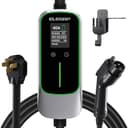
ELEGRP 40A Portable Level 2 Charger
Full 40-amp speed and the longest reach in a portable

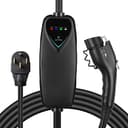
Lectron 40A Portable Level 2 Charger
The lowest-cost route to real Level 2, and portability

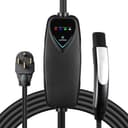
Lectron Portable Level 2 Tesla Charger (NACS)
Tesla and NACS drivers who want a native plug on a portable

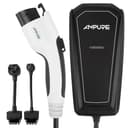
Ampure Go Portable Level 2 Charger
One charger for the garage and the road, certified for both

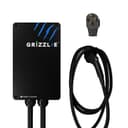
Grizzl-E Classic
Outdoor and cold-climate installs where nothing should need an app

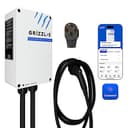
Grizzl-E Classic Connect 40A
A tough plug-in charger that still schedules from an app
6 of the 22 chargers in scope qualify today.
Compare the shape of that list with the same table at $500, where twenty of the twenty-two chargers we track qualify. That contrast is the argument of this page: $500 is barely a filter in this category and $300 is a real one. The band is small, it is dominated by 40-amp plug-in and portable units, and it contains exactly one charger whose maker publishes an app.
What we ranked on
With the price capped at the bottom of the market, the usual value question disappears and four sharper ones replace it.
One: does it reach a full 40 amps?This is the first thing to check and the easiest to get wrong, because the band also contains a 32-amp unit. Forty amps at 240 volts is 9.6 kW, about 34 miles of range an hour at a stated 3.5 miles per kWh; 32 amps is 7.7 kW, about 27. Five of our six picks publish 40 amps (Grizzl-E Classic, Grizzl-E Classic Connect, ELEGRP, both Lectron portables) and the Ampure Go publishes 32 A / 7.7 kW, which is a deliberate trade for its enclosure and warranty rather than a corner cut. Nothing in this band goes above 40, and nothing plug-in anywhere does — see the 14-50 page for why that is code rather than cost.
Two: how much cable, and does the maker publish a number?Cable length decides where the charger can physically live, and it is the spec that varies most inside this band. Grizzl-E publishes a 25-foot output cable on an 18-inch input lead for both Classic models, and describes the cable as remaining flexible in cold temperatures. ELEGRP publishes 25 feet (with 16- and 21-foot options). Ampure publishes 20 feet. Both Lectron portables publish 16 feet, which is the real compromise in this band — 16 feet reaches a car parked next to the outlet and not much else. Our long-cable roundup covers how to measure the run you actually need before you buy.
Three: is there a published enclosure rating, with a temperature range beside it?A rating with no temperature figure next to it is half a claim, and this is where the band separates most clearly. Grizzl-E publishes a UL Type 4 indoor/outdoor cast-aluminum enclosure with IP67 sealing and -22°F to 122°F on both Classics. ELEGRP publishes an IP67 station with an IP54 connector and the same range. Ampure publishes IP67 and a NEMA 6P watertight enclosure, calls the Go submersible to three feet, and publishes -22°F to 122°F. Lectron publishes neithera rating nor a range for either portable — an absence we report rather than infer, and the single biggest specification difference between the top and bottom of this page. NEMA and IP ratings explained covers what each code promises; the cold-weather roundup is the page if the charger lives outside a northern garage.
Four: which connector, and does it match the car you own?This band covers both. Four picks are SAE J1772, which fits every non-Tesla EV and a Tesla with the adapter that came with it. The Lectron Portable Level 2 Tesla Charger is native NACS, and Lectron states that J1772 cars can use it with a NACS-to-J1772 adapter. Getting this wrong is the one mistake on this page that cannot be fixed with a setting — J1772 vs NACS settles which one your car has.
The one thing $300 cannot buy
Everything above has been about what the band contains. Here is what it does not, stated plainly, because it is the only reason to spend more.
A hardwired 48-amp install.Every pick on this page is a plug-in or portable unit, and the plug caps it at 40 amps. If you want 48 amps and 11.5 kW — about 40 miles of range an hour by our arithmetic, and the figure most new EVs can actually accept on AC — you need a hardwired charger on a 60-amp circuit, and the cheapest of those sits above this ceiling. Our 11 kW roundup covers that tier and explains who genuinely benefits from it; the 48-amp page ranks the field. The honest version of the advice is that the extra six miles per hour matters to a small minority of drivers — if your car sits on the drive for eight hours a night, 40 amps refills more range than almost anyone uses in a day.
Automatic load management.If your house has a 100-amp service, the constraint is not the charger, it is the panel, and the fix is hardware that watches the whole service and throttles the charger to keep total load inside the limit. Nothing in this band does that. Setting a lower amperage by DIP switch (which the Grizzl-E units do at 40, 32, 24 or 16 A, and the ELEGRP at 16, 20, 24, 32 or 40 A) is a fixed ceiling, not a dynamic one — useful, but not the same thing. The small-panel roundup is the page to read before buying anything if your panel is full.
Software that ages well. One pick in this band publishes an app. The rest have LEDs, a DIP switch and, on the ELEGRP, a display reporting current, voltage, energy delivered and internal temperature. Whether that is a loss depends entirely on whether you would still be opening an app in year three, and our case for a charger with no app at all argues that for most people the answer is no.
Where the money you did not spend should go
If a complete charger costs $210 to $300, the interesting question is what to do with the rest of the budget. Three answers, in order of how much they improve daily life.
The receptacle, if you are having one installed. A NEMA 14-50 built for continuous duty, on 6 AWG copper, on a dedicated 50-amp circuit, installed by someone who pulled a permit, is worth more than any feature on this page. Heat damage at the terminals of an RV-grade receptacle is the most common failure mode in this whole category. The 14-50 outlet page and wire size and breaker cover what to specify.
Where it mounts.A portable charger hanging from an outlet is the cheapest way to own a Level 2 charger and the least pleasant way to use one. A $20 wall bracket and ten minutes deciding which wall, at what height, so the cable reaches the port without being dragged across concrete, pays back every single day — placement and mounting height has the measurements.
Surge protection. Even a $210 charger is an electronic device on an outdoor-adjacent circuit, and recent code editions require surge protection on new and replaced dwelling service equipment anyway. The surge page has the detail, and it costs less than the difference between the cheapest and dearest pick here.