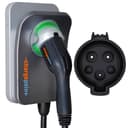
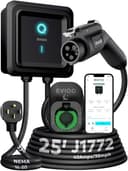
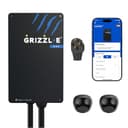
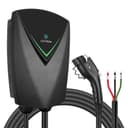
The five specs a garage install turns on: how much power it makes, how far the cable reaches from a fixed wall position, whether it plugs into an outlet or needs a hardwired circuit, the temperature range the brand publishes, and whether it depends on WiFi. Every figure is as published by the brand; blanks read “Not published” because that is what the source says.| Charger | Max amps | Cable | Plugs into | Rated range | WiFi app |
|---|
| ChargePoint Home Flex | 50 A | 23 ft | Hardwired, NEMA 6-50 or NEMA 14-50 | -22°F to 122°F | Yes |
|---|
| Emporia Level 2 EV Charger | 48 A | 25 ft | Hardwired or NEMA 14-50 plug | -22°F to 122°F | Yes |
|---|
| EVIQO 40A NEMA 14-50 Charger | 40 A | 25 ft | NEMA 14-50 plug | -22°F to 122°F | Yes |
|---|
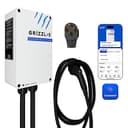
| Grizzl-E Duo Connect 40A | 40 A (shared) | 25 ft x2 | NEMA 14-50 plug or hardwired | -22°F to 122°F | Yes |
|---|
| Lectron Nexus 48A J1772 | 48 A | 23 ft | Hardwired | Not published | No |
|---|
| Grizzl-E Classic Connect 40A | 40 A | 25 ft | NEMA 14-50 plug | -22°F to 122°F | Yes |
|---|
What a garage changes, and what it doesn’t
It does not change charging speed. A 40-amp charger in a garage adds about 34 miles of range an hour at our reference 3.5 miles per kWh; a 48-amp unit adds about 40; the ChargePoint at its full 50 amps, about 42. Those are the same numbers as on a driveway, and the same what-size-charger arithmetic applies: buy for the circuit you have, not the biggest number on the box.
What changes is everything around the charger. The wall position is fixed, so reach is settled once. The outlet, if there is one, is where a previous owner or a builder put it, not where you would. The panel is close, which makes a hardwired 60-amp circuit cheaper than it would be anywhere else in the house. The temperature inside an attached garage tracks the outside far more closely than people expect, and a detached garage is the outdoors with a roof. And the router is in the house, on the far side of a concrete or foil-insulated wall. Those five facts are the whole ranking.
The five criteria, in full
1. Reach from a wall you cannot move
A charger mounted on a driveway post can often be placed wherever the cable reaches best. A garage charger goes where the structure, the door track, the shelving and the panel allow, and the car’s charge port goes where the manufacturer put it. Measure the real cable path — down the wall, along the floor, around the bumper — and add slack. Five of these six carry a 25-foot cable; the ChargePoint and the Lectron Nexus carry 23 feet, which is enough for a single bay with the charger on the port side and marginal for reaching across a two-car garage from one end.
On a plug-in unit, the input lead matters almost as much. The EVIQO 40A ships with a 40-inch lead from body to plug, so the charger can hang where you want it rather than directly over the outlet. Grizzl-E’s plug-in units carry an 18-inch input lead, which is honest but short: the outlet effectively decides the mounting point. If reach is your binding constraint, our long-cable roundup ranks on that alone, and the placement guide walks the measuring method step by step.
2. Plug-in or hardwired: the garage is where this decision is cheapest
Every charger here installs one of two ways. A plug-in unit ends in a NEMA 14-50 plug and goes into a 50-amp receptacle; a hardwiredunit is wired to the circuit by an electrician with no plug at all. Under the National Electrical Code’s continuous-load rule, a circuit serves 80% of its rating, so a 14-50 on a 50-amp breaker caps any plug-in charger at 40 amps. Every 48- and 50-amp charger is hardwired for that reason, on a 60-amp circuit. The full argument is in hardwired vs plug-in.
In a garage, two things tilt the decision. If a 14-50 is already on the wall — common in newer builds and anywhere a previous owner ran a welder or an RV hookup — a plug-in charger is a ten-minute job with no electrician, and the EVIQO 40A and both Grizzl-E units are built for exactly that. If nothing is there yet, the panel is usually close enough that a hardwired 60-amp circuit costs little more than a new 50-amp outlet would, and you get 48 amps for the difference. Our installation cost guide breaks down what a garage run actually adds, and the NEMA 14-50 guide explains why an existing outlet needs to be an EV-grade receptacle rather than the cheapest one from the hardware store, and why a dryer outlet is not the same thing.
3. A published operating range, because “indoor” is not “heated”
An attached garage in a northern winter routinely sits well below freezing, and a detached one sits at whatever the outdoor temperature is. The charger does not care about the roof; it cares about the air. So we treat a published operating-temperature range as a garage requirement, not an outdoor one. Five of the six publish -22°F to 122°F on their own spec pages. Lectron publishes no range for the Nexus 48A, which is why it appears as Not published in the table and why it does not take the cold-garage award despite an IP66 body and a cable the brand says stays flexible in freezing weather. The cold side of this question, including what the car does when the pack is cold, is in our cold-weather picks.
4. What the charger does when WiFi never arrives
Concrete block, poured slab, foil-faced insulation in the ceiling and a large metal door: a garage is built almost perfectly to block a home network, and the router is usually at the far end of the house. Our garage WiFi guide covers the fixes, but the buying question is simpler: what does each charger lose offline?
The Lectron Nexus 48A loses nothing, because it has no radio and no app; you set a charging schedule in the car. Grizzl-E’s units set their amperage on a physical DIP switch, so the charger’s output never depends on the network, only the app’s scheduling and history do. ChargePoint’s datasheet states the Home Flex stores up to 90 days of session data locally if the network drops, which is the most graceful failure in the group. The EVIQO sets its amperage in the app, and the Emporia keeps its scheduling and energy history there, so with either you want the connection working at least once, at install, before you rely on it. Whether you need an app at all is the subject of smart vs dumb chargers.
5. Name the standard
Every EVSE sold in the US should be listed to UL 2594 and UL 2231, by UL itself or by a rival lab such as Intertek, whose mark is ETL. The ChargePoint is UL and cUL listed to UL 2594 and UL 2231. The Lectron Nexus is ETL listed to UL 2594, 2231 and 2251. The EVIQO states UL and ETL listings, the Emporia a UL listing, the Grizzl-E Classic Connect a UL/cUL file number, and the Grizzl-E Duo states “UL tested and certified” without publishing the file. All six state a listing; four of the six add ENERGY STAR, which is the certification that gates most utility rebates. Grizzl-E does not publish ENERGY STAR for either unit here, so we do not claim it.
How we separated them
ChargePoint Home Flexwins because a garage is where its flexibility pays off most. It sells as a plug-in on a NEMA 14-50 or a NEMA 6-50, or hardwired, and the amperage is set in the app to 16, 24, 32, 40, 48 or 50, so it fits a crowded panel today and a bigger circuit later without a second purchase. It publishes -22°F to 122°F, stores 90 days of sessions locally when the network drops, and carries a 3-year warranty. The honest cons: you pay a premium for the brand and the app, the plug-in SKUs are capped at 40 amps so the full 50 is a hardwired-only figure, the enclosure is Type 3R rather than the Type 4 or IP66 bodies most of the others carry, and the 23-foot cable is two feet shorter than the field. Our ChargePoint Home Flex review has the spec-by-spec picture.
Emporia Level 2is the pick if you are running a fresh 60-amp circuit and want the full 48 amps for the least money. A 25-foot cable, a watertight NEMA 4 body rated -22°F to 122°F, ENERGY STAR, real energy monitoring in the app and a 3-year warranty, at a price that undercuts the big names. The cons are the same everywhere we rank it: 48 amps hardwired means a 60-amp breaker, the plug-in version is limited to 40 amps like everything else on a 14-50, and the app trails ChargePoint’s. Full detail in the Emporia review.
EVIQO 40A NEMA 14-50is what to buy when a 14-50 is already on the garage wall. The 40-inch input lead is the feature that matters here: it lets the charger hang where the cable reaches the car instead of directly over the outlet. It carries a 25-foot cable, an IP66 / NEMA 4 body, a published -22°F to 122°F range, ENERGY STAR, app adjustment from 6 to 40 amps and a 3-year warranty. The cons: 40 amps is the plug-in ceiling, the receptacle behind it must be an EV-grade 14-50 rather than a dryer outlet, and EVIQO is a smaller brand with a shorter track record than ChargePoint. See the EVIQO 40A review.
Grizzl-E Duo Connect 40Ais the answer to the two-car garage with one circuit. One cast-aluminum IP67 body, two 25-foot cables, and one 40-amp supply that Grizzl-E states splits in half automatically when both cars are plugged in, or can be set per connector in the app. No second breaker, no panel upgrade. The cons are real: 40 amps is the total, so two cars charging at once get about 17 miles of range an hour each; the box costs roughly what two single chargers do, so the saving is in the wiring; this Amazon SKU is NACS-to-NACS, so a mixed household needs a different cable pairing; and Grizzl-E publishes no warranty term for it. The alternatives — a load-sharing pair, or one charger and a routine — are worked through in best chargers for two cars and the Duo Connect review.
Lectron Nexus 48A is for the garage where the WiFi will never reach and you have made peace with that. A full 48 amps hardwired, an IP66 body, a heavy 15 mm cable Lectron says stays flexible in freezing weather, ETL listing to UL 2594 / 2231 / 2251, ENERGY STAR and a 3-year warranty, with no app, no account and no firmware. Scheduling happens in the car. The cons: hardwired only, so there is no plug-in route; 23 feet of cable against 25 on most rivals; and no published operating-temperature range, which is why it does not take the cold-garage award. It leads our no-app charger roundup for the same reasons; the Lectron Nexus 48A review has the full spec table.
Grizzl-E Classic Connect 40Atakes the unheated and detached garage. A cast-aluminum body sealed to IP67, rated -30°C to +50°C (-22°F to 122°F), with a 25-foot cable the brand builds to stay flexible in the cold, a NEMA 14-50 plug, a UL/cUL file number and a 3-year warranty. It is the toughest build here and the one we would hang in a garage that is effectively outside. The cons: 40 amps is the ceiling, the amperage is set on a DIP switch rather than in the app, the 18-inch input lead means the outlet decides where it hangs, and Grizzl-E publishes no ENERGY STAR certification for it, which can matter for a rebate. Full detail in the Classic Connect review.
What we left off, and why
The Lectron 40A portable and the ELEGRP 40A, our budget picks elsewhere, both work perfectly well in a garage — the Lectron arguably belongs nowhere else, since it publishes no enclosure rating. They are portables, designed to be unplugged and carried, and a garage roundup is about a charger that stays on the wall. If price is the constraint, our budget picks cover both.
The Autel MaxiCharger Home and the Wallbox Pulsar Plusare excellent chargers that lead other pages here. The Autel’s defining feature is a NEMA 4X enclosure rated to about -40°F, which is an outdoor argument rather than a garage one; if your garage genuinely sees -30°F, it is the right call and our Autel review covers it. The Wallbox is the compact choice for a tight wall, and its dynamic load management is the feature to want on a small panel; it sits on our small-panel picks for that reason.
Before the electrician arrives
Three things settle most of the cost and all of the regret. First, park the way you actually park and measure the cable path to the port, then measure the awkward case — backing in, the other bay, the other car. Second, find the panel and count the spare capacity honestly; the panel-capacity guide shows how, and a 100-amp service does not rule out Level 2. Third, if an outlet is already there, identify it exactly: a 14-50 on a 50-amp breaker is the good case, a 14-30 dryer receptacle is not, and a receptacle that has fed a dryer for fifteen years is not an EV-grade one. A permit is normal for the new circuit, and permits and inspection explains what the inspector is checking for.