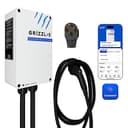
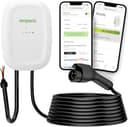
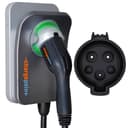
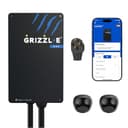
The four things a host cares about, as published by each brand: whether you can lock it from your phone, what record it keeps, how it connects to the supply and how well it is sealed. Blanks read “Not published” because that is what the brand’s page says.| Charger | Guest lockout | Energy records | Install | Enclosure |
|---|
| Grizzl-E Classic Connect 40A | App lockout 'to prevent unauthorized use' (Grizzl-E) | Charging statistics in the Grizzl-E Connect app | NEMA 14-50 plug | NEMA 4 (IP67) |
|---|
| Emporia Level 2 EV Charger | Not published | Per-session energy and cost in the Emporia app | Hardwired or NEMA 14-50 plug | NEMA 4 |
|---|
| ChargePoint Home Flex | Not published | Session history; 90 days stored locally if offline | Hardwired, NEMA 6-50 or NEMA 14-50 | NEMA 3R |
|---|
| Grizzl-E Duo Connect 40A | Remote lockout in the app (Grizzl-E) | Usage history per connector in the app | NEMA 14-50 plug or hardwired | IP67 |
|---|
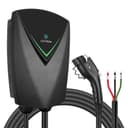
| Lectron Nexus 48A J1772 | None - no app; control access by breaker | None - use the car's own log or a submeter | Hardwired | IP66 |
|---|
Lockout is the feature that matters most
A charger on a driveway is a 240-volt outlet anyone with a car can use. The fix is not a padlock on the handle; it is a charger whose output you can switch off remotely and back on for a booking. Grizzl-E publishes this explicitly — the Classic Connect’s app includes “lockout to prevent unauthorized use,” and the Duo Connect lists “remote lockout” — which is why the two Grizzl-E units take the top and the two-car slots. Emporia and ChargePoint both publish app scheduling and control, which gets you most of the way, but neither page names a lockout function, so we do not credit one.
The no-app alternative is the breaker. A Lectron Nexus on its own circuit can be switched off at the panel between guests, which works fine if the panel is inside a locked space and you or a cleaner is there between stays. It does not work for a remote host with weekly turnovers.
Records: what to bill, and how to know
Most hosts fold charging into the nightly rate and want only a rough idea of the cost. For that, the arithmetic is simple: a typical overnight session might add 30 to 40 kWh, and the EIA puts the 2025 US residential average at 17.30 cents per kWh, so a full session is in the range of five to seven dollars at that rate. Your own rate is on your bill; our cost-to-charge guide has the per-mile version.
A long-term tenancy is different: you may want to bill actual use. Emporia’s app reports per-session energy and cost and is the clearest of the group for that; ChargePoint’s datasheet publishes power measurement to ±2% and keeps session history, storing up to 90 days locally if the network drops. Neither is a utility-grade revenue meter, and for a formal sub-metered lease you should ask your electrician about a dedicated submeter on the circuit. For an informal monthly figure both are more than adequate.
Where it lives decides the body
A rental charger is more likely to be outdoors, more likely to be mounted where a guest backs into it, and less likely to have its cable coiled properly. That argues for a cast-aluminum body and a high sealing rating. Grizzl-E publishes IP67 on a cast-aluminum enclosure for both units here; Emporia publishes NEMA Type 4; Lectron publishes IP66; ChargePoint publishes Type 3R, which is a rain-and-sleet rating rather than a hose-down one and is the lowest of the group. Our ratings explainer covers what those codes actually promise.
Plug-in or hardwired matters more at a rental than at home. A plug-in unit on a NEMA 14-50 can be unplugged and taken — by a departing tenant, or by anyone — while a hardwired charger cannot. ChargePoint’s datasheet also notes that an outdoor plug-in install needs an outdoor-rated GFCI breaker upstream. If the charger is outside and in public view, hardwire it.
How we separated them
Grizzl-E Classic Connectis first because it is the only 40-amp unit here that publishes a lockout, in a cast-aluminum IP67 body rated -22°F to 122°F, on a NEMA 14-50 plug that an electrician can also hardwire. The DIP switch sets 40, 32, 24 or 16 amps to match whatever circuit the property has. Grizzl-E publishes no ENERGY STAR mark for it, which matters only if a rebate program requires one.
Emporia Level 2takes the records slot: per-session energy and cost in the app, 48 amps hardwired or 40 on a plug, UL listed and ENERGY STAR, NEMA 4. If your main question is “what did that guest cost me,” this answers it best.
ChargePoint Home Flex is here for the guest who has never used a charger: the handle, the light and the app are the most familiar in the category, and there is nothing to configure at the unit. The trade is the Type 3R enclosure and no published lockout. Best in a garage, less so on an open driveway.
Grizzl-E Duo Connectis the two-car answer for a property that sleeps two households: two 25 ft cables from one 40-amp circuit, per-connector current limits and remote lockout in the app. The Amazon SKU we link is the NACS-to-NACS cable pair — a rental serving mixed cars would want the J1772 or mixed pairing Grizzl-E sells direct. Read our two-car roundup for the amps math.
Lectron Nexus 48Ais the private-driveway pick: 48 amps, IP66, ETL listed to UL 2594, ENERGY STAR, and no app, no WiFi and no account a guest could log out of. Control is at the breaker. If your property’s parking is behind a gate or in a locked garage, that is enough, and it is the cheapest unit on this page to own.
What we left off, and why
The portable units — Lectron 40A, ELEGRP, Ampure Go — because a charger that lives in a bag walks away from a rental. The Wallbox Pulsar Plus, which publishes Bluetooth and app control and would suit a host well, but at a premium the lockout-equipped Grizzl-E undercuts. And the Autel units, whose apps we cannot verify carry a lockout from the pages we cite.
Before you list it as an amenity
Have the circuit installed and permitted by a licensed electrician — our permits guideexplains why that matters more at a property you rent out. Post a one-line card by the charger: how to start, and who to message if the light is red. And decide the pricing before the first guest asks; a flat “charging included” is the simplest answer and the one most hosts land on.