What Hyundai publishes, and what it does not
Start with the table, because every recommendation on this page comes out of it. These are Hyundai’s own figures for the 2027 IONIQ 5, read from its compare-specs tables across all five trims.
Hyundai’s own 2027 IONIQ 5 figures, read from its compare-specs tables. The Level 2 column is Hyundai’s row “AC Level II, Standard 240V (from 10% to 100% charge)”. There is no onboard-charger row anywhere in these tables — see the arithmetic below for where the amperage ceiling comes from.| Trim | Battery | Pack voltage | 240V Level 2, 10–100% | NACS DC 10–80% | V2L |
|---|
| SE Standard Range | 63 kWh | 523 V | 5 hrs 40 min | 24 min | Not available |
|---|
| SE | 84 kWh | 697 V | 7 hrs 20 min | 30 min | Not available |
|---|
| SEL | 84 kWh | 697 V | 7 hrs 20 min | 30 min | Not available |
|---|
| XRT | 84 kWh | 697 V | 7 hrs 20 min | 30 min | Standard |
|---|
| Limited | 84 kWh | 697 V | 7 hrs 20 min | 30 min | Standard |
|---|
Two things are missing from that table, and both are conspicuous. There is no onboard-charger powerrow — the phrase does not appear anywhere in Hyundai’s IONIQ 5 specifications. And there is no maximum AC amperage. Kia publishes both for the mechanically related EV6 and EV9; Volkswagen publishes an AC acceptance rate for the ID.4; Toyota prints “11-kW onboard charger” on the bZ page. For the IONIQ 5, Hyundai publishes a charge time and leaves you to infer the rest.
So we did the arithmetic, and here it is
This is ourcalculation from Hyundai’s published numbers, not a manufacturer claim, and the assumptions are printed so you can check them.
The 84 kWh trims. Hyundai says 10% to 100% in 7 hours 20 minutes on a 240-volt Level 2 charger. Ninety percent of 84 kWh is 75.6 kWh. Divide that by 7.33 hours and you get about 10.3 kW delivered to the battery on average.
The 63 kWh SE Standard Range. Hyundai says 5 hours 40 minutes. Ninety percent of 63 kWh is 56.7 kWh, over 5.67 hours, which is about 10.0 kW.
Two independent batteries landing within 0.3 kW of each other is a strong sign we are looking at the same hardware limit rather than an artifact of rounding. At 240 volts, 10.3 kW is roughly 43 amps.
Three honest caveats. An average over a full charge is slightly lowerthan the peak, because charging tapers near 100%. AC charging loses a few percent to heat and to the car’s own conversion, so draw at the wall is a little higher than delivery at the battery — our charge-time guide works through where that goes. And Hyundai’s charge times, like everyone’s, assume conditions you will not always have. Treat 43 amps as the neighborhood, not a decimal place. The useful conclusion survives all three: 48 amps covers this car completely, and anything above 48 amps is dead weight.
Worth one more line, because it is a check on the arithmetic rather than a source for it: the Kia EV6 runs the same 63 and 84 kWh batteries and Kia publishes the identicalLevel 2 charge times — 5 hours 40 minutes and 7 hours 20 minutes. Kia also publishes a 10.9 kW onboard charger and labels its charge-time row “@ 240V / 11kw”. We are not going to transplant Kia’s rating onto a Hyundai; the cars are not the same product and we have not seen Hyundai confirm it. But it does tell you our ~10 kW derivation is in sensible territory.
The connector decides this purchase first
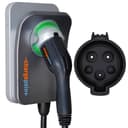
Before amperage, settle the plug. The 2027 IONIQ 5 has a native NACSport — the SAE J3400 connector. Hyundai’s page frames that entirely in terms of DC fast charging: Supercharger access with no adapter, plus an included CCS adapterfor networks like Electrify America and ChargePoint. On AC home charging, Hyundai says only that a 240-volt Level 2 charger is “not included”, and never mentions J1772 or an AC adapter at all.
That silence has a practical consequence. If you buy a NACS home charger, the cable plugs into the car and the matter is closed. If you buy a J1772charger — which is most of the market, and most of our registry — you need a J1772-to-NACS AC adapter, and you are sourcing it yourself against a manufacturer that has published nothing about it. Adapters in that direction exist and are widely used. We will not tell you Hyundai has approved one, and we will not pretend the question does not exist. It is the mirror image of the Toyota bZ, where Toyota puts a J1772 adapter in the box and says so in writing, and it is the same position Kia EV6 buyers are in.
One adapter rule worth carrying over from a different brand: Volkswagen explicitly tells ID.4 owners notto use a NACS DC adapter on a Level 2 AC charger. Different adapter, different direction, different car — but it is a reminder that a DC adapter is not an AC adapter, and the one in your IONIQ 5’s glovebox is the DC kind. Our connector guide keeps the two straight.
Our six picks against the two things that decide an IONIQ 5 purchase: the plug shape, and whether the charger can feed the car’s roughly 10 kW ceiling. Every spec is read from the maker’s own sheet on a dated visit; a figure a maker does not publish reads “Not published”.| Charger | Connector fit | Rated max | Install | Cable | Enclosure |
|---|
| Lectron Nexus NACS (Tesla) Charger | Native NACS plug — goes straight into the port | 48 A | Hardwired | 23 ft | IP66 |
|---|
| ChargePoint Home Flex NACS | Native NACS plug — goes straight into the port | 50 A | Hardwired | 23 ft | NEMA 3R |
|---|
| Lectron Portable Level 2 Tesla Charger (NACS) | Native NACS plug on a portable body | 40 A | NEMA 14-50 plug | 16 ft | Not published |
|---|
| Grizzl-E Duo Connect 40A | Two native NACS cables from one unit | 40 A | NEMA 14-50 plug or hardwired | 25 ft | IP67 |
|---|
| ChargePoint Home Flex | J1772 — needs a J1772-to-NACS AC adapter you source yourself | 50 A | Hardwired, NEMA 6-50 or NEMA 14-50 | 23 ft | NEMA 3R |
|---|
| Ampure Go Portable Level 2 Charger | J1772 — needs a J1772-to-NACS AC adapter you source yourself | 32 A | NEMA 14-50 cord for 240V, NEMA 5-15 cord for 120V | 20 ft | IP67 (NEMA 6P watertight) |
|---|
The picks, in plain terms
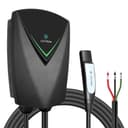
The Lectron Nexus NACS 48Ais our overall pick because it is the cleanest answer to both facts above: a native NACS cable, 48 amps of headroom over the car’s roughly 43, an IP66 enclosure for an outdoor wall, and ETL listings to UL 2594/2231/2251 plus ENERGY STAR. There is no app, which on this car costs you very little — the IONIQ 5 schedules charging in the vehicle. It is hardwired only, so budget an electrician and a 60-amp circuit; our full review has the detail.
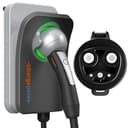
The ChargePoint Home Flex NACSis the same idea with a far more mature app and a factory NACS cable, and its amperage is set in software from 16 to 50 amps, which means one unit fits whatever circuit you can spare. You pay a premium for that flexibility and for ChargePoint’s software. If you want scheduling, usage history and over-the-air firmware rather than a sealed box, it is the pick — see the Home Flex NACS review.
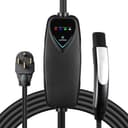
The Lectron Portable Level 2 NACSis the value answer, and on this car it is a better value than it looks. It is 40 amps on a NEMA 14-50 plug, which by our arithmetic sits a fraction of a kilowatt under what the IONIQ 5 can take — so the thing you give up by not buying 48 amps is almost nothing. If there is already a 14-50 outlet where you park, this is the cheapest way to charge an IONIQ 5 properly, and it unplugs and travels. The trade-offs are honest: a 16-foot cable rather than 23 or 25, and no published warranty term.
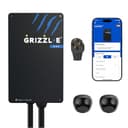
The Grizzl-E Duo Connect 40Aearns its place only in one specific household: two NACS cars, one circuit. It has two NACS cables and shares its output between them, which is the part to understand before you buy — 40 amps is the total for the unit, not per connector, so two cars charging at once each get roughly half. For two cars that both sit overnight that is usually fine, and it is far cheaper than two circuits. Our two-car roundup weighs the alternatives.
The ChargePoint Home Flexis here as the J1772 pick, and it carries the adapter caveat openly. If you already own a Home Flex, or you have a mixed-connector household, or you simply want the best app on the market and are comfortable sourcing an AC adapter, it is the J1772 unit we would buy — adjustable 16 to 50 amps, UL and cUL listed, ENERGY STAR, and a long warranty. Read the Home Flex review, then decide whether you want an adapter in the chain for the next decade.
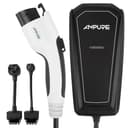
Finally the Ampure Go, which is not a wall charger at all. It is a 32-amp portable with swappable cords — NEMA 14-50 for 240 volts, NEMA 5-15 for 120 — in an IP67 body, UL and cUL listed and ENERGY STAR certified. On a 240-volt outlet it delivers 7.7 kW, below what the car can take, so it is not the charger to rely on at home. It is the one to keep in the trunk for the rental cabin with a dryer outlet, and it is also a J1772 unit, so the same adapter note applies. The Ampure Go review covers it properly, and our portable roundup ranks the segment.
How to choose, in order
One: decide the connector.If this is your only EV and you are buying new hardware, buy NACS and never think about adapters again. If the driveway has a J1772 car in it too, buy J1772 and accept one adapter on the IONIQ 5 — our mixed-household guide covers that trade.
Two: check the panel before the charger. A 48-amp unit needs a 60-amp circuit; a 40-amp unit needs 50. Since the car caps out near 43 amps, a 50-amp circuit is genuinely enough here, and that can be the difference between a simple job and a service upgrade. Work it through with our panel-capacity guide, and get the whole bill in view with the installation cost breakdown.
Three: ignore the top of the amperage range. This is the clearest conclusion on the page. An 80-amp charger delivers 19.2 kW into a car that by our arithmetic accepts about 10, on a circuit most houses cannot spare. Our fastest-chargers roundup exists for the handful of vehicles that can use it, and the IONIQ 5 is not one of them.
Four: do the running-cost math once. An 84 kWh battery is a large overnight load, and what it costs depends entirely on your rate and whether you charge off-peak. Our cost-to-charge calculator takes your own price per kWh, and time-of-use chargingis where the money actually is — the IONIQ 5 will schedule itself, so you do not need to pay a charger for the privilege.