Level 2 Charger vs a 240V Outlet
The most common misunderstanding in home charging is that a 240-volt outlet is a charger. It isn't — it is a socket, and something still has to plug into it. Once that is clear, the real question is a good one: outlet plus a portable charger, or a wall unit?
How this is funded: we earn a commission if you buy through our links, at no extra cost to you. It never changes which product we recommend, and we’ll tell you when we’d skip one. Full disclosure.
“Should I get a Level 2 charger or just a 240-volt outlet?” is one of the most common questions in home charging, and it contains a false choice. A 240-volt outlet charges nothing. It is a receptacle on a circuit; an electric vehicle cannot take raw AC from it any more than a laptop can. Between the outlet and the car there has to be an EVSE — the box with the J1772 or NACS handle — which negotiates the connection with the car over a pilot wire and provides ground-fault protection. That box is what people mean by “a Level 2 charger.” The outlet is where it plugs in.
So the honest version of the question is: an outlet plus a charger that plugs into it, or a charger hardwired to the panel with no outlet at all? Both are Level 2. Both need the same circuit. This page is about which is the better shape for your garage.
What a 240V outlet actually gives you
A receptacle on a dedicated circuit, most usefully a NEMA 14-50 on a 50-amp breaker. The NEC treats EV charging as a continuous load and requires the circuit to be rated at 125% of the charger’s draw, which is the same thing as saying a charger may draw 80% of the breaker — 40 amps on a 50-amp circuit, or 9.6 kW. That is the ceiling of every plug-in install, and it is why ChargePoint’s datasheet caps its NEMA 14-50 and 6-50 Home Flex models at 40 amps while the hardwired version goes to 50.
Into that outlet you can plug three kinds of thing: a portable Level 2 charger with a 14-50 plug, a wall-mounted charger sold in a plug-in version, or — for some cars — the mobile connector that shipped in the trunk, fitted with a 14-50 adapter. Our NEMA 14-50 guide covers the install itself.
| Outlet | Rating | Max charger draw | Speed | Where you find it |
|---|---|---|---|---|
| NEMA 5-15 | 120 V / 15 A | 12 A (Level 1) | ~1.4 kW, 2-5 mi/hr | Every wall |
| NEMA 10-30 / 14-30 | 240 V / 30 A | 24 A | ~5.8 kW, ~20 mi/hr | Older / newer dryer outlets |
| NEMA 6-50 | 240 V / 50 A | 40 A | 9.6 kW, ~34 mi/hr | Welder outlets |
| NEMA 14-50 | 240 V / 50 A | 40 A | 9.6 kW, ~34 mi/hr | Ranges, RV hookups, EV installs |
Why a dryer outlet is not the same thing
The 240-volt outlet many people already have is the dryer’s: a NEMA 10-30 in older houses, a 14-30 in newer ones. Lectron’s NEMA table lists both at 240 V / 30 A. That is a different circuit from the 14-50 — 30 amps, not 50 — and the 80% rule holds a charger on it to 24 amps, or about 5.8 kW: roughly 20 miles of range per hour by our arithmetic, versus 34 on a 14-50. Still usefully faster than Level 1, and still overnight-sufficient for most commutes.
But three things have to be true. The charger must have a matching 10-30 or 14-30 plug, not a 14-50 through an adapter; it must be set to 24 amps or less; and the outlet cannot also be feeding the dryer at the same time. EVIQO’s own page is explicit that its 14-50 unit “needs an EV-grade 4-prong 14-50 receptacle rather than a dryer outlet,” and ELEGRP labels its portable “For NEMA 14-50 Outlets Only.” Lectron states it offers 10-30 plug options, which is the honest route if the dryer outlet is your only option — we do not list one with a live price, so it is not in the picks below. The full account is in our plug and outlet guide.
Outlet plus portable charger: the case for
It moves.A renter, a household that expects to relocate, or anyone who wants to charge at a second property or a relative’s house gets a charger that unplugs and goes. It is cheaper to add later. If the outlet exists, the charger is a purchase, not an electrician visit. It doubles as a road charger.The dual-voltage units — the Ampure Go runs at 32 A on a 14-50 and 12 A on a standard 5-15 — go in the trunk and work anywhere there is a socket. And it is the natural fit for a garage that already has a 14-50 from a range, a welder or a previous owner’s EV.
Outlet plus portable charger: the case against
40 amps is the ceiling. If your car accepts 11.5 kW and you want all of it, you need 48 amps, and that is hardwired only. The receptacle matters.Emporia’s install notes describe continuous EV charging as “a fundamentally different demand than the dryers and ranges most NEMA 14-50 outlets were designed for” — which is why an EV-grade receptacle is specified, not the cheapest one. Outdoors it adds a breaker. ChargePoint’s datasheet notes an outdoor plug-in install requires an outdoor-rated GFCI breaker upstream, while a hardwired unit’s own ground-fault protection can conflict with an external GFCI — another way of saying the plug-in route is simplest indoors. And it can walk away. A plug-in charger on a driveway is a plug-in charger anyone can unplug.
When to hardwire instead
Three triggers. You want more than 40 amps. The charger will live outdoors or in public view. Or you are paying an electrician to run a new circuit anyway and will never need the flexibility — in which case the junction box is marginally simpler than the receptacle and skips the GFCI question. Our hardwired vs plug-in comparison takes each of these in full.
The chargers that make the outlet route work
If you have or are installing a 14-50, these are the plug-in units in our registry with a live price, in the order most buyers rank them: a wall-mounted plug-in with a published outdoor rating, two portables, and a dual-voltage unit for the road.
Quick picks
Ranked on published specs, charging speed, electrical fit and value. Select a row to jump to the full write-up. We have not bench-tested these chargers — here is exactly what we do instead.
| # | Product | Best for | Price |
|---|---|---|---|
| 1 | 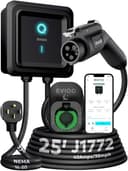 EVIQO 40A NEMA 14-50 Charger The most charger you can get without an electrician's invoice. It plugs into a NEMA 14-50 outlet for a full 40 amps, keeps the WiFi app, the ENERGY STAR listing and the 25 ft cable from EVIQO's hardwired unit, and can be unplugged and taken with you when you move. | Wall-mounted plug-in, IP66, app-adjustable 6-40 A | |
| 2 | 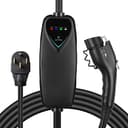 Lectron 40A Portable Level 2 Charger One of the cheapest honest ways into real Level 2 charging. Plug it into a NEMA 14-50 outlet, get a genuine 40A / 9.6 kW, and unplug it to take on a trip. No app and a shorter warranty are the trade-offs for the price. | The budget 14-50 portable | $269.99 · View on Amazon Price as of September 18, 2026. #ad How we’re funded |
| 3 | 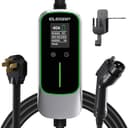 ELEGRP 40A Portable Level 2 Charger The full-speed portable. A genuine 40 amps on a NEMA 14-50, an IP67 station body rated -22F to 122F, and a 25-foot cable - the longest here by five feet - for less than the 32A unit costs. It is the heaviest thing here to coil and there is no app, but if the portable is also going to be your everyday charger, this is the one that does not make you choose. | Portable with selectable 16-40 A output | $209.99 · View on Amazon Price as of September 18, 2026. #ad How we’re funded |
| 4 | 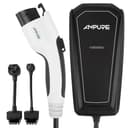 Ampure Go Portable Level 2 Charger The only portable charger we track that is certified like a permanent one. UL 2594 / UL 2231, ENERGY STAR and an IP67 / NEMA 6P body rated from -22F to 122F, in a nine-pound module that ships with a NEMA 14-50 cord for 240V and a standard 5-15 cord for 120V. You give up eight amps against the 40A units and get, in exchange, a charger genuinely rated to live in a trunk and be rained on. | Dual voltage: 14-50 at home, 5-15 anywhere | $299.00 · View on Amazon Price as of September 18, 2026. #ad How we’re funded |
The selectable-output units earn a note: the ELEGRP publishes 16, 20, 24, 32 or 40 A and the EVIQO 6 to 40 A in its app, which lets either be set to 24 amps on a 30-amp circuit — if it is fitted with the right plug. Both ship with a 14-50, so on a dryer circuit they are the wrong hardware unless the outlet is changed. Every pick above is ranked in full on the plug-in and portable roundups.
Frequently asked questions
Can I charge my EV from a 240V outlet without a charger?
Not directly. An EV does not take raw 240 V; it needs an EVSE — the box with the J1772 or NACS handle — between the outlet and the car to negotiate the connection and provide ground-fault protection. What plugs into the outlet is either a portable Level 2 charger, a plug-in wall unit, or the mobile connector some cars ship with, fitted with the matching plug.
Is a NEMA 14-50 outlet the same as a Level 2 charger?
No. The 14-50 is a 240 V / 50 A receptacle. A Level 2 charger is the device that plugs into it. Installing the outlet is half the job; the charger is the other half. Under the NEC 80% rule a charger on a 14-50 draws up to 40 amps, which is 9.6 kW.
Can I use my dryer outlet to charge an EV?
Sometimes, at reduced speed, with the right charger. Dryer outlets are NEMA 10-30 or 14-30 on a 30-amp circuit, which Lectron's FAQ lists at 240 V / 30 A, so a charger may draw at most 24 amps — about 20 miles of range per hour by our arithmetic. It needs a charger with a matching 10-30 or 14-30 plug and its current set to 24 A; EVIQO's own page says its 14-50 unit needs an EV-grade 14-50 receptacle, not a dryer outlet, and ELEGRP's is for 14-50 only. None of the chargers we link ship with a dryer plug.
Is it cheaper to install an outlet or a hardwired charger?
The circuit costs about the same either way — the wire and breaker are the job. An outlet adds a receptacle and, for an outdoor location, an outdoor-rated GFCI breaker that ChargePoint's datasheet notes is required upstream of a plug-in install; hardwiring adds a junction box and skips the GFCI conflict. The outlet route wins on flexibility; hardwiring wins above 40 amps and outdoors.
Should I get a portable charger or a wall-mounted one?
Portable if you rent, may move, want to take it on trips, or already have a 14-50. Wall-mounted if you want more than 40 amps, a permanent tidy install, or the unit lives outdoors. Several plug-in wall units — the EVIQO 40A, the Grizzl-E Classic Connect — sit between the two: they mount to the wall but plug into the outlet.
Does a 240V outlet for an EV need a special receptacle?
It should be an EV-grade one. Emporia's own install notes describe continuous Level 2 charging as 'a fundamentally different demand than the dryers and ranges most NEMA 14-50 outlets were designed for', and EVIQO specifies an EV-grade 4-prong receptacle. Ask the electrician for an industrial-grade 14-50 rather than the cheapest one on the shelf, and see our NEMA 14-50 guide for the details.
Sources
- Lectron - EV Charging FAQ — Lectron's own FAQ, read for its plug-and-cord guidance: 'It's recommended to plug the charger directly into a dedicated outlet without extension cords', with a safety list that reads 'Always match plug and outlet ratings (volts/amps)', 'Use GFCI protection for outdoor plugs', 'Avoid extension cords or daisy-chaining', 'Inspect plugs and cables regularly' and 'Hire a licensed electrician for installation'. Its NEMA table publishes 5-15 as 120V / 15A, 5-20 as 120V / 20A, 6-20 as 240V / 20A, 10-30 / 14-30 as 240V / 30A ('Common in older dryers') and 14-50 as 240V / 50A, and states that Lectron offers NEMA 5-15, 14-50 and 10-30 plug options for portable charging. Also states that a Tesla owner can use the J1772-to-Tesla adapter 'included with most Tesla', and that adapters 'don't generate power - they only enable compatibility between chargers and vehicles' (accessed September 17, 2026)
- EVIQO — Level 2 EV Charger, 40A (9.6 kW), NEMA 14-50 plug-in (Gen 2) — EVIQO's own product page: 40A / 9.6 kW on a NEMA 14-50 plug, SAE J1772, 25 ft charging cable plus a 40 in input cable, IP66 / NEMA 4 enclosure, UL / ETL / FCC / ENERGY STAR listings, 3-year standard warranty, app-adjustable 6-40A output, and a note that it needs an EV-grade 4-prong 14-50 receptacle rather than a dryer outlet. RE-READ September 15, 2026 for the garage roundup: the page additionally states an operating temperature range of -22F to 122F, that the app needs a 2.4 GHz WiFi connection, that the standard 3-year warranty is extendable to 4, and that the unit ships in 1-2 business days (accessed September 15, 2026)
- ELEGRP Store - 40A Level 2 portable J1772 EV charger (NEMA 14-50) — ELEGRP's own listing: 40 A / 9.6 kW on 240 V AC at 50/60 Hz with selectable output at 16, 20, 24, 32 or 40 A, SAE J1772 connector on a NEMA 14-50 plug ('For NEMA 14-50 Outlets Only'), 25 ft cable (16 ft and 21 ft also offered), IP67 charging station and IP54 connector, operating range -22F to +122F (-30C to +50C), 1-to-12-hour delayed-start timer, 2-year warranty, 'ETL & UL' listed. RE-READ September 5, 2026 for the review: the specification table is unchanged, and the page additionally states 'Fully ETL certified and built with UL-listed components - including the J1772 plug, cable, and NEMA 14-50 connector', a built-in display reporting charging current, voltage, total energy delivered (kWh) and internal temperature with LED fault patterns, a wall-mounted holder plus anchors and a carry bag in the box, Tesla compatibility via a J1772-to-NACS adapter sold separately, a 30-day return window and 60-day price protection. The page does not name the UL standards, publish a weight, publish an ENERGY STAR certification, or publish app support for this SKU, and its marketing copy carries two conflicting range claims ('Up to 37 Miles/H' and '30 Miles Per Hour') plus an operating range ('-21F to 121F') that disagrees with its own specification table (accessed September 5, 2026)
- Emporia - Classic Level 2 EV Charger (store listing) — Emporia's own store listing for the Classic: 'Need advanced features like home energy monitoring, solar charging, or PowerSmart Load Management? Check out the Emporia Pro EV Charger', and 'PowerSmart can also be added to the Classic charger for an additional cost if your electrical panel doesn't have enough capacity for a Level 2 charger'. The listing's install notes describe continuous Level 2 charging as 'a fundamentally different demand than the dryers and ranges most NEMA 14-50 outlets were designed for' (accessed September 17, 2026)
- ChargePoint — Home Flex datasheet (PDF) — ChargePoint's own datasheet: enclosure rating Type 3R per UL 50E, operating temperature -22F to 122F, 23 ft cable, plus installer notes that an outdoor plug-in install requires an outdoor-rated GFCI breaker upstream while an external GFCI may conflict with the charger's internal ground-fault protection on a hardwired install. RE-READ September 3, 2026 for the review refresh: the same datasheet also publishes maximum 12 kW (240V AC x 50A) with output amperage adjustable via the mobile app to 16A, 24A, 32A, 40A, 48A or 50A; a required dedicated dual-pole breaker rated for 125% of maximum load; 'Software Updates: Firmware updated over-the-air (OTA)'; 2.4/5 GHz Wi-Fi (802.11 a/b/g/n); local storage of up to 90 days of charging session data (100 sessions) if the network drops; power measurement accuracy +/- 2.0%; ground-fault detection by 20 mA CCID with auto retry; and UL and cUL listing per UL 2594, UL 2231-1 and UL 2231-2, NEC Article 625 compliant. Ordering information lists the plug-in station models CPH50-NEMA6-50-L23 and CPH50-NEMA14-50-L23 (accessed September 3, 2026)
- Ampure - Ampure Go portable Level 2 EV charger product page — Ampure's own specifications for the Go: 32 A / 7.7 kW at 240 V or 12 A / 1.4 kW at 120 V, input range 85-265 VAC at 45-65 Hz, SAE J1772 coupler, NEMA 14-50 and NEMA 5-15 cords, 20 ft (6 m) cable, IP67 rated 'submersible up to 3 feet' with a NEMA 6P watertight enclosure, operating range -30C to +50C (-22F to 122F), 9 lb (4.1 kg) module, and listings to UL, cUL, UL 2594, UL 2231, UL 817, ICES, FCC, ENERGY STAR, REACH and RoHS. Ampure states 'up to 25 miles of range per hour' at 240 V (accessed August 25, 2026)
- Lectron — Portable Level 2 J1772 EV Charger (40A) product page — Lectron's own listing: 40A / 240V / 9.6 kW, NEMA 14-50 plug, 16 ft cable, UL 2594 / UL 2231 certified, 2-year warranty, app control on the WiFi version only (accessed July 23, 2026)
- NFPA — Using the Latest NEC for EV Charger Installations — NFPA on NEC (NFPA 70) Article 625: EV charging is a continuous load, so circuits are sized to 125% of load (the 80% rule) (accessed July 19, 2026)
- U.S. DOE Alternative Fuels Data Center — Electric Vehicle Charging Stations — US DOE on charging levels: Level 1 (~1.9 kW, ~5 mi/hr), Level 2 (2.9-19.2 kW, ~7.2 kW typical residential, ~25 mi/hr), and DC fast charging (accessed July 19, 2026)
- U.S. DOE Alternative Fuels Data Center — Charging Electric Vehicles at Home — US DOE on home EV charging: most owners charge overnight on Level 1 or Level 2, installs follow NEC Article 625, with example home-charging costs (accessed July 19, 2026)
Keep reading
The NEMA 14-50 outlet
What installing one involves, the EV-grade receptacle question, and the GFCI rules.
Read the outlet guideHardwired vs plug-in
The full case for each route once you have decided you need a charger at all.
Read the comparisonBest portable chargers
The units that make the outlet route work — ranked on dual voltage, sealing and carry weight.
See portable picksEV plug and outlet types
Every NEMA configuration you will meet, what it is rated for, and which chargers fit it.
See the plug guide