One case this page does not rank: a household with a Tesla anda J1772 car sharing one charger. That has its own guide — one charger for a Tesla and a non-Tesla— and the answer usually costs nothing beyond the charger.
NACS, J1772 and the adapter in your trunk
NACS (North American Charging Standard) is the connector Tesla has used for years, now formalized as SAE J3400so other brands can adopt it. J1772 is the older standard almost every non-Tesla EV was born with. The practical upshot for a Tesla driver is simple: a NACS charger's cable ends in the plug your car already accepts, so it goes straight in. A J1772 charger ends in the other plug, so you clip on the little J1772-to-Tesla adapter that came with the car — and then it charges exactly the same. Neither is faster; a native NACS charger just skips the adapter.
The trade-off runs the other way if your household is mixed. A NACS charger is best for Teslas and other NACS-equipped cars. If a non-Tesla EV with a J1772 port ever needs to use it, that car needs its own NACS-to-J1772 adapter — which is why a two-car garage with one Tesla and one J1772 EV is often better served by a J1772 charger plus the Tesla's bundled adapter, so both cars plug in without buying extra hardware.
About the official Tesla Wall Connector
Tesla's own Wall Connector is a good charger. The catch is where you buy it: it's sold direct at Tesla's store, not through a normal Amazon listing. Amazon results for “Tesla Wall Connector” are dominated by third-party adapters and unbranded look-alikes, and a device pushing 40–48 amps for hours is the last place to gamble on a knockoff. We won't invent an Amazon buy button for a product that isn't genuinely sold there. If you specifically want the factory unit, order it from Tesla; if you're shopping Amazon, buy a native NACS charger such as the Lectron Nexus, or a J1772 charger like the Emporia and use your car's adapter.
How to choose between the three picks
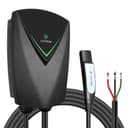
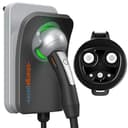
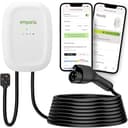
Pick the Lectron Nexusif you want the no-fuss native experience: a NACS plug straight into the Tesla at a full 48 amps, weather-rated, with the UL/ETL listings you want and no app to bother with — a Tesla schedules charging in its own app anyway. Step up to the ChargePoint Home Flex NACS if you'd rather manage charging from a mature phone app and want adjustable amperage, and you're willing to pay a premium for it. Choose the Emporiaif a J1772 charger fits your garage better — it's the value play, adds real energy monitoring, and works with any future J1772 EV as well as your Tesla via the bundled adapter. If you're weighing whether to hardwire or use a plug, our hardwired vs plug-in guide walks through it.
Charging speed and the circuit you'll need
Speed is just math: rated amps × 240 volts = kilowatts, and at roughly 3.5 miles of range per kWh (a reasonable average; your car varies) that sets your miles per hour. A 48-amp charger delivers about 11.5 kW, or near 40 miles of range an hour into a Tesla; the 50-amp ChargePoint is about 12 kW and near 42. To run those safely, the National Electrical Code's 80% continuous-load rule means a 48-amp charger needs a 60-amp circuit and a 40-amp charger needs a 50-amp circuit. Before you buy the biggest number, check what your panel can carry with our panel capacity guide.
If you want the app as well as the plug
The native-NACS options above trade the charger app for the convenience of no adapter, on the reasonable assumption that a Tesla owner schedules charging in the car. If you would rather have both, ChargePoint builds a NACS version of the Home Flex with the same adjustable 16–50 A output and the most mature app in home charging — we review it in full in our ChargePoint Home Flex NACS review, including an honest look at whether the premium is worth paying when the car already does most of what the app does.