What a smart charger actually does for you
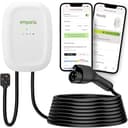
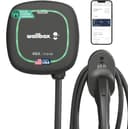
Strip away the marketing and a smart charger earns its price in three ways. Scheduling is the big one: on a time-of-use rate you tell the app to run only during the cheap overnight window, and the charger handles it every night without you thinking about it — our cost-to-charge guide shows how much that shift can save. Energy monitoring is the second: the Emporia in particular reports per-session kilowatt-hours so you can see real numbers instead of guessing. The third is amperage control and load balancing — dialing the charger down to fit a smaller circuit, or letting a unit like the Wallbox share capacity so it doesn’t overload a panel that’s also feeding the house.
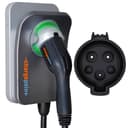
A fourth, quieter one is worth adding: the charger stays current. ChargePoint’s datasheet specifies over-the-air firmware updates, and Wallbox publishes a release-notes archive for each hardware revision. A dumb charger is finished the day it ships; a connected one can gain features and fixes for years. It can also, in fairness, change behaviour you liked — which is exactly the argument our no-app picks make.
One narrower case deserves its own page: a home with solar panels, where the question is whether the charger can see what the roof is producing. Our picks for homes with solar cover the two units that publish an excess-solar mode and what each needs to use it.
The rebate angle: where a smart charger pays for itself
This is the part of the smart-charger case that has actual dollars attached, and most roundups skip it. Your utility — the same company that bills you for the electricity — will frequently pay part of the cost of the charger, the installation, or both. DOE’s Alternative Fuels Data Center keeps the running count, and as of our September 2026 check it stands at:
| Residential program | Utilities offering it |
|---|
| EV Level 2 charging station purchase rebate | 114 |
| EV time-of-use (TOU) rate | 109 |
| EV Level 2 charging station installation rebate | 74 |
| Make-ready or pre-wiring rebate | 17 |
| EV managed charging program | 9 |
Three of those five rows effectively require a smart charger. A managed charging program pays you to let the utility shift or throttle your charging at peak times, which is only possible if the charger can talk to something. An EV time-of-use rate is worthless unless you actually charge off-peak, which is what the scheduler is for. And a large share of the purchase-rebate programs set ENERGY STAR certification as an eligibility condition — a label that, conveniently, every pick on this page carries.
The rules that trip people up are procedural rather than technical, and they are consistent across programs:
- Apply before you buy, or at least before the work is done. Most programs are pre-approval; a receipt from last month is often simply ineligible. This is the single most common way people lose the money.
- Check the qualifying model list. Many utilities publish a specific list of approved chargers rather than a general standard, and being ENERGY STAR certified does not guarantee being on it.
- A permitted, inspected install is often a condition. Which is one more reason not to skip the permit — see permits and inspection.
- Enrolment may be ongoing. Managed-charging programs typically pay an annual credit in exchange for the utility being allowed to adjust your charging during peak events, with an opt-out per event.
Our utility rebates guide walks the ten-minute process of finding yours, and tax credits and rebates covers the wider picture — including why the federal 30C credit stopped applying to chargers placed in service after June 30, 2026, which makes the utility programs the main game now. Worth stressing: a $300–$500 rebate is often larger than the entire price gap between a smart charger and a basic one. If your utility runs a program, the smart unit can be the cheaper purchase.
One more reason ENERGY STAR is the certification to look for: it also means about 40% less standby draw, which matters on a device that sits energized roughly 22 hours a day. Our ENERGY STAR certified picks list the units where the manufacturer publishes it, and UL, ETL and ENERGY STAR explained sets out what each mark on the box actually covers.
The mistake buyers make: paying for an app you won’t open
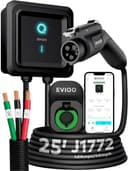
The most common smart-charger regret is paying extra for scheduling you already own. If your EV lets you set a departure time or a charge window in its own app, the charger’s scheduling is redundant — you’d control the same off-peak charging from the car. In that case the honest question is whether you still want the other smart features: per-session energy data, remote start/stop, load balancing, or eligibility for the rebate programs above. If you don’t, a simpler charger does the job and a budget unit like the EVIQO gives you full 48-amp output with WiFi in reserve, without a premium for an app you’d rarely open. Don’t buy the app; buy the feature you’ll actually use.
How to choose between these four
Go Emporia for the best all-round value: a full 48 amps, genuine per-session energy monitoring, hardwired or a NEMA 14-50 plug, and one of the longer 25-foot cables. Pick the ChargePoint Home Flex if the app itself is the point — it’s the most mature software here, with amperage set in the app at 16, 24, 32, 40, 48 or 50, over-the-air firmware, and a choice of hardwired, NEMA 6-50 or NEMA 14-50 SKUs in J1772 or NACS (the plug-in versions cap at 40 amps). Choose the Wallbox Pulsar Plus when space is tight: it’s the compact pick, hardwired at 48 amps, with dynamic load management for panels that need it, Bluetooth alongside WiFi for garages with no signal, and OCPP 1.6j if you ever want to point it at a utility platform instead of the vendor’s. And the EVIQO is the budget route to 48 amps with WiFi — the least you’ll spend for smart-capable, full-speed charging. Full write-ups: ChargePoint Home Flex and Wallbox Pulsar Plus.
Speed and the circuit behind it
None of these is faster because it’s smart — speed is amps × 240 volts. A 48-amp charger is about 11.5 kW, which at roughly 3.5 miles of range per kWh (a fair average; your car varies) adds near 40 miles an hour; the 50-amp ChargePoint is about 12 kW and near 42. Running either safely means respecting the National Electrical Code’s 80% continuous-load rule: a 48-amp charger needs a 60-amp circuit, and a 40-amp charger needs a 50-amp circuit. On a plug-in circuit, the Emporia caps at 40 amps for about 34 miles an hour. If your panel is tight, a smart charger’s adjustable amperage — see our 40A vs 48A comparison — lets you dial it down to fit. What the circuit behind it costs is itemized in our install cost breakdown, and installation cost by state shows how much of that bill is decided by where you live.