Does an EV Charger Need a Neutral Wire?
The charger itself does not use one — a Level 2 charger's load sits between two hot legs at 240 volts. But if you install a NEMA 14-50 receptacle, that device requires a neutral regardless, and the wire has to be pulled. Settle this before the conduit is filled.
How this is funded: we earn a commission if you buy through our links, at no extra cost to you. It never changes which product we recommend, and we’ll tell you when we’d skip one. Full disclosure.
Short answer: the charger does not need a neutral, but your receptacle might. A Level 2 EV charger in a US home runs on 240 volts taken acrosstwo hot legs. The load sits between the hots, so there is nothing for a neutral to carry. That is why a hardwired charger normally terminates just two hots and a ground — and why a NEMA 14-50 receptacle still requires a neutral anyway, because the receptacle is a four-wire device whose configuration demands one whether the thing plugged into it uses the pin or not.
So the question “does my EV charger need a neutral?” is really the question “how is my charger connecting?” Settle that and the wire answers itself. Settle it before the conductors are pulled, because this is a decision that is free on a Tuesday and expensive after the drywall.
The four connection methods, and what each one wants
| How it connects | Conductors | Neutral needed? | Why |
|---|---|---|---|
| Hardwired | Two hots + ground | Normally no | The charger's load sits between the two hot legs. Follow the unit's own install instructions — they are the authority on its terminals. |
| NEMA 14-50 plug | Two hots + neutral + ground | Yes — the receptacle is a 4-wire device | The neutral is required by the receptacle's configuration, not by the charger. It commonly ends up unused at the charger end. |
| NEMA 6-50 plug | Two hots + ground | No | A 3-wire 240 V configuration. Fewer conductors to pull, and no neutral to terminate. |
| NEMA 14-30 (dryer) plug | Two hots + neutral + ground | Yes | No charger in our registry publishes a 14-30 plug, and a 30 A circuit caps a charger at 24 A. See the dryer-outlet page before going down this road. |
The pattern in that table is worth stating plainly: the neutral is a property of the plug, not of the charger. The same ChargePoint Home Flex can be installed hardwired with three conductors, on a NEMA 6-50 with three conductors, or on a NEMA 14-50 with four. Nothing about the charger changed. What changed is the device at the wall.
Why 240 volts does not need a neutral
A residential service in the US is split-phase: two hot legs, each 120 volts to neutral, 180 degrees out of phase with each other, so 240 volts between them. A 120-volt load connects from one hot to neutral, and the neutral carries the return current. A 240-volt load like an EV charger connects hot-to-hot, and the current returns on the other hot. There is no unbalanced current to send home, so no neutral is involved.
The ground is a different thing entirely and it is never optional. The equipment grounding conductor carries no current in normal operation — its job is to give fault current a low-impedance path so a breaker trips instead of the enclosure becoming live. Every charger install has one, in every configuration in the table above. If a conversation about “three wires” starts sounding like it means skipping the ground, that is a different and much worse discussion; our GFCI page covers the ground-fault protection side of it.
One useful consequence: because the 240-volt load is balanced across the legs, the voltage you actually get depends on the supply rather than on the wiring method. Houses on a 240-volt split-phase service get the full figure; a lot of apartment and light-commercial buildings are on 208 volts, which quietly costs you about 13% of your charging power. We cover that in the voltage guide.
What the extra conductor costs
Three things, in descending order of how much they matter.
- Copper. Four-conductor cable costs more per foot than three. The difference scales with the length of the run and the conductor size, so it is a real line item on a long pull to a detached garage and nearly noise on a 15-foot run beside the panel.
- Conduit fill.One more conductor can push a run into a larger conduit size. This is your electrician’s calculation, not a guess, and it is another reason to tell them which configuration you want before anything is ordered.
- Nothing else. An unused neutral is not a hazard. It gets terminated and identified per code and sits there. Plenty of compliant 14-50 EV installs have one.
The practical rule we would follow
If you know you are hardwiring, pull three and move on.Hardwired is how you get above 40 amps — every plug-in charger in our registry caps at 40 — and it removes a connection point that can loosen over years of thermal cycling.
If you want the charger to be removable, pull four and fit a 14-50. The neutral is the price of the most common EV receptacle in the country, and the benefit is real: no electrician for a warranty swap, and the charger comes with you when you move.
If you are not sure, or the run is long, pull four — or pull conduit. This is the asymmetry that should decide it. An unused neutral costs you a few dollars of copper. A missing neutral costs you a re-pull, and in a finished wall that means cutting drywall. In new work the better answer is empty conduit with a pull string, so the conductor count stops being a permanent decision at all.
And in every case: hand your electrician the charger’s own installation instructionsbefore the wire is ordered. The manufacturer document is the authority on the unit’s terminals, and your local inspector is the authority on the code edition that applies. This page is the map, not the permit — our permits page covers that half, and the hiring guide has the questions to ask before anyone quotes.
Chargers that make this decision easy
Two kinds of unit take the pressure off. The first is a charger sold in bothconfigurations, so you can change your mind late: the ChargePoint Home Flex is sold hardwired or on a 6-50 or 14-50 plug. The second is a charger that commits cleanly in one direction — a hardwired 48-amp unit with no plug option, where there is nothing to decide and no neutral to pull.
Quick picks
Ranked on published specs, charging speed, electrical fit and value. Select a row to jump to the full write-up. We have not bench-tested these chargers — here is exactly what we do instead.
| # | Product | Best for | Price |
|---|---|---|---|
| 1 | 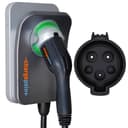 ChargePoint Home Flex The safest default for most homes: you set the amperage in the app to 16, 24, 32, 40, 48 or 50A, so one charger fits whatever circuit your panel can spare today and scales up if you upgrade later. The app is the most mature here, firmware arrives over the air, and the warranty is long. | Hardwired or either plug — decide late | $516.71 · View on Amazon Price as of October 18, 2026. #ad How we’re funded |
| 2 | 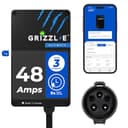 Grizzl-E Ultimate 48A The tank of the 48-amp class: cast-aluminum body, IP67 sealing, a full 11.5 kW, a 25 ft cable built to stay flexible in the cold and a DIP switch instead of a setup wizard. We recorded it as discontinued in August 2026 after its Amazon listing went dark; Grizzl-E sells it and Amazon lists it again as of our 2026-09-28 check, so that record is corrected here. | Hardwired 48 A, nothing to log into | $479.99 · View on Amazon Price as of October 18, 2026. #ad How we’re funded |
| 3 | 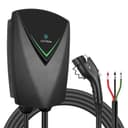 Lectron Nexus 48A J1772 A full 48 amps with nothing to log into. Lectron's Nexus body is IP66-sealed for an outdoor wall, the cable is a heavy 15 mm compound the brand says is built to stay flexible in freezing weather, and the safety paperwork is the real thing — ETL to UL 2594/2231/2251, plus ENERGY STAR. Hardwired only, and there is no app, which is the entire point. | Cheapest hardwired 48 amps | $449.99 · View on Amazon Price as of October 18, 2026. #ad How we’re funded |
| 4 | 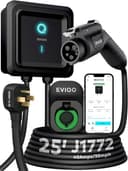 EVIQO 40A NEMA 14-50 Charger The most charger you can get without an electrician's invoice. It plugs into a NEMA 14-50 outlet for a full 40 amps, keeps the WiFi app, the ENERGY STAR listing and the 25 ft cable from EVIQO's hardwired unit, and can be unplugged and taken with you when you move. | Plug-in on an existing 14-50 |
Once the conductors are settled, the remaining install questions are the breaker and the timeline. Our wire-and-breaker guide has the 125% continuous-load arithmetic, the dedicated-circuit page explains why sharing is not an option, and the timeline page covers how long the whole thing actually takes.
Frequently asked questions
Does a Level 2 EV charger need a neutral wire?
The charger does not use one. A Level 2 charger in a US home runs on 240 volts taken across two hot legs, so the load sits between the hots and a neutral carries nothing. What can require a neutral is the connection method: a NEMA 14-50 receptacle is a four-wire device -- two hots, a neutral and a ground -- so if that is what you are installing, the neutral has to be pulled whether the charger uses it or not. A hardwired charger normally terminates two hots and a ground, and a NEMA 6-50 receptacle is a three-wire 240-volt configuration with no neutral.
Why does a NEMA 14-50 outlet have a neutral if the charger does not use it?
Because the receptacle was not designed for EV charging. The 14-50 is a general-purpose 50-amp 240-volt device used for ranges and RV pedestals, and those appliances draw 120-volt loads -- a clock, a light, an outlet inside an RV -- which need a neutral to return current. The configuration carries the neutral so those loads work. An EV charger plugged into one simply does not connect anything to that pin, which is why you can have a fully compliant 14-50 install where the neutral terminates at the receptacle and does nothing for the rest of its life.
Can I use a 3-wire cable for an EV charger?
For a hardwired charger or a NEMA 6-50 receptacle, a cable with two insulated conductors plus an equipment grounding conductor is the normal configuration -- what is sold as 6/2 with ground rather than 6/3 with ground. For a NEMA 14-50 you need the four-conductor version. The decision belongs to your electrician, who sizes conductors to the NEC for your specific install -- ampacity, material, insulation temperature rating, bundling, ambient temperature and the length of the run all enter into it -- and it is also why we will not publish a wire gauge as if it were one number.
Is it cheaper to skip the neutral?
Slightly, and the saving is copper. A four-conductor cable costs more per foot than a three-conductor one, and the difference grows with the length of the run and the size of the conductor, so on a long run to a detached garage it is a number worth asking about. It is a small part of a total install though -- the labor, the panel work and the permit usually dominate. What is genuinely expensive is discovering you needed the fourth conductor after the drywall is up.
Do I need a neutral if I might change chargers later?
This is the real reason to think about it. The neutral question follows the receptacle, so the way to keep your options open is to decide now whether you want a 14-50 in the future -- for a plug-in charger, or to sell the house to someone who wants one. In new construction or any long run, the cheap insurance is empty conduit with a pull string, which lets you add or upsize conductors later without opening a wall. We cover that in the new-construction roundup.
Can an electrician reuse my old dryer or range circuit?
Sometimes the conductors, almost never as-is. An existing 14-30 dryer circuit does have a neutral, but it is a 30-amp circuit, which caps a charger at 24 amps of continuous output, and every manufacturer install instruction we have read specifies a dedicated circuit. A 50-amp range circuit is closer to useful but is still someone else's circuit until an electrician has confirmed the conductors, the breaker and the fact that nothing else shares it. Our dryer-outlet page documents the three obstacles in detail.
Sources
- NFPA — Using the Latest NEC for EV Charger Installations — NFPA on NEC (NFPA 70) Article 625: EV charging is a continuous load, so circuits are sized to 125% of load (the 80% rule) (accessed July 19, 2026)
- U.S. DOE Alternative Fuels Data Center — Charging Electric Vehicles at Home — US DOE on home EV charging: most owners charge overnight on Level 1 or Level 2, installs follow NEC Article 625, with example home-charging costs (accessed July 19, 2026)
- U.S. DOE Alternative Fuels Data Center — Electric Vehicle Charging Stations — US DOE on charging levels: Level 1 (~1.9 kW, ~5 mi/hr), Level 2 (2.9-19.2 kW, ~7.2 kW typical residential, ~25 mi/hr), and DC fast charging (accessed July 19, 2026)
- U.S. DOE Alternative Fuels Data Center — Electric Vehicles for Consumers — US DOE on connector types: J1772 for Level 1/2, and CCS, CHAdeMO or NACS (J3400) for DC fast charging (accessed July 19, 2026)
- ChargePoint — Home Flex datasheet (PDF) — ChargePoint's own datasheet: enclosure rating Type 3R per UL 50E, operating temperature -22F to 122F, 23 ft cable, plus installer notes that an outdoor plug-in install requires an outdoor-rated GFCI breaker upstream while an external GFCI may conflict with the charger's internal ground-fault protection on a hardwired install. RE-READ September 3, 2026 for the review refresh: the same datasheet also publishes maximum 12 kW (240V AC x 50A) with output amperage adjustable via the mobile app to 16A, 24A, 32A, 40A, 48A or 50A; a required dedicated dual-pole breaker rated for 125% of maximum load; 'Software Updates: Firmware updated over-the-air (OTA)'; 2.4/5 GHz Wi-Fi (802.11 a/b/g/n); local storage of up to 90 days of charging session data (100 sessions) if the network drops; power measurement accuracy +/- 2.0%; ground-fault detection by 20 mA CCID with auto retry; and UL and cUL listing per UL 2594, UL 2231-1 and UL 2231-2, NEC Article 625 compliant. Ordering information lists the plug-in station models CPH50-NEMA6-50-L23 and CPH50-NEMA14-50-L23 (accessed September 3, 2026)
- United Chargers — Grizzl-E Ultimate 48A specifications — Grizzl-E's own spec page for the Ultimate 48A: 11.5 kW max output on J1772 or NACS, aluminum enclosure, 25 ft output cable, 208-240 VAC, selectable 48/40/32/24/16 A input current, operating temperature -30C to +50C (-22F to 122F), IP67 protection, LED indicator, DIP-switch power selector, hardwire-only install. RE-CHECKED September 28, 2026: every spec above is unchanged, and the page sells the Ultimate 48A at $383.99 with a J1772 or a NACS connector, listed alongside the 80A / 19.2 kW unit rather than replaced by it. This corrects our August 20, 2026 note, which recorded the 48A as no longer sold on the strength of a dead Amazon listing. RE-READ October 17, 2026 for the EVIQO head-to-head, and the page HAS CHANGED in two ways worth recording. (1) Connectivity is now published: the smart-function row reads 'Wi-Fi (2.4 GHz); Mobile Application' and the communication-protocol row reads 'OCPP', where our September reading of this same page published no app support for the unit. (2) The enclosure row now reads 'UL Type 4 Indoor/Outdoor Rating' with no IP figure alongside it, where the September reading carried IP67. Also published on this visit: an adjustable-current list of '40A, 32A, 24A, 16A' (the 48 A headline is not repeated in that list), 'Hardwire Only', a 25 ft output cable, -30C to +50C (-22F to 122F), 'UL E510712', enclosure dimensions of 10.25 x 6.25 x 3.75 in, a unit weight of 11.00 kg / 24.25 lbs, country of origin Canada, a price of $479.99, SKU GRS-HW-25NACS48-B, and a warranty selector offering '3 Year' or '5 Year' without stating what either covers. No ETL and no ENERGY STAR certification is published, and no Alexa, Google Home, HomeKit, Matter or Home Assistant integration is published (accessed October 17, 2026)
- EVIQO — Level 2 EV Charger, 40A (9.6 kW), NEMA 14-50 plug-in (Gen 2) — EVIQO's own product page: 40A / 9.6 kW on a NEMA 14-50 plug, SAE J1772, 25 ft charging cable plus a 40 in input cable, IP66 / NEMA 4 enclosure, UL / ETL / FCC / ENERGY STAR listings, 3-year standard warranty, app-adjustable 6-40A output, and a note that it needs an EV-grade 4-prong 14-50 receptacle rather than a dryer outlet. RE-READ September 15, 2026 for the garage roundup: the page additionally states an operating temperature range of -22F to 122F, that the app needs a 2.4 GHz WiFi connection, that the standard 3-year warranty is extendable to 4, and that the unit ships in 1-2 business days (accessed September 15, 2026)
- Lectron — NEXUS Level 2 J1772 EV Charging Station, 240V, 48 Amp, Hardwired — Lectron's own product page: up to 48 A continuous at 240 V for 11.5 kW, hardwire-only install by a licensed electrician on a dedicated 240 V circuit, IP66 weatherproof housing for indoor or outdoor use, 23 ft output cable of 15.0 mm (±0.3 mm) heavy-duty compound the brand states is 'engineered to stay flexible and easy to wrap around the wall mount, even in freezing weather', wall-mount J-hook and plug holder included, ETL listed to UL 2594 / UL 2231 / UL 2251 with ENERGY STAR and FCC certification, and a 3-year Lectron warranty. No operating-temperature range and no Wi-Fi or app support are published for this model (accessed August 20, 2026)
- U.S. Bureau of Labor Statistics — Occupational Employment and Wage Statistics, Electricians (47-2111) — BLS's official May 2025 OEWS estimates for electricians (SOC 47-2111): 757,220 employed nationally, mean hourly wage $34.37, mean annual wage $71,490 and median annual wage $63,190. The state-level mean hourly wages used in our table were pulled series by series from the BLS public data API (api.bls.gov/publicAPI/v2, OEWS state series for occupation 47-2111, data type 03 'hourly mean wage', survey year 2025) on the date accessed, covering all 50 states and the District of Columbia (accessed September 3, 2026)
Keep reading
NEMA 14-50 vs 6-50
The two receptacles this question really turns on, compared directly -- including which chargers publish which plug.
Read the comparisonWire size and breaker
The six variables that decide a conductor size, the 125% continuous-load rule, and why a gauge is never a single number.
Read the guideHardwired vs plug-in
The decision that settles the neutral question, weighed on everything else it affects too.
Read the comparisonThe dryer-outlet question
Why the circuit that already has a neutral is still usually the wrong circuit, in three documented obstacles.
Read the guide