EV Charger Voltage and Power Requirements
A Level 2 charger needs 240 volts at a US house, or 208 in a lot of apartment buildings — and that difference quietly costs about 13% of your charging power. Volts times amps is the whole equation; here is each half, and the ceiling inside your car that can override both.
How this is funded: we earn a commission if you buy through our links, at no extra cost to you. It never changes which product we recommend, and we’ll tell you when we’d skip one. Full disclosure.
A Level 2 EV charger needs a nominal 240 volts, and the number you actually get is volts multiplied by amps. At 240 volts a 48-amp charger delivers 11.5 kW; a 40-amp charger delivers 9.6 kW. Almost every buying guide covers the amps and stops. This page covers the volts, because a lot of people are not on 240 volts and do not know it— and in a 208-volt building the same 48-amp charger makes about 10 kW instead, a difference of roughly 13% that no amount of amperage shopping will recover.
Three supply voltages matter in US home charging, and it is worth knowing which one is yours before you spend money on amps.
The three supplies, and what each one gives you
| Supply | Where you find it | A 40 A charger makes | A 48 A charger makes |
|---|---|---|---|
| 120 V single-phase | A standard household outlet — Level 1 | Not applicable (Level 1 is typically 12 A) | Not applicable |
| 208 V (from a 3-phase service) | Many apartment buildings, condos and light commercial garages | 8.3 kW | 10.0 kW |
| 240 V split-phase | The normal US single-family home service | 9.6 kW | 11.5 kW |
120 volts is Level 1: a standard household outlet, roughly 1.4 to 1.9 kW, about five miles of range per hour. Nearly every EV ships with a cable for it, which makes it the free fallback while you wait for an install. Our Level 1 guide is honest about where it stops keeping up.
240 volts split-phase is the normal US single-family service: two hot legs, each 120 volts to neutral and 180 degrees out of phase, so 240 volts between them. A Level 2 charger connects hot-to-hot, which is also why it has no use for a neutral. This is the design case every charger in our registry is rated for.
208 voltsis the one nobody warns you about. Buildings fed from a three-phase service — a great many apartment blocks, condos and commercial garages — deliver 208 volts between any two legs rather than 240. The charger works fine. The arithmetic does not care about your feelings: 48 amps at 208 volts is almost exactly 10 kW, not 11.5. If you live in a multi-family building, this is worth establishing before you buy, and it is covered further in our three-phase page.
Three numbers that get confused
Power delivered is volts times amps — what the car receives. Rated amperageis the charger’s continuous output, which is what the box advertises. Circuit size is a third, larger number: because EV charging is a continuous load under the NEC, the circuit is sized to 125% of the charger’s rating. So a 48-amp charger needs a 60-amp circuit, a 40-amp charger a 50-amp circuit, and a 32-amp charger a 40-amp circuit. Our amps guide tables every step, and the wire-and-breaker page has the conductor side.
One figure to keep in perspective: the DOE describes Level 2 as spanning roughly 2.9 to 19.2 kW, with around 7.2 kW typical for a residential install. The 48-amp hardwired units that dominate the enthusiast conversation are above the national norm, not the baseline.
The ceiling that overrides both halves
Volts times amps tells you what the wall can deliver. What the car accepts is a separate, often lower number set by its onboard charger— the AC-to-DC converter inside the vehicle. The automakers whose published figures we have worked through land mostly between 7.7 and 11.5 kW, with a few at 19.2 kW. If your car caps at 11 kW, a 48-amp charger on 240 volts is already at the ceiling and an 80-amp unit buys you nothing at all. If it caps at 7.7 kW, a 32-amp portable gives you everything the car can take.
This is the single most expensive misunderstanding in home charging, and it is why we wrote a whole page on it. Find your car’s published AC acceptance rate first. Then buy amps.
How to find out what you have
- Have it measured. Your electrician is already at the panel doing the load calculation; a meter answers the 240-or-208 question in seconds. Ask for it.
- Ask the building. In an apartment or condo the manager or the utility knows the service type. This is the fastest route for anyone who cannot open the panel.
- Read it in an app. Several connected chargers report supply voltage, which turns this into a detail you can confirm after installation rather than guess at before it.
And one thing not to do: assume. A single-family house is almost always 240 volts. A unit in a multi-family building is genuinely uncertain, and the cost of being wrong is paying premium money for amperage the supply cannot turn into kilowatts.
Chargers that handle an uncertain supply well
If you do not yet know your voltage or your circuit, the useful property is adjustability— a charger whose output you can set after installation rather than one you have to specify correctly in advance.
Quick picks
Ranked on published specs, charging speed, electrical fit and value. Select a row to jump to the full write-up. We have not bench-tested these chargers — here is exactly what we do instead.
| # | Product | Best for | Price |
|---|---|---|---|
| 1 | 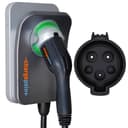 ChargePoint Home Flex The safest default for most homes: you set the amperage in the app to 16, 24, 32, 40, 48 or 50A, so one charger fits whatever circuit your panel can spare today and scales up if you upgrade later. The app is the most mature here, firmware arrives over the air, and the warranty is long. | Sets 16-50 A in the app, after install | $516.71 · View on Amazon Price as of October 18, 2026. #ad How we’re funded |
| 2 | 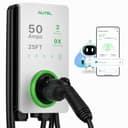 Autel MaxiCharger Home Built for the harshest driveway. The NEMA 4X enclosure is rated to keep charging in extreme cold and heat, it pushes a full 50 amps, and the app is capable. If your charger lives fully exposed to the weather, this is the one. | 16-50 A, and an Ethernet port | |
| 3 | 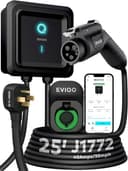 EVIQO 40A NEMA 14-50 Charger The most charger you can get without an electrician's invoice. It plugs into a NEMA 14-50 outlet for a full 40 amps, keeps the WiFi app, the ENERGY STAR listing and the 25 ft cable from EVIQO's hardwired unit, and can be unplugged and taken with you when you move. | 6-40 A on an existing 14-50 | |
| 4 | 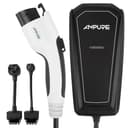 Ampure Go Portable Level 2 Charger The only portable charger we track that is certified like a permanent one. UL 2594 / UL 2231, ENERGY STAR and an IP67 / NEMA 6P body rated from -22F to 122F, in a nine-pound module that ships with a NEMA 14-50 cord for 240V and a standard 5-15 cord for 120V. You give up eight amps against the 40A units and get, in exchange, a charger genuinely rated to live in a trunk and be rained on. | Dual voltage, 120 V or 240 V | $299.00 · View on Amazon Price as of October 18, 2026. #ad How we’re funded |
The Ampure Go is on that list for a specific reason: it is certified for both 120 and 240 volts, which makes it the one unit here that covers a Level 1 outlet and a Level 2 circuit with the same hardware. At 32 amps it is slower than the wall units, but if your supply situation is genuinely unresolved, a dual-voltage portable is the purchase that cannot be made wrong. Our portable roundup and the portable-versus-wall comparison cover that trade, and the cost calculator turns whatever kilowatts you end up with into money on your own rate.
Frequently asked questions
What voltage does an EV charger need?
Level 2 charging in the US runs on a nominal 240 volts, taken across the two hot legs of a normal split-phase residential service. Level 1 charging uses a standard 120-volt household outlet. The third case people meet and do not expect is 208 volts: buildings fed from a three-phase service -- many apartment blocks, condos and commercial garages -- deliver 208 volts between two legs rather than 240, and the same charger produces about 13% less power there. The charger itself usually does not care; the kilowatts you get do.
How much power does a Level 2 EV charger use?
Volts times amps. At 240 volts, a 40-amp charger delivers 9.6 kW, a 48-amp charger 11.5 kW, and the 80-amp unit we track 19.2 kW. The DOE describes Level 2 as spanning roughly 2.9 to 19.2 kW with around 7.2 kW typical for residential installs. The number that matters for your electrician is different again: because EV charging is a continuous load, the circuit is sized to 125% of the charger's rating -- so a 48-amp charger needs a 60-amp circuit.
Why is my EV charging slower than the charger's rating?
Three possible reasons, and they are easy to tell apart. First, the supply: 208 volts instead of 240 knocks about 13% off, which is the single most common surprise in apartment buildings. Second, the charger's configured amperage -- adjustable units ship at or get set to a lower step than their maximum, sometimes to suit the circuit. Third, and most often, your car: the onboard charger inside the vehicle sets the ceiling, and if it caps at 7.7 kW then no wall charger on earth will exceed that. Our onboard-charger guide covers how to find your car's figure.
Can I use a 120-volt outlet to charge an EV?
Yes -- that is Level 1, and nearly every EV ships with a cable for it. It delivers roughly 1.4 to 1.9 kW, which is about 5 miles of range per hour, or around 60 miles overnight. For a short commute that genuinely keeps up and costs nothing to install. Where it stops working is a long daily drive, a big battery, or cold weather, when the car is also spending energy on thermal management. Our Level 1 guide is honest about where that line sits.
How do I find out if I have 240 or 208 volts?
Three ways, in order of reliability. Ask your electrician to measure it at the panel -- a meter settles it in seconds and they are already there for the load calculation. Ask the building manager or the utility, which is the practical route in an apartment or condo. Or read it off a smart charger's app if yours reports supply voltage, which several do. What you should not do is assume: a single-family house is almost always 240, but a unit in a multi-family building is genuinely a coin toss, and the difference is worth knowing before you pay for 48 amps.
Does 208 volts damage an EV charger?
No. Chargers sold for the US market are built for the nominal range they publish, and running at 208 volts means less current-driven heat, not more. What 208 volts costs you is output, not hardware: about 13% fewer kilowatts, which at 48 amps is the difference between 11.5 kW and roughly 10 kW. If you are in a 208-volt building, the sensible response is to stop paying a premium for amps you cannot fully convert into power, and spend it on cable length or weather rating instead.
Sources
- U.S. DOE Alternative Fuels Data Center — Electric Vehicle Charging Stations — US DOE on charging levels: Level 1 (~1.9 kW, ~5 mi/hr), Level 2 (2.9-19.2 kW, ~7.2 kW typical residential, ~25 mi/hr), and DC fast charging (accessed July 19, 2026)
- U.S. DOE Alternative Fuels Data Center — Charging Electric Vehicles at Home — US DOE on home EV charging: most owners charge overnight on Level 1 or Level 2, installs follow NEC Article 625, with example home-charging costs (accessed July 19, 2026)
- NFPA — Using the Latest NEC for EV Charger Installations — NFPA on NEC (NFPA 70) Article 625: EV charging is a continuous load, so circuits are sized to 125% of load (the 80% rule) (accessed July 19, 2026)
- SAE International — J1772 Conductive Charge Coupler — The SAE J1772 connector standard for AC Level 1 and Level 2 charging in North America (accessed July 19, 2026)
- FuelEconomy.gov — Electric Vehicles: Learn More About the Label — DOE/EPA on EV efficiency: kWh per 100 miles and MPGe, accounting for AC charging losses (accessed July 19, 2026)
- ChargePoint — Home Flex datasheet (PDF) — ChargePoint's own datasheet: enclosure rating Type 3R per UL 50E, operating temperature -22F to 122F, 23 ft cable, plus installer notes that an outdoor plug-in install requires an outdoor-rated GFCI breaker upstream while an external GFCI may conflict with the charger's internal ground-fault protection on a hardwired install. RE-READ September 3, 2026 for the review refresh: the same datasheet also publishes maximum 12 kW (240V AC x 50A) with output amperage adjustable via the mobile app to 16A, 24A, 32A, 40A, 48A or 50A; a required dedicated dual-pole breaker rated for 125% of maximum load; 'Software Updates: Firmware updated over-the-air (OTA)'; 2.4/5 GHz Wi-Fi (802.11 a/b/g/n); local storage of up to 90 days of charging session data (100 sessions) if the network drops; power measurement accuracy +/- 2.0%; ground-fault detection by 20 mA CCID with auto retry; and UL and cUL listing per UL 2594, UL 2231-1 and UL 2231-2, NEC Article 625 compliant. Ordering information lists the plug-in station models CPH50-NEMA6-50-L23 and CPH50-NEMA14-50-L23 (accessed September 3, 2026)
- Autel Energy — MaxiCharger AC Elite Home 50A product page — Autel's own listing: compliant with NEMA 4X standards, operating temperature -40F to 131F, 25 ft cable, 3-year warranty. RE-READ October 10, 2026 for the Emporia head-to-head, and the page now publishes materially more: 'Maximum Output | 12 kW / 50 A' with output 'Adjustable 16-50 A'; installation given as 'Hardwired - 70 A Circuit for Full Output'; an 'SAE J1772' connector; an enclosure rating of 'IP65 / NEMA 4X'; an operating range of '-40 to 131 F (-40 to 55 C)'; a '3 Years' warranty quoted as a single term with no component split; 'CSA and ENERGY STAR compliance' (no UL listing is claimed on this page); connectivity listed as 'Bluetooth, Wi-Fi, Ethernet, CAN, RS485'; app control to start, stop and schedule charging, monitor activity and adjust current; dimensions of 13.2 x 7.4 x 3.8 in (336 x 187 x 97 mm) and a weight of 15.4 lbs (7 kg); and the load-management sentence this comparison turns on - 'Supports both Adaptive Load Management (ALM) and charger-to-charger Dynamic Load Balancing (DLB). ALM requires compatible additional hardware, while DLB works between chargers without additional hardware.' The page publishes no solar-specific feature (accessed October 10, 2026)
- EVIQO — Level 2 EV Charger, 40A (9.6 kW), NEMA 14-50 plug-in (Gen 2) — EVIQO's own product page: 40A / 9.6 kW on a NEMA 14-50 plug, SAE J1772, 25 ft charging cable plus a 40 in input cable, IP66 / NEMA 4 enclosure, UL / ETL / FCC / ENERGY STAR listings, 3-year standard warranty, app-adjustable 6-40A output, and a note that it needs an EV-grade 4-prong 14-50 receptacle rather than a dryer outlet. RE-READ September 15, 2026 for the garage roundup: the page additionally states an operating temperature range of -22F to 122F, that the app needs a 2.4 GHz WiFi connection, that the standard 3-year warranty is extendable to 4, and that the unit ships in 1-2 business days (accessed September 15, 2026)
- Autel Energy — MaxiCharger 80A 19.2kW Residential EV Charger (US store listing) — Autel's own US listing: 19.2 kW (240V AC 80A), 208/240V AC 50/60 Hz, SAE J1772, hardwired, 25 ft (7.5 m) cable, output adjustable from 6A to 80A in the app and 16/24/32/40/48/50/64/72/80 A by DIP switch, UL 2594, UL 2231-1, UL 2231-2, UL 1998, CSA C22.2 No. 280, FCC Part 15 Class B, ENERGY STAR, OpenADR 2.0b, NEC Article 625, Wi-Fi / Ethernet / RS485 with the Autel Charge app and cloud, and a warranty of 5 years on the charger body, backplate and internal components with 1 year on the display screen, charging cable and connector (accessed August 12, 2026)
Keep reading
The amps half of the equation
Rated amps, drawn amps and breakered amps are three different numbers. The companion page to this one.
Read the guideThe ceiling inside your car
Why the wall is often not the limit at all, and how to find your vehicle's published AC acceptance rate.
Read the guideThe 22 kW question
Where three-phase power comes from, why 22 kW is a European figure, and what the US single-phase ceiling actually is.
Read the guideCharging in an apartment
Where the 208-volt surprise lives. The picks and the honest workarounds for a building you do not own.
See the picks