Can You Run an EV Charger From a Dryer Outlet?
Electrically, 240 volts is 240 volts and a dryer circuit really can charge a car. Practically, three separate things stand in the way: no charger we track has the right plug, the manufacturers' own instructions want a dedicated circuit, and a 30-amp circuit caps you at 24 amps. Here is the honest version, including where the adapter route survives scrutiny and where it does not.
How this is funded: we earn a commission if you buy through our links, at no extra cost to you. It never changes which product we recommend, and we’ll tell you when we’d skip one. Full disclosure.
The short answer: electrically yes, practically not without an electrician, and the honest recommendation is to stop trying to use the dryer circuit and have a proper EV circuit run instead. That is not the answer anyone wants, so the rest of this page explains exactly what stands in the way, in the order you will hit it — because two of the three obstacles have legitimate solutions, and knowing which is which is worth a few minutes.
The appeal is obvious. A modern dryer receptacle is a NEMA 14-30: 240 volts, 30 amps, two hot conductors plus a neutral and a ground, sitting on a circuit that already runs to a wall in your house. Compared with the cost of having a new 240-volt circuit run, free and already installed is a very attractive specification.
What a dryer circuit is actually worth
Before the obstacles, the prize — because if 24 amps is not enough for you, the rest of the page does not matter.
| Receptacle | Circuit | Conductors | Max continuous | Power | Range per hour |
|---|---|---|---|---|---|
| NEMA 5-15 (standard wall outlet) | 15 A, 120 V | Hot, neutral, ground | 12 A | 1.4 kW | ~5 mi/hr |
| NEMA 14-30 (modern dryer) | 30 A, 240 V | 2 hots, neutral, ground | 24 A | 5.8 kW | ~20 mi/hr |
| NEMA 10-30 (pre-1996 dryer) | 30 A, 240 V | 2 hots, neutral - no ground | 24 A | 5.8 kW | ~20 mi/hr |
| NEMA 6-50 (welder) | 50 A, 240 V | 2 hots, ground - no neutral | 40 A | 9.6 kW | ~34 mi/hr |
| NEMA 14-50 (range / EV) | 50 A, 240 V | 2 hots, neutral, ground | 40 A | 9.6 kW | ~34 mi/hr |
The number to sit with is 24 amps, 5.8 kW, roughly 20 miles of range per hour. EV charging is a continuous load, so the National Electrical Code sizes the branch circuit to 125% of the charger’s draw— the “80% rule”. Eighty percent of 30 amps is 24, and that is a hard ceiling on this circuit no matter what charger you hang off it.
Twenty miles an hour is three to four times faster than a standard 120-volt outlet and about 60% of what a 40-amp charger does. Over an eight-hour night it is around 160 miles. The average US driver covers well under 40 miles a day, so for most households this is a real Level 2 charging experience rather than a compromise — our charger-sizing guide works the mileage question through from first principles. Where it pinches is a large battery charged from near-empty, or two EVs sharing one circuit.
Obstacle one: no charger has the right plug
This is the one nobody mentions until you are holding the box. Of the twenty Level 2 chargers in our registry, not one publishes a NEMA 14-30 plug option. Every plug-in unit we track — Grizzl-E, EVIQO, Autel, ELEGRP, Lectron, Emporia — terminates in a NEMA 14-50, the 50-amp receptacle. The dryer connector does not appear anywhere in the category.
| Charger | Plug / install | Rated max | Lowest published setting | Cable |
|---|---|---|---|---|
| Ampure Go Portable Level 2 Charger | NEMA 14-50 cord for 240V, NEMA 5-15 cord for 120V | 32 A | No adjustable range published (32 A at 240 V, 120 V on its other cord) | 20 ft |
| ELEGRP 40A Portable Level 2 Charger | NEMA 14-50 plug | 40 A | 16 A (40 / 32 / 24 / 20 / 16 A selectable) | 25 ft |
| Grizzl-E Classic Connect 40A | NEMA 14-50 plug | 40 A | 16 A (DIP switch 16 / 24 / 32 / 40 A) | 25 ft |
| ChargePoint Home Flex | Hardwired, NEMA 6-50 or NEMA 14-50 | 50 A | 16 A (16 / 24 / 32 / 40 / 48 / 50 A in the app) | 23 ft |
So the adapter market fills the gap, and here is the honest assessment of it. A 14-30 to 14-50 adapter is a passive lump of copper and plastic. It does not tell the charger anything. Fit one and a charger configured for 40 amps is now sitting on a circuit rated to carry 24 — and the only thing standing between that and an overloaded conductor is the breaker, which is protection of last resort rather than a design.
If you use an adapter, the charger must be set to 24 amps first, and you have to be certain the setting holds. That is why the units on this page are ones whose makers publish an explicit low setting: the ELEGRP 40A publishes selectable 40, 32, 24, 20 and 16 amps; the Grizzl-E Classic Connect has a DIP switch at 16, 24, 32 and 40; the ChargePoint Home Flex sets 16, 24, 32, 40, 48 or 50 in its app. A charger with no published adjustable range has no business on an undersized circuit at all.
One more detail from the hardware itself, because it is Autel saying it rather than us: the MaxiCharger AC Elite’s own listing notes it needs a genuine EV-grade 14-50 receptacle, and an old dryer outlet is not one. Decades of thermal cycling on a receptacle built for an intermittent load is not the same part as a new EV-rated one, and an EV draws its current for hours at a stretch.
Obstacle two: the dryer is still on that circuit
This is the real obstacle, and it is the one that usually ends the conversation. Every charger installation instruction we have read specifies a dedicated 240-volt circuit. Lectron’s own documentation for its hardwired Nexus is explicit about a dedicated circuit and a licensed electrician; the rest are the same. Nothing about an EV charger is designed to share a circuit with an appliance.
The arithmetic is unforgiving. A dryer on a heat cycle and a car drawing 24 amps on the same 30-amp circuit will exceed it. You will not usually get a fire — you will get a tripped breaker, in the middle of the night, on the circuit your car was relying on. And the failure mode of “I remembered not to run them together” is a household member who did not.
There are engineered answers. A mechanical interlock or a manual transfer devicemakes simultaneous use physically impossible, and that is a legitimate solution rather than a hack — it is also an electrician’s job, governed by what your local inspector accepts, and it costs enough that running a new circuit becomes competitive. Our dedicated-circuit page goes through the options, including why the splitter products sold for this purpose need reading carefully.
If the dryer is gone— you have switched to a heat-pump dryer on a 120-volt circuit, or the laundry moved — then this obstacle disappears entirely and you are in the best version of this scenario: an existing, genuinely spare 240-volt circuit that an electrician can convert to a dedicated EV circuit cheaply.
Obstacle three: the pre-1996 three-wire outlet
Look at the face of the receptacle before you plan anything. A NEMA 10-30 has three slots and is the older design: two hot conductors and a neutral, with no separate equipment ground. If that is what you have, treat the dryer route as closed.
EV charging equipment is grounded equipment, and the ground is not decoration — the charger’s own ground-fault protection, the thing that makes it safe to handle a connector in the rain, references it. Which is precisely why no EV hardware is built for a 10-30. The fix is a new four-wire circuit, and once an electrician is pulling new conductors there is no reason to stop at 30 amps. Our plug and outlet guide covers the whole family, and wire size and breaker covers what the upgrade involves.
The two routes that actually work
Route one: convert the dryer circuit.This is the right answer when the dryer is gone or moving, the receptacle is a 14-30, and the run already reaches where the car parks. An electrician decommissions the receptacle, hardwires a charger configured to 24 amps, and you are done — a clean, code-compliant, dedicated EV circuit for a fraction of a new install. The chargers to use are on our 30-amp circuit roundup, and the setting must be noted on the invoice because on the DIP-switch units it ends up sealed inside the enclosure.
Route two: leave the laundry alone and run a proper circuit. This is the right answer in most houses, and the reason is economics rather than purity. You are paying for a trip, a permit and labor either way; the wire is often the smallest line on the quote. A 50-amp circuit gets you 40 amps instead of 24, a plug-in charger you can take with you, and the whole market to choose from. Our installation cost breakdown has the line items and how to hire the electrician covers what to ask for.
And one interim answer that costs nothing: if the install has to wait, charge on 120 volts in the meantime. It adds about 5 miles an hour, which over a 12-hour overnight is 60 miles — more than most people drive. It is slow, not useless.
What to buy for each route
If you are converting the dryer circuit, buy a unit with a published 24-amp settingand hardwire it. If you are running a new circuit, buy for the circuit you are installing rather than the one you had. And if you want something that works at both a dryer outlet on a trip and a proper outlet at home, the dual-voltage portable is the genuinely flexible option — the Ampure Go ships a NEMA 14-50 cord for 240 volts and a NEMA 5-15 cord for 120, in an IP67 body with UL and cUL listings and ENERGY STAR, so it degrades gracefully to whatever outlet it finds.
Quick picks
Ranked on published specs, charging speed, electrical fit and value. Select a row to jump to the full write-up. We have not bench-tested these chargers — here is exactly what we do instead.
| # | Product | Best for | Price |
|---|---|---|---|
| 1 | 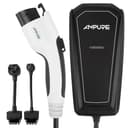 Ampure Go Portable Level 2 Charger The only portable charger we track that is certified like a permanent one. UL 2594 / UL 2231, ENERGY STAR and an IP67 / NEMA 6P body rated from -22F to 122F, in a nine-pound module that ships with a NEMA 14-50 cord for 240V and a standard 5-15 cord for 120V. You give up eight amps against the 40A units and get, in exchange, a charger genuinely rated to live in a trunk and be rained on. | Swappable cords, 120V or 240V | $299.00 · View on Amazon Price as of October 18, 2026. #ad How we’re funded |
| 2 | 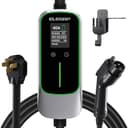 ELEGRP 40A Portable Level 2 Charger The full-speed portable. A genuine 40 amps on a NEMA 14-50, an IP67 station body rated -22F to 122F, and a 25-foot cable - the longest here by five feet - for less than the 32A unit costs. It is the heaviest thing here to coil and there is no app, but if the portable is also going to be your everyday charger, this is the one that does not make you choose. | Publishes a 24 A setting, cheapest | $209.99 · View on Amazon Price as of October 18, 2026. #ad How we’re funded |
| 3 | 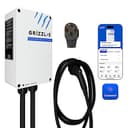 Grizzl-E Classic Connect 40A Grizzl-E's cast-aluminum build with a WiFi radio in it. You get the IP67 body and the cold-flexible 25 ft cable that made the brand's name, plus scheduling, usage history and utility demand-response programs in the Grizzl-E Connect app — in a plug-in unit that comes off the wall when you move. The amperage is still set with a DIP switch, which is either charmingly honest or annoyingly analog depending on your taste. | DIP switch at 24 A, plug-in | $349.99 · View on Amazon Price as of October 18, 2026. #ad How we’re funded |
| 4 | 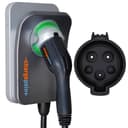 ChargePoint Home Flex The safest default for most homes: you set the amperage in the app to 16, 24, 32, 40, 48 or 50A, so one charger fits whatever circuit your panel can spare today and scales up if you upgrade later. The app is the most mature here, firmware arrives over the air, and the warranty is long. | 24 A in the app, hardwire or plug | $516.71 · View on Amazon Price as of October 18, 2026. #ad How we’re funded |
Two honest notes on those picks. The Ampure Gois 32 amps on its 240-volt cord and publishes no adjustable range, so it is not the unit for a 30-amp circuit — it is the unit for travel and for the 120-volt fallback, and our review says so plainly. The ELEGRP 40Ais the cheapest real Level 2 charger we track and publishes a 24-amp step, but its connector is rated IP54 against an IP67 station body, and ELEGRP publishes no ENERGY STAR listing — see the full review before you decide that price is the whole story.
Frequently asked questions
Can I plug an EV charger into a dryer outlet?
Not directly, because no Level 2 charger in our registry of twenty units ships with a NEMA 14-30 dryer plug - every plug-in model we track ends in a NEMA 14-50. Adapters from 14-30 to 14-50 are sold, and they create a different problem: the adapter lets a charger configured for 40 amps sit on a circuit rated for 24, and the charger has no way to know. If you go that route the charger has to be set down to 24 amps first, and you are relying on a configuration rather than on the hardware being incapable of more.
How fast will an EV charge on a 30-amp dryer circuit?
By our arithmetic, 24 amps at 240 volts is 5.8 kW, which on a reference EV doing 3.5 miles per kWh adds roughly 20 miles of range per hour - about 160 miles over an eight-hour night. That is between three and four times faster than a standard 120-volt wall outlet and about 60% of what a 40-amp charger does. For the average US driver, who covers well under 40 miles a day, it is genuinely enough.
Is it safe to share a circuit between a dryer and an EV charger?
Every charger installation instruction we have read specifies a dedicated 240-volt circuit, and that is the answer we would act on. The reason is not mysterious: a dryer and a car charging simultaneously on one 30-amp circuit will exceed it, and the protection you are relying on is a breaker tripping rather than anything smarter. Interlock devices and manual transfer switches exist to make the sharing physically impossible, which is a legitimate engineering answer - but it is an electrician's job and it is governed by your local code, not by a web page.
What about a NEMA 10-30 dryer outlet?
Treat it as unusable. A 10-30 is the pre-1996 three-wire design: two hot conductors and a neutral, with no separate equipment ground. EV charging equipment is grounded equipment and the ground is load-bearing for its safety systems, which is why the connector family simply does not exist in EV hardware. The fix is to pull a proper four-wire circuit, at which point you may as well size it for the charger you actually want.
Does a 14-30 EV charger exist?
Not in our registry, and the absence is consistent across all twenty units we track - there is no NEMA 14-30 plug option on any of them. Some portable chargers on the wider market ship with interchangeable cord sets that include a 14-30, which is a cleaner solution than an adapter because the charger reads the cord and limits its own current accordingly. We do not currently track one, so we are not going to recommend a specific model we have not verified.
Is a dryer outlet cheaper than installing a proper EV circuit?
Only if it is genuinely spare and genuinely a 14-30, in which case converting it to a dedicated EV circuit is a short job. If the dryer has to stay, you are paying an electrician to visit regardless, and the marginal cost of running a new 50-amp circuit instead is often small on a short run - while buying you 40 amps, a plug-in charger and a far wider choice of hardware. Get both quoted on the same visit.
Sources
- NFPA — Using the Latest NEC for EV Charger Installations — NFPA on NEC (NFPA 70) Article 625: EV charging is a continuous load, so circuits are sized to 125% of load (the 80% rule) (accessed July 19, 2026)
- U.S. DOE Alternative Fuels Data Center — Charging Electric Vehicles at Home — US DOE on home EV charging: most owners charge overnight on Level 1 or Level 2, installs follow NEC Article 625, with example home-charging costs (accessed July 19, 2026)
- U.S. DOE Alternative Fuels Data Center — Electric Vehicle Charging Stations — US DOE on charging levels: Level 1 (~1.9 kW, ~5 mi/hr), Level 2 (2.9-19.2 kW, ~7.2 kW typical residential, ~25 mi/hr), and DC fast charging (accessed July 19, 2026)
- U.S. DOE Alternative Fuels Data Center — Electric Vehicles for Consumers — US DOE on connector types: J1772 for Level 1/2, and CCS, CHAdeMO or NACS (J3400) for DC fast charging (accessed July 19, 2026)
- SAE International — J1772 Conductive Charge Coupler — The SAE J1772 connector standard for AC Level 1 and Level 2 charging in North America (accessed July 19, 2026)
- Lectron — NEXUS Level 2 J1772 EV Charging Station, 240V, 48 Amp, Hardwired — Lectron's own product page: up to 48 A continuous at 240 V for 11.5 kW, hardwire-only install by a licensed electrician on a dedicated 240 V circuit, IP66 weatherproof housing for indoor or outdoor use, 23 ft output cable of 15.0 mm (±0.3 mm) heavy-duty compound the brand states is 'engineered to stay flexible and easy to wrap around the wall mount, even in freezing weather', wall-mount J-hook and plug holder included, ETL listed to UL 2594 / UL 2231 / UL 2251 with ENERGY STAR and FCC certification, and a 3-year Lectron warranty. No operating-temperature range and no Wi-Fi or app support are published for this model (accessed August 20, 2026)
- Autel Energy — MaxiCharger AC Elite Home 40A (NEMA 14-50) product page — Autel's own listing: output adjustable up to 40 A / 9.6 kW, SAE J1772 connector on a NEMA 14-50 input cord, 25 ft cable, NEMA 4 enclosure, Wi-Fi / Bluetooth / Ethernet, three-year limited warranty; the page does not publish a UL or ENERGY STAR listing or an operating-temperature range (accessed August 18, 2026)
- ELEGRP Store - 40A Level 2 portable J1772 EV charger (NEMA 14-50) — ELEGRP's own listing: 40 A / 9.6 kW on 240 V AC at 50/60 Hz with selectable output at 16, 20, 24, 32 or 40 A, SAE J1772 connector on a NEMA 14-50 plug ('For NEMA 14-50 Outlets Only'), 25 ft cable (16 ft and 21 ft also offered), IP67 charging station and IP54 connector, operating range -22F to +122F (-30C to +50C), 1-to-12-hour delayed-start timer, 2-year warranty, 'ETL & UL' listed. RE-READ September 5, 2026 for the review: the specification table is unchanged, and the page additionally states 'Fully ETL certified and built with UL-listed components - including the J1772 plug, cable, and NEMA 14-50 connector', a built-in display reporting charging current, voltage, total energy delivered (kWh) and internal temperature with LED fault patterns, a wall-mounted holder plus anchors and a carry bag in the box, Tesla compatibility via a J1772-to-NACS adapter sold separately, a 30-day return window and 60-day price protection. The page does not name the UL standards, publish a weight, publish an ENERGY STAR certification, or publish app support for this SKU, and its marketing copy carries two conflicting range claims ('Up to 37 Miles/H' and '30 Miles Per Hour') plus an operating range ('-21F to 121F') that disagrees with its own specification table (accessed September 5, 2026)
- Ampure - Ampure Go portable Level 2 EV charger product page — Ampure's own specifications for the Go: 32 A / 7.7 kW at 240 V or 12 A / 1.4 kW at 120 V, input range 85-265 VAC at 45-65 Hz, SAE J1772 coupler, NEMA 14-50 and NEMA 5-15 cords, 20 ft (6 m) cable, IP67 rated 'submersible up to 3 feet' with a NEMA 6P watertight enclosure, operating range -30C to +50C (-22F to 122F), 9 lb (4.1 kg) module, and listings to UL, cUL, UL 2594, UL 2231, UL 817, ICES, FCC, ENERGY STAR, REACH and RoHS. Ampure states 'up to 25 miles of range per hour' at 240 V. RE-READ October 10, 2026 for the review: every figure above is unchanged on the page. Confirmed again that this page publishes NO warranty term (that figure is on the store listing), NO app, WiFi or scheduling feature, and NO description of the unit's internal safety protections (no GFCI / CCID figure, no over-temperature behavior). The page describes the unit as an 'IP67-rated IC-CPD', i.e. an in-cable control and protection device, and the specification block gives the plug types as 'NEMA 14-50 & NEMA 5-15' alongside an 'IEC grid plug'. Ampure's current line separates this unit from a distinct 'Go 2 (NACS)' model; the specifications above are the Gen 1 J1772 unit Amazon lists as the 'Go 1' (accessed October 10, 2026)
- United Chargers — Grizzl-E Classic Connect 40A technical specifications — Grizzl-E's own spec table for the Classic Connect: Type 1 (J1772) or NACS Level 2, aluminum enclosure, operating temperature -30C to +50C (-22F to 122F), IP67 protection, 25 ft output cable on an 18 in input lead, 208-240 VAC, nominal input current 16/24/32/40 A set by a DIP-switch power selector, maximum output current 40 A, LED indicator, 21 lb unit weight (accessed September 3, 2026)
- ChargePoint — Home Flex datasheet (PDF) — ChargePoint's own datasheet: enclosure rating Type 3R per UL 50E, operating temperature -22F to 122F, 23 ft cable, plus installer notes that an outdoor plug-in install requires an outdoor-rated GFCI breaker upstream while an external GFCI may conflict with the charger's internal ground-fault protection on a hardwired install. RE-READ September 3, 2026 for the review refresh: the same datasheet also publishes maximum 12 kW (240V AC x 50A) with output amperage adjustable via the mobile app to 16A, 24A, 32A, 40A, 48A or 50A; a required dedicated dual-pole breaker rated for 125% of maximum load; 'Software Updates: Firmware updated over-the-air (OTA)'; 2.4/5 GHz Wi-Fi (802.11 a/b/g/n); local storage of up to 90 days of charging session data (100 sessions) if the network drops; power measurement accuracy +/- 2.0%; ground-fault detection by 20 mA CCID with auto retry; and UL and cUL listing per UL 2594, UL 2231-1 and UL 2231-2, NEC Article 625 compliant. Ordering information lists the plug-in station models CPH50-NEMA6-50-L23 and CPH50-NEMA14-50-L23 (accessed September 3, 2026)
- FuelEconomy.gov — Electric Vehicles: Learn More About the Label — DOE/EPA on EV efficiency: kWh per 100 miles and MPGe, accounting for AC charging losses (accessed July 19, 2026)
Keep reading
Best chargers for a 30-amp circuit
If you are converting that dryer circuit to EV use, the four units whose makers publish a verifiable 24-amp setting.
See the picksDoes a charger need its own circuit?
The question underneath this one, answered properly - including splitters, interlocks and what they do and do not solve.
Read the guideThe NEMA 14-50 outlet
The receptacle every plug-in charger we track actually uses: what it costs, the GFCI rule that trips people up, and why it is the better target.
Read the guideA 240V outlet is not a charger
What an outlet gives you on its own, and when the outlet-plus-portable route beats a wall-mounted unit.
Read the comparison