Installing an EV Charger in a Detached Garage
The charger is the easy part. Everything between the house panel and the garage wall — the conductor run, the trench, the question of a subpanel, the network that will not make the trip — is what the quote is actually for. Scope it before the electrician arrives and the number stops being a surprise.
How this is funded: we earn a commission if you buy through our links, at no extra cost to you. It never changes which product we recommend, and we’ll tell you when we’d skip one. Full disclosure.
An attached garage shares a wall with the panel, or nearly so, and a Level 2 install is a circuit and a mounting job. A detached garage shares nothing. Power has to leave the house, cross the yard underground, and arrive at a separate building that the electrical code treats as its own structure. That is why the same charger costs more to install thirty feet further from the house, and why the quote arrives with line items an attached-garage owner never sees.
None of it is exotic. Electricians run feeders to outbuildings constantly. But the decisions are made in a different order, and two things that are afterthoughts in an attached garage — the network and the winter — are central out there.
First: what already reaches the garage?
Three starting points, in ascending order of work. A subpanel already in the garage:the job is a breaker and a short circuit, if the subpanel has the capacity — check the feeder breaker rating at the house and what is already on the garage panel. A single 120 V circuit for lights and a door opener: that circuit cannot be upgraded to feed a charger; a new run is needed, and this is the most common case. Nothing: a new feeder from the house, and everything below applies.
The sizing logic is the same as anywhere else. The NEC treats EV charging as a continuous load, so the circuit is rated at 125% of the charger’s draw: 50 amps for a 40-amp charger, 60 for a 48. What changes is that the conductors are longer, and a long run at 50 or 60 amps needs a heavier gauge to hold the voltage drop down. Our wire and breaker guide covers why distance changes the wire.
The run: distance and surface set the price
Two measurements decide most of the bill. Distance from the house panel to the garage wall, which sets the conductor length and gauge. The surface in between, which sets the trenching: a lawn is a shallow trench and an afternoon; a concrete driveway or a paved patio is cutting, boring under, or rerouting around, and can cost more than everything else combined. Walk the route and note every hard surface before you call anyone. If the only path is under paving, ask about directional boring versus cutting and patching; the answer varies by contractor.
We do not print install figures, because for this job a national average is meaningless — the trench dominates, and the trench is entirely local. Our install cost breakdown lists the line items, and the state-by-state guide puts BLS electrician wage data behind the labor component.
Circuit or subpanel?
A charger alone can be served by a single dedicated circuit run from the house. But a detached garage almost always wants more than a charger eventually: lights, a compressor, a heater, a second EV. Running one feeder to a subpanel in the garage and breaking out circuits there is frequently cheaper than a second trench later, and many electricians will recommend it unprompted. It also settles the building’s own requirements — a separate structure fed from the house is governed by the NEC’s rules for outbuildings and feeders, including whether it needs its own disconnect and grounding, which is a question for your electrician and inspector, not for a charger guide. Our subpanel guide covers what the panel adds to the bill and when it pays for itself.
The network will not make the trip
A detached garage is the worst-case WiFi environment: distance, a house wall, open air, then a garage wall, then a metal door and a parked car. Do not assume; test. Take a phone to the exact mounting height with the door closed and see what the signal does. If it is marginal, you have two good options and one bad one.
Good:pull a Cat6 cable in the same trench as the feeder. The marginal cost while the trench is open is small, and it removes the problem permanently for a charger with a wired port — Autel publishes Ethernet alongside WiFi and Bluetooth on its MaxiCharger units. Also good: buy a charger that never needed a network. The Lectron Nexus has no app; every modern EV can schedule its own charging from the dashboard, and a WiFi-connected charger that loses its signal still charges — it just goes quiet. Bad: planning around an extender inside the garage, which inherits the same wall problem it was bought to solve. The full argument is in our WiFi guide.
It is colder out there
An attached garage borrows heat from the house. A detached one does not, and in most of the country it will see the same temperatures as the driveway. That makes the published operating range a first-order spec rather than a footnote. Several brands publish -22°F to 122°F — Grizzl-E and EVIQO among the picks below; some publish nothing, which we report as “Not published” rather than assume. The DOE/EPA note that EV range can fall sharply at 20°F with the cabin heater running and that preconditioning while plugged in helps; a charger in a cold building is where that plug-in time happens. Our cold-weather roundup ranks on exactly this.
Chargers that suit a detached garage
Four from our registry, chosen for the two things a detached building changes: a published cold rating and sealed body, and either a wired network option or no dependence on one. All four are ranked in full on the garage roundup.
Quick picks
Ranked on published specs, charging speed, electrical fit and value. Select a row to jump to the full write-up. We have not bench-tested these chargers — here is exactly what we do instead.
| # | Product | Best for | Price |
|---|---|---|---|
| 1 | 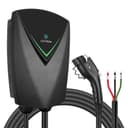 Lectron Nexus 48A J1772 A full 48 amps with nothing to log into. Lectron's Nexus body is IP66-sealed for an outdoor wall, the cable is a heavy 15 mm compound the brand says is built to stay flexible in freezing weather, and the safety paperwork is the real thing — ETL to UL 2594/2231/2251, plus ENERGY STAR. Hardwired only, and there is no app, which is the entire point. | No app to lose signal, 48 A, IP66 | $429.99 · View on Amazon Price as of September 18, 2026. #ad How we’re funded |
| 2 | 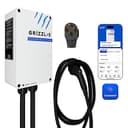 Grizzl-E Classic Connect 40A Grizzl-E's cast-aluminum build with a WiFi radio in it. You get the IP67 body and the cold-flexible 25 ft cable that made the brand's name, plus scheduling, usage history and utility demand-response programs in the Grizzl-E Connect app — in a plug-in unit that comes off the wall when you move. The amperage is still set with a DIP switch, which is either charmingly honest or annoyingly analog depending on your taste. | IP67 cast body, -22°F rated, plug-in | $349.99 · View on Amazon Price as of September 18, 2026. #ad How we’re funded |
| 3 | 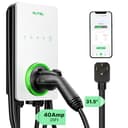 Autel MaxiCharger AC Elite Home 40A Autel's weather-hardened hardware in the install almost everyone can actually have. It is the 50A MaxiCharger's smaller sibling: same 25 ft cable and app, same NEMA 4 body, but it ends in a NEMA 14-50 plug instead of a wire nut — so it goes on an existing outlet, comes off the wall when you move, and needs a 50-amp circuit rather than a 60. The in-body holster is a small thing that stops mattering only if you have never coiled a cold cable. | Ethernet port for the cable in the trench | $470.00 · View on Amazon Price as of September 18, 2026. #ad How we’re funded |
| 4 | 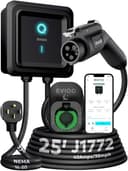 EVIQO 40A NEMA 14-50 Charger The most charger you can get without an electrician's invoice. It plugs into a NEMA 14-50 outlet for a full 40 amps, keeps the WiFi app, the ENERGY STAR listing and the 25 ft cable from EVIQO's hardwired unit, and can be unplugged and taken with you when you move. | -22°F rated, IP66, app-adjustable on 2.4 GHz |
A note on plug-in versus hardwired for this location: a subpanel in the garage makes either easy. ChargePoint’s datasheet notes that a plug-in unit outdoors needs an outdoor-rated GFCI breaker upstream, while a hardwired unit’s own ground-fault protection can conflict with an external one; a detached garage is dry enough that either route works, and the plug-in units above keep the option of taking the charger with you.
Pull the permit
A feeder to a detached building is inspected work nearly everywhere, and it is the kind of job an unpermitted installer is most likely to shortcut — shallow trench, undersized conductor, no disconnect. The inspection is your protection, and the permit is usually a small fraction of the bill. Our permits guide explains the process; our electrician guide lists the questions to ask before the trench is dug.
Frequently asked questions
Can I install an EV charger in a detached garage?
Yes. The difference from an attached garage is the run: power has to travel from the house panel to the outbuilding, usually underground in conduit, and the building may need its own disconnect and subpanel. The charger itself is chosen the same way, with two extra weights on WiFi independence and a published cold rating.
How much does it cost to install an EV charger in a detached garage?
More than the same charger in an attached garage, by roughly the cost of the run: trenching, conduit, a heavier-gauge feeder for the distance, and often a subpanel at the garage. We do not print a figure because it depends almost entirely on distance and surface — a 20-foot run under lawn and a 90-foot run under a driveway are different jobs. Our install cost guide breaks down the line items and the state guide gives regional labor context.
Do I need a subpanel in a detached garage for an EV charger?
Not always for the charger alone, but often the sensible answer. A subpanel lets one feeder serve the charger, lights, outlets and anything else the garage will ever want, and it is usually cheaper than running a second circuit later. If the garage already has a subpanel, the question is whether it has capacity for a 40- or 50-amp breaker.
Does a detached garage need its own electrical disconnect?
Ask your electrician — this is governed by the NEC's rules for outbuildings and feeders, not by Article 625, and it is exactly what turns a 'run a circuit' job into a subpanel job. A permitted install will settle it with the inspector, which is why the permit matters more here than for an attached garage.
What if WiFi doesn't reach the detached garage?
Two answers. Run a Cat6 cable in the same trench as the power — the marginal cost while the trench is open is small — and choose a charger with an Ethernet port, which Autel publishes on its MaxiCharger units. Or choose a charger that never needed a network: the Lectron Nexus has no app, and every modern EV can schedule its own charging from the dashboard.
Which chargers are best for a detached garage?
Ones that publish an operating temperature range that covers your winter (a detached garage is effectively outdoors), a sealed enclosure, and either an Ethernet option or no dependence on WiFi. In our registry that points at the Lectron Nexus 48A (no app), the Grizzl-E Classic Connect (IP67, -22F to 122F, DIP-switch amperage), the Autel 40A (Ethernet) and the EVIQO 40A (-22F to 122F, IP66).
Sources
- NFPA — Using the Latest NEC for EV Charger Installations — NFPA on NEC (NFPA 70) Article 625: EV charging is a continuous load, so circuits are sized to 125% of load (the 80% rule) (accessed July 19, 2026)
- U.S. DOE Alternative Fuels Data Center — Charging Electric Vehicles at Home — US DOE on home EV charging: most owners charge overnight on Level 1 or Level 2, installs follow NEC Article 625, with example home-charging costs (accessed July 19, 2026)
- U.S. Bureau of Labor Statistics — Occupational Employment and Wage Statistics, Electricians (47-2111) — BLS's official May 2025 OEWS estimates for electricians (SOC 47-2111): 757,220 employed nationally, mean hourly wage $34.37, mean annual wage $71,490 and median annual wage $63,190. The state-level mean hourly wages used in our table were pulled series by series from the BLS public data API (api.bls.gov/publicAPI/v2, OEWS state series for occupation 47-2111, data type 03 'hourly mean wage', survey year 2025) on the date accessed, covering all 50 states and the District of Columbia (accessed September 3, 2026)
- Lectron — NEXUS Level 2 J1772 EV Charging Station, 240V, 48 Amp, Hardwired — Lectron's own product page: up to 48 A continuous at 240 V for 11.5 kW, hardwire-only install by a licensed electrician on a dedicated 240 V circuit, IP66 weatherproof housing for indoor or outdoor use, 23 ft output cable of 15.0 mm (±0.3 mm) heavy-duty compound the brand states is 'engineered to stay flexible and easy to wrap around the wall mount, even in freezing weather', wall-mount J-hook and plug holder included, ETL listed to UL 2594 / UL 2231 / UL 2251 with ENERGY STAR and FCC certification, and a 3-year Lectron warranty. No operating-temperature range and no Wi-Fi or app support are published for this model (accessed August 20, 2026)
- United Chargers — Grizzl-E Classic Connect 40A product overview — Grizzl-E's own overview for the Classic Connect: 'the Wi-Fi Connected Smart Level 2 EVSE for home use' at 40A / 9.6 kW, shipping with the Grizzl-E Connect app for charging statistics, schedules, Demand/Response utility programs, remote control, lockout to prevent unauthorized use, updates and diagnostics; a UL Type 4 water-resistant cast aluminum enclosure with IP67 sealing, a NEMA 14-50 input cable and a 25 ft output cable with a J1772 or NACS connector, 'UL Tested and Certified' with built-in GFCI, over-current, over-voltage, ground-fault and over-temperature protections, and adjustable maximum current set with DIP switches at 40A / 32A / 24A / 16A for a 50A / 40A / 30A / 20A breaker. No ENERGY STAR certification and no OCPP support are published for this model (accessed September 3, 2026)
- United Chargers — Grizzl-E Classic Connect 40A technical specifications — Grizzl-E's own spec table for the Classic Connect: Type 1 (J1772) or NACS Level 2, aluminum enclosure, operating temperature -30C to +50C (-22F to 122F), IP67 protection, 25 ft output cable on an 18 in input lead, 208-240 VAC, nominal input current 16/24/32/40 A set by a DIP-switch power selector, maximum output current 40 A, LED indicator, 21 lb unit weight (accessed September 3, 2026)
- Autel Energy — MaxiCharger AC Elite Home 40A (NEMA 14-50) product page — Autel's own listing: output adjustable up to 40 A / 9.6 kW, SAE J1772 connector on a NEMA 14-50 input cord, 25 ft cable, NEMA 4 enclosure, Wi-Fi / Bluetooth / Ethernet, three-year limited warranty; the page does not publish a UL or ENERGY STAR listing or an operating-temperature range (accessed August 18, 2026)
- EVIQO — Level 2 EV Charger, 40A (9.6 kW), NEMA 14-50 plug-in (Gen 2) — EVIQO's own product page: 40A / 9.6 kW on a NEMA 14-50 plug, SAE J1772, 25 ft charging cable plus a 40 in input cable, IP66 / NEMA 4 enclosure, UL / ETL / FCC / ENERGY STAR listings, 3-year standard warranty, app-adjustable 6-40A output, and a note that it needs an EV-grade 4-prong 14-50 receptacle rather than a dryer outlet. RE-READ September 15, 2026 for the garage roundup: the page additionally states an operating temperature range of -22F to 122F, that the app needs a 2.4 GHz WiFi connection, that the standard 3-year warranty is extendable to 4, and that the unit ships in 1-2 business days (accessed September 15, 2026)
- ChargePoint — Home Flex datasheet (PDF) — ChargePoint's own datasheet: enclosure rating Type 3R per UL 50E, operating temperature -22F to 122F, 23 ft cable, plus installer notes that an outdoor plug-in install requires an outdoor-rated GFCI breaker upstream while an external GFCI may conflict with the charger's internal ground-fault protection on a hardwired install. RE-READ September 3, 2026 for the review refresh: the same datasheet also publishes maximum 12 kW (240V AC x 50A) with output amperage adjustable via the mobile app to 16A, 24A, 32A, 40A, 48A or 50A; a required dedicated dual-pole breaker rated for 125% of maximum load; 'Software Updates: Firmware updated over-the-air (OTA)'; 2.4/5 GHz Wi-Fi (802.11 a/b/g/n); local storage of up to 90 days of charging session data (100 sessions) if the network drops; power measurement accuracy +/- 2.0%; ground-fault detection by 20 mA CCID with auto retry; and UL and cUL listing per UL 2594, UL 2231-1 and UL 2231-2, NEC Article 625 compliant. Ordering information lists the plug-in station models CPH50-NEMA6-50-L23 and CPH50-NEMA14-50-L23 (accessed September 3, 2026)
- NEMA — Enclosure Types (definitions from NEMA 250) — NEMA's own definitions: Type 3R protects against falling dirt and rain, sleet and snow; Type 4 adds windblown dust, splashing and hose-directed water; Type 4X adds protection against corrosion. NEMA also states its NEMA-to-IP table cannot be used to convert IP designations back to NEMA types (accessed July 20, 2026)
- FuelEconomy.gov — Fuel Economy in Cold Weather (U.S. DOE / EPA) — DOE/EPA on cold weather: EV range can drop about 41% in mixed driving at 20F versus 75F with the cabin heater running (about 12% with the heater off), roughly two-thirds of the extra energy goes to heating the cabin, and preheating while still plugged in extends range (accessed July 20, 2026)
Keep reading
Subpanels for EV charging
When a detached garage or a long run turns one circuit into a subpanel job — and when that is the cheaper answer anyway.
Read the subpanel guideGetting WiFi to a charger
Why outbuildings defeat wireless, and the fixes in order of cost.
Solve the signalBest chargers for a garage
The full garage roundup — reach, plug-in vs hardwired, cold ratings and offline behavior.
See the picksWhat the install costs
The line items a detached-garage run adds to, and the numbers that move them.
Price the job