Mounting an EV Charger With No Wall
Every installation guide assumes a garage. A great many driveways do not have one — and a charger standing in the open faces weather from every direction, a car reversing toward it, and a conductor run that has to go underground.
How this is funded: we earn a commission if you buy through our links, at no extra cost to you. It never changes which product we recommend, and we’ll tell you when we’d skip one. Full disclosure.
Charger installation guides are written for a garage: find a stud, mount at chest height, run conduit along the wall. If your car lives on a driveway, a parking pad, a carport or a shared apron, none of that applies — and the question that follows is not “which charger” but “what do I attach it to?”
There are three legitimate answers, and then a set of problems that come with all of them.
Route one: the manufacturer’s pedestal
Several charger makers sell a pedestal designed for their own unit — a steel column with the correct mounting pattern, a base plate or in-ground section, and usually a route for the conductor inside the column.
Advantages: the mounting interface is correct by definition, the appearance is finished, and the assembly is designed with the charger’s weight and cable management in mind. There is no fabrication and no argument with an inspector about an improvised bracket.
Drawbacks: it is model-specific, it can cost a meaningful fraction of the charger itself, and if you change chargers in five years the pedestal may not fit the new one. Availability also varies — not every brand offers one, and it is worth confirming before you settle on a charger if this is your install.
Route two: a timber post
A pressure-treated 4x4 or 6x6 set in concrete, with the charger mounted to it and conduit run up the back or through the center. This is the most common answer in practice and usually the cheapest.
Advantages: inexpensive, universal — any charger’s bracket screws to it — and easily replaced if you change hardware. It also gives you free choice of height and orientation rather than accepting a pedestal’s.
Drawbacks: timber weathers, and a post that will hold a charger for fifteen years needs to be properly rated, properly set and properly capped. Setting depth is genuinely a local question — frost depth, soil and wind loading all bear on it, and it belongs in the permit conversation rather than in a national article. A 6x6 is worth the small extra over a 4x4 for stiffness alone.
Route three: steel post or unistrut
A galvanized steel post or a unistrut frame, occasionally lag-bolted to an existing concrete pad rather than set in the ground.
Advantages: the most durable, indifferent to weather, and the surface mount option avoids digging where a suitable slab already exists. Unistrut in particular gives you an adjustable mounting height, which is useful if the charge port height might change with a future vehicle.
Drawbacks: some fabrication, a more industrial look, and grounding and bonding of a metal support is a detail to get right rather than improvise. Not every electrician wants to build one.
The problem that dominates the bill: getting power there
Whichever support you choose, the conductor has to travel from the panel to a point in open ground. That means a trench, conduit and burial to whatever depth code requires — and it is where most of the extra cost of an open install lives. The charger and the post are cheap by comparison with thirty feet of trench.
Three things to raise with your electrician while quoting:
- Voltage drop on a long run. Distance can force a larger conductor size, which is a cost that should appear in the quote rather than on the invoice. Our wire and breaker guide covers why length changes the answer.
- Whether a subpanel is cheaper. On a long run, particularly to a detached structure, running a feeder to a small subpanel can cost less than running a heavily oversized branch circuit — and it leaves capacity for lighting or a second charger later. See subpanels.
- Pull a spare while the trench is open. A Cat6 or a pull string costs almost nothing now and is a separate excavation later. A pedestal is usually further from the router than anywhere in the house, so this matters — see WiFi and connectivity.
Siting: reach, swept path and weather
Cable reach becomes the constraint. On a garage wall a charger is close to the car; on a pedestal it is wherever the trench ended. Measure the actual path from the connector to the charge port with the car parked as it really parks — including being parked the other way round, which happens. A 25-foot cable is worth a lot more here than in a garage, which is the point of our long-cable roundup.
Keep it out of the swept path. The commonest damage to a pedestal charger is a vehicle, not weather. Site it beside the parking space rather than at the head of it, on the side the charge port is on. Where that is not possible, a bollard or wheel stop is the standard answer, and it is far cheaper than the alternative.
Assume weather from every direction. A wall-mounted charger under an eave gets meaningful shelter; a post gets none. NEMA 4 or a dual-coded IP66 is a sensible floor here, NEMA 4X near salt, and the operating-temperature range is a separate specification worth reading. What each code actually means is in NEMA and IP ratings explained.
Give the cable somewhere to live. A connector left on the ground gets driven over and fills with grit. A holster on the post is the minimum, and an in-body holster is a genuine convenience on an exposed install.
Chargers that suit an open install
Quick picks
Ranked on published specs, charging speed, electrical fit and value. Select a row to jump to the full write-up. We have not bench-tested these chargers — here is exactly what we do instead.
| # | Product | Best for | Price |
|---|---|---|---|
| 1 | 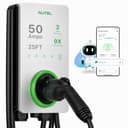 Autel MaxiCharger Home Built for the harshest driveway. The NEMA 4X enclosure is rated to keep charging in extreme cold and heat, it pushes a full 50 amps, and the app is capable. If your charger lives fully exposed to the weather, this is the one. | NEMA 4X, rated for the harshest exposure | |
| 2 | 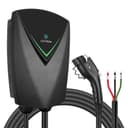 Lectron Nexus 48A J1772 A full 48 amps with nothing to log into. Lectron's Nexus body is IP66-sealed for an outdoor wall, the cable is a heavy 15 mm compound the brand says is built to stay flexible in freezing weather, and the safety paperwork is the real thing — ETL to UL 2594/2231/2251, plus ENERGY STAR. Hardwired only, and there is no app, which is the entire point. | IP66 and a cold-flexible 23 ft cable, hardwired | $449.99 · View on Amazon Price as of October 18, 2026. #ad How we’re funded |
| 3 | 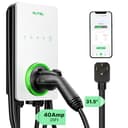 Autel MaxiCharger AC Elite Home 40A Autel's weather-hardened hardware in the install almost everyone can actually have. It is the 50A MaxiCharger's smaller sibling: same 25 ft cable and app, same NEMA 4 body, but it ends in a NEMA 14-50 plug instead of a wire nut — so it goes on an existing outlet, comes off the wall when you move, and needs a 50-amp circuit rather than a 60. The in-body holster is a small thing that stops mattering only if you have never coiled a cold cable. | In-body holster and a plug-in install on a post |
A closing note on permits. An outdoor, in-ground installation involves excavation, burial depth and often a structure, which means it is more likely to attract inspector attention than a wall mount, not less. Do it on a permit, with an electrician who has done one before — our hiring guide covers what to ask, and permits and inspection covers what gets checked.
Frequently asked questions
Can I mount an EV charger on a post instead of a wall?
Yes, and it is common on driveway-only installs. The three routes are a manufacturer's own pedestal designed for that charger, a treated 4x4 or 6x6 timber post set in concrete, or a galvanized steel post or unistrut assembly. All three are legitimate; they differ in cost, appearance and how much the electrician has to fabricate.
How deep does a post for an EV charger need to be set?
That is a local question — frost depth, soil and wind loading all bear on it, and your jurisdiction's requirements govern. It is exactly the sort of detail to settle with the electrician and the permit rather than from a national article, because the correct depth in Florida and in Minnesota are not the same number.
Does an outdoor post-mounted charger need a different enclosure rating?
It needs a genuinely outdoor-rated one, and typically a better one than a sheltered wall. An open post takes weather from every direction with no eave above it, so NEMA 4 or a dual-coded IP66 is a sensible floor, and NEMA 4X earns its money near salt. Check the operating temperature range separately — that is not part of the enclosure code.
How is power run to a pedestal in the middle of a driveway?
Underground, in conduit, in a trench — which is the part that dominates the cost. Burial depth, conduit type and conductor rating are all code matters your electrician will size, and a long run may need a larger conductor to control voltage drop. This is also where a subpanel sometimes becomes the cheaper answer overall.
What stops someone reversing into it?
Placement first: put it outside the vehicle's swept path rather than at the head of the parking space, and toward the side the charge port is on. Where that is not possible, a bollard or wheel stop is the standard protection, and some chargers publish an impact rating — Autel's 80-amp unit lists IK10, for instance — though siting it out of the way beats relying on the casing.
Is a pedestal install much more expensive?
Usually yes, and the extra is almost entirely trenching and the post rather than the charger. The hardware difference between a wall bracket and a pedestal is modest; the difference between screwing into a stud and digging thirty feet of trench is not. Get it itemized so you can see which part of the quote is the ground and which is the charger.
Sources
- NFPA — Using the Latest NEC for EV Charger Installations — NFPA on NEC (NFPA 70) Article 625: EV charging is a continuous load, so circuits are sized to 125% of load (the 80% rule) (accessed July 19, 2026)
- NEMA — Enclosure Types (definitions from NEMA 250) — NEMA's own definitions: Type 3R protects against falling dirt and rain, sleet and snow; Type 4 adds windblown dust, splashing and hose-directed water; Type 4X adds protection against corrosion. NEMA also states its NEMA-to-IP table cannot be used to convert IP designations back to NEMA types (accessed July 20, 2026)
- IEC 60529 — Degrees of protection provided by enclosures (IP Code), full text — The IP code standard (verbatim national adoption, IS/IEC 60529:2001): first numeral 6 = dust-tight; second numeral 6 = protected against powerful water jets; second numeral 7 = protected against temporary immersion, and a 7 alone does not imply water-jet protection unless dual coded (accessed July 20, 2026)
- Autel Energy — MaxiCharger AC Elite Home 50A product page — Autel's own listing: compliant with NEMA 4X standards, operating temperature -40F to 131F, 25 ft cable, 3-year warranty. RE-READ October 10, 2026 for the Emporia head-to-head, and the page now publishes materially more: 'Maximum Output | 12 kW / 50 A' with output 'Adjustable 16-50 A'; installation given as 'Hardwired - 70 A Circuit for Full Output'; an 'SAE J1772' connector; an enclosure rating of 'IP65 / NEMA 4X'; an operating range of '-40 to 131 F (-40 to 55 C)'; a '3 Years' warranty quoted as a single term with no component split; 'CSA and ENERGY STAR compliance' (no UL listing is claimed on this page); connectivity listed as 'Bluetooth, Wi-Fi, Ethernet, CAN, RS485'; app control to start, stop and schedule charging, monitor activity and adjust current; dimensions of 13.2 x 7.4 x 3.8 in (336 x 187 x 97 mm) and a weight of 15.4 lbs (7 kg); and the load-management sentence this comparison turns on - 'Supports both Adaptive Load Management (ALM) and charger-to-charger Dynamic Load Balancing (DLB). ALM requires compatible additional hardware, while DLB works between chargers without additional hardware.' The page publishes no solar-specific feature (accessed October 10, 2026)
- Autel Energy — MaxiCharger AC 80A product page — Autel's own product page for the MaxiCharger AC 80A: NEMA 3S / IK10 enclosure, operating temperature -40F to 131F (-40C to +55C) with derating above 113F, 19 ft or 25 ft cable options, SAE J1772 or NACS connector, hardwired with wall or pedestal mounting, output adjustable 6A to 80A via the mobile app, and a stated warranty of 3 years extendable up to 5 — a figure that differs from the 5-year term on Autel's own US store listing for the same unit (accessed August 12, 2026)
- U.S. DOE Alternative Fuels Data Center — Charging Electric Vehicles at Home — US DOE on home EV charging: most owners charge overnight on Level 1 or Level 2, installs follow NEC Article 625, with example home-charging costs (accessed July 19, 2026)
Keep reading
Charging without a garage
The wider decision a pedestal sits inside: which parking situations need a post, and which do not.
Read the guidePlacement and mounting height
The general version of this decision — reach, height, and where the charge port actually is.
Plan the positionChargers built for outside
The units whose enclosures and temperature ranges are rated for a fully exposed life.
See outdoor picksDo you need a subpanel?
On a long run to a detached structure, a subpanel is sometimes the cheaper answer.
Weigh the optionsChargers with long cables
Cable reach does more work on an open install than on a garage wall. The units with 25 feet.
See long-cable picks