EV Plug and Outlet Types
“What plug does my EV use?” is two different questions wearing one coat. One is about the connector that goes into the car; the other is about the receptacle the charger hangs off. Here are both sides.
How this is funded: we earn a commission if you buy through our links, at no extra cost to you. It never changes which product we recommend, and we’ll tell you when we’d skip one. Full disclosure.
Search for “EV plug types” and you get two completely different articles, both correct. One is about connectors — J1772, NACS, CCS — the shapes that go into the car. The other is about receptacles — NEMA 14-50, 6-50, 14-30 — the outlets a charger plugs into.
They are unrelated decisions. Your car dictates the first; your electrical panel dictates the second. Confusing them is why people ask whether they need a “CCS outlet”, which is not a thing. Here is each side, then the pairing.
The car side: what goes into the port
| Connector | Used for | What to know |
|---|---|---|
| J1772 (SAE J1772) | AC Level 1 and Level 2 | The North American AC standard. Fits every non-Tesla EV, and a Tesla with the adapter that ships with the car. |
| NACS (SAE J3400) | AC Level 1 and 2, and DC fast | The Tesla-derived connector, now an SAE standard and being adopted industry-wide. One connector shape does both AC and DC. |
| CCS (Combo) | DC fast only (the DC pins) | A J1772 head with two DC pins added below. The AC portion is still J1772 — which is why a CCS car uses a J1772 charger at home. |
| CHAdeMO | DC fast only | The older Japanese DC standard, listed by DOE alongside CCS and NACS. Never used for home AC charging. |
The single most useful clarification on that table: CCS is not a home charging connector. It is a J1772 head with two DC pins added underneath. When a CCS car charges at home it uses the J1772 portion, and an ordinary J1772 wall charger fits it perfectly. The DC pins sit unused unless you are at a roadside fast charger.
The live question is J1772 against NACS, and it is a convenience decision rather than a compatibility wall — adapters bridge both directions cheaply, and Teslas ship with the J1772 one. We take the whole transition apart in J1772 vs NACS, and apply it to hardware in our Tesla and NACS roundup.
The wall side: what the charger plugs into
This is the side your house decides. A NEMA designation encodes voltage, current and the physical pin arrangement — and the number of wires, which is where several of the practical differences live. (None of these outlets charges a car by itself; our charger vs 240V outlet page covers what plugs into each, including the dryer-outlet question.)
| Receptacle | Rating | Charging amps | Notes |
|---|---|---|---|
| NEMA 5-15 | 120 V, 15 A | 12 A | The ordinary household outlet. Level 1 only. |
| NEMA 5-20 | 120 V, 20 A | 16 A | The 120 V outlet with a T-slot. Level 1, a little faster. |
| NEMA 14-50 | 240 V, 50 A | 40 A | The default for plug-in Level 2. Four wires, including a neutral. |
| NEMA 6-50 | 240 V, 50 A | 40 A | Same amps, three wires, no neutral. Common welder outlet. |
| NEMA 14-30 | 240 V, 30 A | 24 A | The modern dryer outlet. Real Level 2, at 24 amps. |
| NEMA 10-30 | 240 V, 30 A | 24 A | The old dryer outlet — no separate ground. Needs care. |
| NEMA 6-20 | 240 V, 20 A | 16 A | Small 240 V circuit. Still around 3.8 kW. |
| Hardwired | Circuit-dependent | 80% of breaker | No plug at all. Required above 40 A. |
Reading that table properly
The 80% rule is doing all the work in column three.The NEC treats EV charging as a continuous load, so the circuit is sized at 125% of the charger’s current — which read backwards means a receptacle supports 80% of its rating for continuous charging. Fifty amps gives 40. Thirty gives 24. Twenty gives 16. Memorize the multiply-by-0.8 and you can size anything on sight.
14-50 and 6-50 differ by a wire, not by speed. Both are 240 V / 50 A and both give 40 amps of charging. The 14-50 carries a neutral, which a charger does not use but a future RV or range might; the 6-50 is cheaper to wire. The full case either way is in 14-50 vs 6-50.
Dryer outlets are a real option with a real caveat. A modern NEMA 14-30has four wires including a separate ground and supports 24 amps — genuine Level 2, roughly 5.8 kW, around 20 miles of range an hour. An old NEMA 10-30does not have a separate ground, which is why it was dropped from new installations. That is an electrician’s assessment, not a hardware-store adapter decision.
Above 40 amps, the plug disappears.There is no household receptacle rated for a 48-amp continuous load, so 48-amp chargers are hardwired. That is not a manufacturer preference, it is where the plug options end — and it is the real content of the hardwired vs plug-in decision.
Pairing the two sides
Put them together and buying gets simple:
- Non-Tesla EV, existing 14-50 outlet: a plug-in J1772 charger. No electrician, and it comes with you when you move.
- Non-Tesla EV, nothing in the garage: decide amperage first with what size charger do I need, then have the electrician install either a 14-50 or the hardwired circuit that amperage needs.
- Tesla or NACS car: either a native NACS charger, or a J1772 charger plus the adapter that came with the car. Both work; one is tidier.
- Mixed household: J1772 on the wall is the flexible answer, because the Tesla adapts and the other car does not need to.
Quick picks
Ranked on published specs, charging speed, electrical fit and value. Select a row to jump to the full write-up. We have not bench-tested these chargers — here is exactly what we do instead.
| # | Product | Best for | Price |
|---|---|---|---|
| 1 | 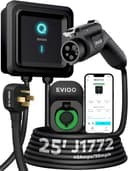 EVIQO 40A NEMA 14-50 Charger The most charger you can get without an electrician's invoice. It plugs into a NEMA 14-50 outlet for a full 40 amps, keeps the WiFi app, the ENERGY STAR listing and the 25 ft cable from EVIQO's hardwired unit, and can be unplugged and taken with you when you move. | Best plug-in J1772 on a 14-50 | |
| 2 | 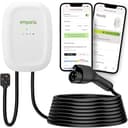 Emporia Level 2 EV Charger The value pick that doesn't feel cheap: a full 48 amps, ENERGY STAR listing, WiFi with genuine energy monitoring, and a 25 ft cable — for well under what the big names charge. It's the one we point most people to first. | Hardwire for 48A or plug in for 40A | |
| 3 | 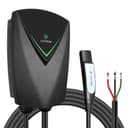 Lectron Nexus NACS (Tesla) Charger For a Tesla owner who doesn't want to babysit an adapter: a native NACS (J3400) connector plugs straight into the car, at a full 48 amps, with the safety listings you want. No app, but Teslas schedule charging in the car anyway. | Native NACS, no adapter at home | $449.99 · View on Amazon Price as of October 17, 2026. #ad How we’re funded |
One receptacle detail that matters more than any of the above: whatever outlet you have installed, it should be an EV-grade receptacle, not the cheapest one on the shelf. A charging session is hours of near-maximum continuous draw, and budget receptacles are a documented failure point under exactly that duty. Our NEMA 14-50 guide covers what to ask for and the GFCI requirement that comes with it.
Frequently asked questions
What plug does my EV use for home charging?
In North America, either J1772 or NACS. J1772 is the SAE AC standard used by essentially every non-Tesla EV, and a Tesla can use it with the adapter that ships with the car. NACS — standardized as SAE J3400 — is the Tesla-derived connector now being adopted more broadly, and it carries both AC and DC in one shape.
If my car has a CCS port, do I need a CCS home charger?
No, and this is the most common mix-up. CCS is a J1772 head with two extra DC pins below it. Home charging uses the AC portion, which is plain J1772 — so a CCS car takes an ordinary J1772 home charger. The DC pins are only ever used by roadside fast chargers.
What outlet do I need for a Level 2 charger?
Most plug-in Level 2 chargers use a NEMA 14-50 — a 240-volt, 50-amp receptacle that supports 40 amps of continuous charging. NEMA 6-50 is the same amperage without a neutral wire, and a 14-30 dryer outlet supports 24 amps. Above 40 amps there is no plug option at all; 48-amp chargers must be hardwired.
Can I plug an EV charger into my dryer outlet?
Physically often yes, safely it depends on which dryer outlet you have. A modern NEMA 14-30 has a separate ground and can support 24 amps of charging on a properly protected circuit. An older NEMA 10-30 does not have a separate ground, which is why it was removed from new installations, and it should be assessed by an electrician rather than adapted casually.
Why does a 50-amp outlet only give 40 amps of charging?
Because the NEC treats EV charging as a continuous load and limits continuous draw to 80% of the circuit rating. Eighty per cent of 50 is 40. The same rule runs in reverse when you shop: whatever breaker you have, multiply by 0.8 to get the charging current it supports.
Do I need an adapter if I buy a J1772 charger for a Tesla?
Teslas ship with a J1772 adapter, so a J1772 charger works out of the box — you just clip the adapter on each time. Buying a native NACS charger removes that small daily ritual, at some cost in flexibility if a J1772 car ever joins the household. Our Tesla roundup weighs both routes.
Sources
- SAE International — J1772 Conductive Charge Coupler — The SAE J1772 connector standard for AC Level 1 and Level 2 charging in North America (accessed July 19, 2026)
- SAE International — J3400 North American Charging System (NACS) — The SAE J3400 / NACS standard (the Tesla-derived connector) now being adopted industry-wide (accessed July 19, 2026)
- U.S. DOE Alternative Fuels Data Center — Electric Vehicles for Consumers — US DOE on connector types: J1772 for Level 1/2, and CCS, CHAdeMO or NACS (J3400) for DC fast charging (accessed July 19, 2026)
- U.S. DOE Alternative Fuels Data Center — Electric Vehicle Charging Stations — US DOE on charging levels: Level 1 (~1.9 kW, ~5 mi/hr), Level 2 (2.9-19.2 kW, ~7.2 kW typical residential, ~25 mi/hr), and DC fast charging (accessed July 19, 2026)
- NFPA — Using the Latest NEC for EV Charger Installations — NFPA on NEC (NFPA 70) Article 625: EV charging is a continuous load, so circuits are sized to 125% of load (the 80% rule) (accessed July 19, 2026)
- U.S. DOE Alternative Fuels Data Center — Charging Electric Vehicles at Home — US DOE on home EV charging: most owners charge overnight on Level 1 or Level 2, installs follow NEC Article 625, with example home-charging costs (accessed July 19, 2026)
Keep reading
J1772 vs NACS, in depth
The connector transition, what adapters do in each direction, and what to buy today.
Read the deep dive14-50 vs 6-50
The two 50-amp receptacles compared — the neutral wire, the resale case and the cost difference.
Compare the outletsInstalling a NEMA 14-50
What the outlet costs, the GFCI requirement, and why an EV-grade receptacle is not optional.
See the install guideHardwired vs plug-in
The decision the wall side forces, and why 48 amps takes the choice away from you.
Settle the question